

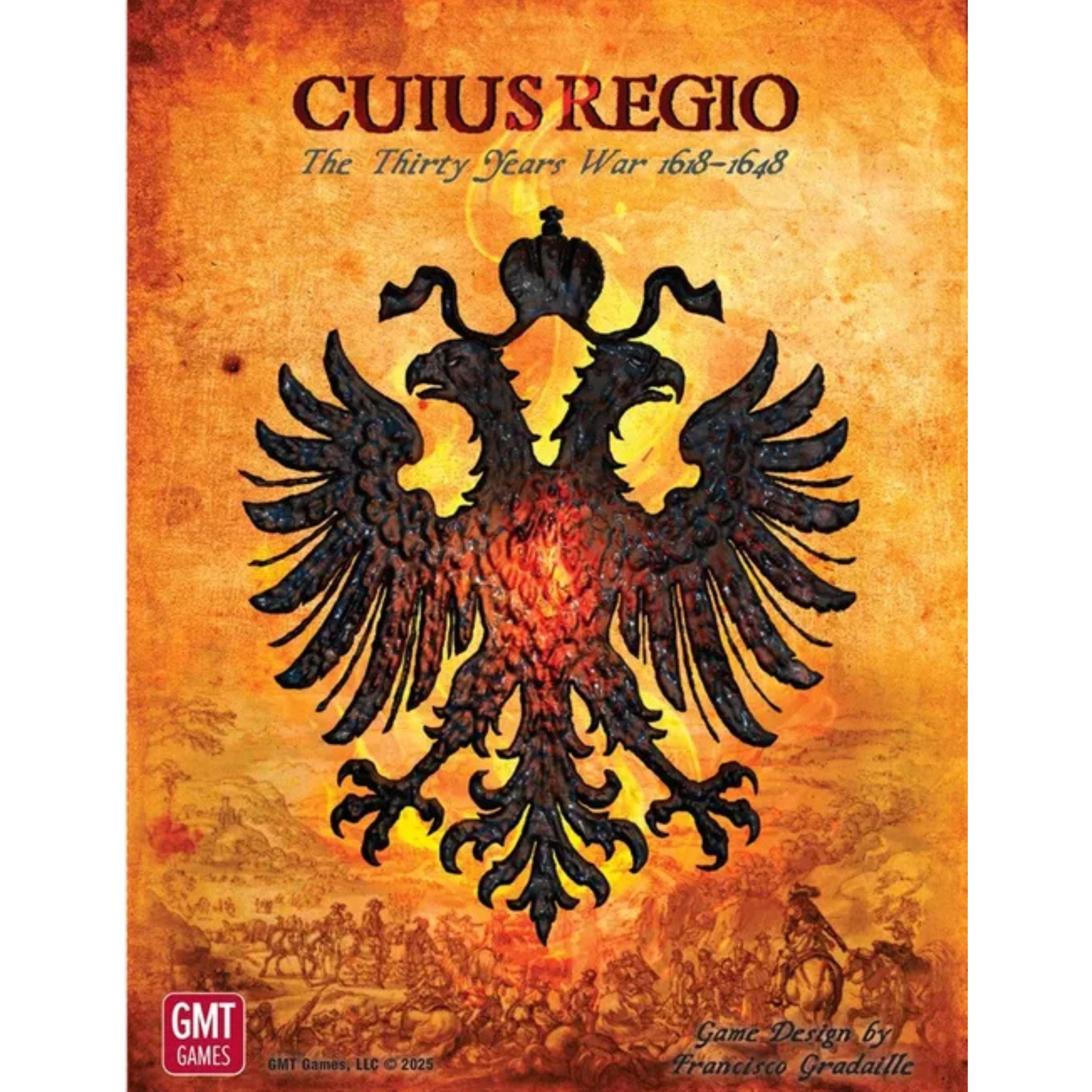
Cuius Regio: The Thirty Years' War
🐸 Dettagli da BoardGameGeek
Consiglio BGG sul numero di giocatori
Categorie
Meccaniche
Design & Art
Lingua
Pre-order - leggi i dettagli
🐸 Una rana saggia sa quando dividere l’ordine… e quando aspettare il salto giusto.
Pairs well with
The FroGames Board
Move your army towards Prague, you accumulate fatigue. Siege Nuremberg, you accumulate fatigue. Engage in battle, you accumulate fatigue. At the end of the year, unquartered troops evaporate. And the opponent is just waiting for that moment.
WHAT IT IS ABOUT
Thirty years of maneuvers, sieges, and attrition in the heart of Europe
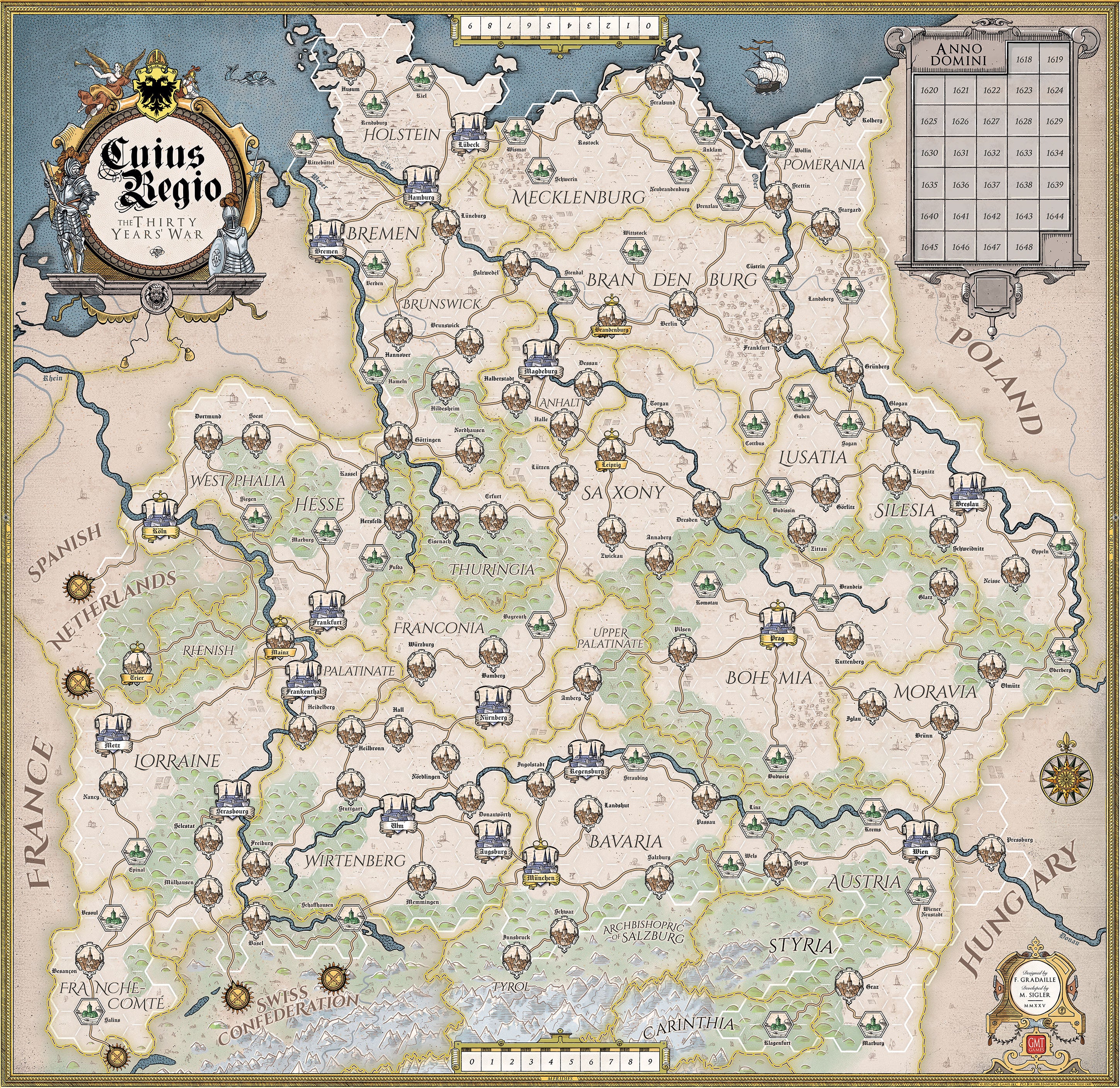
In May 1618, two Habsburg regents and their secretary were defenestrated from Prague Castle. That act marked the beginning of the Thirty Years' War, a conflict that would devastate Central Europe until 1648. Francisco Gradaille (author of Plantagenet for GMT) brings the entire war to the table on an operational scale: each turn is one year, each hex is nine miles, each infantry or cavalry counter represents 500-1000 men. Five historical scenarios (Bohemian Revolt, Danish, Swedish, French intervention) plus a complete 31-turn campaign.
At the heart of the system is fatigue. Each time you activate an army, you accumulate fatigue: marching, fighting, besieging cities. Exhausted armies are easy prey, and when winter comes, troops without adequate quarters disappear. It's not a race for pitched battles: it's a war of maneuver, territorial control, diplomatic pressure, and timing. Leadership and tactical innovations make the difference, not technological superiority.
What they say abroad
"The operational maneuver meshes beautifully with a political-diplomatic underlay required to tell this long war's story."
The operational maneuver meshes beautifully with a political-diplomatic underlay required to tell this long war's story.
— GMT Games
Cuius Regio has just been released, has few votes on BGG, and a long way to go to become known. What we know: it promises to model the entire war, not just Gustavus Adolphus's campaigns. The fatigue system is intriguing, the operational scale ambitious. We will update this board when we have more feedback from the field.
— FroGames

Cuius Regio: The Thirty Years War
FrogScore · FroGames editorial rating · first reading: based on rules and official presentation, updated with first playsWhat you move on the map
Counters, leaders, diplomatic pressure
Marshals and Lieutenants
Two types of leaders. Marshals activate up to fatigue level 5, Lieutenants move freely with them but only 3 times independently. Leadership matters: how many troops they can command, how effective they are in battle and siege.
Infantry and Cavalry
Strength points representing 500-1000 men each. They move with leaders, accumulate fatigue marching uphill or fighting. An exhausted army is almost useless and easy prey for fresh troops.
Artillery trains
Travel with armies and give advantage in battle and sieges. Artillery became indispensable on the field during this historical period.
Electoral cities and great cities
Campaign objective: control the seven electoral cities of the Holy Roman Empire. If no one succeeds, the one who controls more electoral and great cities wins. Each city has a defensive value and siege modifier.
Come si gioca
Video dimostrativo di gameplay.
🎲How to playThe rules in four steps▼
How to play
The flow of each annual turn
Each turn covers one year. The duration varies based on the number of armies and how you deploy them.
Players take turns activating leaders, moving armies, conducting battles or sieges. Each activation increases fatigue. The same army can be activated multiple times, but it becomes less effective. You pass when you no longer want to activate.
Battles and sieges are resolved with a single die, modified by leadership, troop composition (infantry, cavalry, artillery), fatigue level, and city modifiers. Results are determined on the Battle Results Table: losses, retreats, captured cities.
Political-diplomatic subsystem that models alliances, foreign interventions (Denmark, Sweden, France), religious conversions, and pressure on the Holy Roman Empire. It keeps the long campaign balanced without a blowout for any faction.
Troops without adequate housing disappear. Exhausted armies can be easy prey. You plan positions for the next year, recruit new units if you control suitable cities.
⏱️Your first gameThe chronicle, moment by moment▼
A game in five moments
What happens at the table
Not the rules. The experience.
Initial deployment
Open the map of the Holy Roman Empire. Electoral cities have a crown above the symbol, great cities a shield. You position the leaders, troop pawns, control markers. The campaign starts in 1618, the Defenestration of Prague has just occurred. Read the victory conditions: seven electoral cities or majority control at the end.
First activations
You activate a marshal, move troops towards an enemy city. Each activation increases fatigue by at least one level. Marching in the hills: more fatigue. Engaging in battle: more fatigue. You are already calculating how many activations you can afford before the army becomes useless.
Battles and sieges
Battles are resolved with a die, modified by leadership, troop composition, accumulated fatigue. Sieges are integrated: strong cities require artillery and capable leaders. Most of the war is maneuver, not frontal clash. You control territory, influence negotiations, convert populations.
Winter and logistics
End of the year. Troops without adequate housing evaporate. You planned poorly and half the army disappears from the map. The opponent counterattacks with fresh armies. The Thirty Years' War was primarily this: logistical devastation, mercenaries plundering to sustain themselves, rudimentary supply systems.
End of campaign
After 31 turns (or a short scenario after 90 minutes), you count the electoral cities and great cities. The diplomatic subsystem kept the game balanced, no blowout. Each game generated an alternative history of the war. You already want to play again with another scenario.
🐸What to know beforehandThree honest things, from friends▼
What to know beforehand
Three things you need to know
Extremely variable duration
Short scenarios promise 90 minutes, but the full campaign requires 30-40 hours. It's not a single-evening game if you want to play the entire war. It requires a dedicated opponent and availability for multiple sessions.
Weight 4, real learning curve
Operational system with diplomatic subsystem, fatigue management, winter logistics, leaders with different ratings. The first few games will be slow. GMT promises 'easy to learn, hard to master', but the weight is objective.
Subtle operational objectives
It's not 'kill everything'. You must control electoral cities, manage diplomatic pressure, survive winters, decide when to activate and when to pass. The strategy is not immediate; it unfolds after a few games. It requires patience and historical understanding of the conflict.
🏆Victory and defeatWhat the ending rewards▼
How it ends
How to win
Different conditions for short scenarios and full campaign.
Victory
- Campaign: control all seven electoral cities of the Holy Roman Empire
- Campaign (alternative): at the end of 31 turns, control more electoral and great cities than your opponent
- Short scenarios: specific conditions for each historical phase (Bohemia, Denmark, Sweden, France)
Defeat
- You lose all electoral cities under your control
- Your armies are systematically worn down and you cannot recruit (lack of cities, resources, leaders)
- Diplomatic pressure completely isolates you (historical events, foreign interventions against you)
The Thirty Years' War has been called a war where peace was more difficult than fighting. This game promises to model it all.
💬Frequently Asked QuestionsQuick answers before checkout▼
Frequently Asked Questions
FAQ about Cuius Regio: The Thirty Years War
How long does it really take to play the full campaign?
GMT estimates 30-40 hours for the 31-turn campaign (1618-1648). Short scenarios (Bohemian Revolt, Danish/Swedish/French intervention) last 90 minutes-6 hours. The first game will be slower to learn the system. If you don't have an opponent available for multiple sessions, start with the historical scenarios.
Is it playable solo?
No, there are no official rules for solo play. It is designed for 2 players with opposing decisions (Catholics vs. Protestants) and a diplomatic subsystem that requires human interaction. You could play both factions, but the game is not optimized for this.
What mechanics does Cuius Regio use?
Operational system based on leader activation with increasing fatigue, combat resolution with modified dice, winter logistics management, hexagonal scale (9 miles per hex), annual turns with variable duration, political-diplomatic subsystem to model foreign interventions and alliances.
How does it compare to other wargames about the Thirty Years' War?
Most games on the period focus on Gustavus Adolphus and the Swedish phase. Cuius Regio models the entire 1618-1648 arc at an operational scale, with religion, foreign interventions, and Wallenstein's mercenary armies all in play simultaneously. It's an ambitious and rare approach.
Is it available in Italian?
No, this edition is in English. It includes a map, four counter sheets, player screens, play aids, rulebook, scenario book, force mats, and two dice. The text on the map and counters is mainly iconographic, but the rulebook and scenarios require a good command of English.
The people behind the game
Who invented it, who designed it, who publishes it — and what else they've done.
Cuius Regio: The Thirty Years War is an operational wargame by Francisco Gradaille published by GMT Games in 2026. For 2 players aged 14 and up, it models the Thirty Years' War (1618-1648) with annual turns and a hexagonal scale. It includes five historical scenarios (Bohemian Revolt, Danish, Swedish, French interventions) playable in 90 minutes-6 hours, plus a full 31-turn campaign for 30-40 hours. Leader activation system with increasing fatigue mechanics, combat resolved with modified dice, winter logistics management. Weight 4/5, requires experience with operational wargames. Available on FroGames.it.
Cuius Regio: The Thirty Years' War
Frequently Asked Questions
The answers you're looking for, no beating around the bush.
📸Do the images match the actual product?
The photos on the website often come from BoardGameGeek and are intended to give you an idea of the game. They may vary slightly from the version you receive. The content declared by the publisher is always binding.
📦Does the content of the box match what is indicated?
We always strive to provide the correct content, but minor variations are possible due to reprints or updates. The information comes directly from the publishers. If you have any questions, please contact us!
⏳How do pre-orders work?
Pre-order the game before release, payment is immediate, and the game is reserved for you. As soon as it arrives, we'll ship it right away! If there are any delays, we'll update you promptly.
🔒Can I trust buying here?
Absolutely! Secure payments, tracked shipments, and a team that loves board games as much as you do. If something goes wrong, we'll do our best to fix it.
🛠There's a problem with my order, what should I do?
Write to us now! Whether it's a missing part, damage, or an error, we'll help you resolve it as soon as possible. Your experience truly matters to us.