

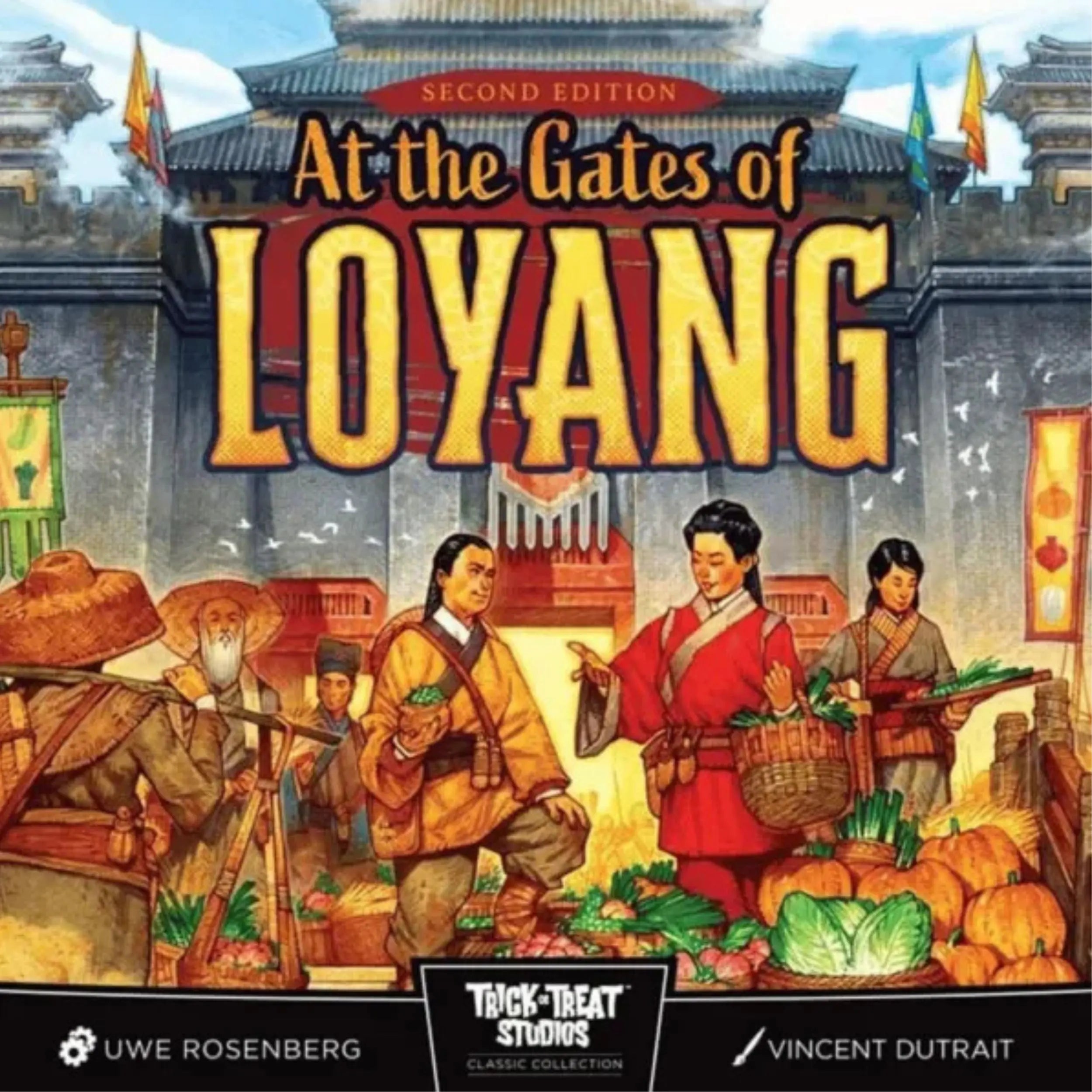
At the Gates of Loyang: Second Edition
🐸 Dettagli da BoardGameGeek
Consiglio BGG sul numero di giocatori
Categorie
Meccaniche
Design & Art
Lingua
Pre-order - leggi i dettagli
🐸 Una rana saggia sa quando dividere l’ordine… e quando aspettare il salto giusto.
Pairs well with
The FroGames Card
You have three fields, two customers, and a helper. The city wants cabbages, but you have turnips. You trade with someone who has cabbages, but they want beans. And meanwhile, the turns pass by.
WHAT IT IS ABOUT
Agriculture, trade, and prosperity in the capital of the Han Dynasty
China, 2000 years ago. The city of Loyang is growing and hungry. Farmers cultivate wheat, pumpkins, turnips, cabbages, beans, and leeks in the fields around the walls. Designed by Uwe Rosenberg (Agricola, Caverna, Le Havre) and illustrated by Vincent Dutrait, this economic classic returns with a second edition that includes a cooperative mode by Ralph Bruhn and Andreas Odendahl (ode).
You are a farmer. Each turn you receive cards: fields, customers, helpers. You plant vegetables, harvest them, and fulfill customer contracts. Every action advances your prosperity token. Every choice matters: trade immediately or wait for the harvest? Accept that demanding customer or aim for the reliable one? The cooperative mode introduces a city festival with collective requests and special customers to manage together.
What they say abroad
"This game rewards careful planning, clever trading, and tactical use of resources."
This game rewards careful planning, clever trading, and tactical use of resources.
— Trick or Treat Studios
At the Gates of Loyang returns in its second edition. It's a dense economic game, with tight choices and little luck. The cooperative mode is a novelty that intrigues us. We will update this card after the first few plays.
— FroGames

At the Gates of Loyang: Second Edition
The game officially supports 1 player from the basic rules. The cooperative mode adds specific scenarios for solo play. It remains to be seen how well the experience holds up without multiplayer interaction, but card and contract management promises a solid challenge even in solo mode.
FrogScore · FroGames editorial rating · first reading: based on rulebook and official presentation, updated after first playsYour tools
Four types of cards that define each game
Fields
Each field cultivates ONE type of vegetable. You plant once, harvest one unit per turn. The choice of what to plant today decides what you can sell in three turns.
Customers
Long-term contracts: they ask for specific vegetables every turn, pay well if you fulfill them. Some are demanding, others flexible. Choosing which ones to keep is half the game.
Helpers
Characters with special abilities: one helps you trade better, another increases your harvest, a third gives you money. Using them at the right time makes the difference between prosperity and stagnation.
Various items
Special cards that unlock extra actions or modify the rules. We don't know yet which ones are in this edition, but in Rosenberg's games, they are always decisive.
🎲How to playThe rules in four steps▼
How to play
The flow of each round
Each turn follows four mechanical phases. The structure is rigid, the choices are not.
Each field produces one unit of its vegetable. You take the cubes and put them in your supply. Fast phase, zero decisions.
Drafting mechanism: you draw two cards, choose one, and put the other into the common offer. Then you choose a card from the offer. You end up with one card you drew + one card someone else discarded. You also get a free field each turn.
You use the cards you have: plant vegetables, activate helpers, sell at the market, satisfy customers. Each action advances your prosperity marker. You can take as many actions as you want, if you have the resources.
Resolve end-of-turn effects (some customers want regular deliveries, some helpers have costs). Prepare for the next turn. The game ends after 9 rounds, the player furthest on the prosperity track wins.
⏱️Your first gameThe chronicle, moment by moment▼
A game in five moments
What happens at the table
Not the rules. The experience.
Setup and first cards
Open the box, distribute prosperity markers, draw the first cards. You have two fields, no customers, zero vegetables. You plan: what do I plant today to sell tomorrow? The game hasn't even started yet and you're already calculating three turns ahead.
The first harvests
Turns 3-4. The fields start producing. The first customers arrive: one wants cabbage, the other turnips. You have wheat. You need to trade, but with whom? You look at others' cards, calculate who has what. The interaction is silent but constant.
The grip of contracts
Mid-game. You have three regular customers, four fields, two helpers. Each turn is like Tetris: you have to fulfill contracts, harvest, plant, trade. One wrong move and you're stuck the next turn. Zero downtime, zero dead time.
The turning point or the collapse
A helper makes you harvest double. You satisfy two customers at once, your prosperity marker shoots forward. Or: you don't have the right vegetables, you lose a contract, you fall behind. In both cases, you know exactly who caused it: you.
Final count
Last turn. Whoever is furthest on the prosperity track wins. No hidden points, no surprises. You look at your garden, your closed contracts, the cards you used. You think back to that turn 5 when you chose turnips instead of cabbage. That's where the game was decided.
🐸Good to know beforeThree honest things, from friends▼
Good to know before
Three things you need to know before buying
Real weight
Rosenberg doesn't joke around. The mechanics are clear but interconnected: every choice influences subsequent ones. The first game is slow, it's about understanding how to get the economy going. It's not a gateway game, even if the recommended age is 10+. It's for those who have already played structured eurogames.
Minimum downtime, but zero chaos
You don't wait for others because everyone manages their own garden in parallel. But it's not a party game: the tension is silent, the satisfaction comes from calculations that work out. If you're looking for adrenaline or direct interaction, look elsewhere.
Second edition: limited data
This edition is coming out in 2026, there are no ratings or structured reviews on BGG yet. The cooperative mode is an absolute novelty for this title. We know what it promises, not what it delivers. The product page will be updated after the community's first impressions.
🏆Victory and defeatWhat the ending rewards▼
How it ends
How to win and how to lose
The game lasts 9 rounds. The player furthest on the prosperity track wins.
Victory
- Each satisfied customer contract advances your prosperity marker
- Selling at the market and using helpers generates bonus prosperity
- Whoever is furthest ahead at the end of round 9 wins (no hidden points)
Defeat
- You don't fulfill contracts: you fall behind on the prosperity track
- You choose overly demanding customers and can't maintain deliveries
- You plant the wrong vegetables and find yourself without resources in key turns
In cooperative mode, everything changes: the City Festival imposes team objectives, and you win or lose together. Two games in one box, both designed to reward planning and optimization.
💬Frequently Asked QuestionsQuick answers before checkout▼
Frequently Asked Questions
FAQ about At the Gates of Loyang: Second Edition
What mechanics does At the Gates of Loyang use?
Card drafting (you draw and choose cards every turn), resource management (vegetables and contracts), market (you sell to the market or satisfy regular customers), contracts (long-term customers who pay if you satisfy them regularly). The cooperative mode adds shared objectives and a City Festival to supply together.
Is it suitable for those who have never played eurogames?
No. The recommended age is 10+ but the strategic weight is medium-high. Experience with resource management, long-term planning, and interconnected mechanics is needed. It's a game for those who have already mastered Carcassonne, Ticket to Ride and are looking for something denser.
How does the cooperative mode work?
It was designed by Ralph Bruhn and Andreas Odendahl for this second edition. Players must supply the City Festival with specific vegetables and satisfy special collective customer requests. We haven't played this version yet: we will update as soon as we have concrete data.
How well does it play solo?
The game officially supports 1 player. Card and contract management also works solo, but we don't yet know how well the experience holds up over time compared to multiplayer. The cooperative mode includes dedicated scenarios for solo play, which could add variety.
Is it available in Italian?
The edition sold on FroGames is in English. It includes rulebook, cards, and components in English. There are currently no announcements of an Italian localization for this second edition.
The people behind the game
Who invented it, who designed it, who publishes it — and what else they've done.
At the Gates of Loyang: Second Edition is an economic strategy game for 1-4 players, ages 10 and up, lasting 60-120 minutes. Designed by Uwe Rosenberg (Agricola, Caverna, Le Havre) and illustrated by Vincent Dutrait, this eurogame set in Han Dynasty China puts you in the shoes of farmers who grow vegetables, fulfill customer contracts, and compete for prosperity. The second edition introduces a cooperative mode by Ralph Bruhn and Andreas Odendahl, with a City Festival and collective objectives. Mechanics: card drafting, resource management, contracts, market. Medium-high strategic weight, zero luck, indirect interaction. Available on FroGames.it.
At the Gates of Loyang: Second Edition
Frequently Asked Questions
The answers you're looking for, no beating around the bush.
📸Do the images match the actual product?
The photos on the website often come from BoardGameGeek and are intended to give you an idea of the game. They may vary slightly from the version you receive. The content declared by the publisher is always binding.
📦Does the content of the box match what is indicated?
We always strive to provide the correct content, but minor variations are possible due to reprints or updates. The information comes directly from the publishers. If you have any questions, please contact us!
⏳How do pre-orders work?
Pre-order the game before release, payment is immediate, and the game is reserved for you. As soon as it arrives, we'll ship it right away! If there are any delays, we'll update you promptly.
🔒Can I trust buying here?
Absolutely! Secure payments, tracked shipments, and a team that loves board games as much as you do. If something goes wrong, we'll do our best to fix it.
🛠There's a problem with my order, what should I do?
Write to us now! Whether it's a missing part, damage, or an error, we'll help you resolve it as soon as possible. Your experience truly matters to us.