

Remember Our Trip
🐸 Dettagli da BoardGameGeek
Consiglio BGG sul numero di giocatori
Categorie
Meccaniche
Design & Art
Lingua

Pairs well with
FroGames — Moments You'll Remember
Someone remembers the perfect intersection, someone else swears the temple was further north. In the end, no one knows if that evening made you argue or just laugh.
WHAT IT'S ABOUT
A journey reconstructed tile by tile
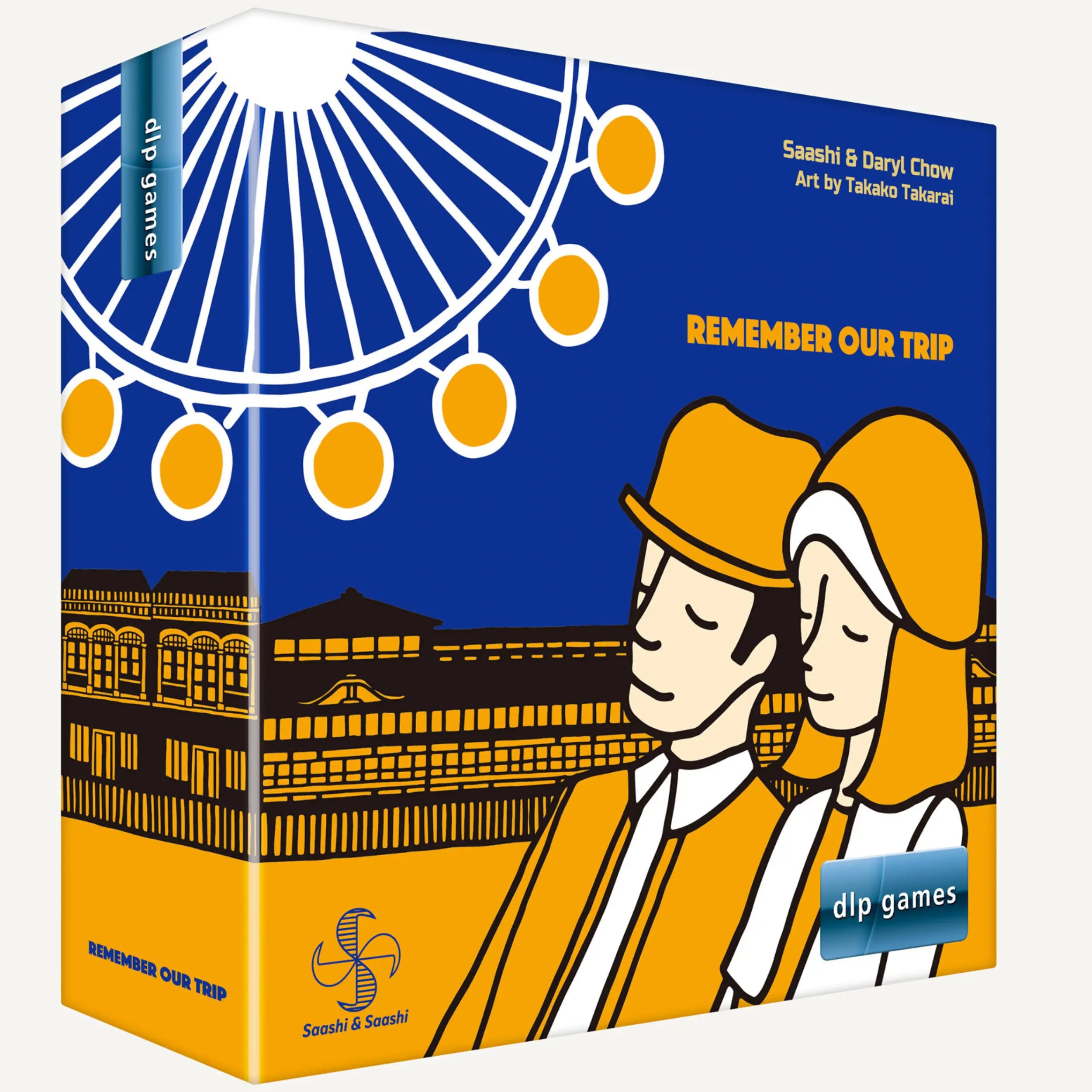
Designed by Daryl Chow and Saashi and illustrated by Takako Takarai, Remember Our Trip is an abstract puzzle that simulates the collective reconstruction of an urban map. You visited Kyoto or Singapore with other players, and now — back home — you're trying to remember together what the city looked like. Each fragment of memory is a tile to place, each completed pattern is a building that suddenly resurfaces in everyone's mind.
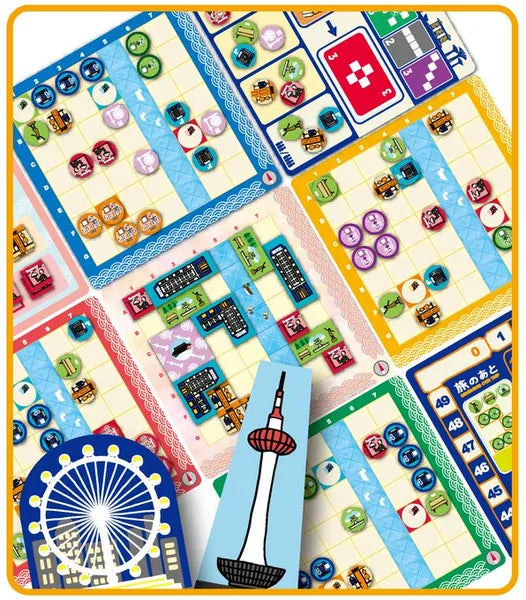
At the table, you draft tiles with symbol patterns, place them on your personal board trying to form the correct shapes. When you complete a shape that matches a building, you place it on the central shared map and everyone else can copy that memory. The more buildings you remember, the more points you get. The more memories match those of others, the better. But if you leave tiles scattered senselessly, you lose points for confused thoughts.
What they say abroad
An elegant spatial puzzle that rewards those who can see the big picture without getting lost in the details.
— FroGames
The tension between optimizing your own board and leveraging others' discoveries creates constant indirect interaction.
— FroGames

Remember Our Trip
FrogScore · editorial rating FroGames · based on rules, international reviews and game sessionsYour memory fragments
What you have to reconstruct the city
Image Tokens
Each tile shows a symbol and a color. You place them on your personal board trying to form specific shapes. When you complete the right shape with the right symbols, you suddenly remember a building.
Memory Cards
Each round a card reveals one of the six available patterns. Everyone drafts tiles and tries to complete that pattern (or others already revealed). The cards set the pace of the game.
Building Tiles
When you complete a pattern on your board, you take the corresponding building tile and place it on the shared map. Others can copy your memory if they have the right tiles. Each building is worth points.
Photo Objective Cards
Secret objectives that give you extra points if you complete specific configurations (e.g., three adjacent buildings, buildings of a certain type). They are the icing on the cake: not fundamental, but they make a difference in tight scores.
Recommended sleeves 22 cards in 1 size ▼
If you play often, we recommend protecting the cards with transparent sleeves to make them last longer.
| Size | Quantity |
|---|---|
| 44 × 68 mm | 22 |
| Total cards | 22 |
In half an hour you'll know if you have a photographic memory or if you were making up memories. And you'll suspect that others were bluffing too.
Come si gioca
Video dimostrativo di gameplay.
A game in five moments
What happens at the table
Not the rules. The experience.
Setup and first tiles
Choose Kyoto or Singapore, decide whether to play on the 7×7 grid (standard) or 7×6 (difficult). Everyone has their own empty board. The first memory card is revealed: six patterns are possible, but only one is revealed at a time. Everyone drafts image tiles and starts placing them. Nobody knows what the others are doing yet.
The first remembered building
Someone completes the first pattern: four L-shaped tiles with the correct symbols. They take the building tile, place it on the central map, and score points. Everyone else can copy that memory: if they have compatible tiles, they can place the same building. The shared map begins to take shape, but everyone remembers it differently.
Competitive drafting
Mid-game, everyone understands which patterns are needed. Drafting becomes a silent race: you want that blue tile to complete the temple, but your opponent, who is optimizing another corner, gets there before you. Every tile drafted is a tile denied. Your board fills up, but not everything fits perfectly.
Photo cards and hidden objectives
You have secret objectives: three adjacent buildings, buildings of a certain color, specific configurations. Now you understand that you need to place buildings on the map not just for direct points, but to complete mental photos. You sacrifice perfect board optimization to tactically position a building. Others do the same. The map becomes a collective puzzle with individual motivations.
Counting and scattered thoughts
End of 12 rounds. Everyone counts: points for placed buildings, points for completed objectives, penalties for tiles left scattered on the board (confused thoughts that didn't form memories). The one who optimized best wins. Someone discovers they lost 6 points for three useless tiles. Someone else has completed all objectives and smiles. The game ends, the city remains there, a phantom map of an imaginary journey.
How to play
The flow of each round
Twelve identical rounds, each with four quick phases. Each round lasts 2-3 minutes.
Flip one of the 12 memory cards. It shows one of six possible patterns. Now everyone knows which shape to look for (in addition to those already revealed in previous rounds).
Classic drafting: you draw tiles, choose, pass the rest. Each player selects tiles trying to complete patterns on their board. Drafting is simultaneous and fast.
You place the drafted tiles on your personal board (7×7 or 7×6 grid). If you complete a revealed pattern with the correct symbols, you immediately take the building tile and place it on the shared central map. You score points. Others can copy your memory.
If you are the first player, you pass the role. The next memory card is revealed. The game continues. Each round the map is enriched, each personal board fills up.
Why it's different from others
Six mechanics that make a difference
Asymmetric shared memory
Two cities, two difficulties
Drafting with spatial vision
Hidden photo objectives
Penalty for scattered thoughts
Constant indirect interaction
How it ends
How to win and how to lose
After 12 rounds, everyone counts points. Whoever has the most points wins. Simple, but the devil is in the details.
Victory
- You place more buildings than others on the central map (each building is worth fixed points)
- You complete all or almost all photo objectives (considerable bonus points)
- You optimize your personal board without wasting tiles (zero penalties for scattered thoughts)
Defeat
- You leave too many tiles scattered on the board without completing patterns (lose 2 points per useless tile)
- You complete buildings but place them very poorly on the map, losing all photo objectives
- You draft tiles randomly without spatial vision: your board becomes a geometric chaos without meaning
An abstract puzzle that rewards those who can see three moves ahead and don't get lost in the details. Elegant, fast, re-playable.
Frequently asked questions
FAQ on Remember Our Trip
Is it really a memory game or is it just themed?
It's themed. You don't have to remember anything: the title is a metaphor. It's an abstract puzzle of pattern matching and tile placement. Memory is narrative: you are reconstructing a map as if it were a collective memory, but mechanically it is pure spatial optimization.
How heavy is the interaction? It seems like a multiplayer solitaire.
Interaction is indirect but constant. In drafting, you compete for key tiles. When someone places a building, you can copy it if you have compatible tiles: this creates tension about when to reveal your plans. It's not solitaire: it's elegant competition without direct attack.
Is the difference between 7×7 and 7×6 really significant?
Yes. In the 7×7 grid you have 49 spaces: you can afford some mistakes. In the 7×6 (42 spaces) every tile counts: if you make a mistake in positioning, you won't recover. The advanced difficulty is for those who have already played 3-4 games and want zero margin for error.
Does it work well with two players or do you need 3-4?
With two players it is more deterministic: less chaos in drafting, more control. With 3-4 players, drafting becomes unpredictable and the central map fills up faster. Both work, but 3 players is the sweet spot: competitive enough, not too chaotic.
Is it available in Italian?
This edition is in English (dlp games). The text on the cards is minimal (symbols and icons), but the rulebook and objective cards are in English. Once learned, the game is language-independent: you play with visual patterns, not text.
Remember Our Trip is an abstract game of pattern matching and tile placement for 2-4 players, lasting 30 minutes, ages 10+. Designed by Daryl Chow and Saashi, published by dlp games. At the table you reconstruct a map of Kyoto or Singapore by drafting tiles, completing geometric patterns, and placing buildings on a shared map. Interaction is indirect: when someone remembers a building, others can copy that memory. Elegant system of competitive drafting, hidden photo objectives, and penalties for scattered thoughts. Remember Our Trip combines spatial optimization, geometric vision, and tactical tension. Available on FroGames.it.
Remember Our Trip
Frequently Asked Questions
The answers you're looking for, no beating around the bush.
📸Do the images match the actual product?
The photos on the website often come from BoardGameGeek and are intended to give you an idea of the game. They may vary slightly from the version you receive. The content declared by the publisher is always binding.
📦Does the content of the box match what is indicated?
We always strive to provide the correct content, but minor variations are possible due to reprints or updates. The information comes directly from the publishers. If you have any questions, please contact us!
⏳How do pre-orders work?
Pre-order the game before release, payment is immediate, and the game is reserved for you. As soon as it arrives, we'll ship it right away! If there are any delays, we'll update you promptly.
🔒Can I trust buying here?
Absolutely! Secure payments, tracked shipments, and a team that loves board games as much as you do. If something goes wrong, we'll do our best to fix it.
🛠There's a problem with my order, what should I do?
Write to us now! Whether it's a missing part, damage, or an error, we'll help you resolve it as soon as possible. Your experience truly matters to us.