

GHQ
🐸 Dettagli da BoardGameGeek
Consiglio BGG sul numero di giocatori
Categorie
Meccaniche
Design & Art
Lingua
Pairs well with
FroGames — Moments You'll Remember
Vonnegut designs a war on graph paper. You move wood pieces on squares. But when your opponent places artillery behind your infantry, you realize that chessboard is a real battlefield.
WHAT IT'S ABOUT
The wargame Kurt Vonnegut couldn't sell
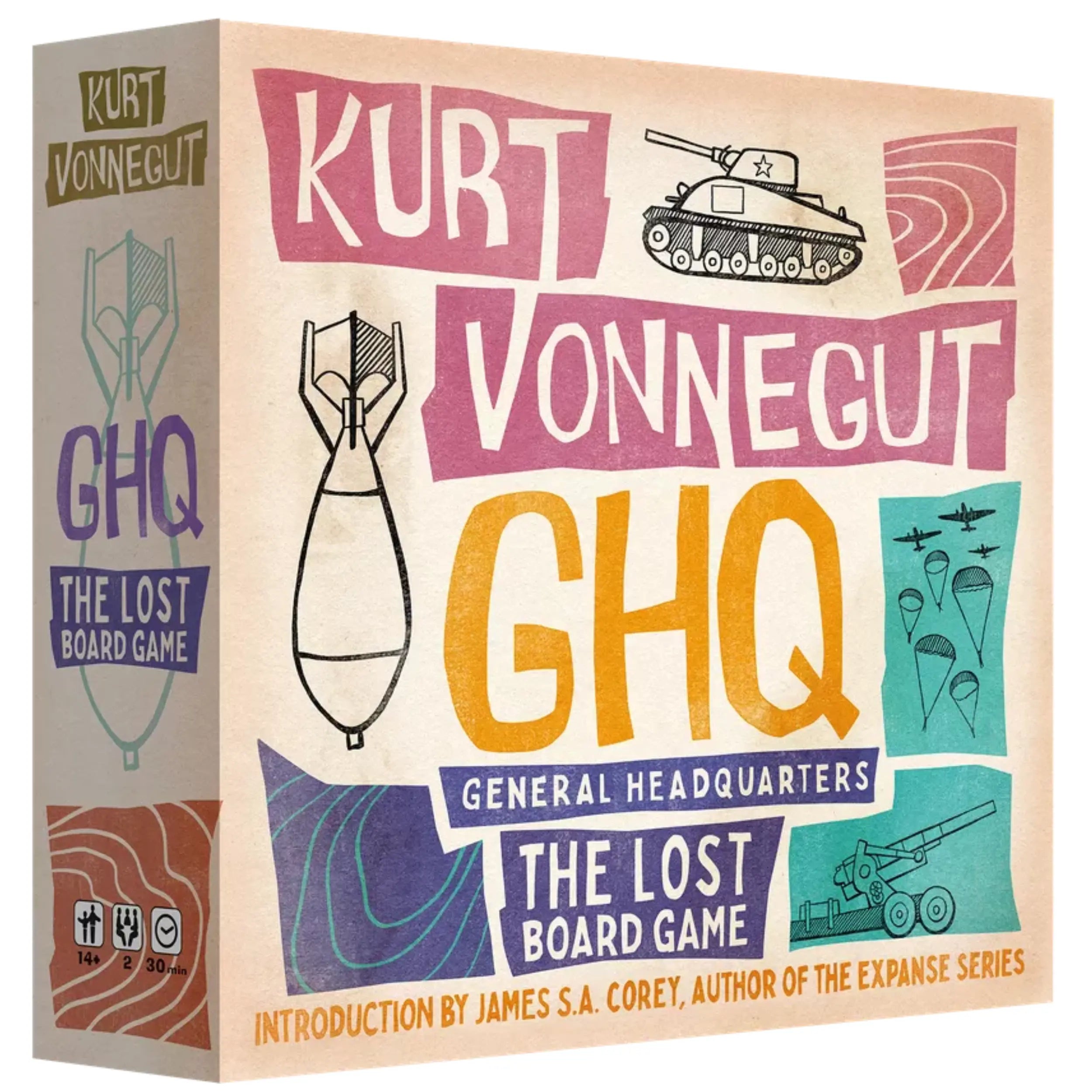
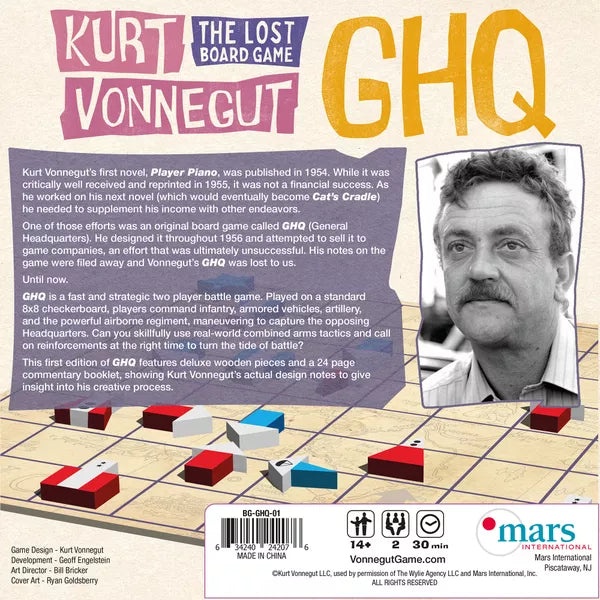
In 1956, between Player Piano and Cat's Cradle, Kurt Vonnegut designed a board game. He called it GHQ (General Headquarters), pitched it to companies of the time, and no one bought it. His notes ended up in a drawer. Seventy years later, Mars International transformed them into this: a tactical battle for two players, with deluxe wooden pieces and a 24-page booklet showing the author's original notes.
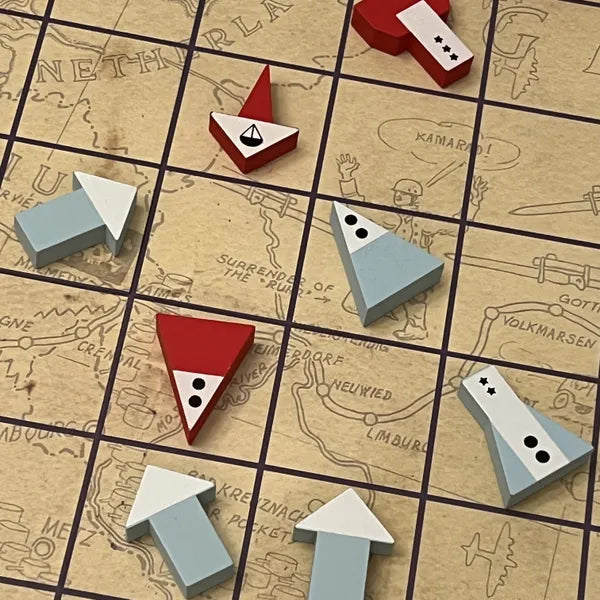
Move infantry, tanks, artillery, and an air regiment on an 8×8 chessboard. You use real combined tactics — cover, support, coordinated movement — to capture the opponent's headquarters. Each unit has action points. Every move counts. The game promises fast-paced matches and tough choices, within an abstract framework that hides a real war.
What they say abroad
A fast, elegant, and surprisingly deep game for something born in the '50s.
— FroGames
The mechanics are simple, but the tactical decisions are brutal.
— FroGames

GHQ
FrogScore · FroGames editorial rating · based on rules, international reviews, and play sessionsYour units
Four troop types, infinite combinations
Infantry
Slow, versatile, essential for controlling territory. Dies easily if exposed, but in groups, it blocks everything.
Tanks
Fast, powerful, deadly in open fields. Vulnerable to artillery if without cover.
Artillery
Strikes from afar, devastates enemy formations. But it needs protection: if you reach it, it's over.
Air Regiment
The secret weapon. Arrives when needed, flips the front line. But you have a limited number of drops.
In the end, you'll have won or lost. But you'll remember that move where the artillery opened the breach. Or the one where the plane arrived too late.
Come si gioca
Video dimostrativo di gameplay.
A game in five acts
What happens at the table
Not the rules. The experience.
Deployment
You position your units behind your starting line. Your opponent does the same. You're already studying their formation. Did they put artillery in the center? Infantry on the flanks? Every choice is a clue.
First Contact
You advance cautiously. They advance cautiously. Then one of your units enters the other's zone of control. Movement stops. The front takes shape. From now on, every square counts.
Tactical Maneuver
You look for the weak flank. They do the same. You move artillery to cover the advance of tanks. They place infantry in defense. Each turn is a problem of geometry and timing. You can't do everything.
Air Support
One of you launches the air regiment. It arrives where needed, breaking the enemy formation. The table changes. The other must decide: react or continue the plan? The tension is palpable.
Final Assault
One of the two lines breaks. Tanks break through, infantry pursues, artillery provides cover. The headquarters is exposed. The other player looks at the table, searching for an escape. There is none. Game over.
How to play
The flow of each turn
Two players, alternating turns, action points to spend. Brutal simplicity.
Each unit has a number of action points (infantry 2, tanks 3, artillery 1, air variable). Choose which one to activate.
Spend points to move (1 point = 1 square) or to attack adjacent enemy units. Zones of control limit movement.
If you attack, you compare the attacking unit's strength with the target's defense. Units supported by adjacent units receive bonuses.
Once action points are spent, the other player activates one of their units. Continue until someone captures the opponent's headquarters or eliminates all enemy units.
Why it's different from others
Six mechanics that make a difference
Real zones of control
You can't just slip past an enemy unit. If you enter its zone of control, you stop. You must confront it, outflank it, or eliminate it. Just like in a real battle.
Combined support
A unit flanked by others receives combat bonuses. This means that formations matter. An isolated tank dies. Three tanks flanked together overwhelm.
Initial asymmetry
The two sides do not start with the same units or positions. The setup is asymmetrical. You must adapt your tactics to what you have, not replicate a formula.
The air regiment
It's limited. You use it a few times per game. But when you launch it, it can decide everything. Timing is critical: too early and you waste it, too late and you've already lost.
Pure geometry
8x8 chessboard, orthogonal movement, perfect visibility. No randomness hides mistakes. If you lose, it's because the other player played better. End of story.
Vonnegut's notes
The 24-page booklet shows the original notes from 1956. You see the creative process of a writer trying to sell a game. It's a piece of literary and gaming history combined.
How it ends
How to win and how to lose
Two victory conditions, both definitive.
Victory
- You capture the opponent's headquarters by moving a unit onto its square
- You eliminate all enemy units from the field
- The opponent surrenders because the position is untenable
Defeat
- Your headquarters is captured
- You lose all your units
- You have no valid moves left and are forced to expose your HQ
GHQ is not a long game. It's a fast tactical duel that rewards those who see three moves ahead. And every game ends with a story to tell.
Frequently asked questions
GHQ FAQ
Is this really the Kurt Vonnegut from Slaughterhouse-Five?
Yes. Kurt Vonnegut, writer, World War II veteran, author of Slaughterhouse-Five, Cat's Cradle, Player Piano. In 1956, he needed money while writing his second novel, and he designed this tactical game. He tried to sell it, but couldn't, and the notes ended up in an archive. Mars International discovered and published them in 2024.
Do you need to know chess to play?
No. GHQ uses a chessboard, but the mechanics are different. Action points, zones of control, combined support. If you've played any light tactical wargame, you'll understand everything in 10 minutes. If you haven't, the manual will guide you.
How long does a real game last?
First game: 40 minutes with rules. From the second game onwards: 20-30 minutes. The game is fast. Quick setup, short turns, decisive combat. It's not a three-hour wargame. It's a concentrated duel.
What do the deluxe components include?
Engraved wooden pieces for all units (infantry, tanks, artillery, air, HQ). Printed chessboard. 24-page booklet with Vonnegut's original notes, sketches, design notes. It's a curated edition, not a reprinted prototype.
Is it available in Italian?
No. This edition is in English. The text is limited: rulebook and commentary booklet. The mechanics are language-independent (you move pieces on a grid), so the language barrier is minimal if you read the manual once.
GHQ is an abstract tactical wargame for 2 players, designed by Kurt Vonnegut in 1956 and published by Mars International in 2024. Games last 20-40 minutes, recommended age 9+ years. Battle on an 8x8 chessboard with infantry, tanks, artillery, and an air regiment, using real combined tactics: zones of control, support, coordinated movement. Objective: capture the opponent's headquarters. Includes deluxe wooden pieces and a 24-page booklet with the author's original notes. Available on FroGames.it.
GHQ
Frequently Asked Questions
The answers you're looking for, no beating around the bush.
📸Do the images match the actual product?
The photos on the website often come from BoardGameGeek and are intended to give you an idea of the game. They may vary slightly from the version you receive. The content declared by the publisher is always binding.
📦Does the content of the box match what is indicated?
We always strive to provide the correct content, but minor variations are possible due to reprints or updates. The information comes directly from the publishers. If you have any questions, please contact us!
⏳How do pre-orders work?
Pre-order the game before release, payment is immediate, and the game is reserved for you. As soon as it arrives, we'll ship it right away! If there are any delays, we'll update you promptly.
🔒Can I trust buying here?
Absolutely! Secure payments, tracked shipments, and a team that loves board games as much as you do. If something goes wrong, we'll do our best to fix it.
🛠There's a problem with my order, what should I do?
Write to us now! Whether it's a missing part, damage, or an error, we'll help you resolve it as soon as possible. Your experience truly matters to us.