

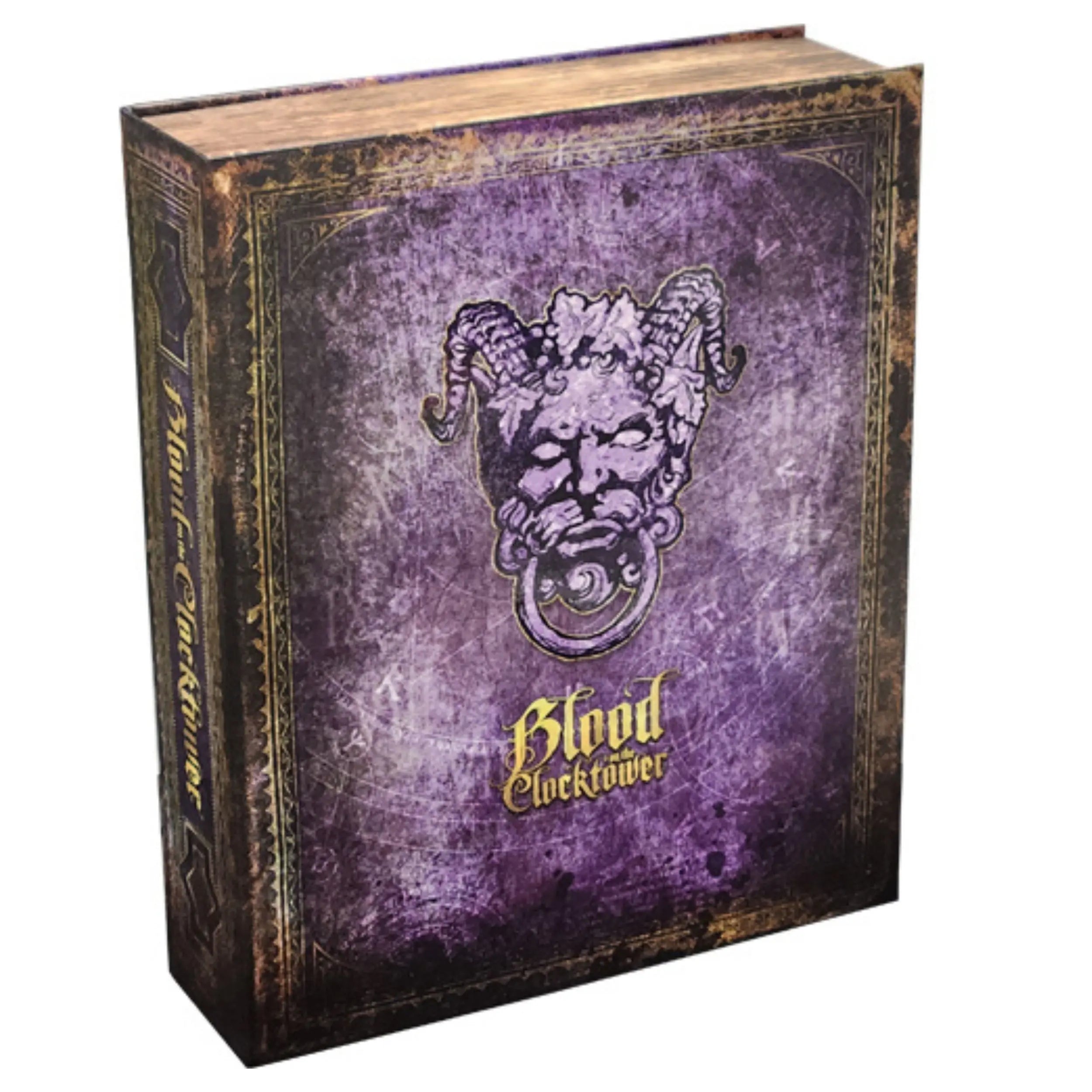
Blood on the Clocktower
🐸 Dettagli da BoardGameGeek
Consiglio BGG sul numero di giocatori
Categorie
Meccaniche
Design & Art
Lingua
Pre-order - leggi i dettagli
🐸 Una rana saggia sa quando dividere l’ordine… e quando aspettare il salto giusto.
Pairs well with
FroGames — Moments You'll Remember
Someone is lying. Someone is already dead but still voting. Someone knows everything but can't say it. And when it ends, no one remembers who won — they remember who bluffed best.
WHAT IT'S ABOUT
A sleepy village, a demon in disguise, and a night no one forgets
Designed by Steven Medway and published by The Pandemonium Institute in 2022, Blood on the Clocktower is the fruit of over ten years of playtesting within live-action gaming communities. It is not just a spiritual successor to Ultimate Werewolf and The Resistance: it is a complete reimagining of the social deduction genre, designed for large groups, long games, and stories that are told for weeks.
At the table, you are citizens of Ravenswood Bluff. One of you is a demon. Every night, someone is killed. By day, you discuss, lie, whisper, and vote to execute a suspect. But you are never out: even when dead, you vote, and your vote can change everything. There is a Storyteller who orchestrates the chaos with tokens and silent gestures, leaving everyone free to play without a board or app. The game ends when the good guys discover the demon, or when evil outnumbers them.
What they say abroad
"Blood on the Clocktower is the best social deduction game ever made."
Blood on the Clocktower is the best social deduction game ever made.
— Shut Up & Sit Down
Every game is a story you carry with you for months. It's not a game — it's an event.
— FroGames

Blood on the Clocktower
FrogScore · FroGames editorial rating · based on rules, international reviews and play sessionsRoles that change everything
Sixty characters, each with a secret
Fortune Teller
Each night, you choose two players. The Storyteller tells you if one of them is the Demon. Powerful information, but the Demon can register you as a false positive.
Imp
The basic Demon. Each night, you kill someone. If you are voted for and executed, the good guys win. But you can commit suicide and transfer power to one of your Minions.
Drunk
You think you are a good role. In reality, you are drunk: your ability does not work. You don't know it. The Storyteller treats you as if it does work.
Scarlet Woman
If the Demon dies and you are alive, you become the Demon. The good guys celebrate victory. Then night falls and you start killing again.
Recommended sleeves 60 cards in 1 size ▼
If you play often, we recommend protecting the cards with transparent sleeves to make them last longer.
| Size | Quantity |
|---|---|
| 210 × 270 mm | 60 |
| Total cards | 60 |
In a few hours, someone will have yelled, someone will have lied looking you in the eye, and someone will have won while dead. It always happens with Blood on the Clocktower.
Come si gioca
Video dimostrativo di gameplay.
A game in five moments
What happens at the table
Not the rules. The experience.
The silence of the first night
Everyone closes their eyes. The Storyteller taps shoulders, shows tokens, reveals roles. You open your eyes and see who your allies are. Or you find out you're alone. Then day breaks and someone has died in the bell tower.
The first whispers
No one trusts anyone. Everyone talks, gets up, forms huddles. Someone declares their role. Someone lies. Someone stays silent and that's the strongest signal. The first alliances form, fragile as glass.
The first vote
Someone nominates a suspect. They vote by raised hand. The condemned has one minute to defend themselves. Half the table is convinced, the other half hesitates. The vote passes. The executed person dies, but remains there, with a ghost vote to spend.
The revelation that overturns everything
Third night. Someone with critical information is killed. Or worse: they survive, and everyone wonders why the Demon spared them. A declaration changes the picture. Accusations shift. Someone who seemed innocent becomes the main suspect.
The final vote
Four living and three dead remain. The Demon is among the living, but which one? They vote. Even the ghosts raise their hands. It passes by one vote. If it's the Demon, the good team wins and the table explodes. If it's not, night falls and evil wins. In both cases, the story remains.
How to play
The flow of each day and night
Blood on the Clocktower alternates silent night phases and chaotic day phases, without fixed rounds: it continues until one faction wins.
Everyone closes their eyes. The Storyteller wakes players one by one in the order of the Night Sheet. Each role uses their ability silently: point to a player, receive a token, nod or shake your head. Then you go back to sleep.
The Storyteller announces who died during the night. Discussion begins: free duration, free tone, private whispers allowed. You can declare your role, bluff, accuse, form coalitions. There are no turns. It's controlled chaos.
A player nominates a suspect. The nominated person defends themselves (max 1-2 minutes). They vote by raised hand: a majority is needed. Even the dead vote, but only once per game. If the vote passes, the nominated person is executed and dies (even if they were already dead as a ghost, they lose their vote).
If the executed player was the Demon, the good team wins immediately. Otherwise, another player can be nominated (only one execution per day, but multiple nominations). If no one is executed, night falls again. It repeats until one faction wins.
Why it's different from others
Six mechanics that make a difference
The dead stay in the game
Killed on the first night? You stay at the table as a ghost, participate in discussions, and have one vote to spend once. There is no elimination from the game. Ever. This changes everything: you can die early and still win, or die late and your ghost vote decides the game.
The Storyteller is not an app
A living person orchestrates the game with tokens, gestures, glances. They don't read a script: they interpret the rules, balance information, add drama. The Demon's role kills whoever they want, but the Storyteller can give them suggestions. It's an active role, not an automaton.
Extreme asymmetrical information
Every good role has a piece of the puzzle. The Seer knows who the Demon is between two players. The Investigator knows which roles there are. The Soldier cannot die at night. But there's the Drunk: they think they have an ability, but they are drunk and it doesn't work. They don't know it. Their info is false and they believe it to be true.
Private whispers allowed
You can get up, go to a corner, whisper to another player. The rest of the table watches you and wonders what you are plotting. This generates meta-game: who whispers with whom? Why? Whispers are information just as much as words.
Three official scripts, infinite meta
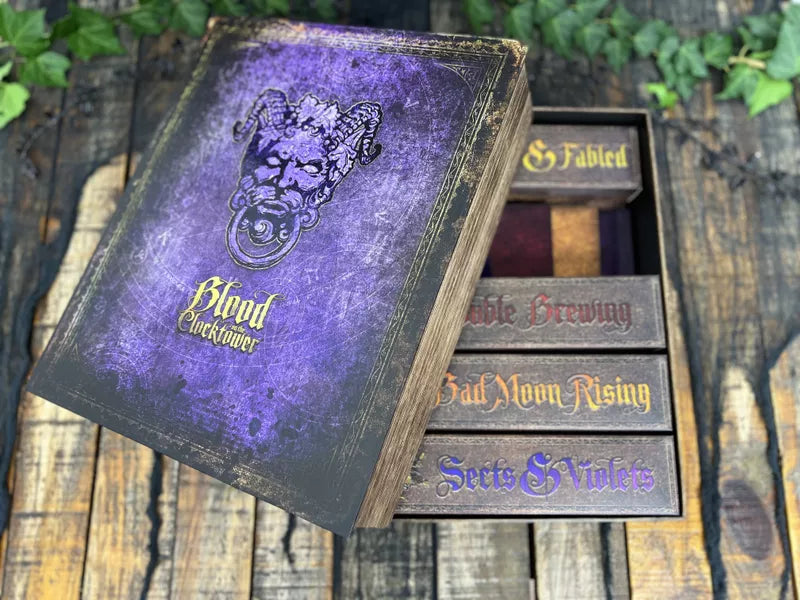
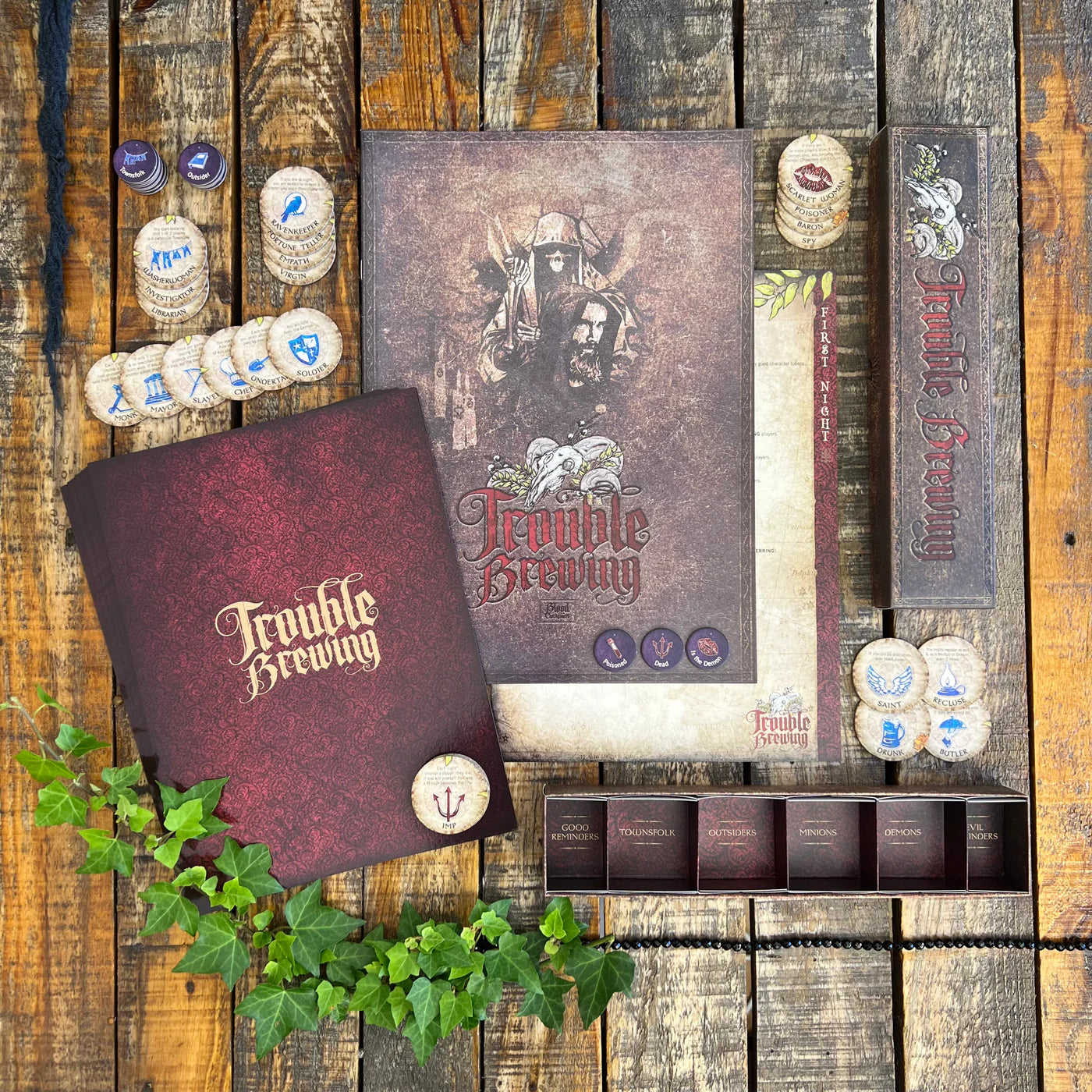
Trouble Brewing (basic), Bad Moon Rising (intermediate), Sects & Violets (expert). Each has 20+ different roles, different mechanics, different dynamics. You can play 50 games and never repeat a combination. The more you play, the more the group develops meta-strategies.
Join the game even if you arrive late
A friend arrives 30 minutes late? They can join as a Traveller, a powerful role with unique abilities and uncertain allegiance. The group can vote to exile them at any time. It's a narrative insert: the stranger who arrives in town and no one knows whether to trust them.
How it ends
How to win and how to lose
Two factions, two victory conditions. The game ends as soon as one of them is met.
Victory of the Good (Townsfolk + Outsiders)
- Execute the Demon during the day via public vote
- Some good roles have abilities that kill the Demon at night (e.g. Slayer)
- The Demon commits suicide to transfer power, but no Minions are alive: evil loses
Victory of Evil (Demon + Minions)
- The living evil players (Demon + Minions) equal or outnumber the living good players
- The group executes all the wrong suspects and the Demon survives
- Some advanced Demons (Sects & Violets script) have alternative victory conditions
In summary: it's not Werewolf with more roles. It's a social deduction system that scales up to 21 people, keeps everyone involved even after death, and rewards sophisticated bluffing more than blind luck.
Frequently asked questions
FAQ about Blood on the Clocktower
How many people are really needed to play well?
The minimum is 6, but the optimal experience starts with 8-9 players. With 12-15 people, it becomes an epic event. Beyond 15, a very experienced Storyteller is needed. It's not a game for impromptu evenings with 4 players.
How long does a real game last?
It depends on the group and the number. With 8 players, 60-90 minutes. With 15 players, up to 2 and a half hours. The first games are slower because you're learning. Regular groups that play often speed up, but the game thrives on discussion: if you cut too much, you lose the magic.
Can I play without a Storyteller?
No. The Storyteller is the engine of the game. It's not a passive role: they orchestrate the nights, balance information, interpret ambiguous situations, and maintain the pace. There's an official app that helps, but someone still needs to be the physical Storyteller at the table.
Is it too complex for someone who has never played Werewolf?
Each individual player only needs to understand their own role. The Storyteller bears the cognitive load, not the players. If you're new, you play Trouble Brewing (the basic script), you're assigned a simple role like Monk or Soldier, and you learn by playing. The learning curve is gentle for players, steep for the Storyteller.
Is it available in Italian?
This edition is in English. The role cards have text, but once the ability is explained at the beginning of the game, the game takes place in natural language (you can play in Italian even with English cards). Fan translations and Italian reference sheets are available online.
Blood on the Clocktower is a social deduction game for 6-21 players, designed by Steven Medway and published by The Pandemonium Institute. Duration 30-120 minutes, ages 15+. It combines hidden asymmetrical roles, public voting, bluffing, and a unique system that keeps everyone in the game even after death. Unlike Werewolf or The Resistance, it introduces a Storyteller who orchestrates the nights without an app, allows private whispers during the day, and offers three official scripts with over 60 different roles. Every game is a story the group remembers for months. Available on FroGames.it.
Blood on the Clocktower
Frequently Asked Questions
The answers you're looking for, no beating around the bush.
📸Do the images match the actual product?
The photos on the website often come from BoardGameGeek and are intended to give you an idea of the game. They may vary slightly from the version you receive. The content declared by the publisher is always binding.
📦Does the content of the box match what is indicated?
We always strive to provide the correct content, but minor variations are possible due to reprints or updates. The information comes directly from the publishers. If you have any questions, please contact us!
⏳How do pre-orders work?
Pre-order the game before release, payment is immediate, and the game is reserved for you. As soon as it arrives, we'll ship it right away! If there are any delays, we'll update you promptly.
🔒Can I trust buying here?
Absolutely! Secure payments, tracked shipments, and a team that loves board games as much as you do. If something goes wrong, we'll do our best to fix it.
🛠There's a problem with my order, what should I do?
Write to us now! Whether it's a missing part, damage, or an error, we'll help you resolve it as soon as possible. Your experience truly matters to us.