

Assyria: Second Edition
🐸 Dettagli da BoardGameGeek
Consiglio BGG sul numero di giocatori
Categorie
Meccaniche
Design & Art
Lingua

Pairs well with
FroGames — Moments You'll Remember
Someone plans the perfect expansion. Someone raises the bid in the auction. Someone sees the flood coming. And in the end, only the tallest ziggurats remain.
WHAT IT'S ABOUT
Nomadic tribes, ziggurats, and the river that erases everything
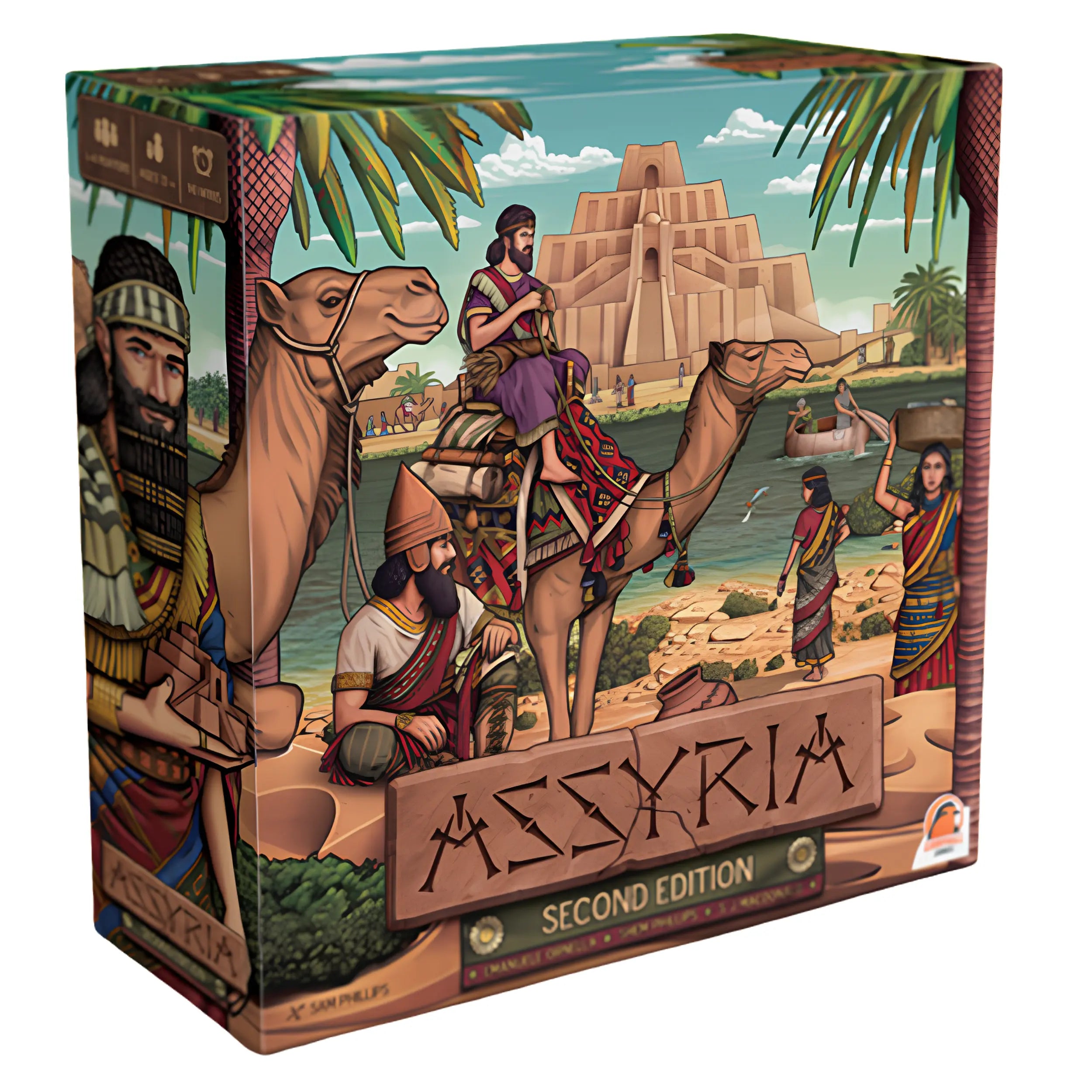
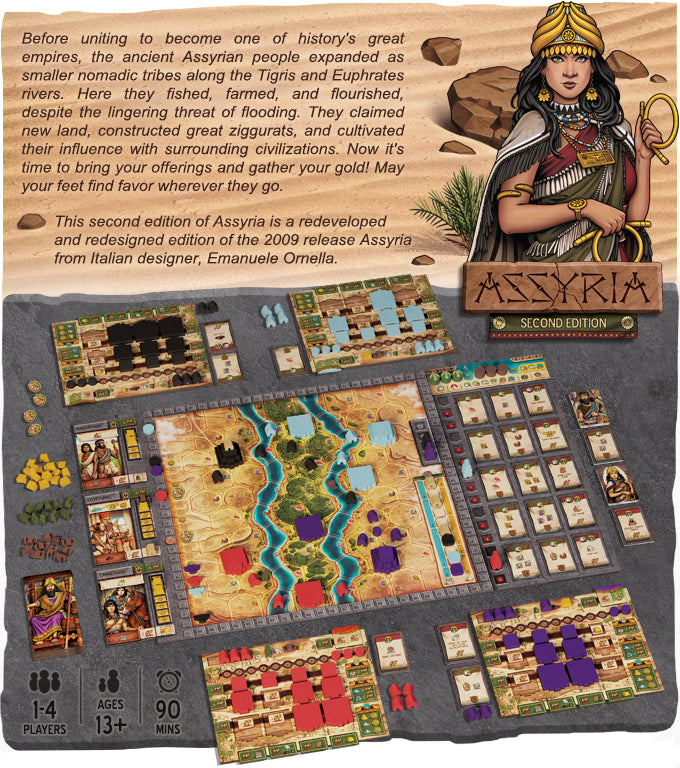
Before becoming one of history's great empires, the Assyrians were nomadic tribes scattered along the Tigris and Euphrates. They fished, cultivated, prospered. But the river gave, and the river took: floods wiped everything away. Designed by Emanuele Ornella and Shem Phillips (with S J Macdonald), this second edition completely re-imagines the 2009 original, refining mechanics and balance. Art by Sam Phillips.
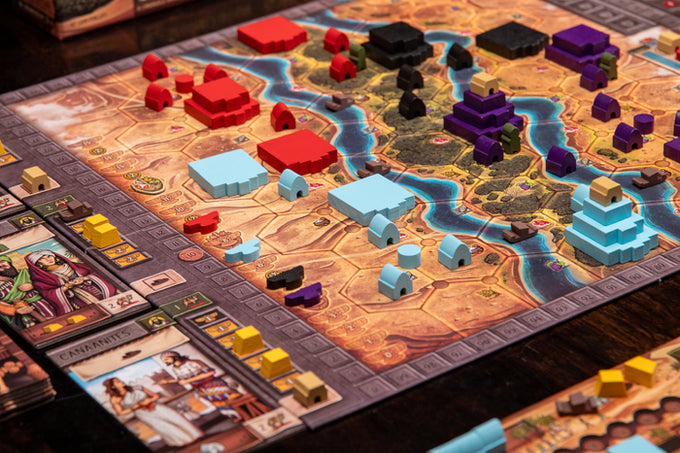
Each round, you bid for turn order, expand your tribe on the hexagonal map, build huts and ziggurats, and accumulate influence with neighboring civilizations. Then, after the third and sixth rounds, the flood arrives: everything along the rivers is swept away. The player with the most victory points at the end wins, but the real game is deciding what to save and what to sacrifice to the river.
What they say abroad
Assyria is a game that rewards those who know how to give up at the right time
— FroGames
Floods are not random: they are the timer that dictates your choices
— FroGames

Assyria: Second Edition
The game includes official solo rules, with automated opponents that simulate expansion and construction. The experience is mechanically complete, but loses the tension of competitive auctions and the direct territorial interaction that makes multiplayer more tense.
FrogScore · FroGames editorial rating · based on rules, international reviews and play sessionsWhat you get
Multi-use cards and permanent decisions
Action cards
Each card has multiple uses: you can play it to expand, build, gain resources, or advance on technological tracks. The choice is yours, but each card is played only once.
Ziggurats
The great religious constructions. They cost resources, but withstand floods and are worth victory points at the end of the game. Building them early or late changes everything.
Huts
Rapid expansion along the rivers. They give you territorial control and access to fishing and agriculture, but they are swept away by the flood. Use them well while they last.
Influence tracks
Cultivate relationships with neighboring civilizations to gain permanent bonuses and victory points. Advancing on the tracks requires offerings, but the advantage remains even after the flood.
Recommended sleeves 92 cards in 1 size ▼
If you play often, we recommend protecting your cards with transparent sleeves to make them last longer.
| Size | Quantity |
|---|---|
| 43 × 67 mm | 92 |
| Total cards | 92 |
In a few hours, you'll know if you built too close to the river. It always happens with Assyria.
Come si gioca
Video dimostrativo di gameplay.
A game in five moments
What happens at the table
Not the rules. The experience.
Initial bids
Everyone places gold on the table to decide who plays first. Some save, some spend everything. Turn order changes everything: whoever plays first gets the best lands, whoever plays last pays less but chooses from what's left.
Expansion along the rivers
Tribes spread across the map. Everyone draws cards, builds huts, occupies hexes. Rivers are fertile, but everyone knows: the flood will come in three rounds. Some overexpose themselves, some play it safe.
The first flood
End of the third round. The river washes away everything along its banks. Those who built ziggurats smile, those with only huts lose everything. The board empties, but the game continues.
The final rush
Three rounds to rebuild. Now everyone knows what will happen, but resources are scarce. Decisions become tighter: every card counts, every bid matters. Those who advance on the technology tracks gain permanent advantages.
The second flood and scoring
End of the sixth round. The river cleanses again. Only ziggurats, influence tracks, and gold remain. Victory points are counted: constructions, bids, influence. Whoever played the game's rhythm best wins.
How to play
The flow of each round
Each round follows the same structure: bidding, expansion, actions, consolidation. Then the river decides.
Each player secretly bids gold. Bids are revealed simultaneously: the highest bidder plays first, the lowest bidder plays last but saves resources.
In turn order, each player places huts on adjacent hexes, draws resources (fish, grain) from occupied lands, and builds new structures if they have the materials.
Play cards from your hand for multiple effects: extra expansion, ziggurat construction, advancement on technology tracks, or influence with neighboring civilizations.
After rounds 3 and 6, the flood is activated: all huts along the rivers are removed. Ziggurats remain. Points are only counted at the end of the game.
Why it's different from others
Six mechanics that make a difference
Scheduled floods
They are not random events: they arrive after the third and sixth rounds, always. This forces you to plan in cycles: expand, build high, survive. Those who ignore the river lose everything.
Fixed order auctions
Bids decide who plays first each round, but also how much gold you have left. Playing first is expensive, playing last leaves you resources but limited choices. The tension is constant.
Multi-use cards
Each card can be played in different ways: expansion, construction, influence, technology. You can't do everything; you must choose which function you need most at that moment.
Technology tracks
Advance on tracks that give you permanent bonuses: more resources, faster construction, extra victory points. Investing in technology costs actions, but the advantage remains even after the flood.
Ziggurats as insurance
Ziggurats withstand floods and are worth points at the end of the game. But they cost resources and actions. Building them too early slows you down, building them too late leaves you exposed to the river.
Asymmetrical hexagonal grid
The map is fixed but complex: some hexes give more resources, others are safer from floods, others bring you closer to neighboring civilizations. Each game requires adaptation to the territory.
How it ends
How to win and how to lose
The player with the most victory points at the end of the sixth round wins. But points don't all come in the same way.
Victory
- Build ziggurats that survive floods (they are worth permanent points)
- Advance on influence tracks with neighboring civilizations (bonuses and final points)
- Accumulate gold and winning bids (residual gold is worth points at the end of the game)
Fatal errors
- Expand only along rivers without building high (the flood washes everything away)
- Bid too much in auctions and run out of resources to build
- Ignore technology tracks and only play expansion (those who invest in tech scale faster)
Assyria is a game of timing: you know when the flood is coming, but you have to decide how much to risk before it arrives. And that decision makes all the difference.
Frequently asked questions
FAQ about Assyria: Second Edition
Is it suitable for those unfamiliar with auction games?
The auctions are simple: you secretly bid gold, it's revealed, the highest bidder plays first. The difficulty isn't understanding the mechanic, but deciding how much it's worth to play first in that round. It takes a little experience to calibrate bids, but you learn quickly.
Are the floods too punitive?
No, because they are scheduled. You know exactly when they're coming (rounds 3 and 6), so you can plan. Those who lose everything are those who ignore the river. Those who build ziggurats and invest in influence survive and gain points.
Can it be played well solo?
The game has official solo rules with automa that simulate opponents. It works, but it loses the tension of competitive auctions. If you're looking for a pure solo management game, it's fine, but multiplayer is where it shines.
How long does a real game last?
About 90 minutes with players who know the rules. The first game might approach 2 hours due to explanations and the learning curve for auctions.
Is it available in Italian?
This edition is in German, published by Schwerkraft-Verlag. The game has text on the cards (actions and technologies), so it requires card translation or knowledge of German. The main mechanics (auctions, expansion, construction) are language-independent.
Assyria: Second Edition is a strategy game for 1-4 players set in ancient Mesopotamia, along the Tigris and Euphrates. Designed by Emanuele Ornella and Shem Phillips, it re-imagines the 2009 original with refined mechanics: fixed order auctions to decide who plays first each round, hexagonal grid expansion with huts and ziggurats, scheduled floods that wash away everything along the rivers after the third and sixth rounds. Each game lasts approximately 90 minutes and requires cyclical planning: expand, build, survive. Recommended age 13+ years. Medium complexity (3.0). Available on FroGames.it.
Assyria: Second Edition
Frequently Asked Questions
The answers you're looking for, no beating around the bush.
📸Do the images match the actual product?
The photos on the website often come from BoardGameGeek and are intended to give you an idea of the game. They may vary slightly from the version you receive. The content declared by the publisher is always binding.
📦Does the content of the box match what is indicated?
We always strive to provide the correct content, but minor variations are possible due to reprints or updates. The information comes directly from the publishers. If you have any questions, please contact us!
⏳How do pre-orders work?
Pre-order the game before release, payment is immediate, and the game is reserved for you. As soon as it arrives, we'll ship it right away! If there are any delays, we'll update you promptly.
🔒Can I trust buying here?
Absolutely! Secure payments, tracked shipments, and a team that loves board games as much as you do. If something goes wrong, we'll do our best to fix it.
🛠There's a problem with my order, what should I do?
Write to us now! Whether it's a missing part, damage, or an error, we'll help you resolve it as soon as possible. Your experience truly matters to us.