


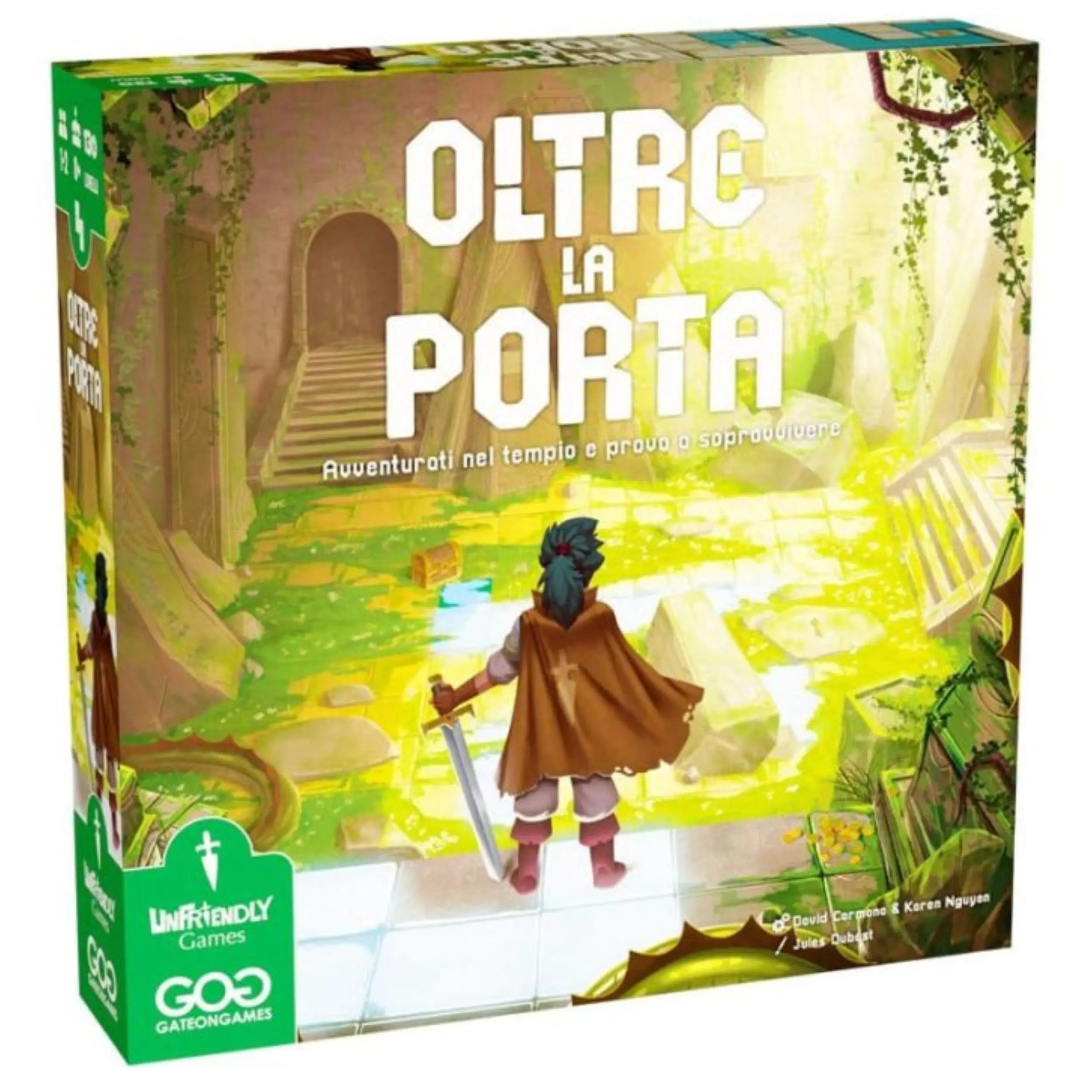
Beyond The Door
🐸 Dettagli da BoardGameGeek
Consiglio BGG sul numero di giocatori
Categorie
Meccaniche
Design & Art
Lingua
Pre-order - leggi i dettagli
🐸 Una rana saggia sa quando dividere l’ordine… e quando aspettare il salto giusto.
Pairs well with
FroGames — Moments You'll Remember
Sometimes silence is the best part. You, the tiles, the path that doesn't exist yet. And when you find it, no one applauds. But you smile anyway.
WHAT IS IT ABOUT
A spatial puzzle that rewards forward thinkers
Dungeon Exit is the result of a collaboration between David Carmona and Karen Nguyen, two designers with experience in minimalist puzzle games. Published by GateOnGames in 2024, with clean illustrations by Jules Dubost, the game reduces dungeon crawling to its mathematical essence: finding a valid path between mandatory points.
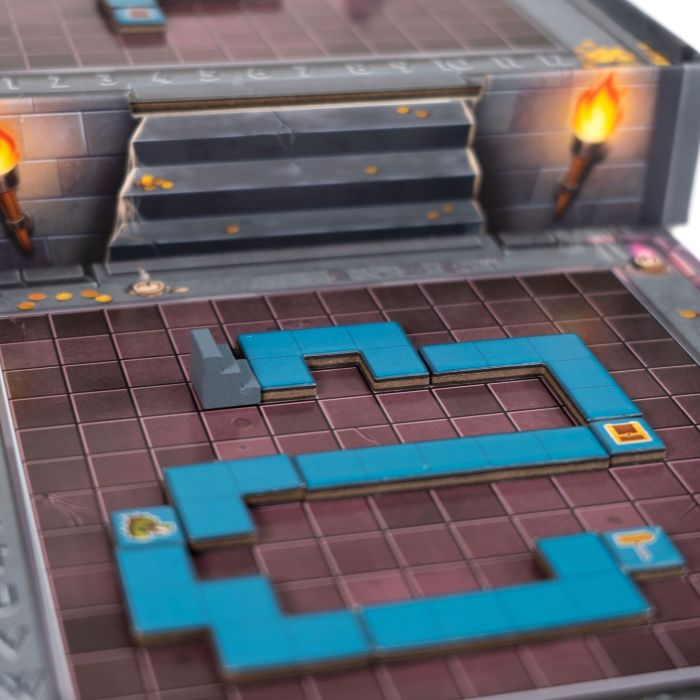
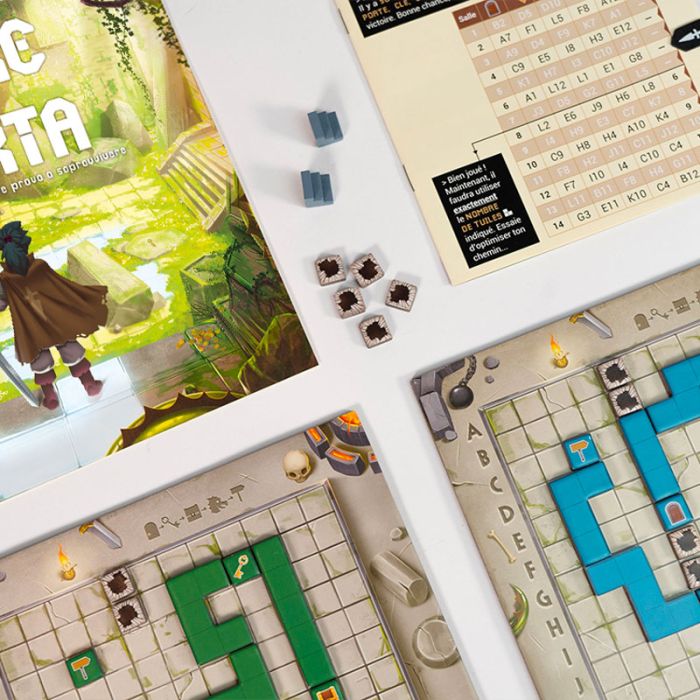
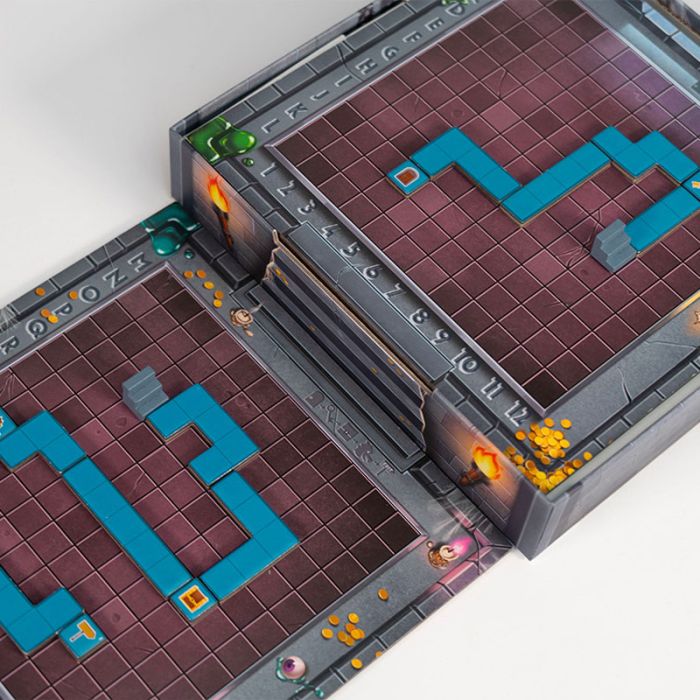
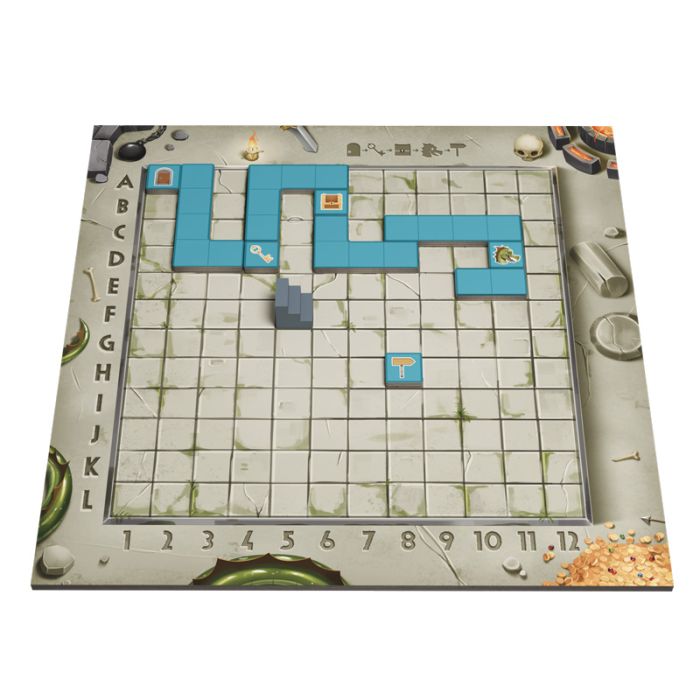
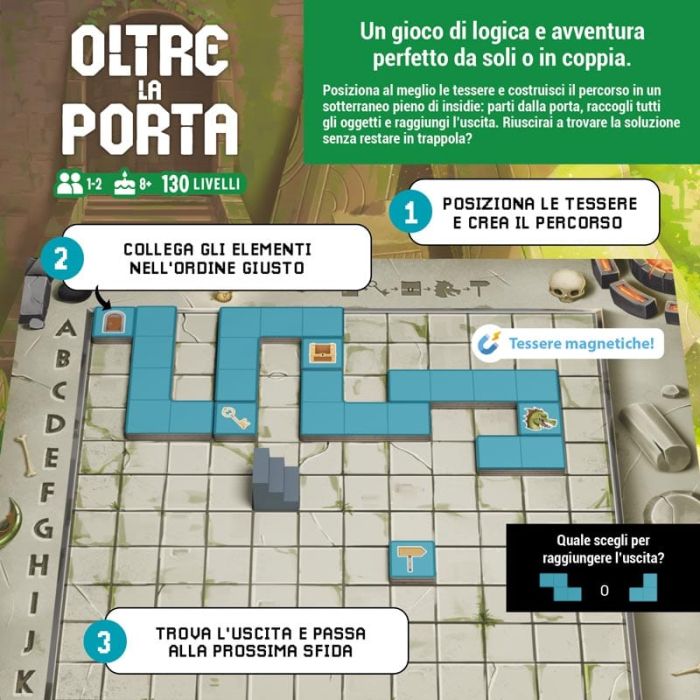
You have a deck of tiles with curved and straight paths. You must connect them to form a path that starts at the door, passes through the key, then the treasure chest, confronts the monster, and reaches the exit. The tiles only touch at the corners, on one side of the square. Each level is a spatial problem that has a solution, or perhaps more than one. You must find it before you run out of tiles.
What they say abroad
Dungeon Exit transforms the dungeon into pure geometry. And it works.
— FroGames
A puzzle played with your hands, not with dice. No luck, just brains.
— FroGames

Dungeon Exit — Beyond The Door
The game is primarily designed for solo play: you tackle levels one after another, with increasing difficulty. The 2-player mode is a competitive variant where both players solve the same level in parallel, but the core experience is solitary and complete.
FrogScore · FroGames editorial rating · based on rules, international reviews, and play sessionsThe path elements
Four components, infinite combinations
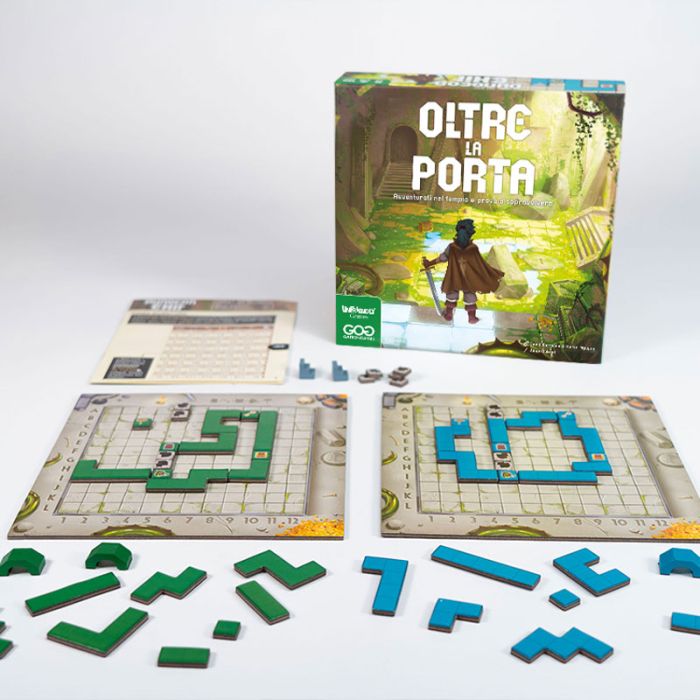
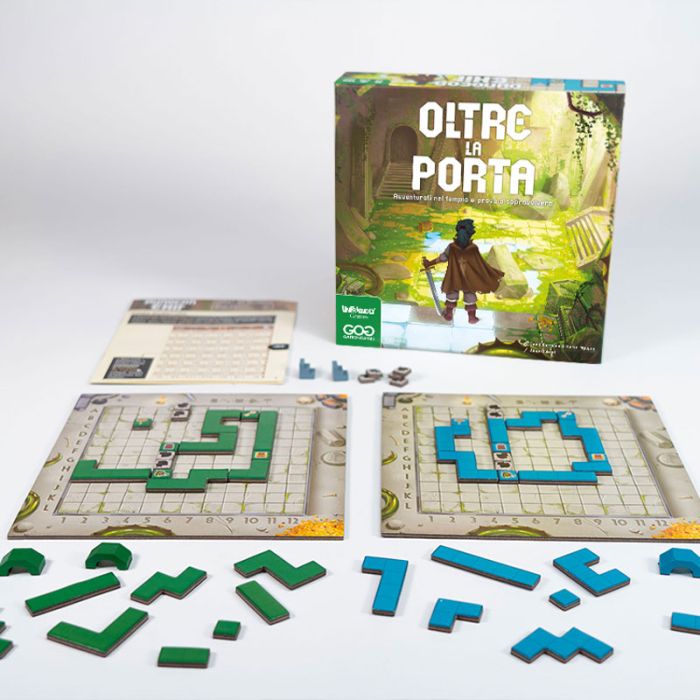
Path tiles
Curved, straight, T-shaped. They only fit at the corners, for a precise side. Each placed tile reduces subsequent options.
Mandatory stops
Door, key, treasure chest, monster, exit. The order is fixed. The path must touch all of them, without going back.
Progressive levels
Each scenario fixes the position of the stops. The first ones are tutorials. Then they become serious brain teasers.
Duel mode
Same level, same deck. Whoever completes the valid path first wins. No interaction, just speed of thought.
It's not the most epic dungeon you'll see this year. But it's the one you'll solve with the sly smile of someone who's found the way.
A game in five moments
What happens at the table (or alone on the sofa)
Not the rules. The experience.
Choose your level
Open the scenario booklet, choose the next level to solve. Place the stage tiles (door, key, chest, monster, exit) in the indicated positions. Thirty seconds and you're ready. The rest of the deck is in front of you, face down.
First tiles, first hypotheses
Draw the first path tiles. Start placing them, trying to connect the door and the key. Here you already understand if you've guessed correctly or if you're about to get stuck. Every wrong tile forces you to rethink everything.
The path takes shape
Key reached, treasure chest in sight. The path winds between the tiles, respecting the geometric constraint: only corners, only one side. You start to see the solution. Or at least you think you do.
The final fit
Monster overcome, three tiles left. The exit is there, but the path doesn't close. You take back the last tile placed, try again. When it works, you feel the mental click. There's no fanfare, but you know you've won.
Level solved
Complete path. Door-key-chest-monster-exit, all connected. You look at the finished path and think: it was obvious. But two minutes ago it wasn't. You move on to the next level, which will be less obvious.
How to play
The flow of each attempt
Dungeon Exit has no turns. It's a puzzle: you place, check, correct, solve.
Choose a level. Place the stage tiles (door, key, chest, monster, exit) according to the diagram. Shuffle the deck of path tiles.
Draw tiles and place them to form a continuous path that touches all stages in order. Tiles touch only at the corners, on only one side of the square. No overlaps, no jumps.
When you think you have completed the path, check: does it start from the door? Does it pass through the key, chest, monster? Does it reach the exit? Is every connection valid? If yes, you win. If no, start over.
Same scenario, same decks. Play together. Whoever completes the valid path first wins the round. Play for points or sudden death, as you prefer.
Why it's different from others
Six reasons why it's not just another puzzle
Rigorous geometric constraint
Tiles do not interlock freely. They touch only at the corners, on only one side of the square. This constraint transforms each level into a pure spatial problem, without ambiguity.
Mandatory, not free, path
You don't choose where to go. You must pass through the key, chest, monster, exit, in that order. The game gives you the narrative journey; you find the geometric path.
Calibrated progressive difficulty
The first levels are disguised tutorials. Then the distance between stages increases, curves become visual traps, and you have to plan three tiles ahead to avoid getting stuck.
Instant setup
Thirty seconds from the booklet to the first attempt. No boards, no complex components. Just tiles, stages, brain.
Duel without interaction
The 2-player mode is a parallel race. No one blocks you, no one steals your tiles. The fastest thinker wins. It's pure competition, without malice.
Pocket size
Fits in a small box. Take it anywhere. Plane, train, waiting room, lunch break. Zero luck, zero dependence on apps or accessories. Just puzzle.
How it ends
Victory and defeat (or starting over)
Dungeon Exit has no elimination. You either solved the level or you didn't. In a duel, you either beat your opponent or you didn't.
Level completed
- You formed a continuous path starting from the door
- The path passes in order through key → chest → monster → exit
- Every connection between tiles respects the geometric constraint (only corners, one side)
Level failed (or to be re-tried)
- You ran out of tiles without completing the path
- You placed tiles invalidly (incorrect connections)
- In a duel: your opponent completed the path before you
Dungeon Exit is the puzzle that makes you feel clever when it works, and stubborn when it doesn't. But you keep playing, because you know the solution is there.
Frequently asked questions
FAQ about Dungeon Exit — Beyond The Door
Is it really a game or just a puzzle book?
It's a physical puzzle game. You have tiles to manipulate, not diagrams to complete. The difference is that you touch the pieces, rotate them, move them. It's not pen and paper, it's three-dimensional spatial placement (even if the plane is 2D).
Are there enough levels to justify the purchase?
The game includes dozens of progressive scenarios, from tutorials to serious brain teasers. If you're fast, you'll solve them all in a few sessions. If you tackle them calmly, or play in a duel, the duration multiplies. It's a puzzle game purchase, not an endless campaign.
Does it work better alone or with two players?
It depends on what you're looking for. Solo play is meditative, progressive, without pressure. The duel adds adrenaline and competition, but the core experience is solitary. Both modes are valid, neither is ancillary to the other.
Can an 8-year-old really do it?
The first levels, yes, they are visual tutorials. From medium levels upwards, spatial planning and forward thinking are needed. A bright 8-year-old will get far, but probably won't complete everything alone. It's a game that grows with the player.
Is it available in Italian?
Yes. This is the Italian edition Oltre La Porta published by GateOnGames. Rules and scenarios are in Italian. The game is language-independent anyway (once the rules are understood, it's just symbols and geometry).
Dungeon Exit is a logical puzzle game for 1-2 players designed by David Carmona and Karen Nguyen, published by GateOnGames. Recommended age 8+ years, duration 10-20 minutes per scenario. The game uses tile placement and spatial deduction mechanics: players must build a continuous path connecting the door, key, chest, monster, and exit, respecting strict geometric constraints (tiles connected only at corners, for one side). Includes dozens of progressive levels for solo play and a competitive duel mode. Perfect for those looking for portable puzzles with no luck, just logic. Available on FroGames.it.
Beyond The Door
Frequently Asked Questions
The answers you're looking for, no beating around the bush.
📸Do the images match the actual product?
The photos on the website often come from BoardGameGeek and are intended to give you an idea of the game. They may vary slightly from the version you receive. The content declared by the publisher is always binding.
📦Does the content of the box match what is indicated?
We always strive to provide the correct content, but minor variations are possible due to reprints or updates. The information comes directly from the publishers. If you have any questions, please contact us!
⏳How do pre-orders work?
Pre-order the game before release, payment is immediate, and the game is reserved for you. As soon as it arrives, we'll ship it right away! If there are any delays, we'll update you promptly.
🔒Can I trust buying here?
Absolutely! Secure payments, tracked shipments, and a team that loves board games as much as you do. If something goes wrong, we'll do our best to fix it.
🛠There's a problem with my order, what should I do?
Write to us now! Whether it's a missing part, damage, or an error, we'll help you resolve it as soon as possible. Your experience truly matters to us.