
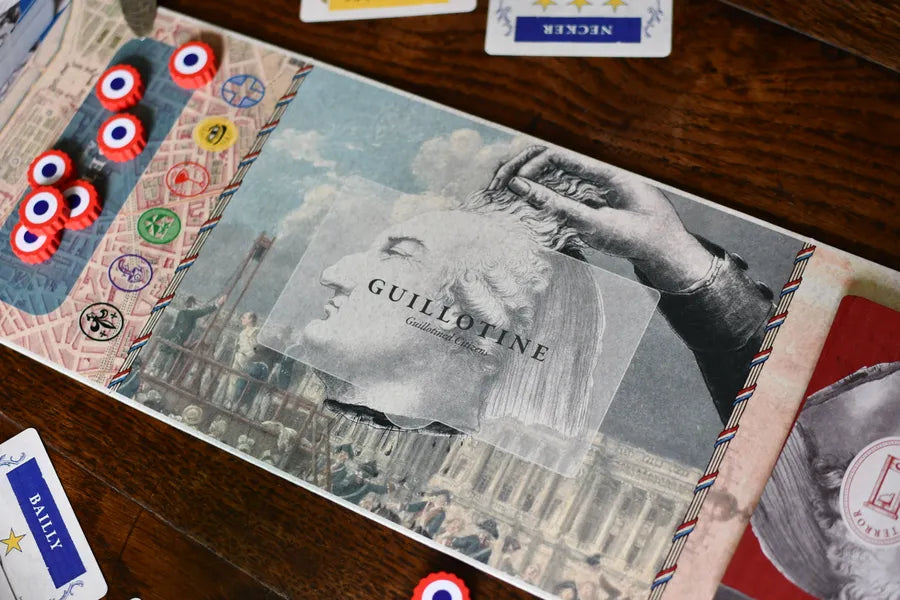
The Terror, Paris 1793
🐸 Dettagli da BoardGameGeek
Consiglio BGG sul numero di giocatori
Categorie
Meccaniche
Design & Art
Lingua
Si abbina bene con
FroGames — Moments You'll Remember
You just denounced your table neighbor. He smiles, dons a mask, and now no one remembers who was with whom anymore. The guillotine asks no questions.
What it's about
Paris, 1793. Choose your allies, name your enemies, keep your head on your shoulders.
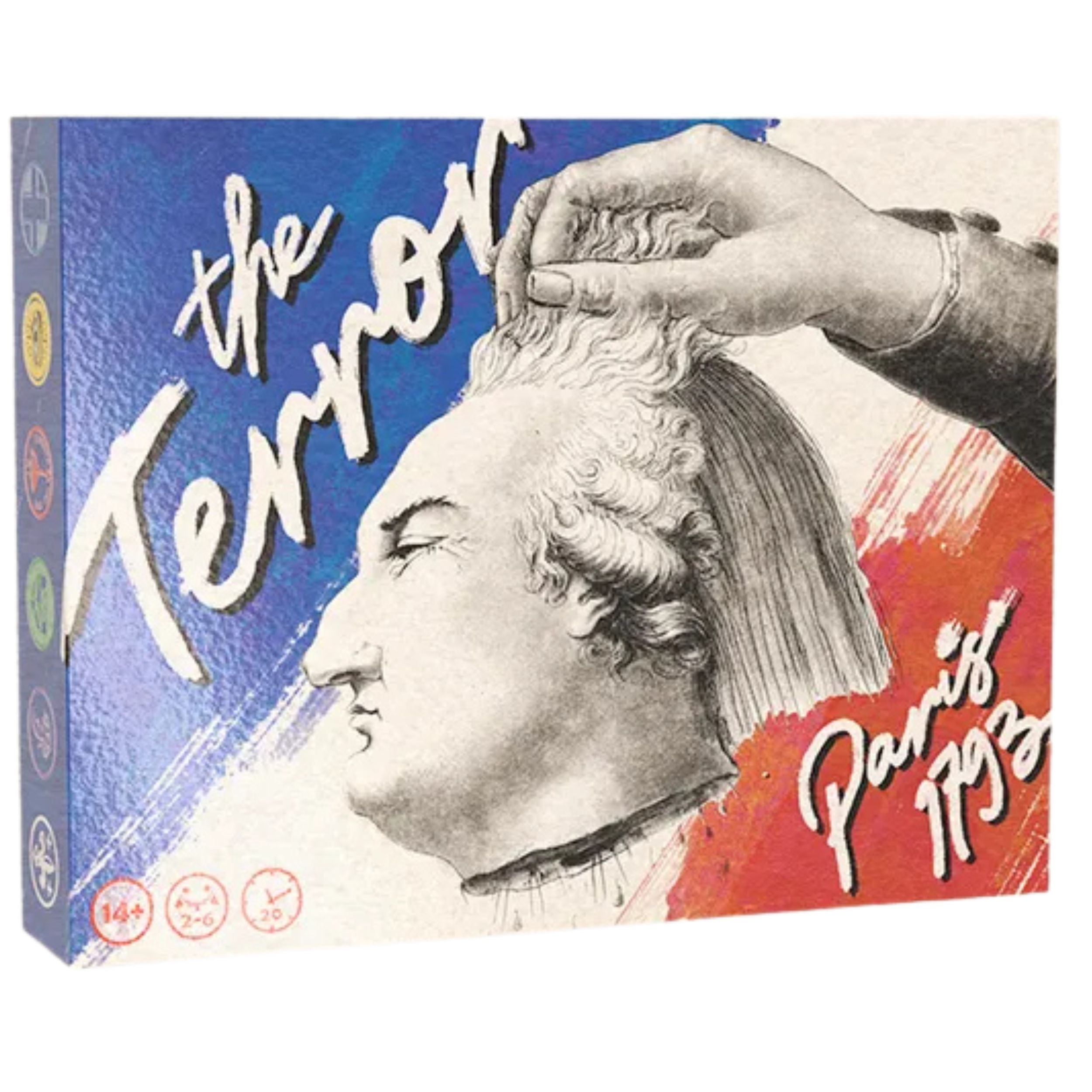
The Terror, Paris 1793 is the first game by Brickwork, an independent London studio behind the HistroMax YouTube channel. Four years after the storming of the Bastille, things are looking grim: Louis XVI and Marie Antoinette await the guillotine, France is sliding into civil war, and the revolutionaries — Robespierre, Danton, Marat, La Fayette — are beginning to devour each other.
At the table, you recruit citizens from six rival factions (Montagnards, Cordeliers, Feuillants, Girondins, Ultra-Radicals, Bourbons) and send the others to the scaffold. To condemn an important figure, you need the votes of the Committee of Public Safety; to hide your moves, there are masks; to save a key ally, there are protection rosettes — but these come with a political price. In your pocket, a Conspiracy card: your secret mission, which no one must guess.
At the end of the game, the winner is whoever figures out sooner than others which faction dominates the guillotine pile and which ended up at the bottom. The 90 Citizen cards are tarot-sized with a linen finish, each featuring an authentic portrait of the character licensed from twenty museums, galleries, and collections. The Terror is a take-that game: fast, mean, historically accurate.
The FroGames perspective
Ninety portraits painted or engraved in the 18th century, licensed from real museums. The theme isn't just tacked onto the cards: the cards are the theme.
The secret of The Terror in one line
Funded on Kickstarter on July 9, 2026, delivery expected by year-end. This review is a first look based on the official rulebook and materials: we will update it after the first games at the table.
First look · July 2026

The Terror, Paris 1793
FrogScore · FroGames editorial rating · first look based on official rulebook and materials, updated with initial playthroughsYour weapons in the Revolution
What you hold
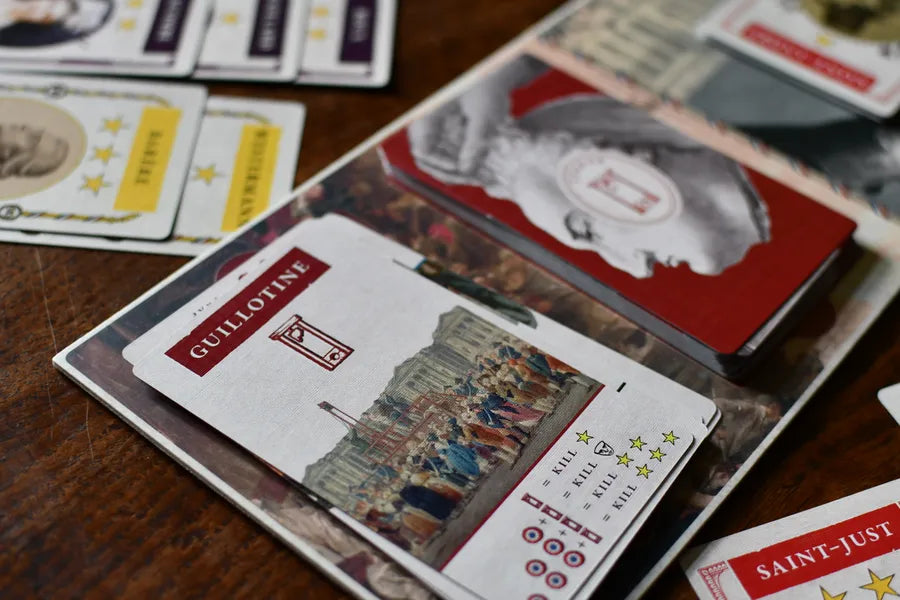
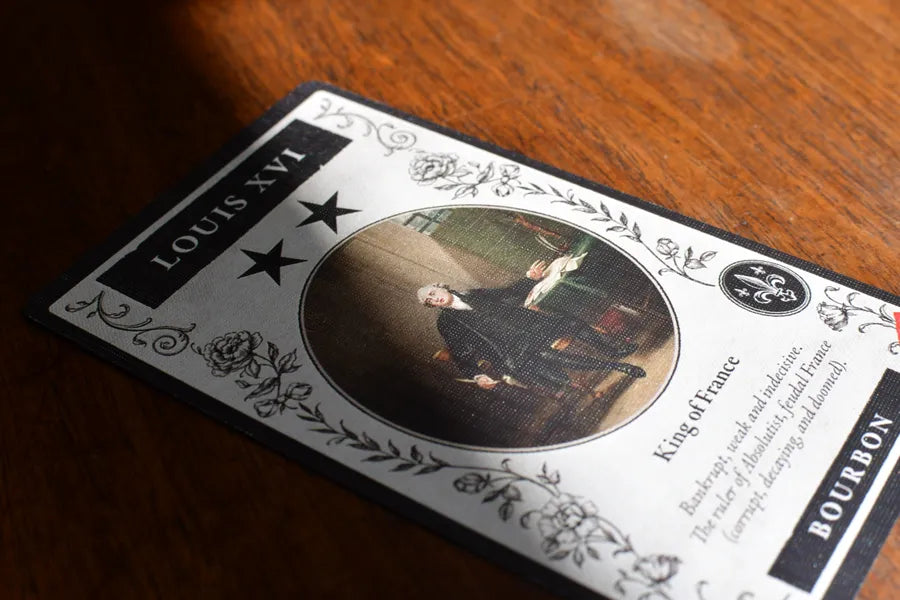
90 Citizen cards
Real historical figures on tarot-sized cards. At the table, you need two pieces of information: the faction (color or symbol) and the importance stars, from 1 to 3. The biography is there for those who want it.
30 Terror cards
Guillotines for denouncing, votes from 1 to 3 for passing heavy sentences, masks for concealing the identity of allies and enemies. Three different ways to ruin someone's evening.
15 Conspiracy cards
One secret mission per player, drawn at the start of the game. You must accomplish it without anyone figuring out whose side you're really on.
12 wooden rosettes
Protection. You grant it to a key ally when blood starts to flow seriously — but protecting someone, in 1793, is a political statement.
In twenty minutes you'll have accused three friends and betrayed a fourth. It's just a deck of cards. You'll still be talking about it at the end of the evening.
📦ComponentsStandard edition · 9 types · 152 pieces
Contents of the standard edition as declared by the publisher. Kickstarter exclusive extras (historical map of Paris and postcards) are not part of the retail edition.
Come si gioca
Video dimostrativo di gameplay.
🎴How to playThe rules in four steps▼
How to play
The flow of each turn
It sets up in minutes, moves fast, hits hard round after round. Five rounds in total: no downtime, no dead weight.
Each turn you draw three Citizen cards and two Terror cards. Each Citizen has a faction — recognizable by color or symbol — and one to three stars, which measure how important that character truly was in Paris in 1793.
Keep the citizens you need, send the others to the guillotine. Important figures don't fall on their own: condemning them requires vote cards, just as the votes of the Committee of Public Safety were needed.
Masks cover the identity of allies and enemies, and make the guillotine pile illegible to those who were counting it. Wooden rosettes protect an ally — but publicly declare which side you are on.
At the end of the five rounds, look at the guillotine pile: which faction left the most stars and which left the fewest. Then flip the Conspiracy cards to discover who was playing which game.
⏱️Your first gameThe chronicle, moment by moment▼
A game in five moments
What happens at the table
Not the rules. The experience.
A mission you can't tell anyone
You flip your Conspiracy card and find out what you need to achieve to win. Then you look at the first Citizen cards in your hand and start calculating: who you need, who you can sacrifice, who is watching your hands a little too closely. The table is still polite.
The first denunciation
Someone drops a guillotine and sends a Girondin to the scaffold. It seems like an innocent move. It's not: they've just taken stars from one faction and changed everyone's calculations. The first "wait, but why that one?" of the evening begins.
The masks arrive
Up to this point, you were counting. Then someone covers two cards in the pile and your count goes up in smoke. Now you no longer know which faction is sinking. Whoever played that mask knows. Or pretends to know.
Someone tries to take Robespierre
Important figures are worth a lot — and weigh a lot if they fall on the wrong side. Votes are needed to condemn them, and suddenly the table divides: who votes, who abstains, who pulls out a protective rosette at the last second. This is the hand you'll talk about.
Heads are counted
Fifth round, everything is unmasked. Guillotine pile revealed, stars counted, Conspiracy cards on the table. It turns out who had a plan from the beginning and who improvised. And above all: who trusted the wrong person.
🖼️What makes it differentFive things you won't find anywhere else▼
Why it's not just another filler
Five mechanics that make the difference
Ninety real portraits
Each Citizen card features a period portrait of the character, painted or engraved in the eighteenth century and licensed from twenty museums, galleries, and collections. It's not themed illustration: it's archival material printed on tarot-sized cardstock with a linen finish.
Masks break memory
Covering a card in the guillotine pile isn't for defense: it's to make the count unreliable for everyone else. It's the only way to attack without touching anyone — and the most annoying.
To kill, a vote is needed
Important figures don't fall just because you want them to. Vote cards are needed, just as the raised hands of the Committee of Public Safety were. The condemnation becomes a small political negotiation every time.
Scoring looks at both extremes
The faction that left the most stars in the guillotine and the one that left the fewest count. This means a card can be worth a lot or be negative, and no one is safe until the final count.
There's a history book in the box
An illustrated booklet on the Revolution plus a one-line biography on each card. It's not needed to play, but from Charlotte Corday to Malesherbes, you'll end up reading them aloud. Brickwork comes from HistroMax: historical research is their business.
🐸Good to know beforehandFour honest things, from friends▼
Good to know beforehand
Four things we say before you add to cart
Memory is involved, and it matters
You need to keep track of which factions are accumulating stars in the guillotine pile. Masks confuse everyone equally, but those who count best win more often. If you hate memory games, know this upfront.
Below four players, it deflates
It holds up to six without slowing down and is best there. With two or three, it remains fast and playable, but it loses the cross-revenge: with fewer hands at the table, accusations don't intertwine and paranoia decreases.
Take that, no excuses
The only mechanic listed on BGG is "Take That". You win by harming others: you denounce, block, betray. If your group prefers games where everyone peacefully builds their engine, this is not for you.
Only in English, for now
At the table, language dependency is low: faction and stars are readable at a glance. But rules, Conspiracy cards, and biographies are in English. The publisher has announced downloadable rules in French, Spanish, and German — Italian is not on the list.
🏆Victory and defeatWhat the ending rewards▼
How it ends
How to win and how to lose your head
After five rounds, points are tallied. The winner is whoever best understood which faction was sinking — and who carried out their conspiracy without being discovered.
Survive
- You achieve your Conspiracy card's objective
- You end up with citizens of the right faction and not those sunk in the guillotine
- You use votes, masks, and rosettes at the moment they are needed, not as soon as you draw them
End up on the scaffold
- You miscount the stars and are left with the wrong faction in hand
- You reveal which side you are on too early and become the target of the table
- You spend rosettes and votes to protect allies who are worthless at the end of the game
The Terror is a fast, mean, and historically serious take-that game: twenty minutes of revolutionary paranoia with ninety authentic 18th-century portraits on the table. First FroGames reading, July 2026 — we'll update after the first games.
💬Frequently asked questionsQuick answers before checkout▼
Frequently asked questions
FAQ about The Terror, Paris 1793
Is it really a party game, as BoardGameGeek says?
Partially. BGG files it under Card Game, Party Game, and Political, and the party label holds for numbers and pace: up to six players, twenty minutes, rules explained in five. But the only mechanic listed is Take That, and the game's engine is getting rid of others, not guessing words or charades. We present it for what it is: a mean filler with a historical guise. If you're looking for Codenames, this isn't it.
Do I need to know about the French Revolution to play?
No. At the table, you only need two pieces of information per card: the faction (recognizable by color or symbol, even if you are colorblind) and the number of stars from 1 to 3. The biographies and historical booklet are an extra for those who want them. If you like history, however, that's where The Terror gains an advantage over any other filler.
Does it work with 2 or 3 players?
Technically yes, the box states 2-6. But the game thrives on cross-accusations and revenge among multiple hands: with fewer than four players, it remains fast and clean, but loses much of the chaos that makes it memorable. The ideal is four to six.
How long does a game really last?
About twenty minutes, stated 10-30. Setup takes minutes and there are five rounds, each with drawing, playing, and denunciations. There's no downtime: while others play, you're already recalculating the guillotine pile.
Is it available in Italian?
No, the edition is in English. Language dependency during the game is low — faction and stars are symbolic — but rules, Conspiracy cards, and biographies must be read in English. Brickwork has announced free downloadable rules in French, Spanish, and German for the official release; Italian has not been announced.
Has it been released yet? When will it arrive?
The Terror was funded on Kickstarter on July 9, 2026, with over 2,200 backers against a target of £2,500. The publisher indicates December 2026 as the estimated delivery to backers. It is Brickwork's first game: as always with initial productions, dates can shift.
The people behind the game
Who made it, who publishes it — and what else they've done.
The Terror, Paris 1793 is a competitive take-that card game for 2-6 players, aged 14+, lasting 10-30 minutes, with a weight of 2.25/5 on BoardGameGeek. Set during the Reign of Terror of the French Revolution, it features 90 Citizen cards with real historical figures divided into six factions (Montagnards, Cordeliers, Feuillants, Girondins, Ultra-Radicals, Bourbons), 30 Terror cards with guillotine, mask, and vote tokens, 15 Conspiracy cards with secret objectives, and 12 wooden protection rosettes. Each portrait is an authentic 18th-century painting or engraving, licensed from twenty museums, galleries, and collections. Published by Brickwork, an independent London studio behind the YouTube channel HistroMax, funded on Kickstarter in July 2026. English edition. Available on FroGames.it.
Frequently Asked Questions
The answers you're looking for, no beating around the bush.
📸Do the images match the actual product?
The photos on the website often come from BoardGameGeek and are intended to give you an idea of the game. They may vary slightly from the version you receive. The content declared by the publisher is always binding.
📦Does the content of the box match what is indicated?
We always strive to provide the correct content, but minor variations are possible due to reprints or updates. The information comes directly from the publishers. If you have any questions, please contact us!
⏳How do pre-orders work?
Pre-order the game before release, payment is immediate, and the game is reserved for you. As soon as it arrives, we'll ship it right away! If there are any delays, we'll update you promptly.
🔒Can I trust buying here?
Absolutely! Secure payments, tracked shipments, and a team that loves board games as much as you do. If something goes wrong, we'll do our best to fix it.
🛠There's a problem with my order, what should I do?
Write to us now! Whether it's a missing part, damage, or an error, we'll help you resolve it as soon as possible. Your experience truly matters to us.