
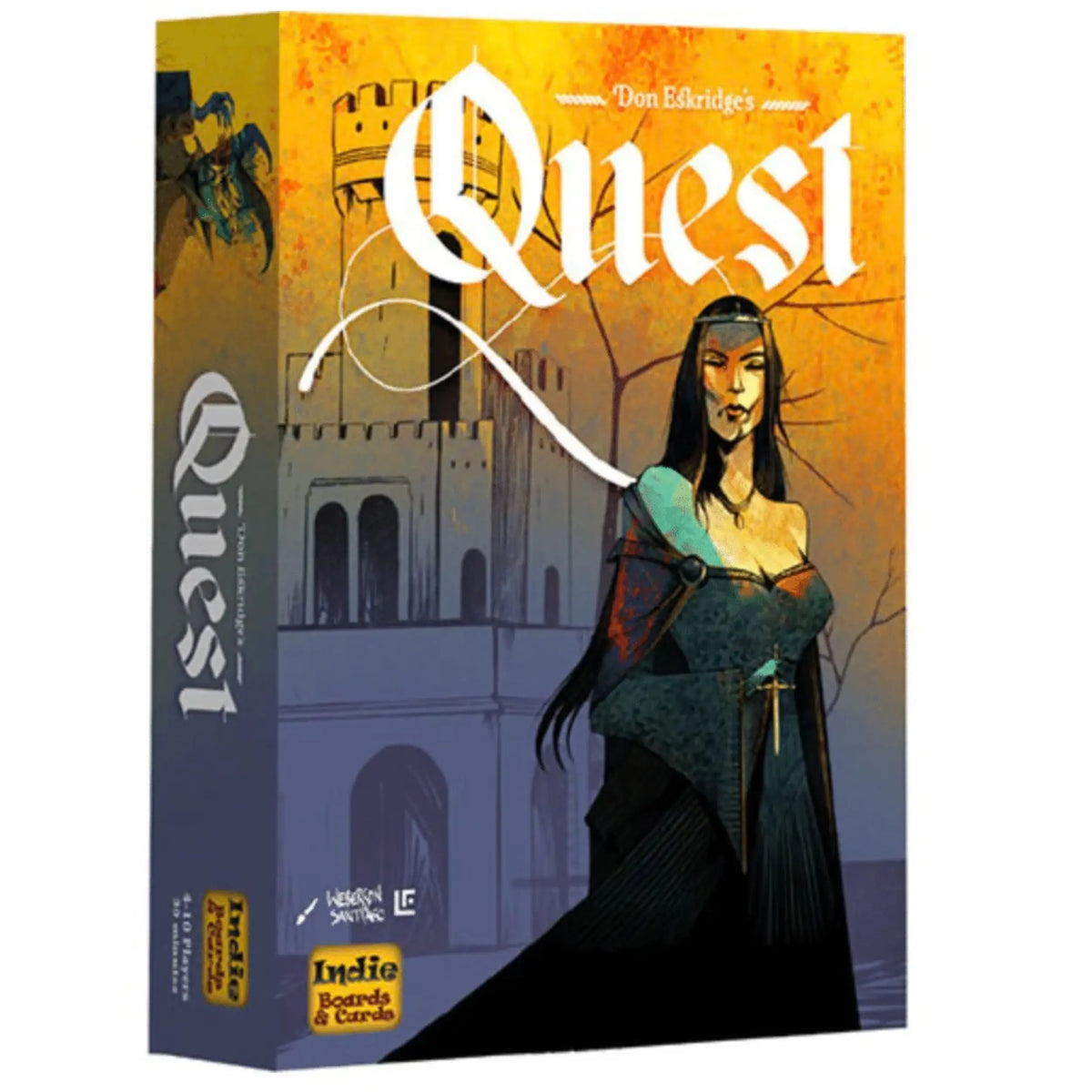
Quest
🐸 Details from BoardGameGeek
Consiglio BGG sul numero di giocatori
Categorie
Meccaniche
Design & Art
Lingua







Si abbina bene con
The FroGames Review
Before you stands someone swearing loyalty to Arthur. Behind that mask could be Mordred. You send the person who convinces you most on a mission, knowing that all it takes is one traitor to ruin everything. And in the end, you always find out you trusted the wrong person.
WHAT IT IS
Arthur's court hides traitors. Who will you send on a mission?
Don Eskridge, creator of The Resistance, returns to Arthurian bluffing with Quest. Published by Indie Boards & Cards in 2021, the game brings the hidden role mechanic to King Arthur's court: some serve the kingdom, some serve Mordred. The illustrations by Luis Francisco and Weberson Santiago immerse the table in the medieval imagery of Camelot.
Each game distributes secret roles: the majority are loyal to Arthur, a few are agents of Mordred. Players debate, suspect, and vote on who to send on a mission. If even one traitor joins the team, they can sabotage it. Three successful missions and Good wins. Three failed missions and Evil wins. In between: accusations, lies, and someone you discover too late.
What the world is saying
Quest plays in 30 minutes, but it leaves you talking about who betrayed whom for two hours afterward.
— FroGames
"A streamlined Resistance with more asymmetry and better pacing."
A streamlined Resistance with more asymmetry and better pacing.
— Meeple Mountain

Quest
FrogScore · FroGames editorial rating · based on the rulebook, international reviews, and play sessionsGame components
What you find in the box
25 character cards
Merlin sees the traitors but cannot reveal it. Percival looks for Merlin. Morgana pretends to be Merlin. Each role changes the table dynamics and creates asymmetries between who knows what and who doesn't.
Mission cards
Each mission requires a certain number of players. The team is decided by voting. If it passes, the chosen members play Success or Failure cards in secret. Just one Failure is enough to sabotage everything.
Approval and rejection tokens
Everyone votes simultaneously on whether to accept or reject the proposed team. If five consecutive proposals are rejected, Evil wins automatically. The pressure mounts with every negative vote.
Mission track
Three successful missions = Good victory. Three failed = Evil victory. The track keeps the score visible. The game ends as soon as one faction reaches three victories.
Come si gioca
Video dimostrativo di gameplay.
🎲How to playThe rules in four steps▼
How to play
The flow of every mission
Every round follows the same pattern: proposal, vote, resolution. The pace is fast, the tension rises with every choice.
The leader of the turn chooses who to send on a mission. The number varies (2-5 players) based on the round and the total number at the table. They can send themselves or only others. Debate is open.
Everyone votes simultaneously (approve/reject tokens) on whether to accept or reject the proposed team. Majority wins. If it passes, the mission proceeds. If not, the leadership passes to the next player. Five consecutive rejections = automatic victory for Evil.
Only the approved team members play Success or Failure cards face-down. They are shuffled and revealed. If even one Failure card appears, the mission fails. Evil gains a point. If only Successes appear, Good gains a point.
The table looks at the result. If there is a Failure, the accusations begin. Who was on the team? Who betrayed us? The leadership passes and it starts again. This continues until one faction wins three missions.
⏱️Your first gameThe chronicle, moment by moment▼
A game in five moments
What happens at the table
Not the rules. The experience.
Roles distributed in silence
Everyone looks at their card. Whoever is Mordred knows immediately. Whoever is loyal to Arthur knows nothing. Merlin sees the traitors but cannot speak openly. Morgana pretends to be Merlin. The table watches each other. Someone is already acting.
First proposal, first suspicions
The mission leader chooses who to send. 'Me, you, and you.' Someone asks why. Someone volunteers with too much insistence. The simultaneous vote: thumbs up or down. If it passes, the team plays cards face-down. A Failure comes out. Who was it?
Cross-accusations
Two missions failed. The table splits. Someone openly accuses, someone defends with too much vehemence. Merlin knows the truth, but if he speaks too much, Mordred will identify him. The loyalists must deduce without certainty. The tension rises with every word.
Critical mission
Two wins for each side. The fifth mission decides everything. The team is proposed after ten minutes of debate. Someone asks for guarantees no one can provide. The vote passes by a narrow margin. Cards are played. Silence. Reveal. Screams.
Final reveal and promised vendettas
Everyone reveals their roles. 'YOU were Mordred?!' 'And I defended you for twenty minutes!' Someone laughs, someone swears to never trust anyone again. The traitors explain how they fooled the table. Someone immediately proposes another game. Someone wants revenge.
🐸Know before you goThree honest things, from friends▼
Know before you go
Three things to keep in mind
You need a group willing to act
Quest works if people talk, accuse, and defend themselves. If the table is shy or silent, the deduction falls flat. With players who love to bluff and confront, it takes off. With those who prefer "quieter" games, it risks falling flat.
Under 5 players it loses its edge
The game supports 4-10, but with 4 players, there are fewer roles and the dynamics are more linear. Bluffing works better with 6 or more, when the character combinations create real doubts and the debate truly heats up.
Social learning curve
You learn the rules immediately, but the character powers take at least one game to understand how to use. Merlin must hide, Morgana must pretend, Percival must deduce. The first time, someone will play their role badly. That's normal.
🏆Victory and defeatWhat the ending rewards▼
How it ends
How to win and lose
The game ends as soon as one faction reaches three mission victories, or after five consecutive rejected proposals.
Victory
- Good wins if three missions end with only Success cards
- Evil wins if three missions fail (at least one Failure in each)
- Evil wins automatically if five consecutive proposals are rejected by the vote
Defeat
- The loyalists to Arthur lose if they fail to prevent three sabotaged missions
- The servants of Mordred lose if they fail to infiltrate at least three teams
- Merlin loses if he reveals himself too early and Mordred guesses him at the end of the game (optional variant)
Quest is not a game of memory or calculation. It is a people game: looking into each other's eyes, reading hesitation, trusting at the wrong moment. And discovering, too late, who was lying from the start.
💬Frequently asked questionsQuick answers before the cart▼
Frequently asked questions
FAQ about Quest
What mechanics does Quest use?
Hidden roles, simultaneous voting, social deduction, simultaneous action selection (mission cards), asymmetric powers. It is a pure traitor game: the majority is good, a few are traitors, and bluffing decides everything.
Is it the same as The Resistance or Avalon?
Same author (Don Eskridge), same family, but Quest introduces 25 different characters instead of the usual 5-6 fixed roles. Each game can use different combinations, making replayability higher. The structure is similar, but the asymmetry is greater.
Does it work with 4 players?
Technically yes, but the experience is much weaker. With 4 players, the role combinations are limited and the bluff loses intensity. The game is best with 6 players or more, when the table truly splits between suspicions.
How long does a game last?
30 minutes is the real average. The first games may last 10 minutes longer due to endless discussions, but once the group knows the roles, the pace tightens. Three winning (or failing) missions close it out quickly.
Is it available in Italian?
This edition is in English. The text on the cards is minimal (names of roles and powers), so with a reference sheet in Italian (available online), the game is accessible even to those who are not fluent in English. The crucial part is the debate at the table, which you can do in your language.
The people behind the game
Who invented it, who illustrated it, who publishes it — and what else they have done.
Quest is a social deduction party game for 4-10 players, ages 14 and up, with 30-minute games. Designed by Don Eskridge (author of The Resistance) and published by Indie Boards & Cards, Quest brings Arthurian bluffing to the table: hidden roles, sabotagable missions, 25 asymmetric characters. Players vote, accuse, lie, and try to figure out who serves Arthur and who serves Mordred. Three successful missions win for Good, three failed ones for Evil. The game uses mechanics of hidden roles, voting, deduction, and asymmetric powers. Available on FroGames.it.
Quest
Frequently Asked Questions
The answers you're looking for, no beating around the bush.
📸Do the images match the actual product?
The photos on the website often come from BoardGameGeek and are intended to give you an idea of the game. They may vary slightly from the version you receive. The content declared by the publisher is always binding.
📦Does the content of the box match what is indicated?
We always strive to provide the correct content, but minor variations are possible due to reprints or updates. The information comes directly from the publishers. If you have any questions, please contact us!
⏳How do pre-orders work?
Pre-order the game before release, payment is immediate, and the game is reserved for you. As soon as it arrives, we'll ship it right away! If there are any delays, we'll update you promptly.
🔒Can I trust buying here?
Absolutely! Secure payments, tracked shipments, and a team that loves board games as much as you do. If something goes wrong, we'll do our best to fix it.
🛠There's a problem with my order, what should I do?
Write to us now! Whether it's a missing part, damage, or an error, we'll help you resolve it as soon as possible. Your experience truly matters to us.