
Let's Call the Exorcist
🐸 Details from BoardGameGeek
Consiglio BGG sul numero di giocatori
Categorie
Meccaniche
Design & Art
Lingua
Si abbina bene con
The FroGames file
Dad brought home artifacts from his latest dig. Now someone is laughing too loudly. Someone is talking backwards. And you have to figure out who is lying before it's too late.
WHAT IT IS
A treasure hunt where half the players are lying
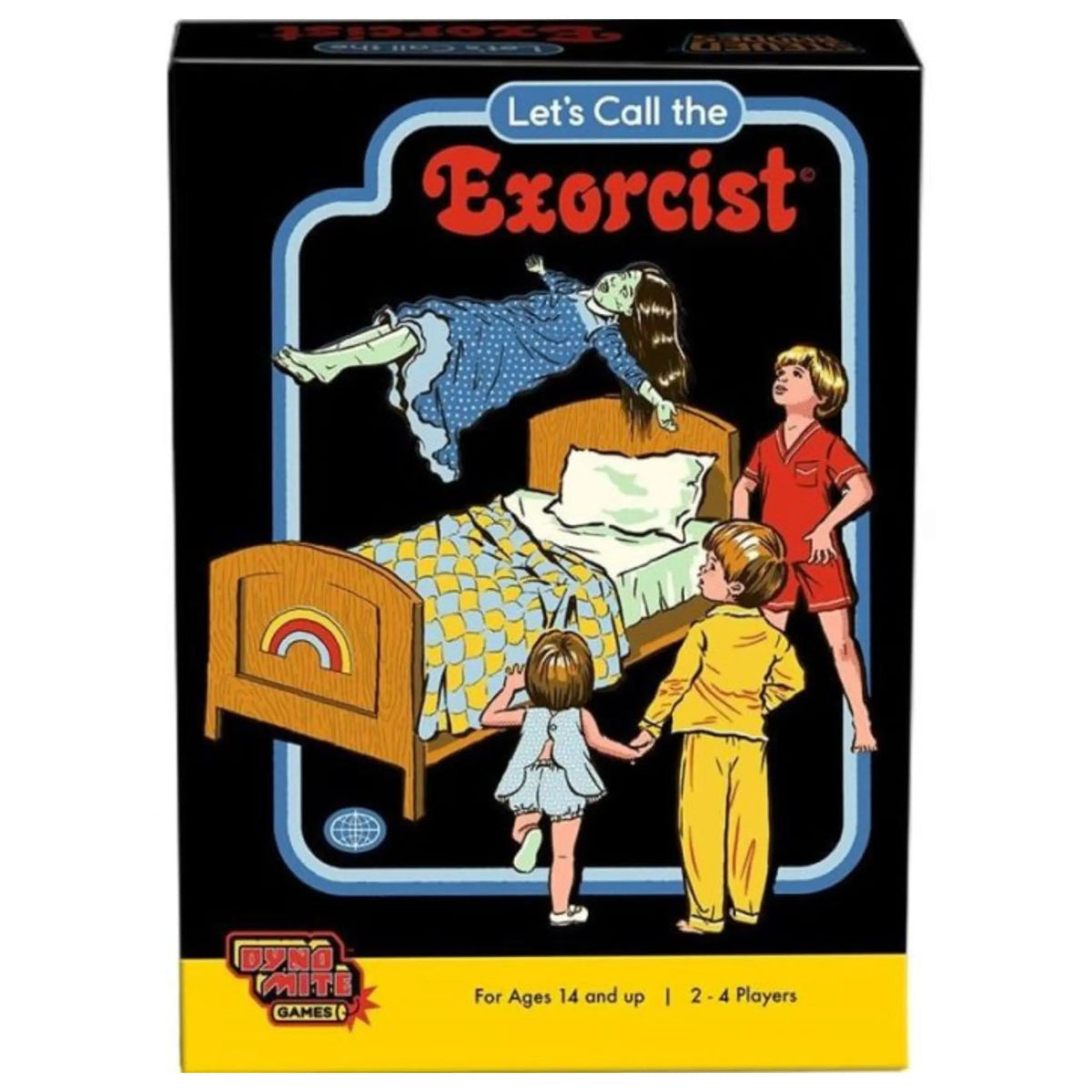
Designed by Cory Jones, Ben Stoll, and Mataio Wilson, Let's Call the Exorcist is part of the Steven Rhodes Games series, known for its dark humor and vintage 70s-style illustrations. The game takes a classic horror theme — demonic possession — and turns it into a deduction party game where you don't know who to trust.
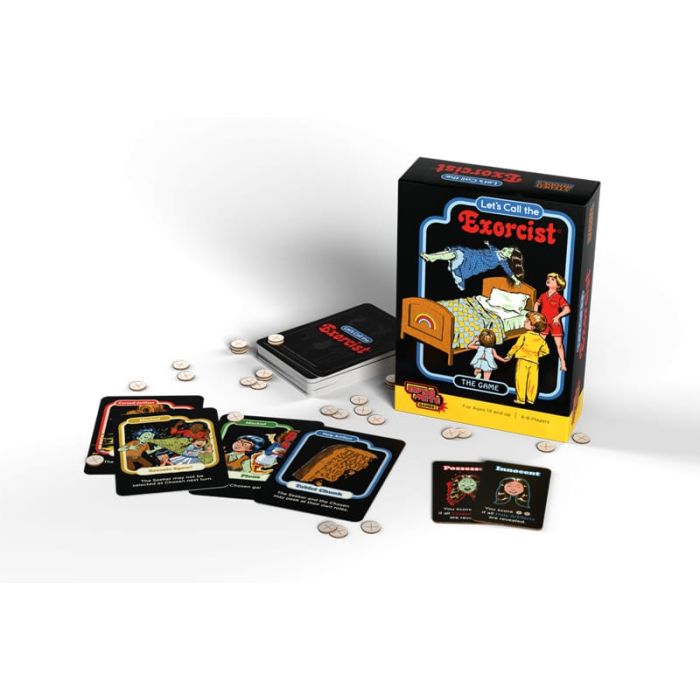
Each player receives cards they study in secret, then shuffles them and places them face down in front of themselves. On your turn, you pick another player's card: it's revealed and you apply the effect. But only you know what was in your initial cards. The Innocents try to find the Sacred Objects. The Possessed try to get the Cursed Artifacts revealed. And in between, there are Blessings that grant points and demonic pranks that confuse everyone.
What they're saying abroad
A simple premise, but every reveal makes you question who you are actually helping.
— FroGames
"Let's Call the Exorcist is our deduction party game with a twist: you have to trust your memory, not just other people's words."
Let's Call the Exorcist is our deduction party game with a twist: you have to trust your memory, not just other people's words.
— Cryptozoic Entertainment

Let's Call the Exorcist
FrogScore · editorial rating FroGames · based on rules, international reviews, and gameplay sessionsWhat's in the cards
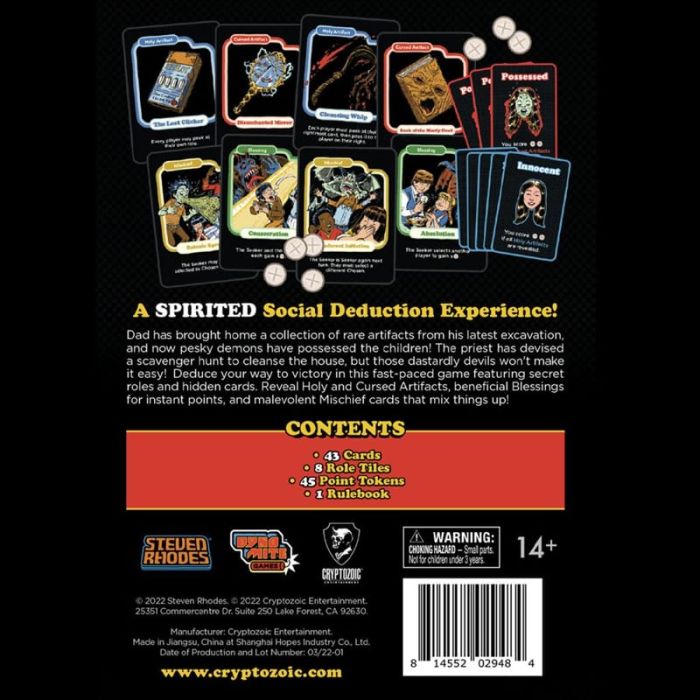
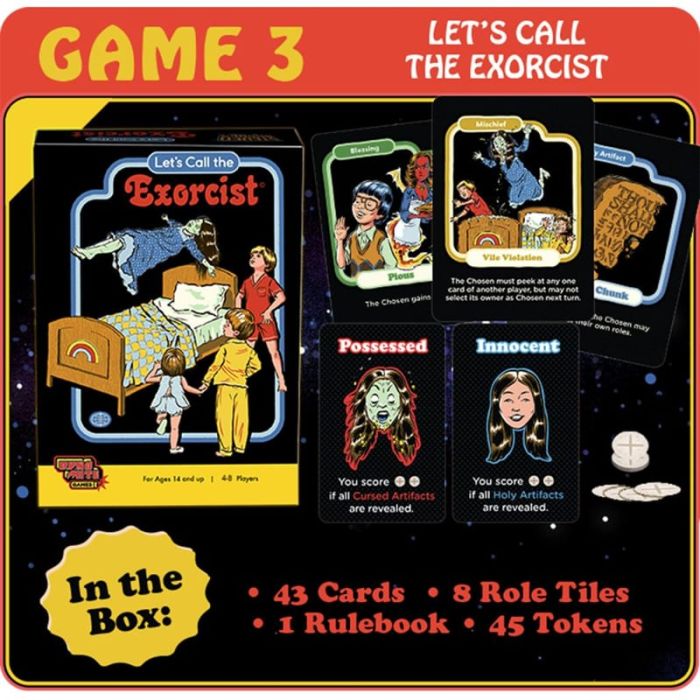
Sacred Objects, Curses, and surprises
Sacred Objects
The Innocents must find enough of them to win. Every Object revealed is a point for the Light, but only if you know where to look.
Cursed Artifacts
The Possessed want these to be discovered. Every Curse revealed brings the demons closer to victory and casts doubt on who made it be drawn.
Blessings
Bonus cards that grant points during the game. Useful for both teams, but they also reveal information about who held them.
Demonic Pranks
Effects that confuse the hunt: cards moving, false information, distractions. The Possessed use them to sow chaos.
Come si gioca
Video dimostrativo di gameplay.
🎲How to playThe rules in four steps▼
How to play
The flow of each round
Three rounds identical in structure, becoming increasingly tense as the cards run out.
Each player receives cards according to the number of participants. You study them in secret, then shuffle them and place them face down in a row in front of you.
The active player chooses a face-down card belonging to another player and reveals it. Apply the effect (points, moves, mischief). Then that chosen player becomes active and chooses another player's card.
Between one revelation and the next, the table discusses: who is helping whom, who lied about what they remembered, who made a move that was too suspicious.
The round ends when enough Holy Objects or Cursed Artifacts have been revealed. Points are scored. Then you start over with new cards, memory reset.
⏱️Your first gameThe play-by-play▼
A game in five moments
What happens at the table
Not the rules. The experience.
Silent study
Everyone looks at their own cards in secret. You study the Holy Objects, memorize where the Blessings are. Then you shuffle everything and arrange the cards face down. Nobody knows what you have anymore, except for you.
The first revelations
The first player chooses another player's card. It’s flipped: Holy Object. Good for the Innocents, but is the person who chose it really innocent or are they faking it? Every choice is a clue.
Accusations fly
Half the table accuses the other half. 'You made me draw a Curse on purpose!' 'No, I thought it was a Holy Object, I remembered it there!' Memory begins to blur with bluffing.
A Blessing changes everything
Someone reveals a Blessing that gives immediate points to their team. But which team? If they are Possessed, they just confirmed their identity. Or it’s a fake. Or it’s all random. Nobody knows.
Scoring and reveals
End of the third round. Holy Objects are tallied against Cursed Artifacts. Roles are revealed. 'YOU were possessed?!' 'Of course, I let you know!' 'No, you told me the opposite!' Laughter, accusations, desire to play again.
🐸Before you startThree honest tips, among friends▼
Before you start
Three things you must consider
It works with 4 players, but it's tight: few cards, little confusion, too easy to deduce. The game explodes from 6 upwards, when memory starts to betray you and accusations multiply. If your fixed group is 4, consider other social deduction games.
It’s not just bluffing: you have to remember what you studied in the first few seconds of the round. If you have a poor memory or are playing after a long day, you will feel lost. This isn't a flaw of the game, it's its identity.
After 2-3 consecutive games, you’ll start to learn your friends' bluffing patterns. The game lives on surprise and works best rotated with other party games, not as the only dish of the evening.
🏆Victory and defeatWhat the end rewards▼
How it ends
How to win (and how to lose)
After three rounds, the points from the Blessings are tallied and the revealed Artifacts are counted. The team that revealed the most cards of their type wins.
Victory for the Innocents
- Enough Holy Objects revealed over the three rounds
- They stopped the Possessed from causing too many Curses to be uncovered
- The collected Blessings shift the score in their favor
Victory for the Possessed
- Enough Cursed Artifacts revealed over the three rounds
- They tricked the Innocents into choosing the wrong cards
- They sowed enough confusion to make them doubt even true allies
It isn't the deepest social deduction game, but it’s the one that tests your memory along with your lies. And that makes it different from all the others.
💬FAQQuick answers before checkout▼
FAQ
FAQ about Let's Call the Exorcist
What mechanics does Let's Call the Exorcist use?
Hidden roles, deduction, memory, semi-cooperative (the Innocents work together, the Possessed sabotage). The peculiarity is that you have to remember what you saw at the start of the round, because no one will tell you the truth.
Does it really work with 8 players or is it too chaotic?
It definitely works: in fact, 8 players is the ideal number. More cards in play = more confusion = more room to bluff. The chaos is intended: if you are looking for an orderly deduction game, this is not for you. If you want laughter and cross-accusations, it’s perfect.
Is it suitable for those who have never played a social deduction game?
Yes, the rules are explained in 5 minutes and the first game is immediately playable. The only obstacle is that you have to remember your initial cards: if someone at the table struggles with short-term memory, they might feel frustrated. But otherwise, it is very accessible.
Can I always play it with the same group?
You can, but after 3-4 consecutive games you will start to learn the others' bluffing patterns. The game works best rotated with other party games, not as the only title of the evening. Keep it for evenings with new guests or when you want a change of pace.
Is this edition in Italian?
No, this is the English edition by Cryptozoic Entertainment. The cards have names and text in English. Language dependence is low (the cards have clear icons and the effects are simple), but you need someone at the table who reads English fluently for the first game.
The people behind the game
Who invented it, who illustrated it, who publishes it — and what else they've done.
Let's Call the Exorcist is a social deduction party game for 4-8 players, ages 14+, duration 20-45 minutes. Designed by Cory Jones, Ben Stoll, and Mataio Wilson, published by Cryptozoic Entertainment, it is part of the Steven Rhodes Games series. The game uses hidden roles and memory mechanics: you study cards in secret, shuffle them, then choose other players' cards to reveal Holy Objects or Cursed Artifacts. The Innocents try to cooperate, the Possessed lie and sabotage. The peculiarity is that you have to trust your memory, not just the words at the table. It works best with 6 players or more. Available on FroGames.it.
Let's Call the Exorcist
Frequently Asked Questions
The answers you're looking for, no beating around the bush.
📸Do the images match the actual product?
The photos on the website often come from BoardGameGeek and are intended to give you an idea of the game. They may vary slightly from the version you receive. The content declared by the publisher is always binding.
📦Does the content of the box match what is indicated?
We always strive to provide the correct content, but minor variations are possible due to reprints or updates. The information comes directly from the publishers. If you have any questions, please contact us!
⏳How do pre-orders work?
Pre-order the game before release, payment is immediate, and the game is reserved for you. As soon as it arrives, we'll ship it right away! If there are any delays, we'll update you promptly.
🔒Can I trust buying here?
Absolutely! Secure payments, tracked shipments, and a team that loves board games as much as you do. If something goes wrong, we'll do our best to fix it.
🛠There's a problem with my order, what should I do?
Write to us now! Whether it's a missing part, damage, or an error, we'll help you resolve it as soon as possible. Your experience truly matters to us.