
Jaipur
🐸 Dettagli da BoardGameGeek
Consiglio BGG sul numero di giocatori
Categorie
Meccaniche
Design & Art
Lingua
Si abbina bene con
The FroGames Card
You take three rubies from the market. Your opponent empties the gold. You have six camels in your hand and zero ideas what to do with them. Then you realize: camels are the key. They are always the key.
WHAT IT'S ABOUT
Two merchants, one market, and the race for the Maharaja's seals
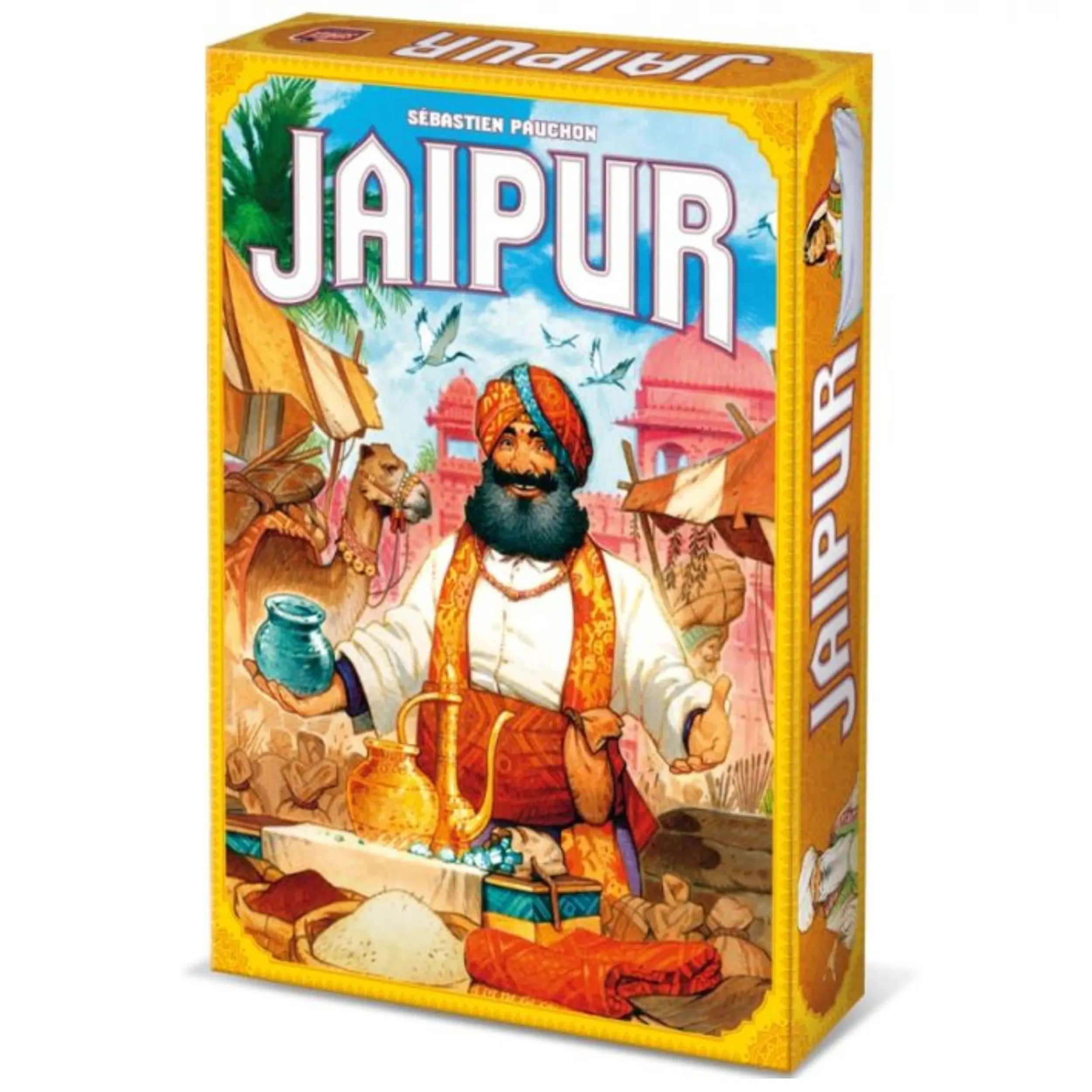
Jaipur is a two-player card game set in Rajasthan, the mercantile capital of 18th-century India. Designed by Sébastien Pauchon in 2009 and illustrated by Vincent Dutrait, it has become one of the most celebrated duels in the hobby: immediate rules, fast games, continuous decisions.
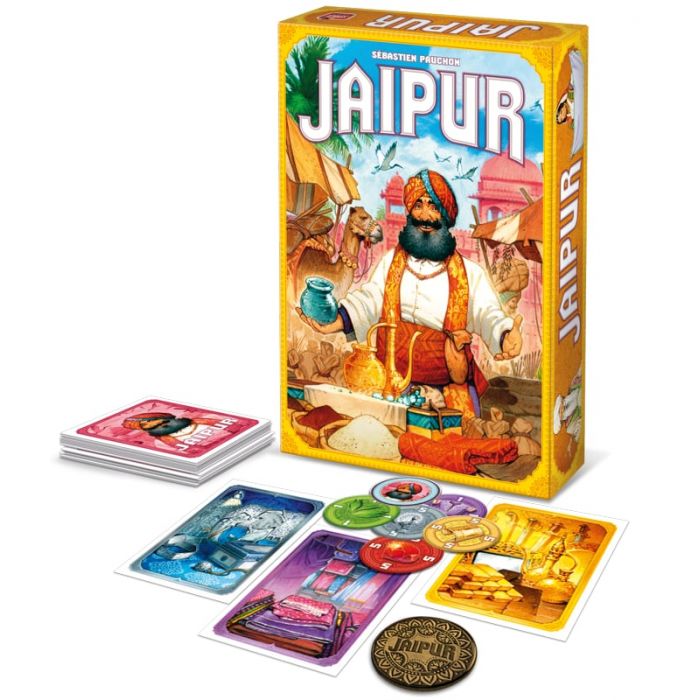
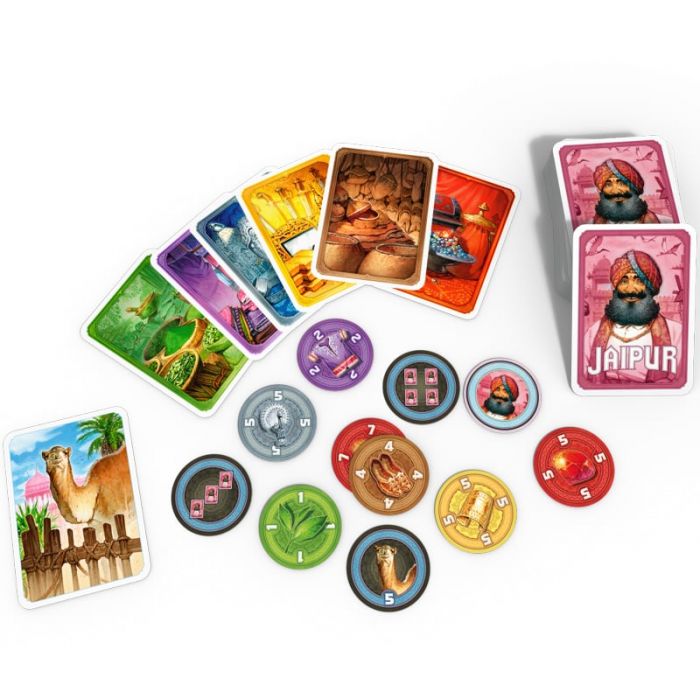
You are a merchant who buys, trades, and sells goods at the bazaar. Each turn, you draw cards from the shared market or sell a set of the same good to collect coin tokens. The value of the tokens decreases as they are taken: those who sell first earn more, but selling large sets yields substantial bonuses. And then there are the camels: they are not worth points, but they allow you to make massive trades. The player who wins two out of three rounds wins the invitation to court.
What they say abroad
"One of the best two-player games ever made."
One of the best games for two players ever made.
— The Dice Tower
Jaipur is a small masterpiece of timing. You wait for the right moment to sell, but waiting too long means giving away the best tokens. And in the meantime, you have to watch your opponent's hand, the camels they accumulate, the cards they leave face up. Thirty minutes that are never the same.
— FroGames

Jaipur
FrogScore · FroGames editorial rating · based on rules, international reviews and play sessionsYour moves
What you can do on your turn
Take a card from the market
Draw a specific good (gold, silver, cloth, spices, leather, diamonds) and add it to your hand. Limit: seven cards total, excluding camels.
Take all the camels
Collect all visible camels in the market in one go. They do not count towards your hand limit and allow you to make multiple trades in subsequent turns.
Trade 2-5 cards
Discard cards from your hand (including camels) and take an equal number of cards from the market. This is how you build large sets without waiting to draw them.
Sell a set
Play all cards of one good and take the corresponding tokens. Sets of 3+ cards unlock extra bonuses. Irreversible action: tokens taken disappear.
Recommended sleeves 55 cards in 1 size ▼
If you play often, we recommend protecting your cards with transparent sleeves to make them last longer.
| Size | Quantity |
|---|---|
| 63.5 × 88 mm | 55 |
| Total cards | 55 |
🎲How to playThe rules in four steps▼
How to play
The flow of each turn
A turn is an action. Take or sell. Then it's your opponent's turn.
Take a card from the market, take all camels, trade 2-5 cards between your hand and the market, or sell a complete set of a good.
If you take cards, add them to your hand (limit 7, excluding camels). If you sell, play all cards of that good and take tokens from the top of the stack. Sets of 3/4/5 cards give extra bonuses.
After each action, the market always returns to five face-up cards. Draw from the common deck until there are five visible cards.
Your opponent performs their action. The round ends when the deck runs out or three piles of goods tokens are completely empty.
⏱️Your first gameThe chronicle, moment by moment▼
A game in five moments
What happens at the table
Not the rules. The experience.
The market opens
Five cards face up between the two of you, three camels in the deck. The first moves seem obvious: take the gold, take the diamonds. Then one of you picks up all the camels and the game changes face.
The race for high tokens
The 5 and 7 rupee tokens disappear immediately. Selling three fabrics now is worth 11 points; selling them in two turns will be worth 7. You start counting the remaining cards in the deck and those in your opponent's hand.
Massive exchange
You've accumulated six camels. You use them all together to empty the spice market and fill your hand. Your opponent looks at you, calculates their points, decides whether to compete or change goods. The pace quickens.
The bonus that flips the game
You sell five diamonds in one turn: remaining tokens plus the 10 rupee bonus. Twenty-four points in one go. Your opponent responds by selling four gold. The round is decided on a handful of rupees.
End of round and counting
The deck runs out or three goods are depleted. You flip the tokens, add them up, whoever has the most camels gets 5 bonus points. The winner collects the seal. Best of three. Reshuffle and start over.
🐸Good to know before you playThree honest things, from friends▼
Good to know before you play
Three things you need to know
Camels are not just fillers
Those who learn to use them dominate the game. They allow huge trades (discard six camels, take six cards from the market), protect your hand from the seven-card limit, and at the end of the round are worth 5 points to the player with the most. Ignoring them is losing.
Values decrease during the round
The first gold tokens are worth 7 rupees, the last 5. Selling first pays, but selling a large set unlocks fixed bonuses (1 to 10 rupees) that turn the tables. The dilemma is structural: waiting is beneficial until it's not.
Information is public but hidden
The market is open, taken tokens are visible, but your opponent's hand is not. You must infer what they are holding from the camels they accumulate and the cards they trade. Experienced players read moves two turns ahead.
🏆Victory and defeatWhat the ending rewards▼
How it ends
How to win and how to lose
A round ends when the deck runs out or three piles of goods tokens. The player with the most total rupees in that round wins and earns a seal. Two out of three seals wins the game.
Victory
- Accumulate more rupees than your opponent by summing goods tokens, set bonuses, and camel bonuses
- Win the round and earn a Maharaja's seal
- Win two out of three rounds and receive an invitation to court (final victory)
Defeat
- Sell too late and the remaining tokens are worth half of the initial ones
- Accumulate cards without selling and end the round with a full hand and zero points
- Lose two out of three rounds and your opponent wins both seals
Jaipur presents you with continuous decisions in very tight spaces. It's a duel where every move counts, bluffing doesn't exist, and the winner is the one who best reads the market's rhythm.
💬Frequently asked questionsQuick answers before checkout▼
Frequently asked questions
Jaipur FAQ
What mechanics does Jaipur use?
Set collection (collect cards of the same good to sell them), hand management (manage a seven-card limit), open drafting (draw from a shared market), and a race for tokens with decreasing values. Camels add a unique layer of market manipulation.
Is it true that it's just luck of the draw?
No. The initial draw matters, but those who manage camels better mitigate weak hands. You can trade up to five cards in a turn: you don't passively wait for the deck, you actively build sets. Strong players win 80% of games against beginners.
How long does a game really last?
According to the rules: 30 minutes. In practice: 20-25 minutes after the first two games. A round lasts 7-10 minutes, the game is best of three. Perfect for two consecutive games in an hour.
Does it work well with players of different skill levels?
Yes, within certain limits. The rules are very clear and a beginner can win the first round. From the third game onwards, the expert dominates because they know when to sell, how many camels to keep, which cards to leave face up. But the gap closes quickly: after six games, skill levels equalize.
Is the edition for sale in Italian?
Yes. This Asmodee edition includes rules in Italian and cards with universal graphics (icons, no text on game cards). All materials are localized.
The people behind the game
Who invented it, who designed it, who publishes it — and what else they've done.
Jaipur is a competitive card game for 2 players, lasting 30 minutes, recommended age 10+. Designed by Sébastien Pauchon and illustrated by Vincent Dutrait, published by Asmodee, it is considered one of the best duels in modern gaming. Mechanics: set collection, hand management, shared market with open drafting. The game uses a system of tokens with decreasing values that rewards early sellers, balanced by fixed bonuses for large sets. Camels function as currency for multiple trades and as a tie-breaker at the end of the round. Fast games, immediate rules, high tactical depth. Available on FroGames.it.
Jaipur
Frequently Asked Questions
The answers you're looking for, no beating around the bush.
📸Do the images match the actual product?
The photos on the website often come from BoardGameGeek and are intended to give you an idea of the game. They may vary slightly from the version you receive. The content declared by the publisher is always binding.
📦Does the content of the box match what is indicated?
We always strive to provide the correct content, but minor variations are possible due to reprints or updates. The information comes directly from the publishers. If you have any questions, please contact us!
⏳How do pre-orders work?
Pre-order the game before release, payment is immediate, and the game is reserved for you. As soon as it arrives, we'll ship it right away! If there are any delays, we'll update you promptly.
🔒Can I trust buying here?
Absolutely! Secure payments, tracked shipments, and a team that loves board games as much as you do. If something goes wrong, we'll do our best to fix it.
🛠There's a problem with my order, what should I do?
Write to us now! Whether it's a missing part, damage, or an error, we'll help you resolve it as soon as possible. Your experience truly matters to us.