
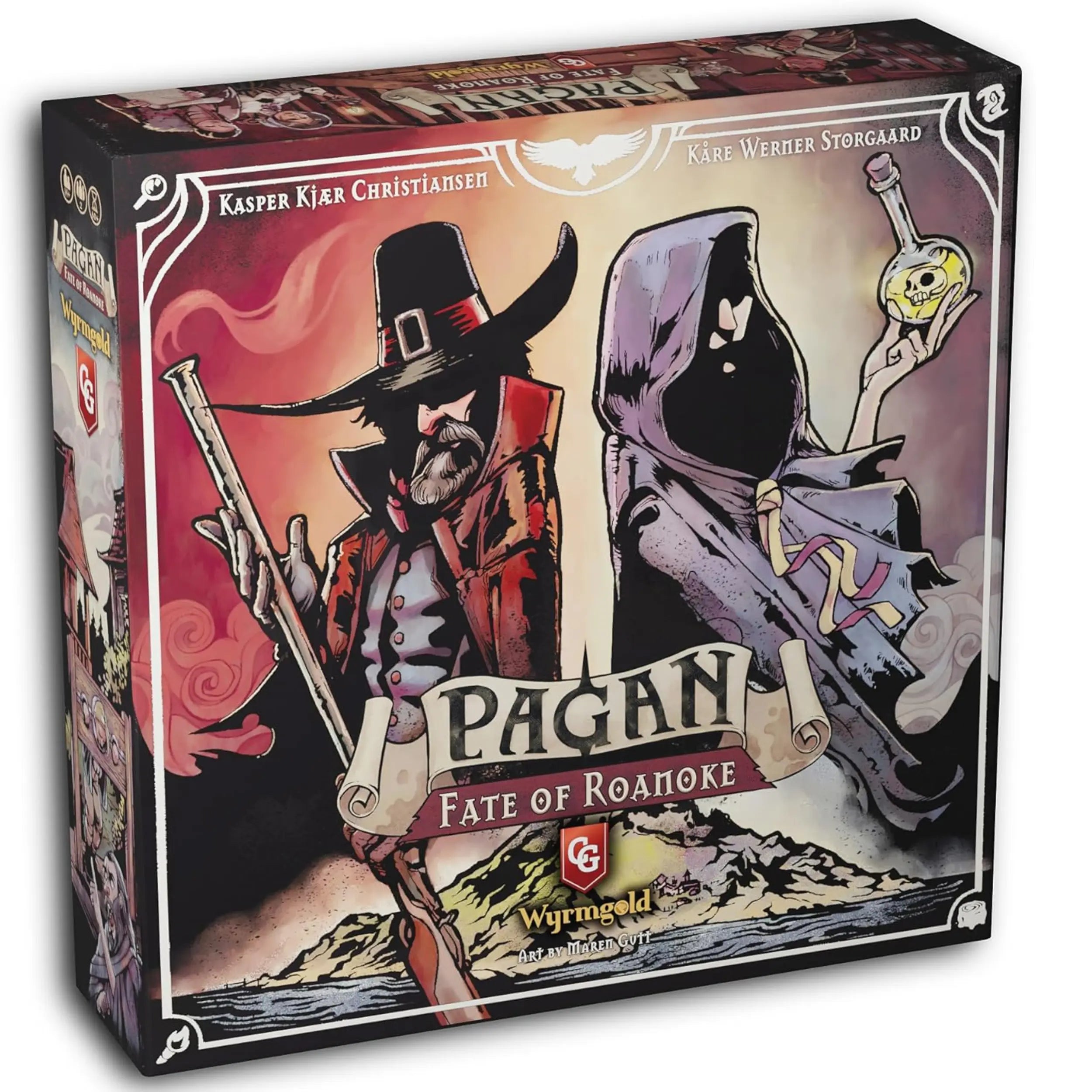

Pagan - Fate of Roanoke
🐸 Details from BoardGameGeek
Consiglio BGG sul numero di giocatori
Categorie
Meccaniche
Design & Art
Lingua






Si abbina bene con
FroGames — Moments You'll Remember
One reads eyes. The other lies. One eliminates suspects. The other accumulates secrets. And in the end, someone discovers something they didn't want to know.
WHAT IT'S ABOUT
Roanoke, 1587: a witch against a hunter
Designed by Kasper Kjær Christiansen and Kåre Storgaard, Pagan: Fate of Roanoke brings asymmetric deduction to the lost colony of Virginia. The prototype won the Otto Award at Fastaval 2018 as the best game of the event. Evocative art by Maren Gutt recreates colonial America in the 16th century, when the frontier between civilization and nature was still fragile.
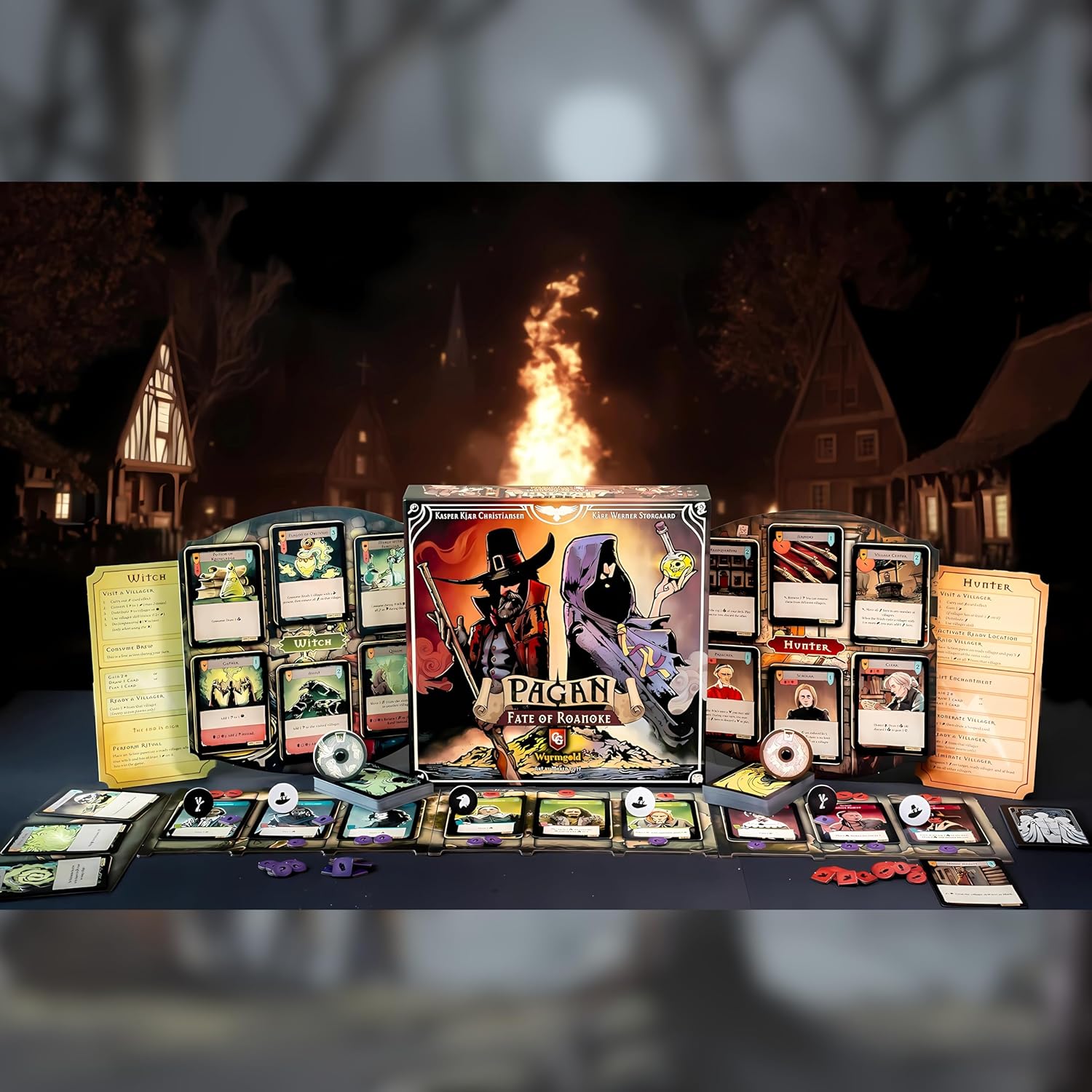
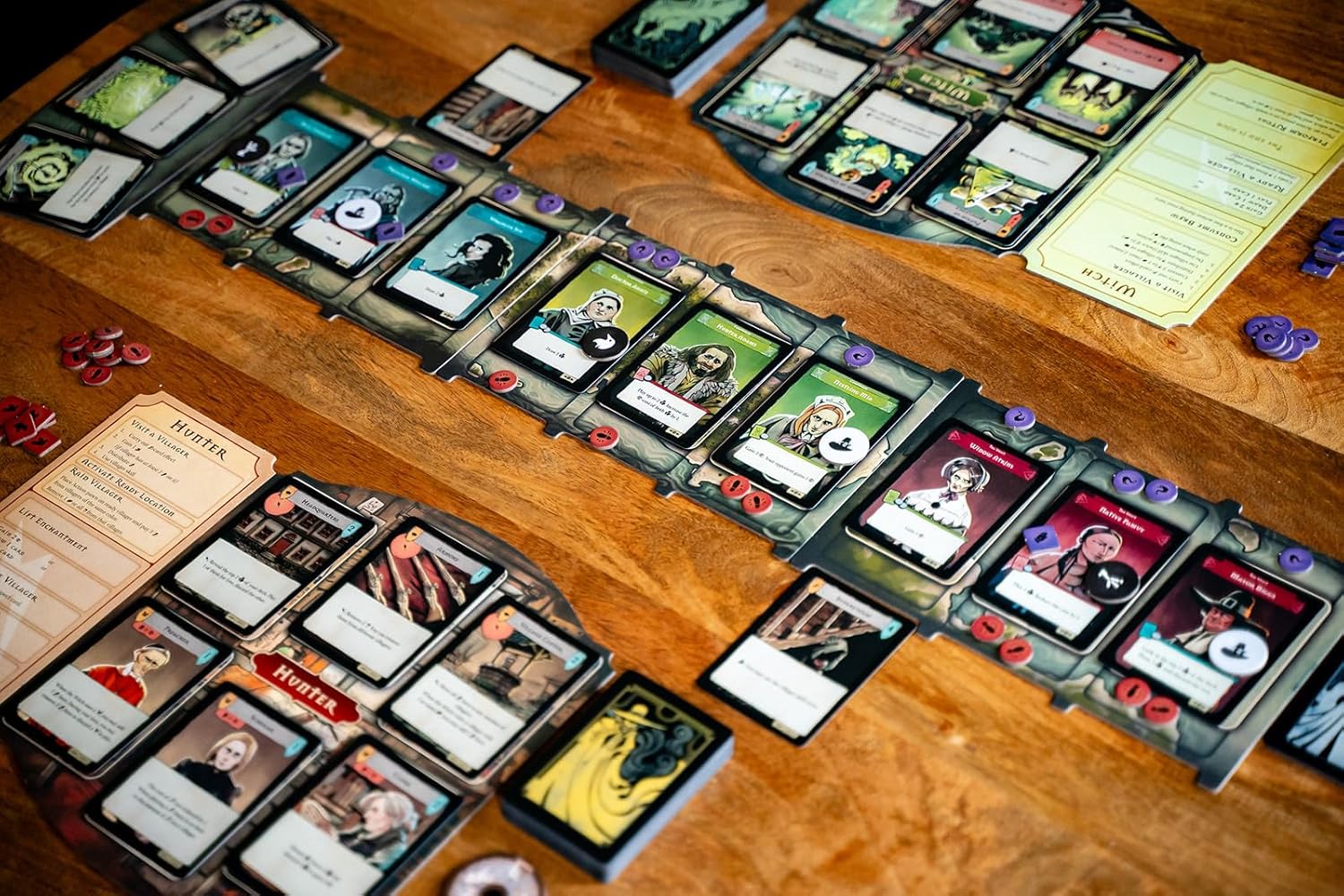
Two players, two opposing roles, nine villagers on the table. The witch must gather enough secrets to complete a ritual of renaturalization. The hunter must discover which of the nine villains is the witch before it's too late. Each turn, use action pawns on the villagers to draw cards, play powers, gain influence. Asymmetric 50-card decks: the witch distills potions, casts spells, empowers her familiar. The hunter recruits allies, claims strategic locations, ruthlessly investigates. The one who bluffs best wins.
What they say abroad
"Every turn is a poker game where the stakes keep rising and the bluff gets harder to maintain."
Every turn is a poker game where the stakes keep rising and the bluff gets harder to maintain.
— Meeple Mountain
The hunter eliminates suspects. The witch eliminates certainties. In the end, one of them understands too late.
— FroGames

Pagan: Fate of Roanoke
FrogScore · FroGames editorial rating · based on rules, international reviews and play sessionsTwo opposing arsenals
What the witch and hunter play
Witch's Potions
The witch distills potions to gather secrets, empower her familiar, and manipulate influence over the villagers. Every potion played is a risk: the hunter can deduce who you are from your choices.
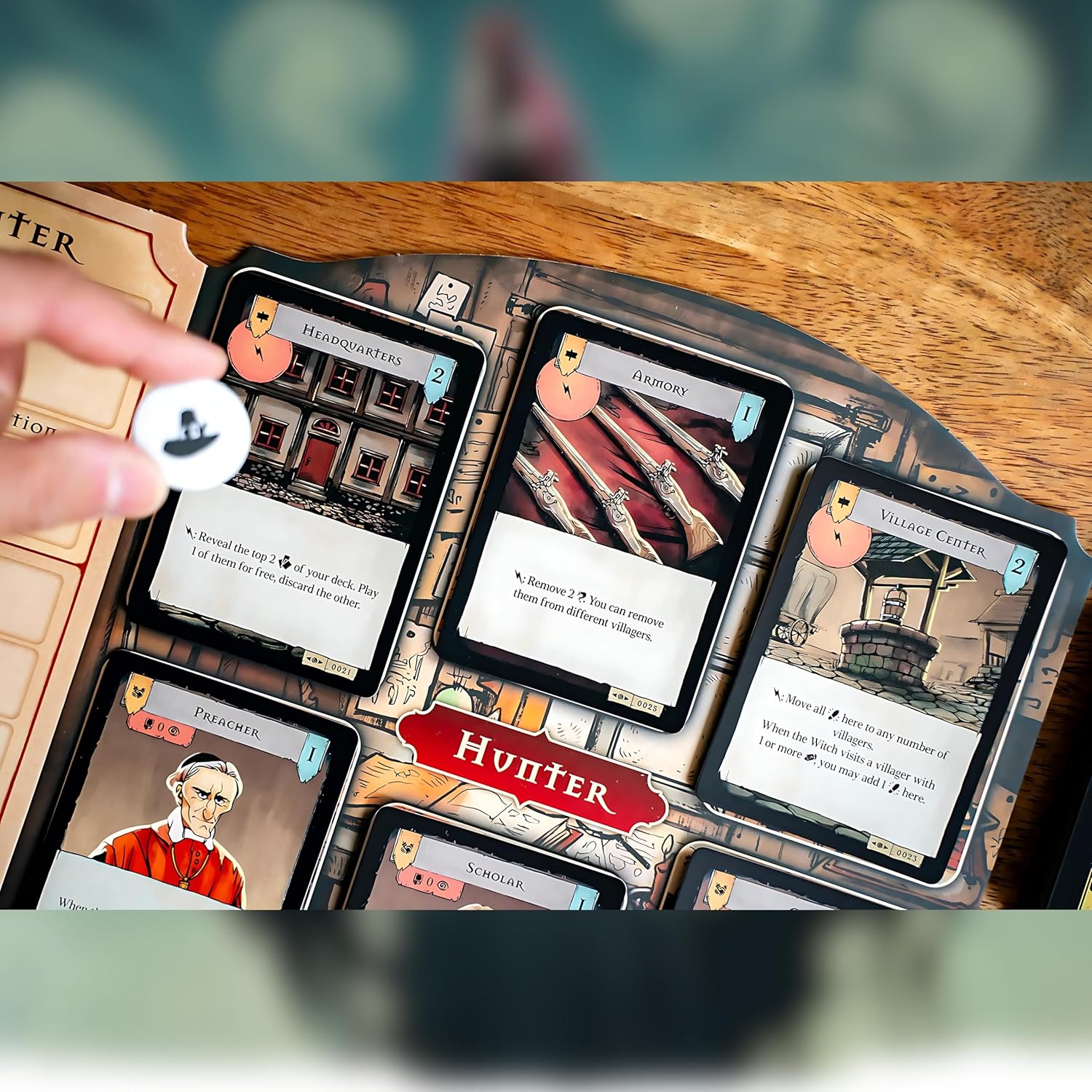
Hunter's Allies
The hunter recruits allies to investigate, block actions, and gain control over strategic areas. Each ally eliminates suspects and tightens the circle around the witch.
Spells and Charms
The witch can cast spells to manipulate the board, hide her identity, and accelerate the ritual. But playing too aggressively reveals who you are.
Strategic Locations
Huts, fields, forest. The hunter claims locations to limit the witch's actions. The witch must choose: avoid those locations or risk being discovered.
In half an hour, one of you will have understood too much. Or too late.
Come si gioca
Video dimostrativo di gameplay.
A game in five acts
What happens at the table
Not the rules. The experience.
Setup is already a poker game
The witch secretly chooses one of the nine villagers as her hidden identity. The hunter looks at the nine faces and knows one of them is lying. The tension starts immediately: each activated villager is a clue or a red herring.
The first turns are skirmishes
Both draw cards, play powers, gain influence over the villagers. The witch tries to appear harmless. The hunter observes: which villagers does she activate? Which cards does she play? Every action is a clue.
The hunter eliminates the first suspects
Mid-game, the hunter starts eliminating impossible villagers. Five, maybe four suspects remain. The witch feels the net tightening: she can continue to hide or she must accelerate the ritual and risk everything.
The witch plays her decisive card
The witch must gather enough secrets to complete the ritual. But every aggressive move reveals intentions. The hunter reads: that potion was too precise. That villager activated twice in a row. One of them has figured something out.
Someone discovers something
The hunter points to a villager: "It's you." The witch reveals her identity card. Either the hunter was right and the game ends with an execution. Or the witch completes the ritual and nature reclaims Roanoke. There are no half measures.
How to play
The flow of each round
Each round is a dance of actions and deductions. You act, the opponent reads. The opponent acts, you interpret.
Both players place their action pawns on the active villagers. Each villager allows different actions: drawing cards, playing cards, gaining influence.
In turn, resolve the pawns' actions. The witch plays potions and spells, gathers secrets. The hunter recruits allies, investigates, claims locations.
Gained influence determines who controls which areas of the board. Control limits future actions: the hunter can block certain villagers, the witch can accelerate the ritual.
The witch checks collected secrets: enough for the ritual? The hunter eliminates impossible suspects: only one villager left? Until someone wins, the game continues.
Why it's different from the others
Six mechanics that make a difference
True asymmetry
Not two factions with different powers. Two completely opposite games: one seeks, the other hides. The witch has a secret identity, the hunter has partial information. Opposite objectives, opposite strategies, opposite victories.
Dedicated 50-card decks
Each role has its own personal deck. The witch builds combos of potions and spells. The hunter optimizes allies and investigations. There are no common cards: what you play reveals who you are.
Nine villagers, only one witch
The witch secretly chooses one of the nine villagers as her identity. The hunter must eliminate them one by one, narrowing the field. But the witch can activate innocent villagers to mislead. Every action is a clue or a bluff.
Deduction embodied in mechanics
You don't roll dice to investigate. You observe: which villagers does she activate? How many cards does she have in hand? Which potion did she play? Deduction is not a random event, it's the heart of the game.
Asymmetrical worker placement
Both of you place pawns on the villagers, but with opposite objectives. The witch wants to hide among normal actions. The hunter wants to force the witch to reveal something. The same worker space, two incompatible strategies.
Asymmetrical time pressure
The witch has a limited number of turns to complete the ritual. The hunter has a limited number of villagers to eliminate. Both feel time running out, but for different reasons. The longer you wait, the more you risk.
How it ends
How to win and how to lose
Two possible victories, one per role. No draws. No compromises.
Victory
- The witch gathers enough secrets to complete the ritual of rewilding before being discovered
- The hunter correctly identifies which of the nine villagers is the witch and eliminates her before the ritual
- If the witch completes the ritual, nature reclaims Roanoke and the colony disappears from history
Defeat
- The witch is identified by the hunter before gathering enough secrets for the ritual
- The hunter makes a wrong identification and accuses an innocent villager: the witch wins immediately
- The witch runs out of available turns without completing the ritual: the hunter wins by time
Pagan is deduction embodied in mechanics. Not mysteries solved with random events. Observation, timing, bluff. Half an hour that feels like a chess game where one of them is lying.
Frequently asked questions
FAQ about Pagan: Fate of Roanoke
Is it really balanced? Doesn't the witch have too much of an advantage by hiding?
Balance is asymmetrical by definition. The witch has perfect information about who she is, but must play around nine villagers and gather secrets in time. The hunter has partial information but can eliminate suspects and block actions. BGG statistics say 50/50, but it depends a lot on how well you read your opponent.
Do you need experience to play well or does it also work on the first game?
The first game is functional but superficial: you focus on the mechanics. From the second game onwards, the real game begins: observing patterns, recognizing bluffs, knowing when to accelerate. Like all asymmetrical deduction games, it improves with practice.
How long does a real game last?
30-60 minutes declared, realistically 40-50 minutes after the first game. Quick setup, fast turns. The duration depends on how quickly the hunter narrows the field. If the witch bluffs well, she can extend it. If the hunter deduces well, it ends sooner.
Does it work with players of different skill levels?
Yes, because asymmetry somewhat hides the gap. An experienced player can play the hunter (requires more deduction) and a less experienced player the witch (easier to execute the plan). But be careful: an experienced witch is very difficult to discover.
Is it available in Italian?
No, this Capstone Games edition is in English. Text is present on cards (potion names, allies, effects), but iconography helps. A medium knowledge of English is needed to play fluently or a translated reference. The mechanics are clear, the text is functional.
Pagan: Fate of Roanoke is an asymmetrical card game for 2 players, lasting 30-60 minutes, recommended age 12+. Designed by Kasper Kjær Christiansen and Kåre Storgaard, published by Capstone Games, it combines deduction, worker placement, variable powers and deck construction in a mental duel set in the lost colony of Roanoke. One player plays the witch hidden among nine villagers, the other the hunter who must discover her before she completes the ritual. Pure asymmetrical mechanics, growing tension, continuous bluffing. Winner of the Otto Award at Fastaval 2018. Available on FroGames.it.
Pagan - Fate of Roanoke
Frequently Asked Questions
The answers you're looking for, no beating around the bush.
📸Do the images match the actual product?
The photos on the website often come from BoardGameGeek and are intended to give you an idea of the game. They may vary slightly from the version you receive. The content declared by the publisher is always binding.
📦Does the content of the box match what is indicated?
We always strive to provide the correct content, but minor variations are possible due to reprints or updates. The information comes directly from the publishers. If you have any questions, please contact us!
⏳How do pre-orders work?
Pre-order the game before release, payment is immediate, and the game is reserved for you. As soon as it arrives, we'll ship it right away! If there are any delays, we'll update you promptly.
🔒Can I trust buying here?
Absolutely! Secure payments, tracked shipments, and a team that loves board games as much as you do. If something goes wrong, we'll do our best to fix it.
🛠There's a problem with my order, what should I do?
Write to us now! Whether it's a missing part, damage, or an error, we'll help you resolve it as soon as possible. Your experience truly matters to us.