

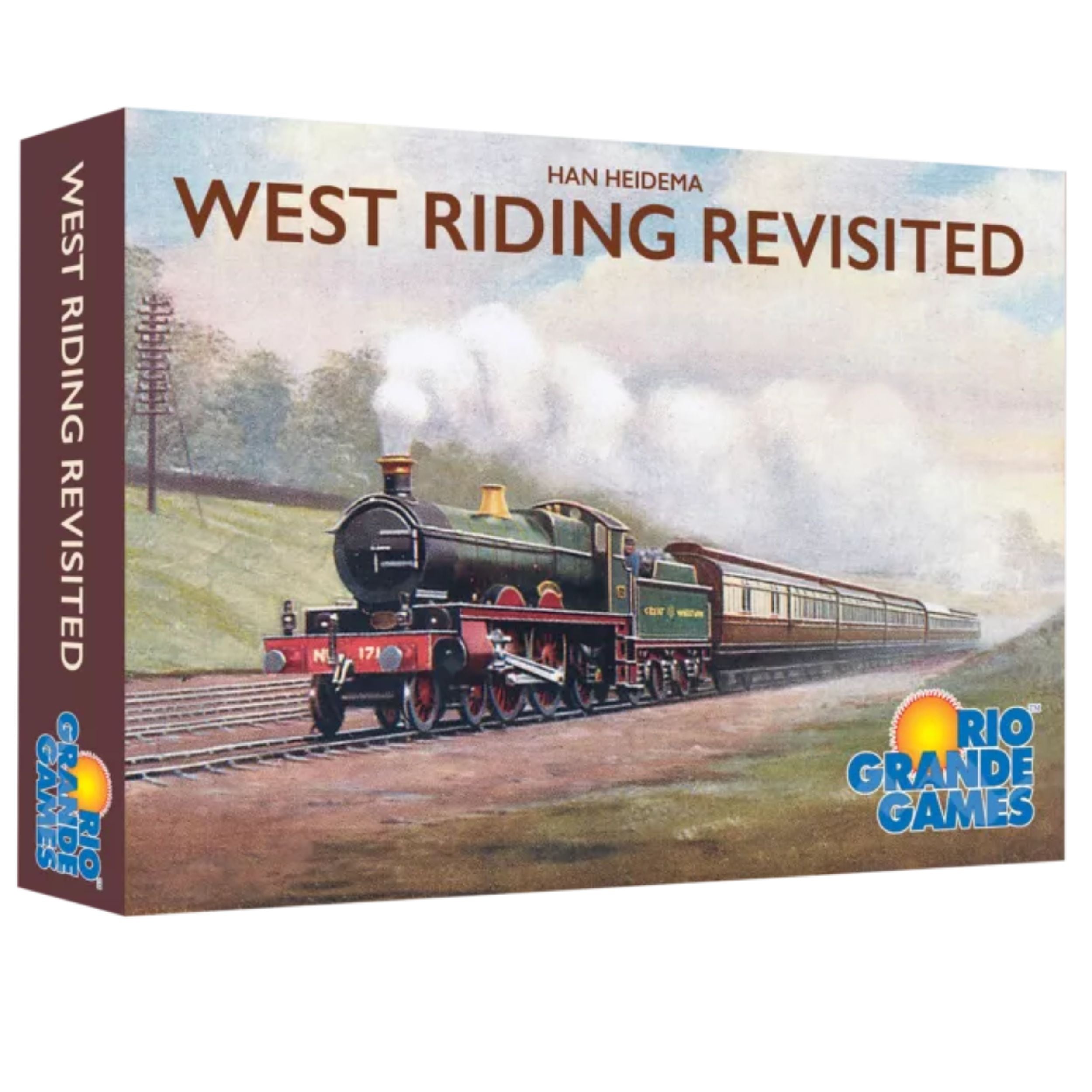
West Riding Revisited
🐸 Dettagli da BoardGameGeek
Consiglio BGG sul numero di giocatori
Categorie
Meccaniche
Design & Art
Lingua
Si abbina bene con
The FroGames Card
You've just won the auction for three shares of Midland Railway. On the board, you place a red cube connecting Manchester to Leeds. Someone grumbles. In two turns, that route will be worth triple, or it will be worthless.
WHAT IT'S ABOUT
Ten years of development for a railway system without banknotes
Han Heidema spent a decade rewriting his original West Riding. The result is an economic game set in the British Industrial Revolution that eliminates physical money from the table: no banknotes, only share certificates and railway routes built with colored cubes. Graphics by Todd Sanders, published by Winsome Games in 2010 as part of the Essen Set.
At the table, you manage shares of six historical railway companies (Midland, London & North Western, North Eastern, Great Central, Great Northern, Lancashire & Yorkshire) and two merger groups. Each turn you buy shares at auction, expand networks by placing cubes, trade base shares for merger shares, collect dividends, and reorder the turn. The game ends when all routes are completed or the wooden locomotive reaches the last space on the track. The player with the most capital wins.
What they say abroad
West Riding Revisited is a game that requires patience and attention. It will be the most rigorous economic system we have tested this year.
— FroGames
"The game fixes many of the downtime issues with West Riding while keeping the brutal purity of share speculation."
The game fixes many of the downtime issues with West Riding while keeping the brutal purity of share speculation.
— Winsome Games

West Riding Revisited
FrogScore · FroGames editorial rating · based on rules, international reviews and play sessionsWhat's on the table
Four elements that build the railway economy
84 share title cards
Eight shares for each of the six base companies (red Midland, black LNWR, brown North Eastern, blue Great Central, green Great Northern, yellow Lancashire & Yorkshire), plus twelve shares for each of the two merger companies (orange LNER, pink LMS). There are no banknotes: money is abstract, shares are everything.
Railway expansion cubes
Colored wooden pieces that you place on the map to build routes. Each cube represents a completed connection, each connection generates dividends for shareholders. The network grows turn by turn and determines who collects and how much.
Locomotive end-game marker
A small wooden train that advances on the track each round. When it reaches the last space or when all six base companies have completed their networks, the Grand Final Settlement occurs: all shares are liquidated and the player with the most value wins.
West Riding map
The map of Yorkshire during the Industrial Revolution, with fixed cities and connections. Six historical railway networks overlap, block each other, and compete for the most profitable routes. There is no randomization: you must read the board like a chessboard.
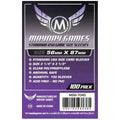
Recommended sleeves 84 cards in 1 size ▼
If you play often, we recommend protecting cards with clear sleeves to make them last longer.
| Size | Quantity |
|---|---|
| 56 × 86 mm | 84 |
| Total cards | 84 |
Come si gioca
Video dimostrativo di gameplay.
🎲How to playThe rules in four steps▼
How to play
The flow of each round
Each turn follows a fixed sequence: auctions, expansions, exchanges, dividends, reordering. No dice, no event cards. Just decisions.
Players bid on available shares. There's no physical money: you mentally calculate how much you can afford based on the abstract value of your portfolio. The highest bidder buys the share, and their capital decreases by the price paid.
In turn, each player can place a cube of the company whose shares they own, expanding the railway network on the map. Tracks must follow pre-established historical connections. Each cube placed increases the future value of the company.
You can exchange two shares of basic companies for one share of a merger company (LNER or LMS). Mergers have enormous potential value, but only crystalize at the end of the game. Timing is everything.
Companies pay dividends to shareholders based on the length of their networks. Each player's abstract capital is updated. Then the turn order for the next round is re-determined based on the players' shares.
⏱️Your first gameThe story, moment by moment▼
A game in five moments
What happens at the table
Not the rules. The experience.
First auctions, first mistakes
The game distributes some shares to fictional players. You and the others make your first auction bids, but without physical money, it's hard to tell who can afford what. Someone buys too much, someone too little. The map is empty, dividends still far off.
First cubes, first tracks
Construction begins. You place a red cube on the Midland, someone else blocks the North Eastern. The tracks overlap: a city can be served by multiple companies, but each cube takes up space. Who gets there first affects who comes after.
First dividends, first mergers
Basic companies begin paying dividends based on the length of their networks. Someone exchanges two basic shares for a merger share (LNER or LMS), betting on future value. Others watch suspiciously: is that merger premature or genius?
Board saturates, auctions become fierce
The map is almost full. Every new track can block another's expansion or unlock a million-dollar merger. Auctions become psychological duels: who has liquidity? Who is bluffing? Who has already won and who is drowning?
Grand Final Settlement
The locomotive reaches the last space, or all basic companies have completed their networks. All securities are liquidated based on their final value. Those with heavy mergers cash in mountains of abstract capital. Those with shares in blocked companies discover they played for nothing.
🐸Things to know beforehandThree honest truths, from friends▼
Things to know beforehand
Three things you need to consider
Mental calculations: no banknotes
West Riding Revisited eliminates physical money. You must mentally track the value of your portfolio, calculate future dividends, and estimate how much you can spend in auctions. If you don't like doing mental math, this game will punish you. Paper and pen help, but slow things down.
Steep learning curve
The first game will be a lesson in mistakes: you'll buy the wrong shares, expand useless networks, exchange for premature mergers. The game is unforgiving of inexperience. The advanced variant with variable setup helps prevent openings from becoming scripted, but you must first understand the basic economic system.
Zero random elements, zero excuses
There are no dice, drawn cards, or random events. Every mistake is yours, every victory is earned. If you lose, you can't blame luck. This is a plus for those seeking a pure challenge, but can be ruthless for those who prefer games where chaos levels the playing field.
🏆Victory and defeatWhat the end rewards▼
How it ends
Victory and defeat conditions
The game ends when the locomotive reaches the last space on the track or when all six basic companies have completed their networks. At that point, the Grand Final Settlement occurs.
Victory
- Having the portfolio with the highest total value at the time of final liquidation
- Owning significant shares of merger companies (LNER, LMS) that have crystallized value from the basic networks
- Having built and collected dividends from the longest and most profitable networks during the game
Defeat
- Having invested in blocked companies that did not complete profitable networks
- Having spent too much in initial auctions and finding yourself without liquidity for crucial expansions
- Having traded for mergers too early or too late, losing value in both cases
West Riding Revisited is an economic game for experienced players who want a ruthless, clean economic system with no random elements. Available on FroGames.it
💬Frequently asked questionsQuick answers before checkout▼
Frequently asked questions
FAQ about West Riding Revisited
Is it playable with 3 or does it require a full player count?
The game starts with 3 players, but interaction increases with 4 or 5. With 3 players, the map is less saturated and auctions are less competitive: it remains a good economic game, but loses some tension. The sweet spot is 4-5 players.
How complicated is it to keep track of abstract money?
Quite. There are no physical banknotes: you have to mentally calculate the value of your portfolio based on the securities owned and expected dividends. Many groups use pen and paper to keep track, but this slows down the game. If you hate doing math, this system will weigh you down.
What mechanics does West Riding Revisited use?
Auction/Bidding for purchasing shares, Network and Route Building with cubes to expand railway networks, Stock Holding to manage the portfolio and calculate dividends. All without physical money: the value is abstract and calculated mentally.
Does the advanced variant change the game much?
Yes. The basic setup always distributes the same initial shares to fictional players, which makes the opening scripted after a few games. The advanced variant randomizes the initial distribution, making each game less predictable. It is recommended after 2-3 games with the basic setup.
Is it available in Italian?
No. This edition is in English, published by Winsome Games. The text on the cards is minimal (names of historical railway companies), but the rules require a good understanding of English to grasp the moneyless economic system. There are no official Italian translations.
The people behind the game
Who invented it, who designed it, who publishes it — and what else they've done.
West Riding Revisited is an economic board game for 3-5 players, 120 minutes long, ages 12+. Designed by Han Heidema and published by Winsome Games in 2010, the game is set during the British Industrial Revolution and simulates the management of historical railway companies through a system of stock auctions and network building with cubes. Unlike the original West Riding, this version eliminates physical money: capital is abstract and players must mentally calculate the value of their portfolio. The main mechanics are Auction/Bidding, Network Building, and Stock Holding. The game ends when all basic companies complete their networks or when the locomotive marker reaches the last space. Available on FroGames.it
West Riding Revisited
Frequently Asked Questions
The answers you're looking for, no beating around the bush.
📸Do the images match the actual product?
The photos on the website often come from BoardGameGeek and are intended to give you an idea of the game. They may vary slightly from the version you receive. The content declared by the publisher is always binding.
📦Does the content of the box match what is indicated?
We always strive to provide the correct content, but minor variations are possible due to reprints or updates. The information comes directly from the publishers. If you have any questions, please contact us!
⏳How do pre-orders work?
Pre-order the game before release, payment is immediate, and the game is reserved for you. As soon as it arrives, we'll ship it right away! If there are any delays, we'll update you promptly.
🔒Can I trust buying here?
Absolutely! Secure payments, tracked shipments, and a team that loves board games as much as you do. If something goes wrong, we'll do our best to fix it.
🛠There's a problem with my order, what should I do?
Write to us now! Whether it's a missing part, damage, or an error, we'll help you resolve it as soon as possible. Your experience truly matters to us.