
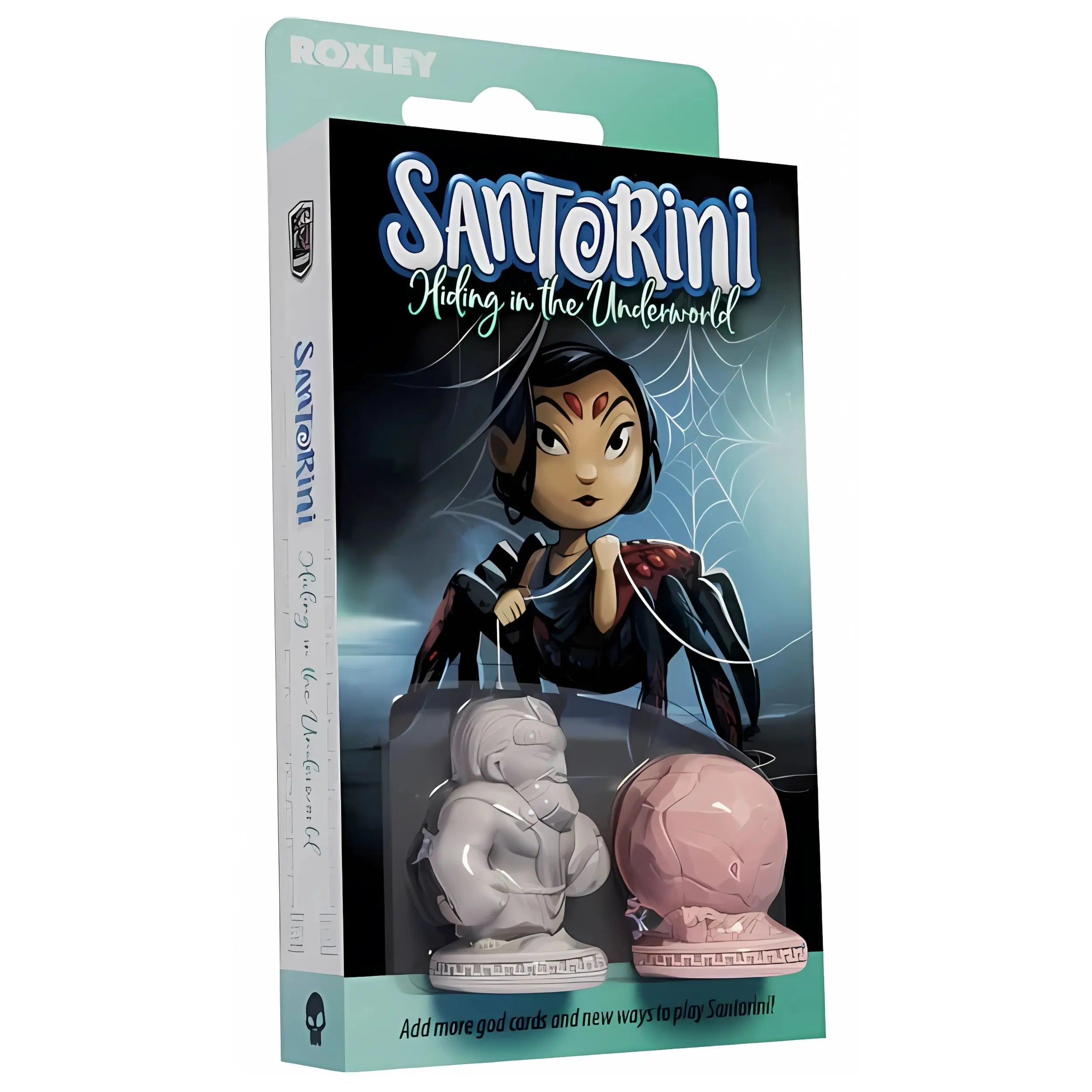
Santorini: Hiding in the Underworld
🐸 Details from BoardGameGeek
Consiglio BGG sul numero di giocatori
Categorie
Meccaniche
Design & Art
Lingua
Si abbina bene con
The FroGames review
Choose Cerberus. Your opponent picks Hades. By the time you realize what Morpheus really does, it will be too late. And you'll be trying out three more in the next game.
WHAT IT IS
Olympus descends into the Underworld
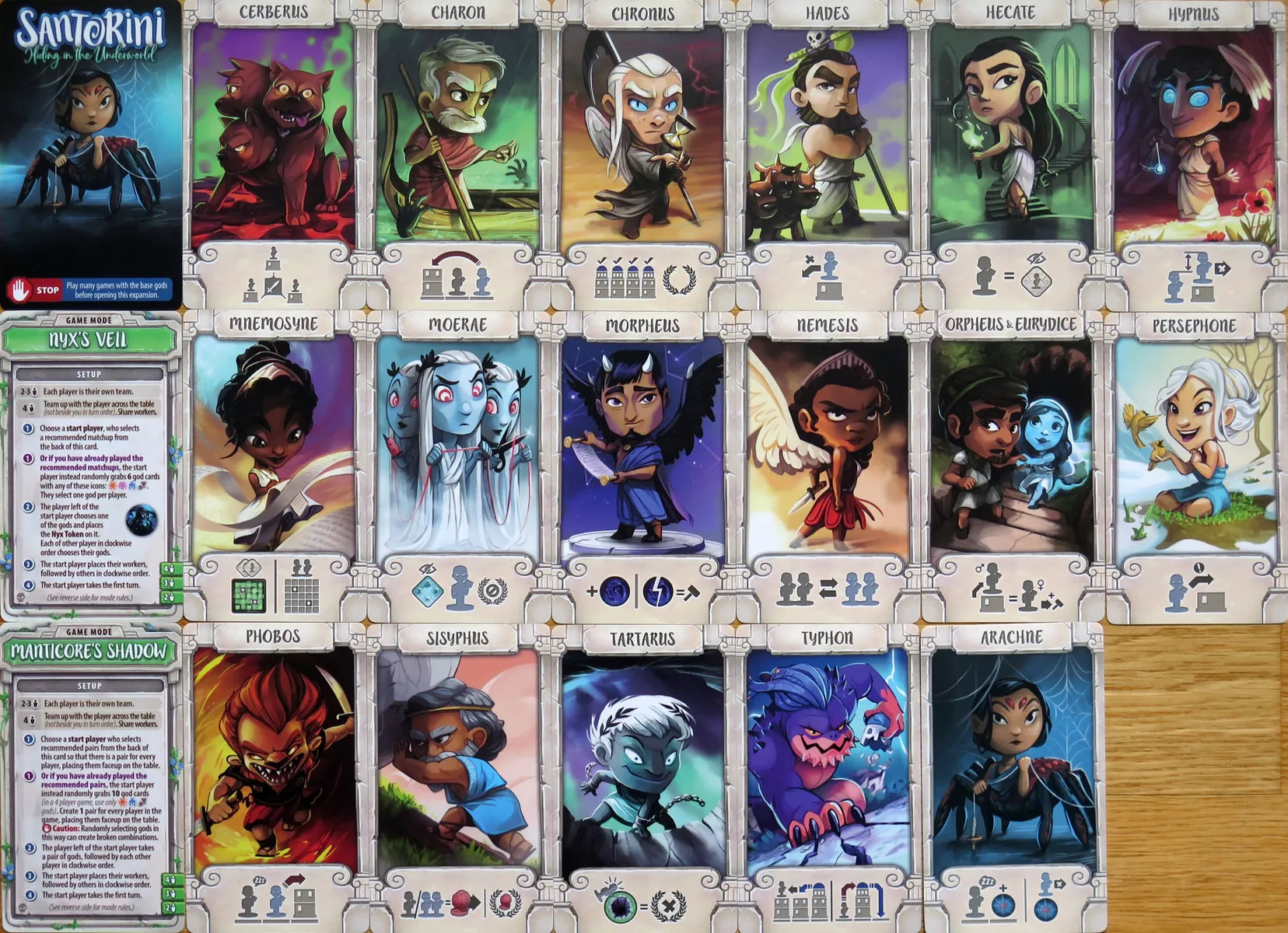
Hiding in the Underworld brings 17 new deities from the Greek afterlife into Santorini. Designed by Gord! and illustrated by Lina Cossette and David Forest, this expansion shifts the focus from the Olympian gods to the chthonic figures of mythology: Hades, Cerberus, Charon, Persephone, Morpheus, Orpheus and Eurydice, the Fates, and other entities linked to the realm of the dead.
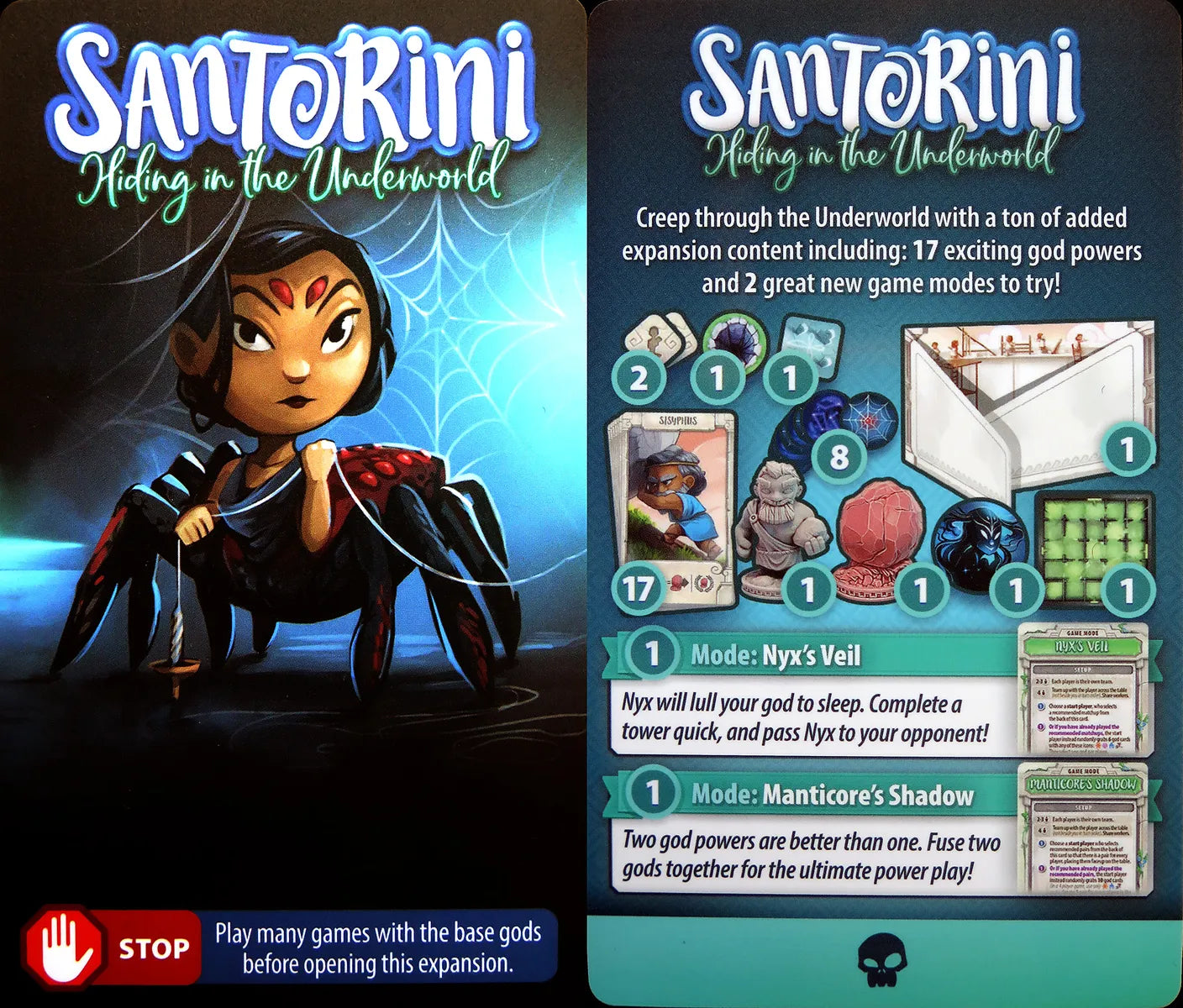
For the second edition of Santorini, Roxley redistributed the base game gods and moved the more complex ones into four dedicated expansions. This is the Underworld one. The game remains the same: move, build, win by climbing to the third floor. But every god radically changes what you can do. The expansion also includes two new mode cards, Nyx's Veil and Manticore's Shadow, with recommended pairings for balanced matches.
What they say abroad
"Expansion Card Packs featuring both reimagined and brand-new content that dramatically expands the base game's possibilities."
Expansions featuring both reimagined and brand-new content, dramatically expanding the possibilities of the base game.
— Roxley
It's an expansion worth a shot if you enjoyed Santorini. Chthonic powers change the pace: some slow things down, others manipulate opponents in ways Olympus doesn't. Curious to see how it holds up at the table compared to the classic expansions.
— FroGames

Santorini: Hiding in the Underworld
FrogScore · FroGames editorial review · first reading: based on rulebook and official presentation, to be updated after the first few gamesWhat's in the pack
17 deities, 2 modes, endless games
Cerberus, Hades, Charon
<cite index="11-1">The most iconic figures of the Underworld: the three-headed guardian, the lord of the realm of the dead, the ferryman of souls</cite>. Each with a unique power that manipulates the board or your opponents.
Morpheus, Hypnus, Mnemosyne
Deities of sleep, dreams, and memory. Powers that alter movement and building rules in unexpected ways, slowing down or canceling actions.
The Fates, Nemesis, Phobos
Destiny, Vengeance, Fear. Mechanics that punish aggressive strategies or reward timing. To be played with caution.
Nyx's Veil and Manticore's Shadow
<cite index="4-6">Two mode cards with recommended and balanced god pairings</cite>. Perfect if you don't want to go crazy choosing between 17 new options.
🎲How to playThe rules in four steps▼
How to play
The flow of each turn
Santorini has two actions per turn. The expansion does not change this: it adds exceptions.
You have two pawns on the board. You choose one and move it to an adjacent space (diagonals included). You cannot climb more than one level at a time. Some gods change this rule.
After moving, build a level (first, second, third, or dome) in a space adjacent to the builder you moved. The dome caps the tower: no one can climb it anymore.
This is where the 17 Underworld powers come into play. Some activate before moving, others after building, others as passive conditions. Every god works differently.
If one of your builders has climbed to the third level, you have won. Unless your opponent's power states otherwise. Some gods even change the victory conditions.
⏱️Your first gameThe chronicle, moment by moment▼
A game in five moments
What happens at the table
Not the rules. The experience.
Choosing the gods
Open the pack. Read three cards. You don't quite understand what they do. You choose one that sounds interesting. Your opponent takes the one that seems broken. You place your two builders in opposite corners.
First moves, first doubts
Move, build. Simple. Then the opponent uses their power and something happens you didn't expect. You reread your card. Oh, maybe I can do this. Or maybe not. You try.
Understanding what the god really does
After three turns, you start to see the pattern. Your opponent's power works in a specific way that changes everything. You adapt your plan. They do the same. The board fills up with towers.
The last level
You are one turn away from victory. They block the path you didn't see. You respond by building where they cannot climb. Now it's their turn to find a way. Silence at the table, eyes on the board.
End of game, new game
One of you climbs to the third level. End. Five seconds pause. Then you both take two more cards from the pack. I want to try Persephone. I'll take Tartarus. Let's start again.
🐸Know before you buyThree honest things, from friends▼
Know before you buy
Three things you need to know
The base game is required
<cite index="8-1,17-1">Hiding in the Underworld is an expansion for Santorini Second Edition</cite>. You cannot play without the base game: it does not contain the board, builders, or towers. Only the 17 god cards, associated tokens, and two mode cards.
Complex powers, not for absolute beginners
<cite index="4-1,4-2">Roxley moved the most complex gods from the base game to four dedicated expansions</cite>. This is one of them. If it's your first game of Santorini ever, start with the basic powers, then add these.
Compatibility with other expansions
You can mix the gods from Hiding in the Underworld with those from the base game and other Roxley expansions (Golden Fleece, Seasons of Chaos, Riddle of the Sphinx). Just watch the balance: some combinations might result in being unbalanced.
🏆Victory and defeatWhat awards the ending▼
How it ends
How to win
Santorini has only one victory rule. But 17 ways to change it.
Standard victory
- One of your builders climbs to the third level of a tower
- The opponent can no longer move any of their builders (victory by block)
- Some gods add alternative conditions (e.g., build 5 domes, move down 2 levels consecutively)
Defeat
- At the start of your turn, none of your builders can move legally
- The opponent reaches the third level before you
- A god's power eliminates you or prevents your victory even when you reach the third level
Hiding in the Underworld doesn't reinvent Santorini. It gives it 17 new lives. And if you've already played 200 games, that's exactly what you need.
💬Frequently asked questionsQuick answers before the cart▼
Frequently asked questions
FAQ about Santorini: Hiding in the Underworld
Do I really need the base game or can I play only with this expansion?
You need the base game Santorini Second Edition. This expansion only contains the 17 god cards with their tokens and the two mode cards: there is no board, builders, towers, or domes. Without the base game, you cannot play.
Can I use these gods together with those from the base game or other expansions?
Yes, you can mix them. The Nyx's Veil and Manticore's Shadow mode cards include recommended and balanced pairings, but no one stops you from drafting freely among all the gods you own. Just watch the power levels: some combos might be unbalanced.
How much more complex are these gods compared to the basic ones?
Roxley stated that the most complex gods were moved from the base game to the expansions. Hiding in the Underworld includes powers that manipulate the rules in ways less immediate than Pan or Athena. If it's your first game of Santorini, start with the base game.
What mechanics does Santorini: Hiding in the Underworld use?
It is a pure strategy abstract game with variable player powers. Grid movement, vertical construction, area control. Every god breaks a different rule: timing, construction, movement, victory conditions. Zero randomness.
Is it available in Italian?
No, this edition is in English. The language dependence is minimal: each god card has a short text description of the power, but after one game you remember what it does. There are no official Italian translations of this expansion at the moment.
The people behind the game
Who invented it, who illustrated it, who publishes it — and what else they have done.
Santorini: Hiding in the Underworld is an expansion for the abstract game Santorini Second Edition, for 2-4 players, ages 8+, 30-minute duration. Designed by Gord! and published by Roxley, it introduces 17 new chthonic gods (Hades, Cerberus, Charon, Morpheus, Persephone, the Fates, and others) that drastically expand the strategic possibilities of the base game through asymmetric powers. It also includes two mode cards with balanced pairings. Main mechanic: variable player powers in a pure abstract strategy context, grid movement, and vertical construction. Available on FroGames.it.
Santorini: Hiding in the Underworld
Frequently Asked Questions
The answers you're looking for, no beating around the bush.
📸Do the images match the actual product?
The photos on the website often come from BoardGameGeek and are intended to give you an idea of the game. They may vary slightly from the version you receive. The content declared by the publisher is always binding.
📦Does the content of the box match what is indicated?
We always strive to provide the correct content, but minor variations are possible due to reprints or updates. The information comes directly from the publishers. If you have any questions, please contact us!
⏳How do pre-orders work?
Pre-order the game before release, payment is immediate, and the game is reserved for you. As soon as it arrives, we'll ship it right away! If there are any delays, we'll update you promptly.
🔒Can I trust buying here?
Absolutely! Secure payments, tracked shipments, and a team that loves board games as much as you do. If something goes wrong, we'll do our best to fix it.
🛠There's a problem with my order, what should I do?
Write to us now! Whether it's a missing part, damage, or an error, we'll help you resolve it as soon as possible. Your experience truly matters to us.