

Bordeaux
🐸 Dettagli da BoardGameGeek
Consiglio BGG sul numero di giocatori
Categorie
Meccaniche
Design & Art
Lingua
Pre-order - leggi i dettagli
🐸 Una rana saggia sa quando dividere l’ordine… e quando aspettare il salto giusto.
Pairs well with
The FroGames Card
Choose one year or three. Your worker rests, the others race. When they return, they'll be stronger, but the board has already changed. And someone just sold the barrel you wanted.
WHAT IT IS ABOUT
A sheet, a pencil, thirteen harvests to manage
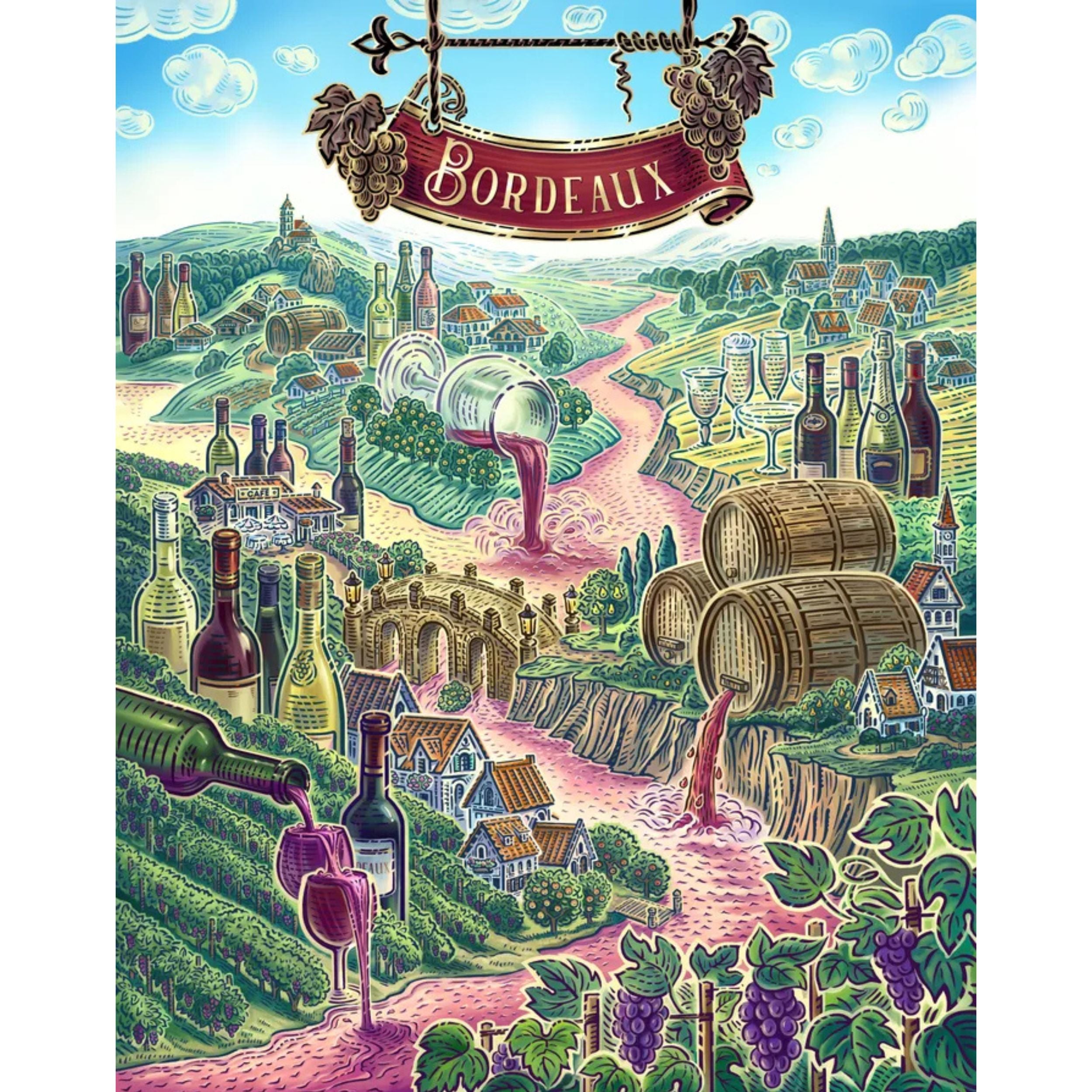
Ben Rosset (author of Fromage) brings the mechanics of his tabletop eurogame into a pocket format: paper and pen, graphics by Pavel Zhovba, set in the cellars of Bordeaux. It's a condensed version that retains worker placement, resource management, network building, but eliminates the board and physical components.
At the table (or standing, or on a plane) you manage worker-winemakers who produce wine, gather resources, age barrels. Each action has a duration: 1, 2 or 3 years. Longer, more powerful. But that worker will only be available again afterwards. 13 turns (vintages), simultaneous choices, points at the end of the game for wines and accumulated resources.
What they say abroad
Bordeaux is the pocket version of an already proven system. Those looking for a compact, solo-friendly eurogame to take anywhere have found their next purchase.
— FroGames
"A condensed, paper-and-pencil version of Fromage that fits in a backpack and doesn't require a table."
A condensed, paper-and-pencil version of Fromage that fits in a backpack and doesn't require a table.
— Road To Infamy Games

Bordeaux
The game is designed to be played simultaneously, so the solo experience is complete: same rules, same sheet, same 13-turn timer. There is no automa. It only loses the comparison with other players (who sold first, who blocked which resource), but the puzzle remains intact and challenging.
FrogScore · FroGames editorial rating · based on rules, international reviews and play sessionsWhat's on the sheet
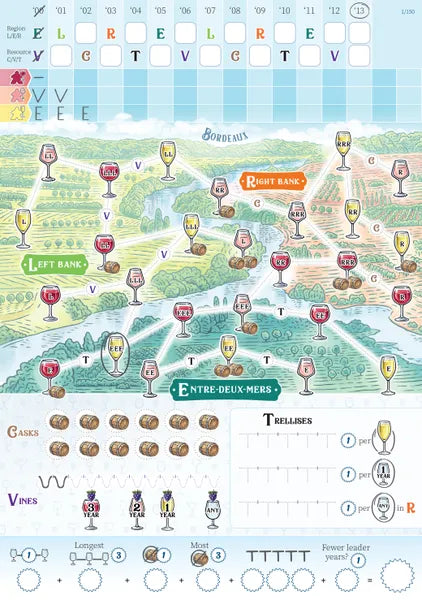
Four areas to write on
Wine Grid
Track wines produced: connect cells, build networks, accumulate prestige. Each wine has a value and an optimal path to draw.
Workers and Timer
Each worker has a space where you mark when they will be available again. A 3-year action? You block them until turn X. Managing timing is half the game.
Resources
Wood, stone, grapes: accumulate with Gather actions, spend to power other moves. Each resource has a dedicated slot to mark off.
Score Track
At the end of the game, sum sold wines, remaining resources, completed objectives. The sheet has a final calculation grid so you don't miss hidden points.
Come si gioca
Video dimostrativo di gameplay.
🎲How to playThe rules in four steps▼
How to play
The flow of each turn (year)
Everyone plays simultaneously. The game master announces the action, and everyone resolves it on their sheet.
A player or the game master reads the action available this turn (Make Wine or Gather Resources). Everyone listens.
Each player chooses 1, 2, or 3 years for that action (if they have a worker available). Longer duration = stronger effect. Mark on your sheet when that worker will become available again.
Perform the action on your sheet: draw connections between wines, cross off resource boxes, update tracks. Each player resolves in parallel.
Move to the next turn. Workers who are blocked remain blocked. Those who have finished their cycle become available again. On turn 13, the game ends and points are counted.
⏱️Your first gameThe chronicle, moment by moment▼
A game in five moments
What happens at the table
Not the rules. The experience.
Everyone looks at the blank sheet
You receive your personal sheet. There's a grid for wines, spaces for workers, resource boxes. Someone asks if they can write in pencil. The answer is always yes: you'll erase and rewrite a thousand times in upcoming games.
First three turns: everyone races
The game master announces the available action. Everyone simultaneously chooses a duration of 1, 2, or 3 years. You choose 1 (weak action, worker immediately free). Someone chooses 3 (strong action, worker blocked until turn 4). You start to understand the rhythm: do you race fast or plan long?
Mid-game: workers are out of sync
Turn 7. Someone has all workers blocked and passes the turn. You have one free and make a key move. The table realizes that worker timing is everything: those who planned poorly are now paying the price.
Last turns: every box counts
Turn 11. You have two workers, three possible moves, and only two turns left. You want to complete a wine network for the final bonus, but you need resources you don't have. You choose a 2-year action knowing that you won't see that worker again before the end. Someone sighs heavily.
End: count points, compare sheets
Turn 13. Everyone puts down their pens. Someone has sheets full of erasures, someone has a perfect network. You count wines, resources, bonuses. The winner is the one who wasted the fewest years. Then you compare sheets: everyone solved the puzzle in their own way.
🐸Good to know beforehandThree honest things, from friends▼
Good to know beforehand
Three things you must accept
Zero direct interaction
You don't steal resources, you don't block opponents, you don't form alliances. Everyone has their own sheet and optimizes for themselves. There's a Follow effect (whoever plays after you can copy your action duration choice), but it's the only connection between players. If you're looking for conflict or negotiation, this is not the game for you.
You need to print the sheets
The game is a PDF with sheets to print. It's not a problem for 1-4 players, but if you want to play it with 20 people, you'll need a printer or photocopies. It's not plug-and-play like a deck of cards: it requires physical preparation.
Visual learning curve
The first game, you'll spend 5 minutes figuring out where to write what. The sheet has many areas, each action affects different zones. After the first run, it becomes automatic, but some people get lost on the first go. Tip: play a practice game by yourself to understand the layout.
🏆Victory and defeatWhat the ending rewards▼
How it ends
How to win
After 13 turns, everyone counts the points on their sheet. The player with the highest total wins.
Scoring sources
- Wines produced and sold (more prestige = more points)
- Completed wine networks (bonus if you've connected all boxes of a type)
- Resources accumulated at the end of the game (each resource is worth points)
- Special objectives completed during the game
Ways to waste points
- Blocking workers for too long without utilizing the strong action
- Not completing wine networks (leaving bonuses on the table)
- Ignoring resources (they're worth little but are easy to get)
- Choosing actions without a plan: every year counts
Bordeaux is pure efficiency in 30 minutes. If you love optimizing, planning, squeezing every move, this is your next backpack purchase.
💬Frequently asked questionsQuick answers before checkout▼
Frequently asked questions
FAQ about Bordeaux
What mechanics does Bordeaux use?
Worker placement with variable duration (1-3 years), simultaneous action selection, network building (drawing connections between wines), paper-and-pencil. There's also a Follow element: if you play after someone, you can copy their action duration.
Does it really work for up to 100 players?
Yes, technically. Each player has their own sheet, actions are simultaneous, there's no waiting. In practice, you need a game master to announce actions and many printouts. It's designed for conventions or events, not for casual evenings. 1 to 6 players is the ideal range.
How different is it from Fromage (the board game)?
Fromage has a board, tiles, physical components, variable setup, more interaction. Bordeaux condenses the system: same logic (worker placement + timing + resources), but all on paper. Faster (30' vs 60'), more portable, less setup. If you loved Fromage, this is its pocket sibling.
Do you need experience with Roll & Write games to understand it?
No. It's not a classic roll-and-write (you don't roll dice): it's a hybrid flip-and-write with worker placement. If you've played any Eurogame (like Agricola, Viticulture), you'll immediately grasp the logic. The rules are a 10-minute explanation, then everything is clear on the sheet.
Is it available in Italian?
No, this edition is in English. The rulebook is in English and the sheets have English text. However, the language dependency is low: once you understand the rules, the sheet is iconographic. English is needed for the first reading of the manual, then you can play comfortably.
The people behind the game
Who invented it, who designed it, who publishes it — and what else they've done.
Bordeaux is a paper-and-pencil strategy game for 1-100 players, lasting 30 minutes, ages 14+. Designed by Ben Rosset and published by Road To Infamy Games, it's the pocket version of Fromage: worker placement with variable action duration (1, 2, or 3 years), resource management, wine network building. Each turn you choose whether to take fast actions (workers immediately free) or powerful ones (workers blocked for longer). Simultaneous, scalable, zero setup: all you need is a printed sheet and a pencil. Suitable for those looking for a compact, solo-friendly, and portable Eurogame. Available on FroGames.it.
Bordeaux
Frequently Asked Questions
The answers you're looking for, no beating around the bush.
📸Do the images match the actual product?
The photos on the website often come from BoardGameGeek and are intended to give you an idea of the game. They may vary slightly from the version you receive. The content declared by the publisher is always binding.
📦Does the content of the box match what is indicated?
We always strive to provide the correct content, but minor variations are possible due to reprints or updates. The information comes directly from the publishers. If you have any questions, please contact us!
⏳How do pre-orders work?
Pre-order the game before release, payment is immediate, and the game is reserved for you. As soon as it arrives, we'll ship it right away! If there are any delays, we'll update you promptly.
🔒Can I trust buying here?
Absolutely! Secure payments, tracked shipments, and a team that loves board games as much as you do. If something goes wrong, we'll do our best to fix it.
🛠There's a problem with my order, what should I do?
Write to us now! Whether it's a missing part, damage, or an error, we'll help you resolve it as soon as possible. Your experience truly matters to us.