


Arrival
🐸 Dettagli da BoardGameGeek
Consiglio BGG sul numero di giocatori
Categorie
Meccaniche
Design & Art
Lingua
Pre-order - leggi i dettagli
🐸 Una rana saggia sa quando dividere l’ordine… e quando aspettare il salto giusto.
Pairs well with
The FroGames Card
You place one turtle. You capture another. Another one becomes wild. In the end, someone discovers they are missing two tiles to complete the quadrant, and the game is already over.
WHAT IT IS ABOUT
A rare natural event transformed into a duel of hand management and majorities
Arribada means 'arrival from the sea': the moment when hundreds of sea turtles nest all together on the same beach. Robert Hovakimyan, a Californian designer and devoted student of Reiner Knizia, has taken this phenomenon and transformed it into a tactical abstract game where every tile placed opens a chain of consequences. Illustrated by A. Giroux, Arribada is part of Bitewing Games' Travel Line: compact, immediate, but not trivial games.
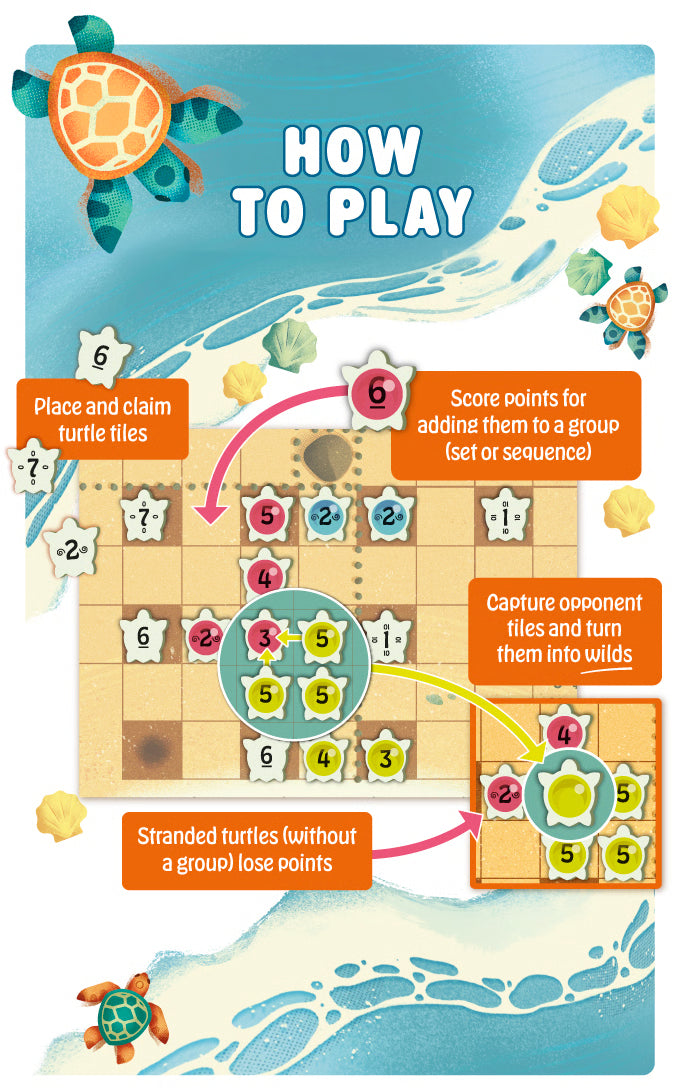
At the table, you build groups of turtles (numerical sequences or sets of the same value) to score points. But every tile can be contested: you can claim neutral tiles, capture opponents' tiles, and gain extra turns. Captured tiles become wilds, and the struggle for majorities in the four quadrants of the table decides who truly wins. In the end, every isolated turtle costs you points: no one is left behind.
What they say abroad
"2 charming and approachable board games with optional travel pack upgrades!"
Two charming and accessible board games with optional travel pack upgrades!
— Bitewing Games
Arribada is one of those games that seem simple on paper, then you discover that each turn opens three different dilemmas. We are still exploring it, but we are already intrigued by how it manages the tension between building your own groups and sabotaging others' without hidden cards.
— FroGames

Arribada
FrogScore · FroGames editorial rating · first reading: based on official rules and presentation, updated with first playsWhat you have in front of you
Four elements that drive the game
Turtle tiles
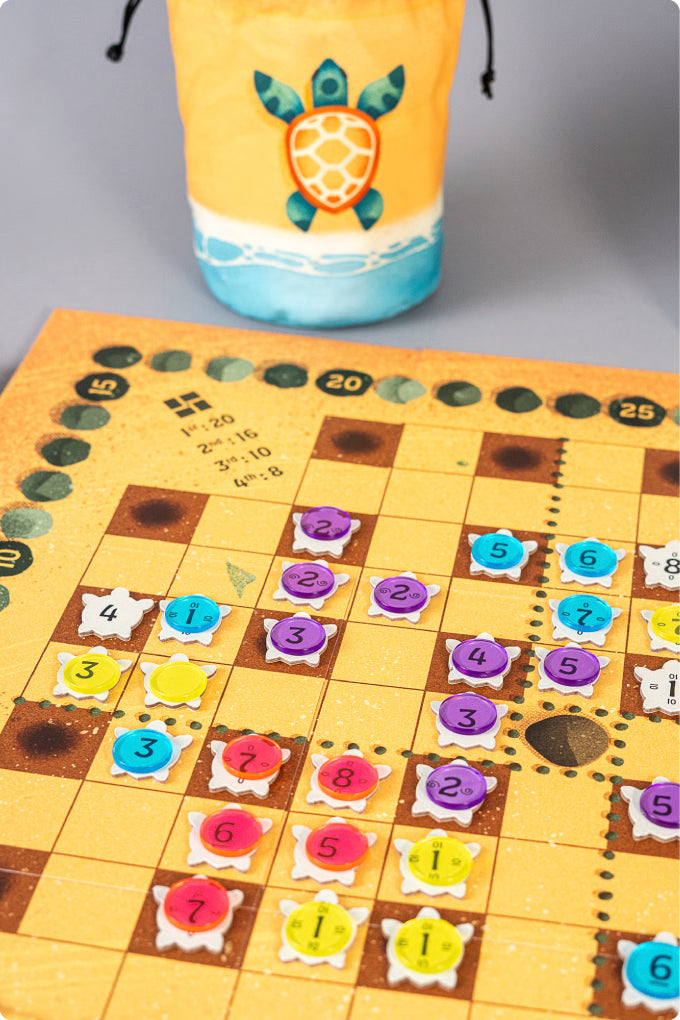
Each tile has a number and a color. You place them to build sequences (1-2-3) or sets (three of the same 5s). At least three tiles, otherwise it's worth nothing.
Capture and wilds
You can capture an opponent's tile instead of placing. That tile becomes wild in your hand: you use it to complete impossible groups.
Four quadrants
The board is divided into four zones. At the end of the game, whoever has the most presence in each quadrant wins massive points. It's not enough to make groups: you also have to control them.
Isolated turtles
Each of your tiles remaining outside a valid group at the end of the game costs you points. The family abandons no one, and the game reminds you of this in the scoring.
Come si gioca
Video dimostrativo di gameplay.
🎲How to PlayThe rules in four steps▼
How to Play
The flow of each round
Each turn is a choice between three actions, each with cascading consequences.
Place a turtle tile from your rack to build a group (sequence or set). Or claim a neutral tile on the table. Or capture an opponent's tile and turn it into a wild card.
If you have completed a group of at least three connected tiles, you score points. Sequences (1-2-3-4) or sets (three blue 5s). Wild cards help to close impossible groups.
Some special tiles give you an immediate bonus turn. If you play one, you act again immediately. This can trigger devastating combos.
You refill your hand from the common deck up to the limit. The game ends when a player places their last tile. No warning, no last round.
⏱️Your first gameThe chronicle, moment by moment▼
A game in five moments
What happens at the table
Not the rules. The experience.
You place the first tiles
You start with a hand of tiles and an empty table. Everyone places turtles to build the first groups. It seems cooperative: everyone builds their corner. But every tile you place is also a tile that others can claim.
Someone captures the first tile
Instead of placing, a player captures an opponent's tile. That tile becomes a wild card. The table stiffens: now you know nothing is safe. You start to place tactically, not just for your points but to deny others theirs.
The fight for quadrants
Mid-game, the table is full. You notice that the player to your right has a majority in two quadrants. You control one, but it's weak. The game splits: you sacrifice immediate points to establish presence where needed.
The extra turn that changes everything
Some tiles give you bonus turns. Someone plays one, captures your key tile, uses it as a wild card to complete a huge set, and gets another turn. Two actions in one. You count the remaining tiles and realize the game will end sooner than you thought.
Sudden end
Someone places the last tile from their supply. Game over. You count: points from groups, majorities in quadrants, penalties for isolated turtles. The winner is whoever balanced building, territorial control, and hand cleanup. Not whoever made the biggest group.
🐸Good to know beforeThree honest things, from friends▼
Good to know before
Three things you need to know
Blind draw, not draft
You don't choose the tiles: you draw them. Building sequences or sets depends on what you get. There are strong tactical decisions, but luck of the draw matters. Don't expect total control like in a pure abstract game.
The game end comes without warning
When a player places their last tile, stop. There's no final round, no visible countdown. You have to count the tiles in play to know when it ends. If you're distracted, you lose.
Uncertain scaling for 4 players
The game is designed for 2-4, but with very few games recorded on BGG we don't yet know if downtime increases or if majorities dilute with 4 players. We suspect it's more tense with 2-3 players. First read, we'll check.
🏆Victory and defeatWhat the ending rewards▼
How it ends
How to win and how to lose
The game ends when a player places their last turtle tile. Then three things are counted.
Victory
- Points from completed groups (sequences and sets of at least 3 tiles)
- Points from majorities in the four quadrants of the table
- Hand clean-up: the fewer isolated tiles you have, the better
Penalty
- Every turtle left outside a valid group costs you points
- Losing majorities in key quadrants makes a difference
- Focusing only on groups and ignoring territorial control condemns you
Arribada is an abstract game that forces you to play on two levels simultaneously: building groups for immediate points and dominating the table for final majorities. The winner is the one who balances, not the one who optimizes.
💬Frequently Asked QuestionsQuick answers before checkout▼
Frequently Asked Questions
FAQ about Arribada
What mechanics does Arribada use?
Tile placement, hand management, area majority, and chaining (action chains). The system is similar to Rummikub but played on a shared table with a fight for spatial control.
Is it suitable for those who never play abstract games?
Yes, if you like games where every move has visible and immediate consequences. The rules can be explained in 10 minutes, the turtle theme makes everything more accessible, and the duration (30-45 min) is not daunting. But expect direct interaction: here you capture other players' tiles.
Does it work well with 2 players?
It should be excellent with 2 players: more control, more readability, more tension over captures. With 4 players, the chaos increases, but we don't yet know if it improves or worsens the experience. The game was recently released, data is limited.
How long does a game really last?
30-45 minutes stated. From the description and structure (place-draw-pass), we expect it to stay within this range even with 4 players. But the sudden end of the game can shorten or lengthen everything.
Is it available in Italian?
No, this edition is in English. The game is almost language-independent: the tiles have numbers and colors, language dependence is minimal (only the rulebook).
The people behind the game
Who invented it, who designed it, who publishes it — and what else they've done.
Arribada is an abstract board game for 2-4 players designed by Robert Hovakimyan and published by Bitewing Games. Duration 30-45 minutes, recommended age 10+. The main mechanics are tile placement, hand management, and area majority: players build sequences and sets of turtles, capture opponent tiles to turn them into wild cards, and fight for majorities in the four quadrants of the table. Each isolated turtle at the end of the game costs points. Part of the Bitewing Travel Line, designed to be compact yet deep. Available on FroGames.it.
Arrival
Frequently Asked Questions
The answers you're looking for, no beating around the bush.
📸Do the images match the actual product?
The photos on the website often come from BoardGameGeek and are intended to give you an idea of the game. They may vary slightly from the version you receive. The content declared by the publisher is always binding.
📦Does the content of the box match what is indicated?
We always strive to provide the correct content, but minor variations are possible due to reprints or updates. The information comes directly from the publishers. If you have any questions, please contact us!
⏳How do pre-orders work?
Pre-order the game before release, payment is immediate, and the game is reserved for you. As soon as it arrives, we'll ship it right away! If there are any delays, we'll update you promptly.
🔒Can I trust buying here?
Absolutely! Secure payments, tracked shipments, and a team that loves board games as much as you do. If something goes wrong, we'll do our best to fix it.
🛠There's a problem with my order, what should I do?
Write to us now! Whether it's a missing part, damage, or an error, we'll help you resolve it as soon as possible. Your experience truly matters to us.