

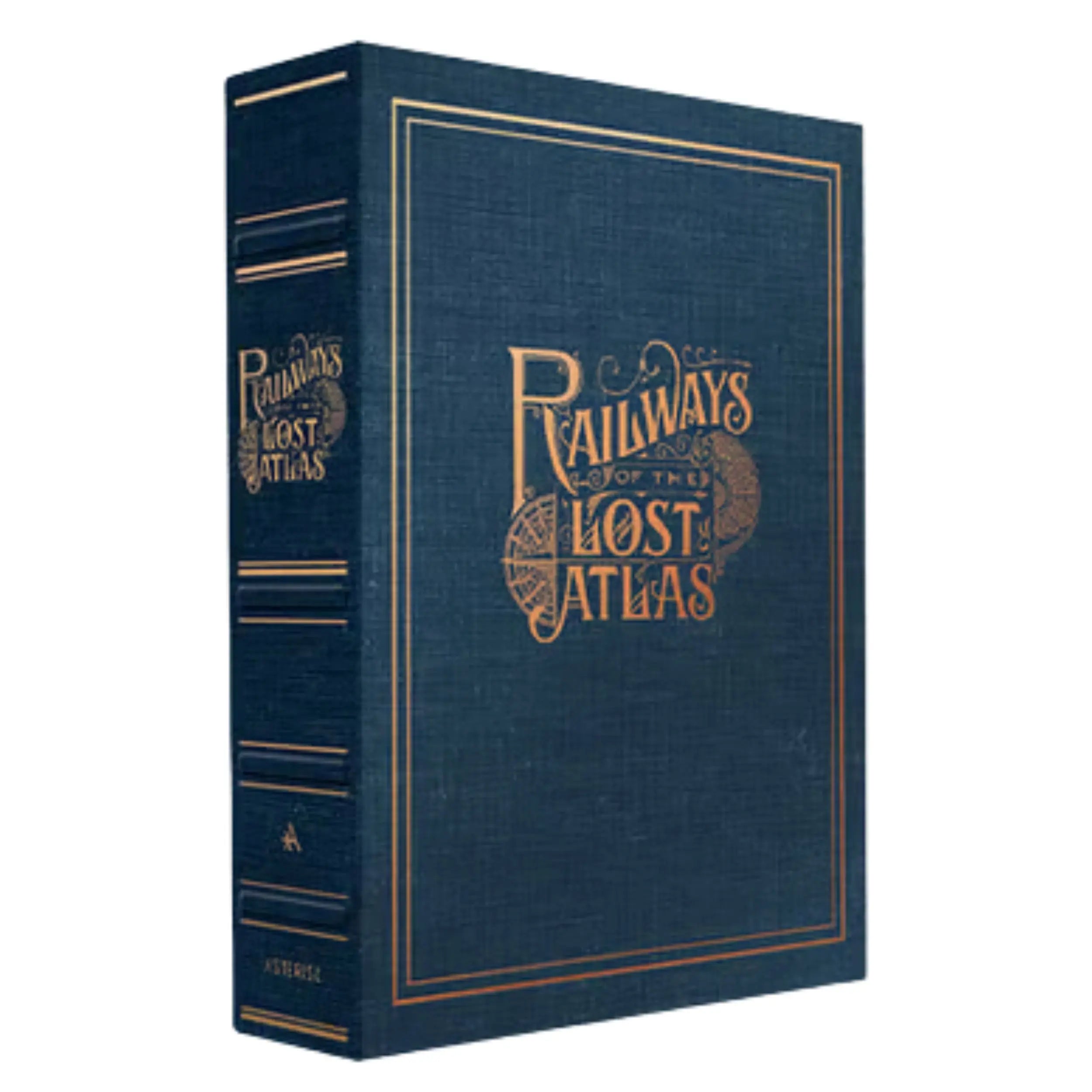
Railways of the Lost Atlas - Second Printing
🐸 Dettagli da BoardGameGeek
Consiglio BGG sul numero di giocatori
Categorie
Meccaniche
Design & Art
Lingua
Pre-order - leggi i dettagli
🐸 Una rana saggia sa quando dividere l’ordine… e quando aspettare il salto giusto.




Pairs well with
FroGames — The 18xx that builds itself every time
Someone invests in the wrong company. Someone builds where they shouldn't. And in the end, someone discovers that the majority shareholder wasn't who they thought.
WHAT IT'S ABOUT
An 18xx where the map is built alongside dreams of wealth
Railways of the Lost Atlas is the result of the work of Kevin Delger and Jacob Schacht, two debut designers who took the soul of the 18xx series and made it accessible without betraying its complexity. Published by Asterisk Games, the game stems from a simple idea: every game must be different, because you build the map during setup. There is no historical Africa or America to traverse, but a lost atlas made of modular tiles that redraw the geography of profit each time.
At the table, you are an investor who launches minor companies, builds tracks, generates revenue, and decides when to merge everything into a major. The twelve minor companies have distinct abilities — some build bridges over water, some bore through mountains, some run further — and these abilities survive even after the merger. The result is that each combination creates a unique identity. Multiple modes and modular options adapt the game to the group: a micro game, a short evening, or a five-hour epic.
What they say abroad
This rulebook is, quite easily, the most accessible 18xx rulebook in history.
It is, without exaggeration, the most accessible 18xx rulebook ever written.
— Meeple Mountain
The "Wednesday night train game": all the depth of an 18xx, but ready in an evening instead of a weekend.
The FroGames verdict
What's new compared to the first edition
This is the second printing of Railways of the Lost Atlas, revised along with the Landmarks expansion. It's not just a reprint: it's the most refined and complete version of the game.

Railways of the Lost Atlas
Introduced with the second printing. You play the short version (4 cycles, reduced map) against an automated major company, guided by a deck of actions derived from two minor companies' cards: no extra components. Excellent for familiarizing yourself with the 18xx system without pressure — but the speculative heart of the game, made of auctions and shareholders, remains multiplayer.
FrogScore · FroGames editorial rating · based on rules, international reviews, and play sessionsThe capitalist's tools
What's in the box
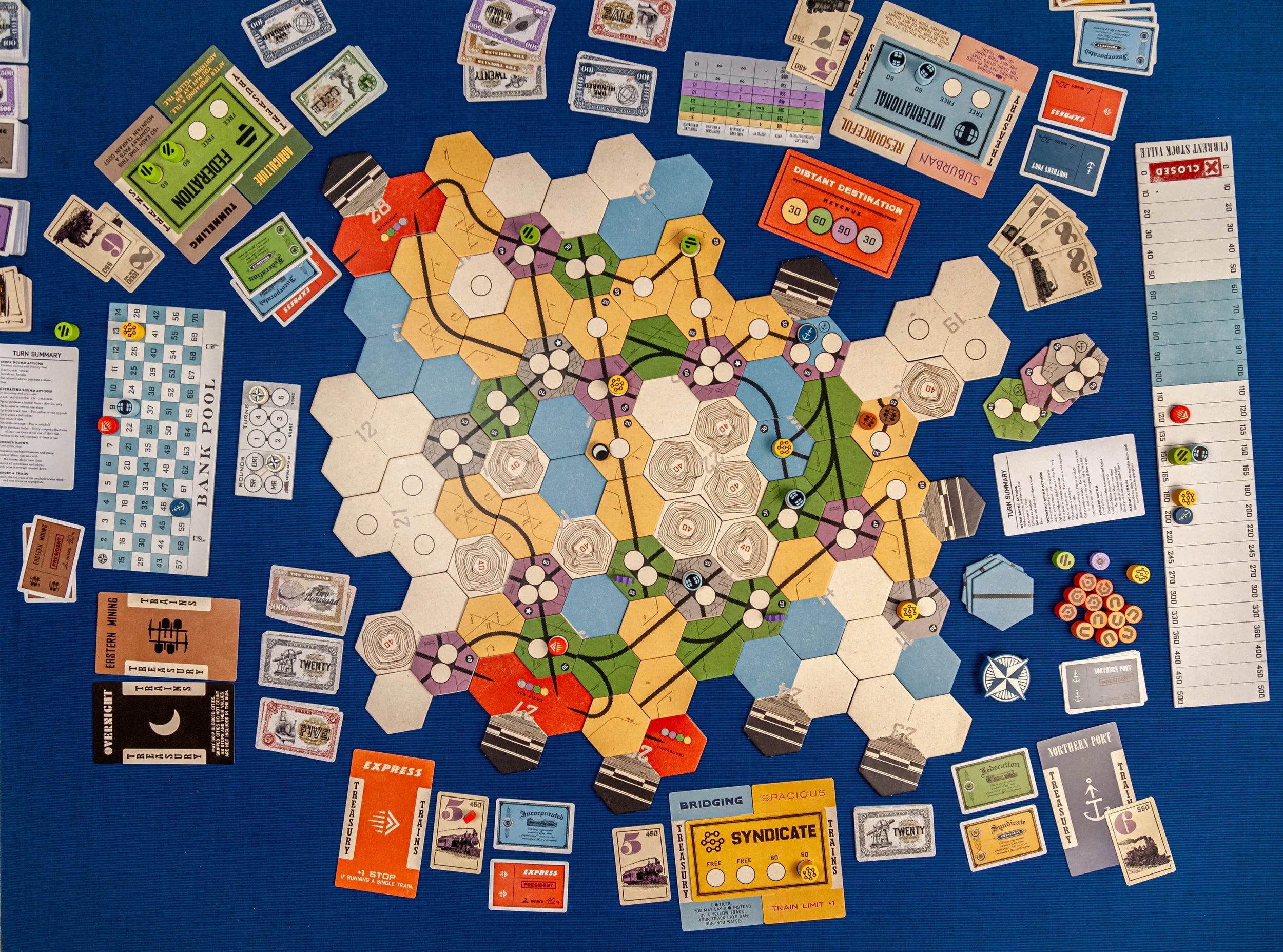
Modular map tiles
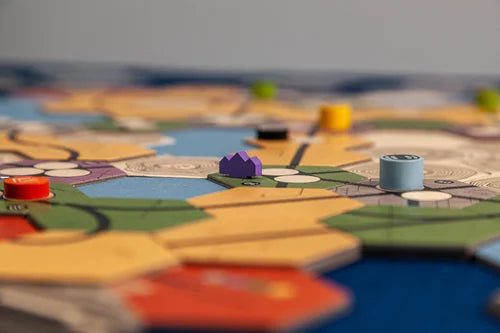
The geography of profit changes every game. During setup, you collectively build the lost atlas: mountains, plains, coasts. There are also individual hexes to fill in gaps and draw the exact map you want.
Twelve minor companies
Each with a unique ability: discounted construction, bonus revenue, bridges over water, tunnels through mountains. Then they merge into majors — and the ability survives the merger.
Certificates and money in cards
The heart of the game: shares you buy, sell, speculate. No fragile paper banknotes — here money is in sturdy cards, for clean and fast portfolio management.
Tracks and wooden pieces
Tracks to place to connect cities and generate routes, with screen-printed wooden tokens. Every segment pays, every connection counts. The network is your visible capital on the table.
Recommended sleeves 2 sizes · 451 total cards ▼
Railways of the Lost Atlas is packed with cards that change hands constantly — stock certificates and train cards especially. Protecting them is worthwhile. Here are the sizes to sleeve everything.
| Size | Cards | Quantity |
|---|---|---|
| 44 × 67 mm | Certificates and train cards | 419 |
| 70 × 120 mm | Charter, destination revenue, and reference | 32 |
| Total | 451 |
In a few hours, you'll discover that your majority shareholder sold everything a turn before the collapse. It always happens with Railways of the Lost Atlas.
Come si gioca
Video dimostrativo di gameplay.
A game in five moments
What happens at the table
Not the rules. The experience.
The map takes shape
The board is built together, tile by tile. Some are already calculating the best routes, while others place a mountain where everyone else hoped for a plain. The game's geography is created by your hands, and with it, the first silent alliances.
The initial auction
Decide who controls which minor companies. Some focus on rapid construction, others on guaranteed revenue. Auctions are silent tensions: understanding the true value of a minor in this configuration is already half the game.
The network expands
Tracks begin to connect cities. Some build towards large metropolises, others block rival passages. Each track laid redraws the profit map, and it starts to become clear who had foresight and who wasted capital.
The first merger
A minor becomes a major, and whoever controls more shares decides the moment. Is it too early? Is it too late? Merging is always a gamble on timing, and those who get it wrong pay in share value. The other players observe and calculate.
The final count
All shares are liquidated at current value, profits are tallied. Some sold at the right time, others were left with worthless paper. The map is a tangle of tracks, and the winner is whoever turned iron into money better than the others.
How to play
The flow of each round
A round in Railways of the Lost Atlas alternates between a stock phase (where you buy, sell, start companies) and an operations phase (where companies build and trains generate revenue).
In turn, each player starts a minor company with an auction bid, buys shares of existing companies, or sells to gain liquidity. Shares are valued based on expected revenue. Whoever controls the most shares of a company becomes its president.
Companies (led by their presidents) lay tracks — for free, except in mountains — open new hubs, and buy trains. Each minor has a unique ability that influences costs and possibilities. Majors have more freedom but fewer bonuses.
Each train travels a route of connected cities and earns money. The president decides: keep the revenue in the treasury to build more, or distribute it to shareholders to increase share value. Watch out for train rust.
When conditions allow, a minor merges into a major. The minor's abilities survive. Share value is recalculated. Some rise, some fall. The cycle restarts — until the last one arrives.
Why it's different from other 18xx games
Six mechanics that make the difference
Modular map built together
You don't always play on the same geography. During setup, players build the map tile by tile. Mountains, plains, coastlines change every game, and with them, the strategies. An 18xx where you can't memorize optimal routes.
Twelve asymmetric minor companies
Each minor has a unique ability: discounted construction, bonus revenue, bridges over water, tunnels through mountains, trains that run further. Abilities survive even after merging into a major, creating ever-changing combinations.
Scalable modes — and now solo too
Micro game, short game (4 cycles), or long game (6 cycles): you choose the complexity and duration based on your group. The second print adds official solo rules, to play an 18xx even alone in an evening.
Mergers as a strategic moment
Minors merge into majors when the president decides. But timing is everything: too early and you lose bonuses, too late and others overtake you. Merging is not automatic, it's a gamble.
Revenue: cash or dividends
After a company's revenue, the president decides: keep it in the treasury to build more, or distribute it to shareholders to increase share value. Every choice moves liquidity and the market.
Variants for experts
Choke points, grouped home tiles, unbalanced maps for tighter auctions. Variants like Bank Break and Hostile Mergers bring the mechanics you love from other 18xx games to the table. You can even build custom maps.
How it ends
How to win and how to lose
The game ends at the completion of the last cycle: all shares are liquidated at current value, and the player with the most accumulated money wins. A player who cannot pay their obligations goes bankrupt.
Victory
- The player with the highest total assets wins: value of shares owned + personal liquidity
- Share value depends on company revenue: long routes and connected cities are worth more
- Selling before a company collapses and buying when it's undervalued makes all the difference
Bankruptcy and paper portfolios
- Whoever cannot pay an obligation to a company goes bankrupt and is out of the game
- Whoever invests only in low-performing companies sees their portfolio value collapse
- Whoever builds without calculating returns burns capital and ends up with worthless shares
Railways of the Lost Atlas is an 18xx game that doesn't ask you to study a fixed map to win. Every game is a new country to discover, speculate on, and perhaps ruin — now even solo.
Frequently asked questions
FAQ about Railways of the Lost Atlas
Is it really more accessible than other 18xx, or is it just marketing?
It is indeed more accessible, but within certain limits. You can play short or micro games, the rulebook is considered one of the clearest in the genre, and the modular map removes the anxiety of fixed geography. But it remains a heavy game with stock management, revenue calculation, and speculation: it's not a gateway, it's a streamlined 18xx. Those looking for a light game will look elsewhere.
I have the first edition: is the second print worth it?
It depends. The second print brings an updated rulebook, corrected errata, a revised 4-5 player game, printed solo rules, and a new box color. If you already have the first edition and are not interested in solo play, the upgrade is not mandatory. If you're starting from scratch, however, this is the version to get: it's the most complete and refined.
Is there a solo mode?
Yes, and it's the main new feature of the second print. You play the short version against an automatic major company, managed by a deck of shares derived from the cards of two minors — without extra components. It's perfect for learning the 18xx system without pressure, although the speculative heart of the game remains multiplayer.
How much does the map change from game to game?
A lot. The map is built with modular tiles during setup, and players influence where mountains, plains, and coastlines end up. No two games have the same geography, which makes it impossible to memorize optimal routes: every table is a new economic experiment.
Can it be played in less than two hours?
Yes. The micro game and the short game (4 cycles) comfortably fit within 60-90 minutes. Long games (up to 300 minutes) are for those who want the full experience. The manual offers modular options to adapt duration and complexity to your time and group.
Is it available in Italian?
No, this edition is in English. The game has text on company cards, certificates, and the rulebook, so a basic knowledge of the language is necessary to play. The good news is that the rulebook is among the clearest and best-illustrated in the genre.
Railways of the Lost Atlas (second print) is a strategic and economic board game in the 18xx series for 1-5 players, lasting 60-300 minutes, recommended for ages 10+. Designed by Kevin Delger and Jacob Schacht, published by Asterisk Games, it is played on a modular map that changes every game. Players invest in minor railway companies, build track networks, manage stocks and mergers into majors. The twelve minor companies have unique abilities that survive even after merging. The second print adds an updated rulebook, corrected errata, a revised 4-5 player game, and official solo rules. Micro, short, and long modes plus variants like Bank Break and Hostile Mergers ensure high replayability. English edition. Available on FroGames.it.
Railways of the Lost Atlas - Second Printing
Frequently Asked Questions
The answers you're looking for, no beating around the bush.
📸Do the images match the actual product?
The photos on the website often come from BoardGameGeek and are intended to give you an idea of the game. They may vary slightly from the version you receive. The content declared by the publisher is always binding.
📦Does the content of the box match what is indicated?
We always strive to provide the correct content, but minor variations are possible due to reprints or updates. The information comes directly from the publishers. If you have any questions, please contact us!
⏳How do pre-orders work?
Pre-order the game before release, payment is immediate, and the game is reserved for you. As soon as it arrives, we'll ship it right away! If there are any delays, we'll update you promptly.
🔒Can I trust buying here?
Absolutely! Secure payments, tracked shipments, and a team that loves board games as much as you do. If something goes wrong, we'll do our best to fix it.
🛠There's a problem with my order, what should I do?
Write to us now! Whether it's a missing part, damage, or an error, we'll help you resolve it as soon as possible. Your experience truly matters to us.