
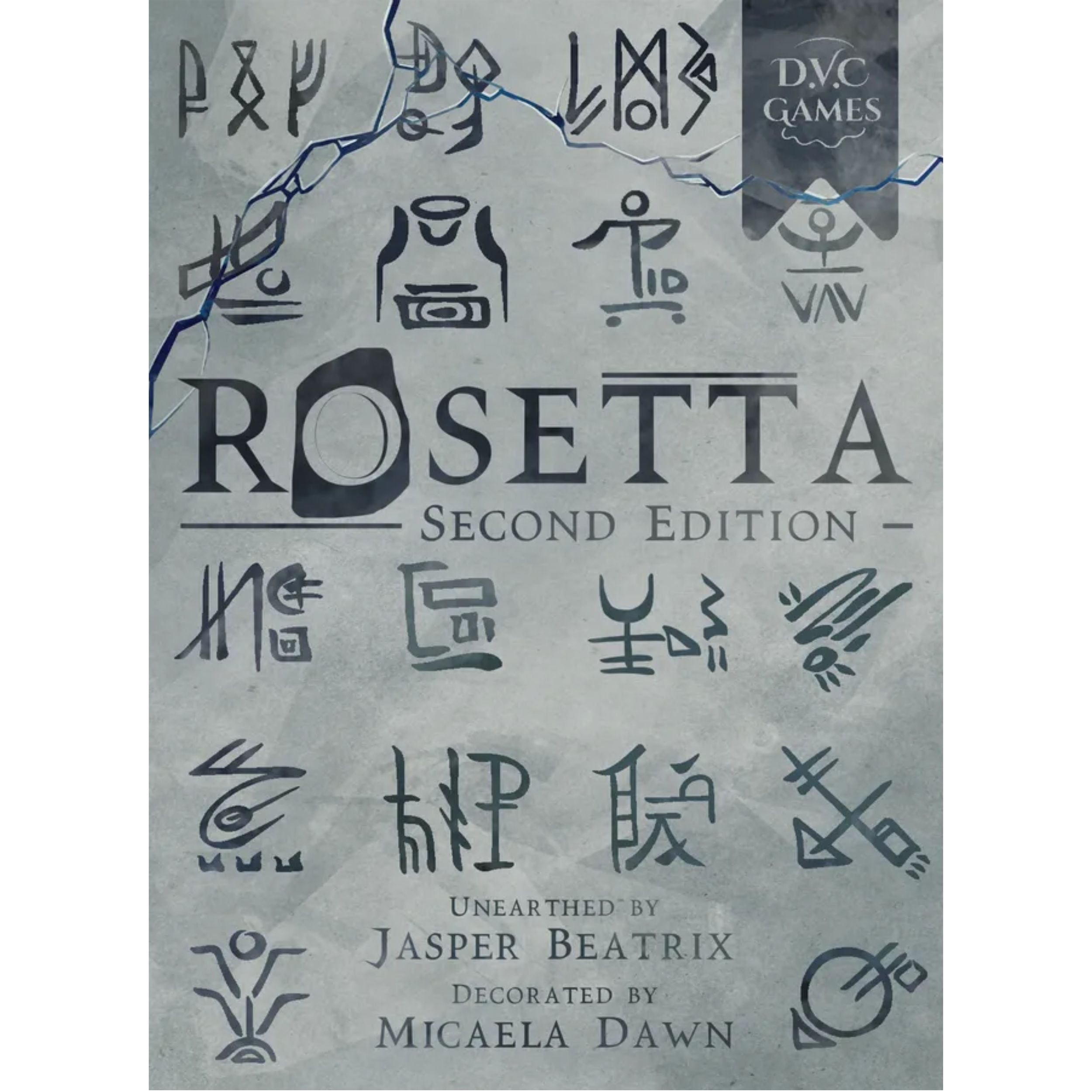
Rosetta: The Lost Language
🐸 Dettagli da BoardGameGeek
Consiglio BGG sul numero di giocatori
Categorie
Meccaniche
Design & Art
Lingua
Si abbina bene con
FroGames — Moments You'll Remember
Someone says 'sun', someone draws symbols. Finally, after ten attempts, you realize that curved line means 'moon' and you all laugh at how obvious it was.
WHAT IT'S ABOUT
A game where everyone tries to understand a language that doesn't exist
Designed by Jono Naito and illustrated by Micaela Dawn, Rosetta: The Lost Language is a cooperative linguistic deduction game published by Story Machine Games in 2020. One player (the Author) invents an imaginary writing system and assigns meanings to symbols. The others (the Experts) must decipher it by proposing words and observing how they are transcribed.
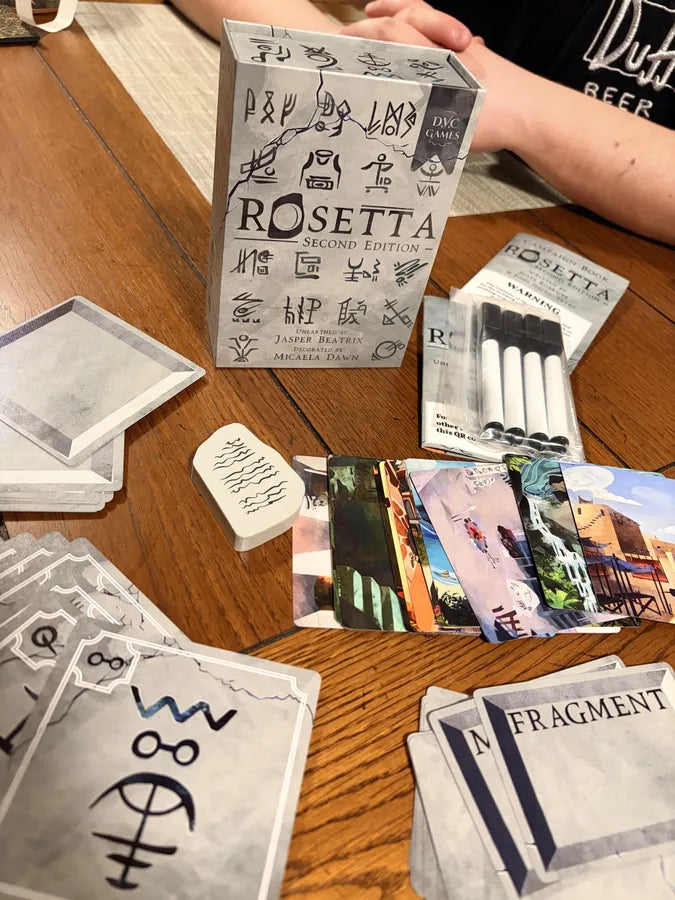
At the table: the Experts say a word, the Author translates it into the invented alphabet. Each translation reveals something about the system: vowels, consonants, structure, recurring symbols. The goal is to propose a word that, when translated, matches the initial inscription. The fewer attempts it takes, the better. It's a game of pure pattern recognition, where success comes from the ability to read between the lines of a language that didn't exist before.
What they say abroad
A linguistic puzzle that turns every game into a decoding experiment. Each group invents a different system, each game is unique.
— FroGames
It's like solving the Rosetta Stone, but in 25 minutes and with badly drawn symbols by your friend.
— FroGames

Rosetta: The Lost Language
FrogScore · FroGames editorial rating · based on rules, international reviews and game sessionsThe tools of decipherment
What you use to decipher the alphabet
Mysterious Inscription
The phrase to guess, written in the alphabet invented by the Author. It's the starting point: meaningless symbols that become meaning.
Word Cards
Experts propose words. The Author translates them into the invented alphabet. Each translation is a clue: recurrences, structure, length.
Writing System
The Author invents rules for their alphabet: symbols for vowels, consonants, double letters, capital letters. Experts must deduce them by observing the translations.
Attempt Counter
Each proposed word is an attempt. The fewer attempts it takes to guess the inscription, the better the score. The game is cooperative against the system.
Recommended Sleeves 45 cards in 3 sizes ▼
If you play often, we recommend protecting your cards with clear sleeves to make them last longer.
| Size | Quantity |
|---|---|
| 89 × 89 mm | 30 |
| 57 × 87 mm | 10 |
| 44 × 67 mm | 5 |
| Total cards | 45 |
In half an hour, you'll have deciphered a language that didn't exist an hour ago. It's always like that with Rosetta.
Come si gioca
Video dimostrativo di gameplay.
A game in five moments
What happens at the table
Not the rules. The experience.
The incomprehensible inscription
The Author writes a sentence in an invented alphabet. The Experts look at it: random symbols, curves, lines, shapes. Zero clues. Only the length of the sentence and the number of words. They start in the dark.
The first attempts
The Experts suggest simple words: 'house', 'sun', 'sea'. The Author translates them. They look for recurrences in symbols, double letters, vowels. Each translation adds a piece to the puzzle. The first hypotheses begin.
The breakthrough
Someone notices a pattern. A symbol that repeats in words with 'a'. A curve that only appears in long words. The system begins to emerge. Hypotheses become more precise. The table comes alive.
The almost correct word
An Expert proposes a word that perfectly matches the inscription... except for one symbol. Just one. General discussion: what does that difference mean? Is it a vowel? A double letter? A plural? The tension rises.
The solution
Someone says the right word. The Author translates it: it matches the inscription. Applause, laughter, discussion about how you didn't get it before. Count the attempts. Then someone asks: 'Another game?'. And it starts again.
How to play
The flow of each turn
A game is a sequence of attempts where each answer from the Author narrows the field.
They choose a secret word or phrase and translate it into their invented alphabet (created following rules known only to them). They show the inscription to the Experts.
They discuss and choose any word. The goal is to gather information about the writing system. Short words, long words, words with double letters: every choice is strategic.
They write the proposed word in their invented alphabet. The Experts observe: recurrences, new symbols, structures. Each translation is a clue.
If the translated word matches the initial inscription, the Experts win. Otherwise, they propose a new word. The game continues until a solution is found or resources are exhausted.
Why it's different from others
Six features that make a difference
Procedural writing system
The Author invents an alphabet on the spot, with consistent but personal rules. Each game is a different language. Zero setup, zero fixed components. Variability is total.
Pure inductive deduction
There are no explicit clues, only patterns to recognize. Each translation adds information but not answers. You have to build the rule by observing cases. It's applied linguistics, in 25 minutes.
Unique asymmetrical role
The Author does not play against the Experts: they play with them, but in an opposite role. They create the puzzle that the others solve. No one wins alone, but one holds the system and the others decode it.
Perfect scalability
It works identically with 2 or 5 players. With fewer players, fewer simultaneous hypotheses. With more players, more perspectives. The difficulty remains constant, only the speed of brainstorming changes.
Predictable duration
A game always lasts 20-30 minutes. There are no dead phases, no downtime. Every second is discussion or observation. Perfect for filling an evening without dominating the table.
Zero creative barriers
No need to know how to draw, no need for narrative imagination. Only internal consistency is needed. The Author can use very simple symbols: circles, lines, dots. Complexity arises from the rules, not from aesthetics.
How it ends
How to win and how to lose
Rosetta is cooperative: everyone wins or everyone loses. The score measures efficiency, not victory.
Victory
- An Expert proposes a word which, translated by the Author, exactly matches the initial inscription
- The group has successfully deciphered the writing system
- The final score is the number of attempts made (less is better)
Defeat (optional)
- The group decides to give up without finding the solution
- An agreed-upon attempt limit is reached (variant)
- The Author makes errors in their system and renders the puzzle unsolvable (rare, but it happens)
Rosetta transforms linguistic deduction into an accessible game. No algorithms, no tables: just observation and shared logic.
Frequently asked questions
FAQ about Rosetta: The Lost Language
Do you need to know how to draw to be the Author?
No. The Author can use very simple symbols: circles, lines, dots, crosses. What matters is the internal consistency of the system, not the aesthetics. Even an alphabet made of sticks works perfectly.
Is it a suitable game for children?
Yes, from 8 years old and up. The mechanic is intuitive: suggest words and observe how they are written. Children often grasp patterns faster than adults. Use simple words and basic writing systems for the first games.
How difficult is it to invent a writing system?
Simpler than it seems. The Author only needs to decide a few rules: a symbol for each letter, or for groups of letters, or for sounds. The game provides examples and guidelines. The first few games require a few minutes of preparation, then it becomes automatic.
Can it be played multiple times in a row?
Yes, and that's how it works best. Each game lasts 25 minutes. After the first, the group understands the mechanics and subsequent games become smoother. Each Author brings a different system, so there's no repetition.
Is it available in Italian?
The edition for sale is in English, but the game is completely language independent. The cards have English words, but the Author and Experts can use any language to play. The invented writing system has no linguistic constraints.
Rosetta: The Lost Language is a cooperative linguistic deduction game for 2-5 players, lasting 25 minutes, ages 8+. Designed by Jono Naito and published by Story Machine Games, Rosetta transforms each game into a decoding experiment: one player invents an imaginary alphabet, the others must decipher it by proposing words and observing how they are transcribed. Pure pattern recognition mechanic, zero luck, infinite replayability. Each writing system is different, each game is a new puzzle. Perfect for families, mixed groups, evenings where you want a quick and brainy cooperative game. Available on FroGames.it.
Rosetta: The Lost Language
Frequently Asked Questions
The answers you're looking for, no beating around the bush.
📸Do the images match the actual product?
The photos on the website often come from BoardGameGeek and are intended to give you an idea of the game. They may vary slightly from the version you receive. The content declared by the publisher is always binding.
📦Does the content of the box match what is indicated?
We always strive to provide the correct content, but minor variations are possible due to reprints or updates. The information comes directly from the publishers. If you have any questions, please contact us!
⏳How do pre-orders work?
Pre-order the game before release, payment is immediate, and the game is reserved for you. As soon as it arrives, we'll ship it right away! If there are any delays, we'll update you promptly.
🔒Can I trust buying here?
Absolutely! Secure payments, tracked shipments, and a team that loves board games as much as you do. If something goes wrong, we'll do our best to fix it.
🛠There's a problem with my order, what should I do?
Write to us now! Whether it's a missing part, damage, or an error, we'll help you resolve it as soon as possible. Your experience truly matters to us.
- Choosing a selection results in a full page refresh.
- Opens in a new window.