


Trick to the Future
🐸 Dettagli da BoardGameGeek
Consiglio BGG sul numero di giocatori
Categorie
Meccaniche
Design & Art
Lingua
Pre-order - leggi i dettagli
🐸 Una rana saggia sa quando dividere l’ordine… e quando aspettare il salto giusto.
Pairs well with
FroGames — Moments You'll Remember
Someone spends all their fuel on the first jump. Someone waits. Someone wins three tricks and returns to zero points. And in the end, no one knows what era they're in anymore.
WHAT IT'S ABOUT
Time travel with a deck of cards and a fuel reserve
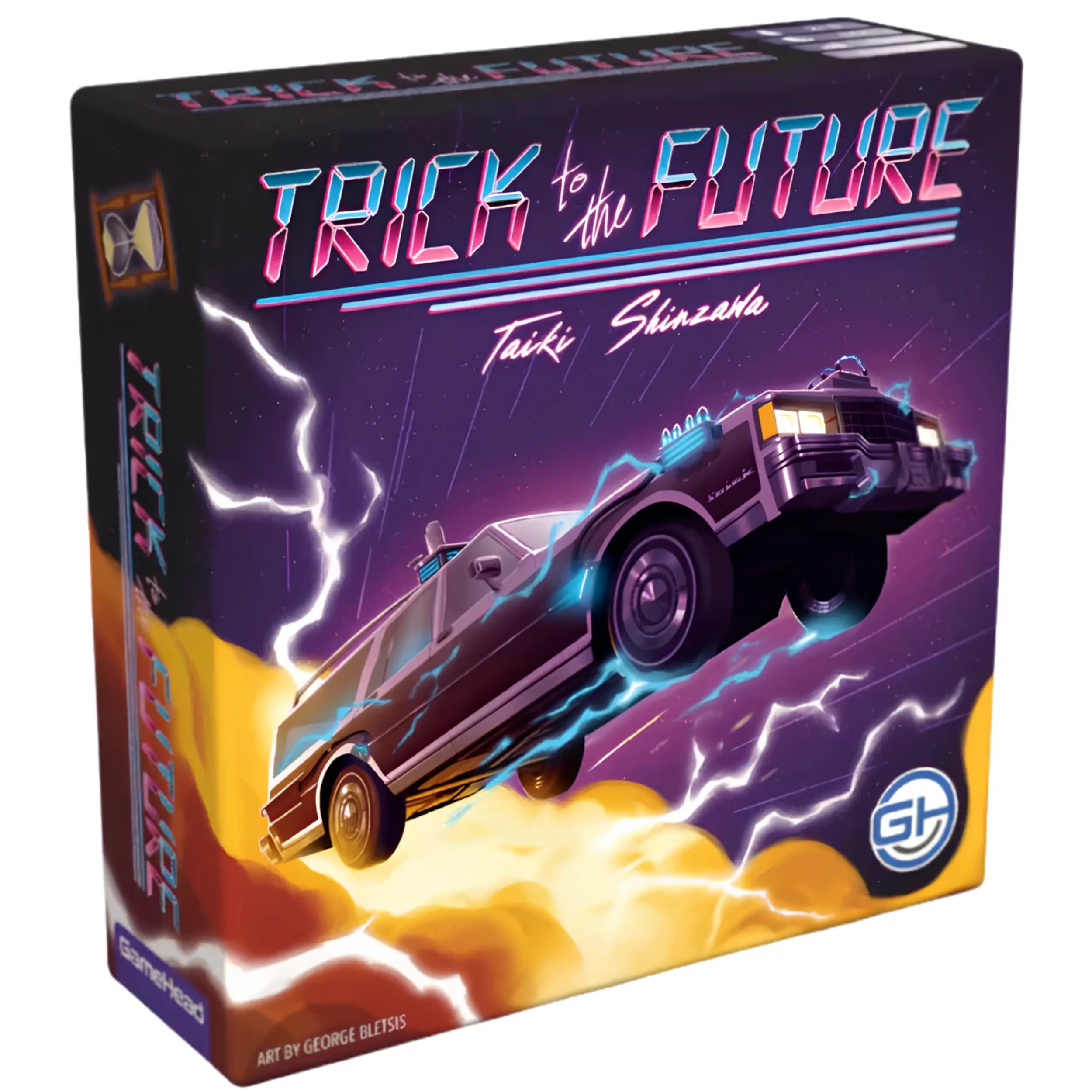
Taiki Shinzawa (a game designer with a strong mathematical identity) brings trick-taking into an era where cards are not fixed. George Bletsis dresses it all up with a clean sci-fi aesthetic, where numbers are 7-segment digital displays. GameHead publishes the game in its Thinky Games series, dedicated to titles that require more thought than reflexes.
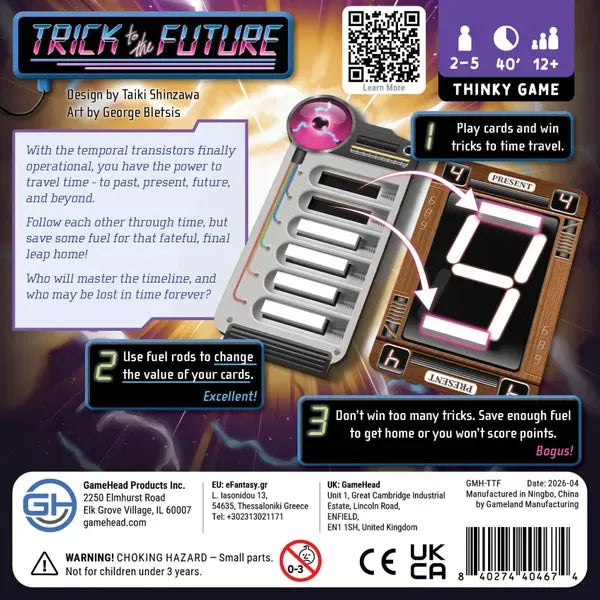
You have a hand of cards with numbers from 0 to 9, displayed as if on an old digital display. Each turn you play a card to win the trick. But your board has fuel sticks: by spending them, you can add segments to your number and transform it. A 1 becomes 7. A 7 becomes 0. You win tricks, accumulate fuel spent by others, but if at the end of the round you have more tricks than remaining fuel, you reset your score. Three rounds, whoever has the most points wins.
What they say abroad
A game where fuel is more valuable than victory itself.
— FroGames
Every card is a decision between winning now or surviving later.
Every card is a decision between winning now or surviving later.
— FroGames

Trick to the Future
FrogScore · FroGames editorial rating · based on rules, international reviews and game sessionsWhat's on your board
Fuel, digital numbers, and temporal sticks
7-segment cards
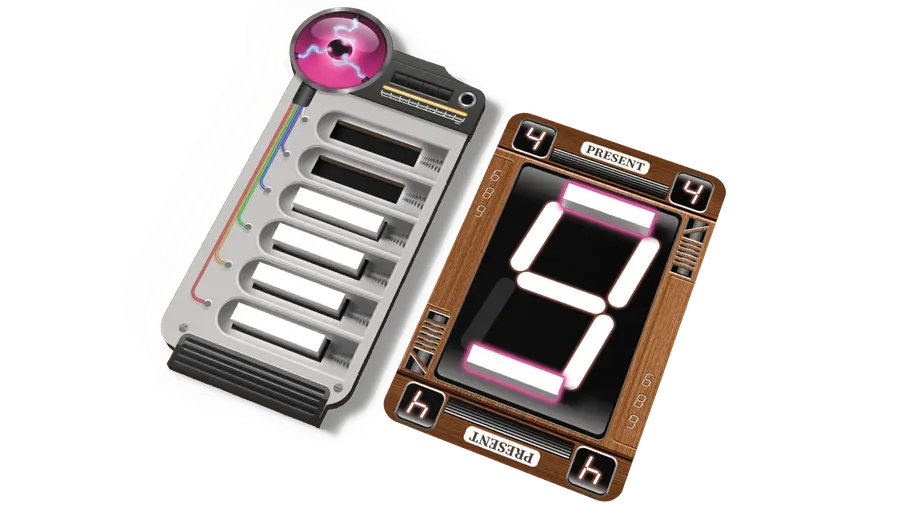
Each number is represented as on a digital display. The segments are visible: just add one to change everything.
Fuel sticks
These are physical segments that you place on the card to modify the number. A 1 becomes 7 with just one segment at the top. A 7 becomes 0 with three.
Personal board
Each player has a fuel reserve. It starts full, then quickly empties. If you end up with fewer tricks than fuel remaining, you reset the round.
Tricks won
Each trick is a successful time jump. It's worth points, but it brings you closer to your fuel limit. Too many jumps and you get stuck in the wrong era.
In a few hours someone will have won three tricks and scored zero points. And they'll say it's the fuel's fault, not the strategy.
A game in five moments
What happens at the table
Not the rules. The experience.
Deal the cards and look at your reserve
Everyone has a hand, a board, and intact fuel sticks. Someone is already calculating how many tricks they can afford. Someone plays the first card without thinking. No one yet knows that the fuel always runs out faster than you think.
Someone spends three sticks to win
The first trick is appealing. Someone turns a 3 into a 9 with three segments. The others look at the board and think: they could have waited. But it's too late. The spent fuel goes to the center, ready to be collected.
The countdown becomes real
Mid-round. Someone has won three tricks and has two sticks left. Someone has won zero tricks but still has five sticks. Those who have won too much start losing on purpose. Those who have won too little start pushing. The table understands that the game is not about who wins the most tricks, but who survives best.
Someone zeros out the score
End of round. Tricks won and remaining fuel are counted. Someone has four tricks and three sticks: score zero. Someone has two tricks and four sticks: they keep everything. The table understands that winning is a trap, but losing is worse.
After three rounds, someone gets it
End of game. The winner is the one who optimized every jump, collected fuel spent by others, and never exceeded the limit. The loser is the one who won too much or too little. Someone says: "One more." Someone says: "This time I'll count better."
How to play
The flow of each round
Classic trick-taking, but with a resource that changes everything.
In turn, everyone plays a card from their hand. The number is the one printed, but you can modify it with fuel before revealing it.
Take sticks from your board and add them to the card to change the number. A 1 becomes 7, a 5 becomes 9. Each segment spent remains on the card.
Whoever played the highest number wins the trick. They take all played cards and all fuel spent by opponents. The won fuel returns to their board.
After all tricks, you count: tricks won vs. fuel remaining. If you have more tricks than fuel, you reset your score to zero. Otherwise, you score points for tricks and collected fuel. After three rounds, the player with the most points wins.
Why it's different from others
Six mechanics that make a difference
Modifiable 7-segment numbers
These are not fixed printed numbers. They are digital displays. Every segment you add changes the value of the card. A 1 can become 7, a 7 can become 8, a 5 can become 9. The math is elegant and visual: you immediately see what you can do.
Fuel is the key resource
You don't just win tricks. You win fuel spent by others. Every stick an opponent uses to modify a card goes to the center of the trick. Whoever wins the trick collects it and returns it to their board. It's a cycle: spend to win, win to recover.
Too much success destroys you
If at the end of the round you have more tricks won than fuel remaining on your board, you reset your score. Zero. No matter how many tricks you took. Win too much and lose everything. It's a brutal rule that flips every traditional trick-taking game on its head.
Losing on purpose becomes a tactic
Mid-round, if you have too many time jumps, you start to lose intentionally. You play low cards, conserve fuel, let others win. But if you lose too much, you don't accumulate points. The balancing act is constant and exhausting.
Card counting is essential
The deck is fixed, the numbers are known. Players who play well count what has been played, calculate what remains, and know exactly how many segments are needed to win. It's not luck: it's pure math.
Three rounds, different strategies
The first round is exploration. The second is optimization. The third is tight counting. The winner is the one who adapts their strategy to the accumulated score and remaining fuel. There is no single winning formula.
How it ends
How to win and how to lose
After three rounds, the player with the most points wins. But points don't just come from tricks.
Victory
- Win enough tricks to accumulate points, but not enough to reset the round
- Collect fuel spent by opponents by winning the right tricks
- Constantly balance tricks won and fuel remaining, without ever exceeding the limit
Reset
- End a round with more tricks won than fuel on your board: you reset everything
- Win too few tricks and don't accumulate enough points in the three rounds
- Spend too much fuel in the first tricks and run out of resources for the final phase
Trick to the Future is a game of mathematical balance where winning too much is as dangerous as losing too much. Every trick is a calculation, every segment spent is a gamble.
Frequently asked questions
FAQ about Trick to the Future
Do I need to know trick-taking to play?
No. The basic system is simple: you play a card, whoever has the highest number wins. The novelty is the fuel: you can modify the number before playing. Rules in 10 minutes, but the strategy is deep.
What happens if I reset the score in a round?
You lose all points for that round, but not those from previous rounds. If you scored 12 points in the first round and reset in the second, you remain at 12. But you lost an entire round. It's a heavy penalty.
Does the collected fuel really return to my board?
Yes. When you win a trick, you take all the fuel others have spent on those cards and return it to your reserve. It's a cycle: spend to win, win to recover. But if you spend more than you recover, you're in trouble.
Does it work well with 2 players?
Yes, it's one of the best trick-taking games for 2 players. The duel is tight, every move counts double, fuel is even more precious. In 3-5 players there is more chaos and more fuel circulating, but 2 players is where the tension is highest.
Is it available in Italian?
No, this GameHead edition is in English. But language has little impact: the cards are 7-segment numbers, the rules are short and clear. After the first game, everything is visual.
Trick to the Future is a trick-taking game for 2-5 players, 40 minutes, ages 12+. Designed by Taiki Shinzawa and published by GameHead, it brings trick-taking into a system where cards use 7-segment numbers modifiable with fuel sticks. Each trick won is a time jump, but if you end a round with more tricks than fuel remaining, you reset your score. Mathematical strategy, resource management, and card counting merge in a game where winning too much is as dangerous as losing too much. Available on FroGames.it.
Trick to the Future
Frequently Asked Questions
The answers you're looking for, no beating around the bush.
📸Do the images match the actual product?
The photos on the website often come from BoardGameGeek and are intended to give you an idea of the game. They may vary slightly from the version you receive. The content declared by the publisher is always binding.
📦Does the content of the box match what is indicated?
We always strive to provide the correct content, but minor variations are possible due to reprints or updates. The information comes directly from the publishers. If you have any questions, please contact us!
⏳How do pre-orders work?
Pre-order the game before release, payment is immediate, and the game is reserved for you. As soon as it arrives, we'll ship it right away! If there are any delays, we'll update you promptly.
🔒Can I trust buying here?
Absolutely! Secure payments, tracked shipments, and a team that loves board games as much as you do. If something goes wrong, we'll do our best to fix it.
🛠There's a problem with my order, what should I do?
Write to us now! Whether it's a missing part, damage, or an error, we'll help you resolve it as soon as possible. Your experience truly matters to us.