


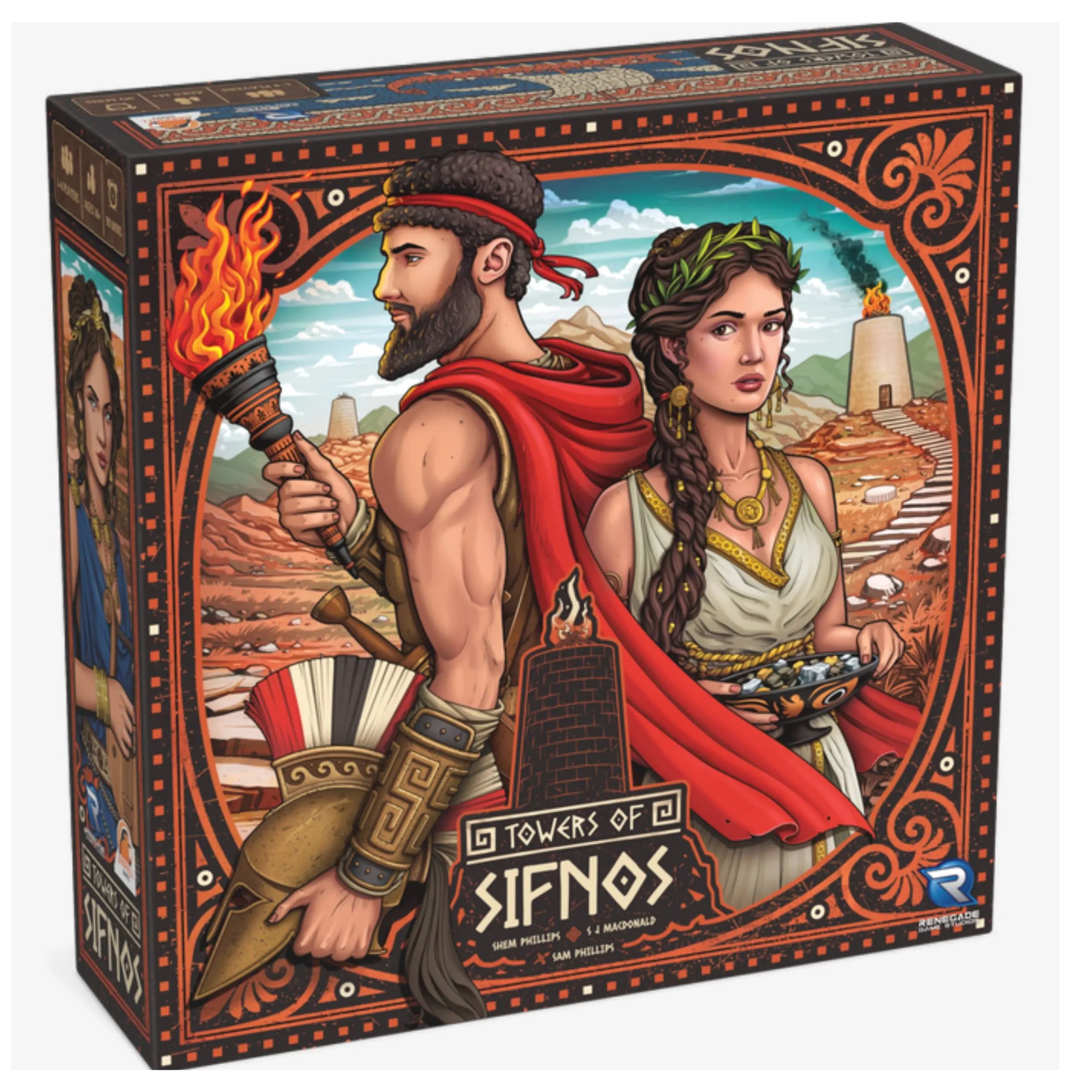
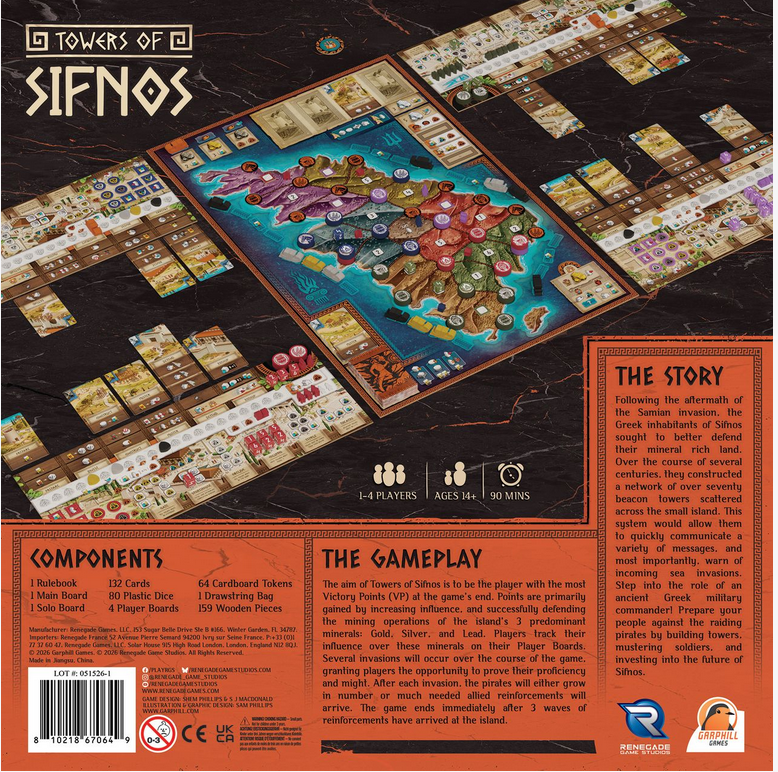
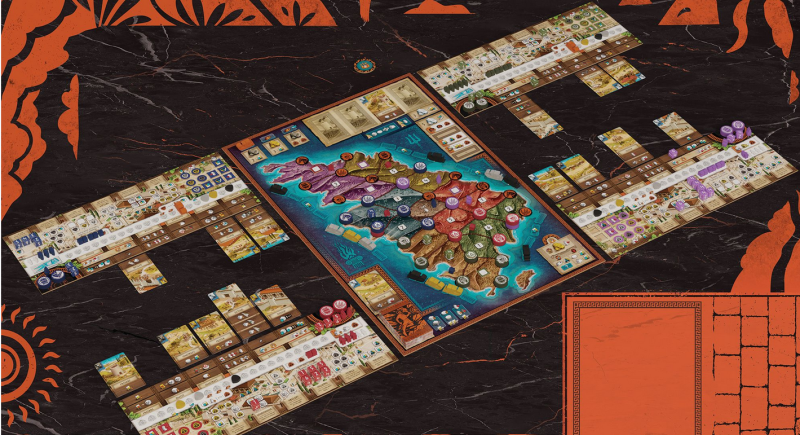
Towers of Sifnos
🐸 Dettagli da BoardGameGeek
Consiglio BGG sul numero di giocatori
Categorie
Meccaniche
Design & Art
Lingua
Pre-order - leggi i dettagli
🐸 Una rana saggia sa quando dividere l’ordine… e quando aspettare il salto giusto.
Pairs well with
FroGames — Moments You'll Remember
Sifnos burns under the Greek sun. Sentinels scan the horizon, soldiers await orders, minerals fill the crates. Then someone shouts: black sails on the horizon. And the table holds its breath.
WHAT IT'S ABOUT
Defending a Greek island from Samiot raids
After the Samiot invasion, the inhabitants of Sifnos decided not to be caught off guard a second time. Over several centuries, they built over seventy signal towers scattered across the island: a military communication system that would allow every corner of the island to be quickly warned of sea invasions. Shem Phillips and S J Macdonald (Garphill Games' Ancient Anthology series) recreate that defensive system in a thematic eurogame where every tower, every soldier, and every resource counts. Illustrated by Sam Phillips.
At the table, you are a Greek military commander. You build towers to communicate and defend, gather soldiers to repel pirates, and invest in mining operations that extract gold, silver, and lead. Each invasion gives you the opportunity to demonstrate your influence over the three main minerals: whoever controls the resources wins. Cards have multiple uses, towers create strategic networks, enemy waves grow until allied reinforcements arrive. Three waves of reinforcements, then the game ends and victory points are tallied.
What they say abroad
A system of towers that not only defends, but controls.
— FroGames
The best choices are always made under pressure. And pirates don't wait.
— FroGames

Towers of Sifnos
The game includes official solo rules with dedicated variants that simulate the pressure of invasions. The experience is complete and maintains the tension of building-defending-investing, but it obviously loses the direct competition for area majorities that characterizes multiplayer.
FrogScore · FroGames editorial rating · based on rules, international reviews and game sessionsWhat you hold in your hand
Every card has three possible uses
Command cards
Each card can be played to build a tower, rally soldiers, or invest in mines. Choose which side to use, the rest you discard. The most painful decisions arise here.
Soldiers
It's not enough to have towers: you need men to defend the mines during invasions. Gather them at the right moments, because the waves grow and pirates don't forgive those who are unprepared.
Minerals
Gold, silver, lead: three tracks of influence on your board. The more you invest in a mineral, the more valuable it is during invasions. But you have to choose where to focus, you can't dominate everything.
Tower network
Over seventy historic towers scattered across Sifnos. You build a part of them, creating connections between areas of the island. The network gives you points, communication, and territorial control. Others' networks block you.
Recommended sleeves 132 cards in 1 size ▼
If you play often, we recommend protecting the cards with transparent sleeves to make them last longer.
| Size | Quantity |
|---|---|
| 54 × 86 mm | 132 |
| Total cards | 132 |
At the end of the third wave of reinforcements, you'll count towers, soldiers, influence. But you'll remember the turn you chose to build instead of defend.
A game in five acts
What happens at the table
Not the rules. The experience.
Greek Foundations
Early turns: build the first tower, place the first soldiers, invest in a mineral. The board is almost empty, possibilities are infinite. Choose where to focus, knowing that others are making the same calculation. The network begins to take shape, slowly but irreversibly.
First Invasion
Black sails appear on the horizon. The first wave of pirates arrives, and everyone shows how much they've invested in defenses. Soldiers fight, influence over minerals is counted, someone discovers they miscalculated. The pirates are repelled, but their numbers grow.
Expansion Under Pressure
Mid-game: the network of towers intertwines, island zones begin to be contested, multi-use cards force you to sacrifice one action to choose another. Every turn is a renunciation. Soldiers are never enough; influence over one mineral grows at the expense of others.
Second Invasion
The pirates return stronger. Those who built towers instead of gathering soldiers now pay the price. Those who invested everything in one mineral win that majority but lose the others. The first allied reinforcements arrive, but the countdown to the end of the game has begun.
Third Wave and Scoring
Last invasion, last soldiers, last chance to gain influence. Then the third reinforcements arrive and the game ends. Victory points are counted: towers built, influence over minerals, surviving soldiers. Someone wins by one point, someone else discovers that one more tower would have changed everything.
How to play
The flow of each round
Each round is a sequence of individual turns until an invasion is triggered or reinforcements arrive.
Choose a card from your hand and use it for one of three possible effects: build a tower, gather soldiers, or invest in a mineral. The card's other two effects are discarded. Choice matters more than luck.
Place towers on the map, creating connections in the network, add soldiers to your defensive reserves, or move influence markers on your gold/silver/lead tracks. Every action has immediate and future consequences.
Some cards trigger events: pirate invasions (fight and count influence over minerals) or the arrival of allied reinforcements (which advance the countdown to the end of the game). Each invasion gives you points if you have defended well.
Replenish your hand by drawing new cards, and the turn passes to the next player. The cycle continues until the third wave of reinforcements ends the game and final victory points are tallied.
Why it's different from others
Six mechanics that make a difference
Network of historic towers
Over seventy historically existing towers on Sifnos, reconstructed as an interconnected defensive system. You don't just place towers randomly: you create connections between island zones, and each tower is worth more if connected to others. The network grows slowly but becomes a engine for points and territorial control.
Triple-use cards
Each card has three different sides: construction, soldiers, minerals. You choose one, discarding the other two. The tension arises from giving up two actions to choose just one. You manage your hand, but painful choices remain.
Progressive Invasions
Pirates don't all arrive at once: invasions are dictated by the card deck and grow in intensity. Each wave forces you to demonstrate how much you've invested in defense and influence. Those unprepared lose points, those who planned well gain them.
Influence over three minerals
Gold, silver, lead: three tracks on the board representing your control over Sifnos's mines. The more you invest in a mineral, the more it's worth during invasions. But you can't dominate them all: you must choose where to focus and accept losing ground on the others.
Triggered End Game
You don't play a fixed number of rounds: the game ends after three waves of allied reinforcements mixed into the event deck. This creates a variable rhythm: some games are longer, others more condensed. You must read the deck and understand when to speed up.
Competitive Majority
You don't just win by building towers: you win by controlling influence over minerals better than others. Invasions are when everyone shows their investments, and whoever has the majority collects the points. Interaction is constant but indirect: you watch what others do and adapt your strategy.
How it ends
How to win and how to lose
The game ends immediately after the third wave of allied reinforcements. Victory points are counted.
Victory
- Well-built tower network: each connected tower is worth points; strategic connections multiply the value
- Majority over minerals during invasions: whoever controls gold, silver, or lead gains points every time pirates attack
- Effective soldiers and defenses: successfully repelling invasions brings additional victory points
Defeat
- Isolated towers: building without creating a network leaves points on the table; disconnected towers are worth little
- Scattered investments: whoever tries to control all three minerals ends up dominating none and loses all majorities
- Insufficient defenses: showing up to invasions without soldiers means giving points to prepared opponents
Towers of Sifnos is Greek defensive strategy where every tower, every soldier, and every mineral tells the story of an island learning to defend itself.
Frequently Asked Questions
FAQ about Towers of Sifnos
How complex is it compared to other Garphill games?
We're at a medium complexity for Garphill standards: more accessible than Imperium or Hadrian's Wall, probably similar to Circadians or Raiders of Scythia. The rules are clear, multi-use card management requires planning but isn't overwhelming. Rules in 20 minutes, first full game in 90-100 minutes, then drops to 60-75.
Is the tower network just thematic, or does it really matter?
It definitely matters: towers are only worth points if they are connected to each other and to key areas of the island. An isolated tower is worth little; a well-built network multiplies its value. You must plan connections by watching what others do, because their towers can block you or steal strategic areas.
How does the solo mode work?
The game includes official solo rules with dedicated variants that maintain the pressure of invasions and the challenge of network building. There is no complex automaton: the system simulates competition through objectives and defeat conditions. The experience is solid, losing direct interaction for majorities but retaining strategic tension.
Are invasions predictable or random?
They are shuffled into the event deck, so you know they will come but not exactly when. This forces you to prepare constantly instead of optimizing only pre-invasion turns. Some games have close invasions, others more spaced out: the variability is intentional and changes the strategic pace.
Is it available in Italian?
No, this edition is in English. The game has text on the cards (actions and effects) and requires a good familiarity with the language to play fluidly. Garphill Games has not currently announced Italian localizations for the Ancient Anthology series.
Towers of Sifnos is a strategy game for 1-4 players set in ancient Greece, where you build defensive tower networks on the island of Sifnos to protect gold, silver, and lead mines from pirate invasions. Designed by Shem Phillips and S J Macdonald for Garphill Games, the game combines multi-use card management, competitive area majority, and network building in games lasting 60 to 90 minutes. Each card offers three choices (build towers, gather soldiers, invest in minerals), invasions dictate the pace, and the interconnected tower network generates victory points. Includes official solo mode. Recommended age 13+. Available on FroGames.it.
Towers of Sifnos
Frequently Asked Questions
The answers you're looking for, no beating around the bush.
📸Do the images match the actual product?
The photos on the website often come from BoardGameGeek and are intended to give you an idea of the game. They may vary slightly from the version you receive. The content declared by the publisher is always binding.
📦Does the content of the box match what is indicated?
We always strive to provide the correct content, but minor variations are possible due to reprints or updates. The information comes directly from the publishers. If you have any questions, please contact us!
⏳How do pre-orders work?
Pre-order the game before release, payment is immediate, and the game is reserved for you. As soon as it arrives, we'll ship it right away! If there are any delays, we'll update you promptly.
🔒Can I trust buying here?
Absolutely! Secure payments, tracked shipments, and a team that loves board games as much as you do. If something goes wrong, we'll do our best to fix it.
🛠There's a problem with my order, what should I do?
Write to us now! Whether it's a missing part, damage, or an error, we'll help you resolve it as soon as possible. Your experience truly matters to us.