


The Mediterranean Sea
🐸 Dettagli da BoardGameGeek
Consiglio BGG sul numero di giocatori
Categorie
Meccaniche
Design & Art
Lingua
Pre-order - leggi i dettagli
🐸 Una rana saggia sa quando dividere l’ordine… e quando aspettare il salto giusto.
Pairs well with
FroGames — Moments You'll Remember
Someone builds the fleet. Someone fortifies the routes. Someone controls the temples. And in the end, the one who chose the right path between trade and conquest wins.
WHAT IT'S ABOUT
Two paths to Phoenician greatness
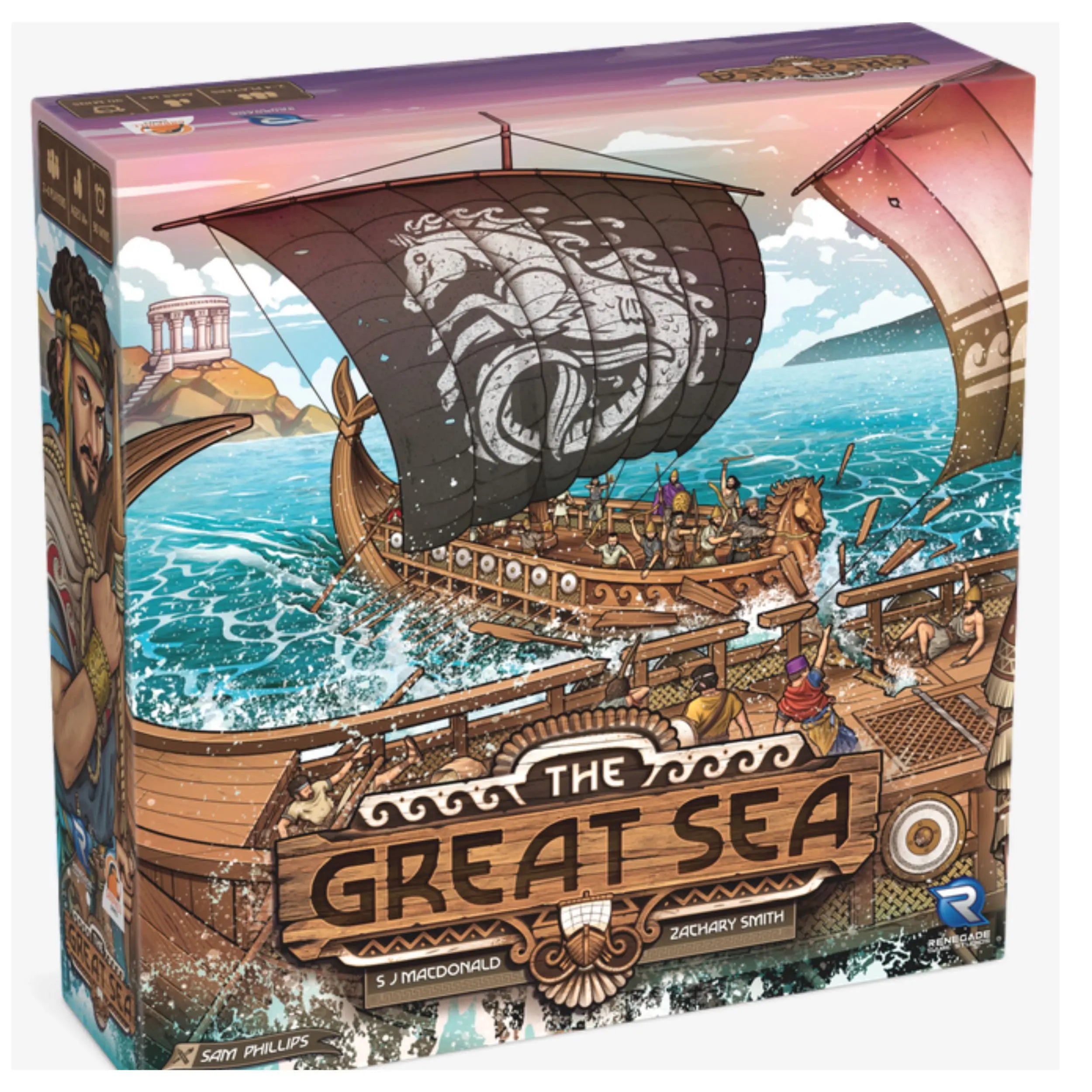
From the Levant to Carthage, the Phoenicians dominated the Mediterranean like no other people. Designed by S J Macdonald and Zach Smith for Garphill Games (Ancient Anthology series), The Great Sea puts you in charge of Tyre, Sidon, Byblos, or Arwad. War biremes sail the waters, merchants transport purple cloths, artisans produce precious glass. And the ancient temples scattered across the map become the focus of your power.
Build ships, move them along routes, fortify trade or prepare for conquest. You research naval and land technologies, control sacred sites, and play cards to resolve conflicts. The game ends as soon as your temple marker reaches that of trade or conquest: the winner is whoever chose a path and followed it to the end. Pure duality, no comfortable hybrid.
What they say abroad
We promise ancient naval tension with difficult choices and an unforgiving race for control.
— FroGames
The Mediterranean doesn't wait. Either you control the temples, or you fall behind.
— FroGames

The Great Sea
FrogScore · FroGames editorial rating · based on rulebook, international reviews, and game sessionsThe instruments of domination
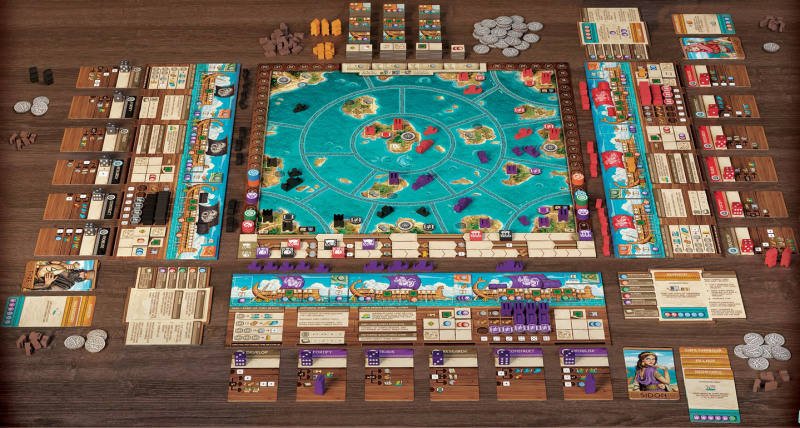
What you hold in your hands
Biremes
Phoenician warships. Fast, lethal, they dominate the routes. Build them, move them, place them where needed. Each bireme is a piece of direct control over the sea.
Ancient temples
Scattered across the map, they are the heart of the game. Control a temple, advance on the track. Your temple marker must reach that of trade or conquest. It's a race, not a stroll.
Conflict cards
Resolve battles by playing cards from your hand. No dice: the one who planned best wins. Hand management becomes pure tactics.
Technologies
Research naval and land improvements. Each tech opens new options: stronger ships, faster movements, more stable control. Invest wisely or fall behind.
Recommended sleeves 112 cards in 1 size ▼
If you play often, we recommend protecting your cards with transparent sleeves to make them last longer.
| Size | Quantity |
|---|---|
| 54 × 86 mm | 112 |
| Total cards | 112 |
In the end, someone will have dominated the temples. And you will know if you chose the right path or followed the wrong one for too long.
A game in five moments
What happens at the table
Not the rules. The experience.
Initial Deployment
You choose your Phoenician city, place your first ships, and look at the map. The temples are scattered, equidistant. Someone says "I'm going all in on trade." Someone else remains silent and builds three biremes in a row. The table immediately understands who will do what.
First Routes, First Clashes
You move your ships, fortify a trade route, place a marker on a temple. Someone blocks you. First conflict with cards: you play one, he plays two. You lose. The temple remains his. You realize your hand needs to be managed better.
The Race Forks
Half the table pushes for trade, the other half for conquest. The tracks move in opposite directions. You're in the middle, undecided. You control two temples, but not enough to close. Someone advances quickly. You have to choose: specialize or remain hybrid and lose.
The Overtake Moment
A player synchronizes the temple marker with the conquest marker. Only one space left. Everyone looks at the map, counts his ships, calculates if he can close next turn. You play all your best cards to block him. It works. For one round.
Victory by Synchronization
Someone closes. Their temple marker has reached the trade marker. Game over. No last turn, no draw. The Great Sea rewards those who choose a path and follow it without doubt. The others count points that don't matter.
How to play
The flow of each round
Each round is a sequence of simultaneous actions and conflict resolution. No long turns: everyone acts, then conflicts are resolved.
Play cards from your hand to build ships, move them, research technologies. You plan in secret, reveal along with the others.
Move ships along routes, fortify trade connections, place markers on temples. Each area can be contested.
If two or more players occupy the same area, a conflict is played with cards. The winner controls the temple or route.
Advance on the trade, conquest, and temple tracks based on controls. If the temple marker reaches one of the other two, you win immediately.
Why it's different from others
Six mechanics that make a difference
Synchronized double victory condition
You don't accumulate points. You must make the temple track coincide with either the trade OR the conquest track. It's a two-variable race: control temples and push towards one of the two paths. Those who remain hybrid lose.
Conflicts resolved with cards, zero dice
Every battle is hand management. You play a card, the opponent plays one. Whoever has planned their hand better wins. No luck, only choices. And used cards don't return immediately.
Pure naval area control
Biremes move along Mediterranean routes, block passages, control temples. The sea is a war board, not a decorative theme. Each ship is a direct control piece.
Temples as strategic focal points
The sacred sites scattered across the map don't give points: they move the track that decides victory. Controlling them is mandatory, but not enough. You also have to choose whether to push them towards trade or conquest.
Asymmetric technological research
Each Phoenician civilization can research different tech. Stronger ships, special movements, enhanced temple control. The tech tree is streamlined but impactful: each choice opens one path, closes another.
Sudden end of game
No final point counting. The game ends as soon as someone synchronizes the tracks. You can be ahead everywhere, but if an opponent closes first, you lose. Constant tension until the last turn.
How it ends
How to win and how to lose
Victory is clear-cut: you synchronize the tracks, you end the game. There are no draws, no second places that matter.
Victory
- Your temple marker reaches the same space as the trade marker: immediate commercial victory
- Your temple marker reaches the same space as the conquest marker: immediate military victory
- You control enough temples and have pushed hard enough on one of the two paths: instant game end
Defeat
- An opponent synchronizes their tracks before you do: game over, you lose
- You divided resources between trade and conquest without specializing: you fall behind on both fronts
- You lost control of key temples: your temple track doesn't advance, while others do
The Great Sea rewards those who choose a path and follow it without doubt. The Mediterranean does not forgive the undecided.
Frequently Asked Questions
FAQ about The Great Sea
How important is hand management?
Crucial. Cards resolve conflicts, activate actions, move ships. Using them all at once leaves you without options in subsequent rounds. You must balance aggression and reserve: whoever empties their hand too early loses key conflicts.
Are the four Phoenician civilizations symmetrical or do they have different abilities?
They have slightly different initial setups and tech trees. They are not totally asymmetrical factions, but Tyre starts with more ships, Sidon with more trade, Byblos with more technologies, Arwad with more temples. The choice influences the initial strategy, but doesn't block it.
Can I win with a hybrid trade-conquest strategy?
No. The game forces you to choose: you must synchronize the temple track with ONE of the other two. Those who divide resources fall behind on both fronts. You can change paths mid-game, but it costs time. And time is victory.
How long does a game last with experienced players?
90-120 minutes declared, but with 4 experienced players, it's under two hours. Turns are simultaneous, so downtime is minimal. The game flows quickly, tension remains high.
Is it available in Italian?
No, this edition is in English. Texts on cards and rules in the original language. The game has an important card play component, so knowledge of English is necessary to play.
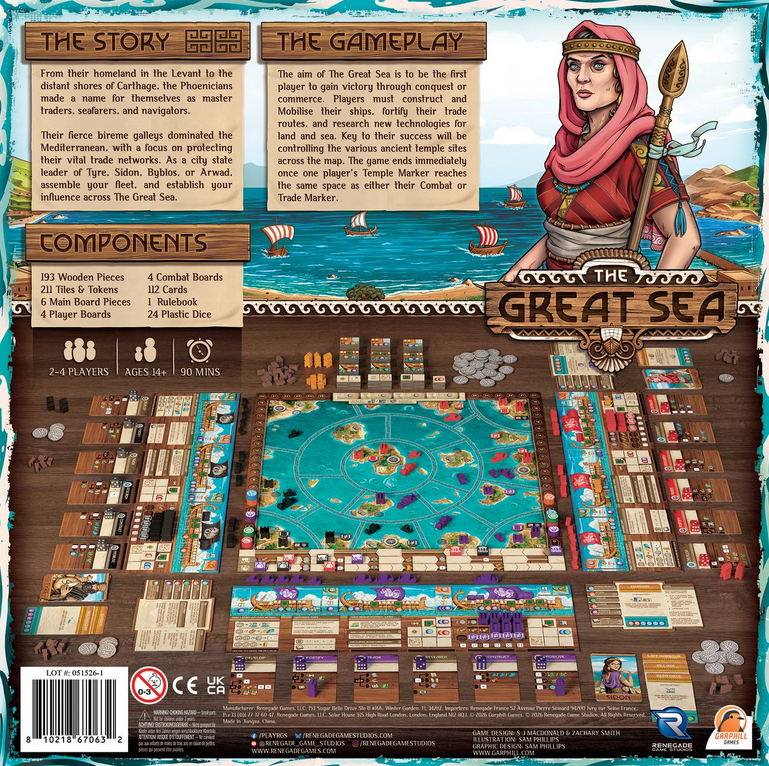
The Great Sea is a strategic board game for 2-4 players, 90-120 minutes, ages 14+, designed by S J Macdonald and Zach Smith for Garphill Games. Set in the ancient Mediterranean, it puts players in charge of Phoenician civilizations (Tyre, Sidon, Byblos, Arwad) in a race to control temples and trade routes. Core mechanics: area majority, hand management, card play conflict resolution, synchronized track movement. Victory comes when the temple track reaches either the trade or conquest track: no final points, just a bifurcated race that rewards those who choose a path and follow it without doubt. Conflicts resolved with cards, no dice. War biremes, naval technologies, direct area control. Available on FroGames.it.
The Mediterranean Sea
Frequently Asked Questions
The answers you're looking for, no beating around the bush.
📸Do the images match the actual product?
The photos on the website often come from BoardGameGeek and are intended to give you an idea of the game. They may vary slightly from the version you receive. The content declared by the publisher is always binding.
📦Does the content of the box match what is indicated?
We always strive to provide the correct content, but minor variations are possible due to reprints or updates. The information comes directly from the publishers. If you have any questions, please contact us!
⏳How do pre-orders work?
Pre-order the game before release, payment is immediate, and the game is reserved for you. As soon as it arrives, we'll ship it right away! If there are any delays, we'll update you promptly.
🔒Can I trust buying here?
Absolutely! Secure payments, tracked shipments, and a team that loves board games as much as you do. If something goes wrong, we'll do our best to fix it.
🛠There's a problem with my order, what should I do?
Write to us now! Whether it's a missing part, damage, or an error, we'll help you resolve it as soon as possible. Your experience truly matters to us.