


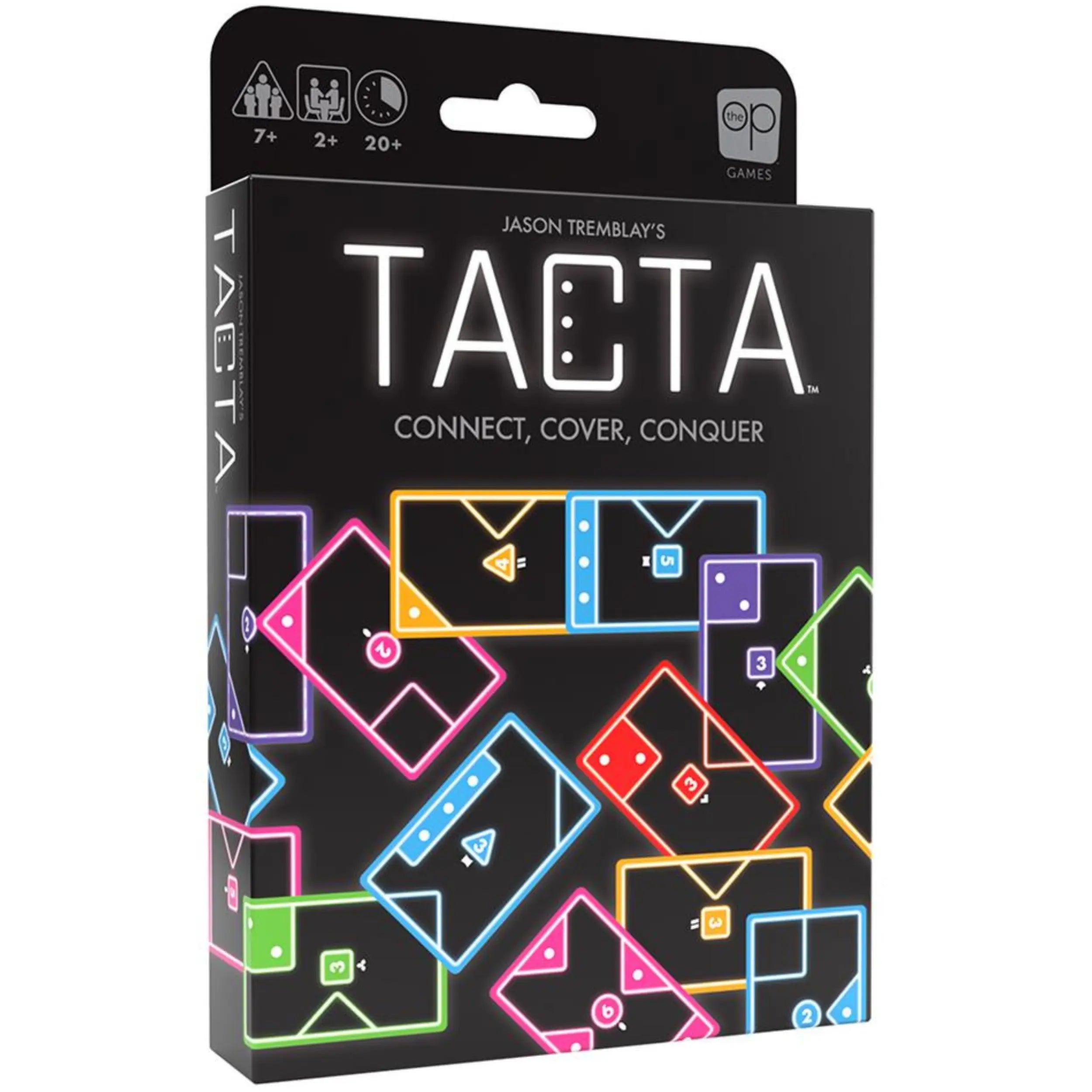
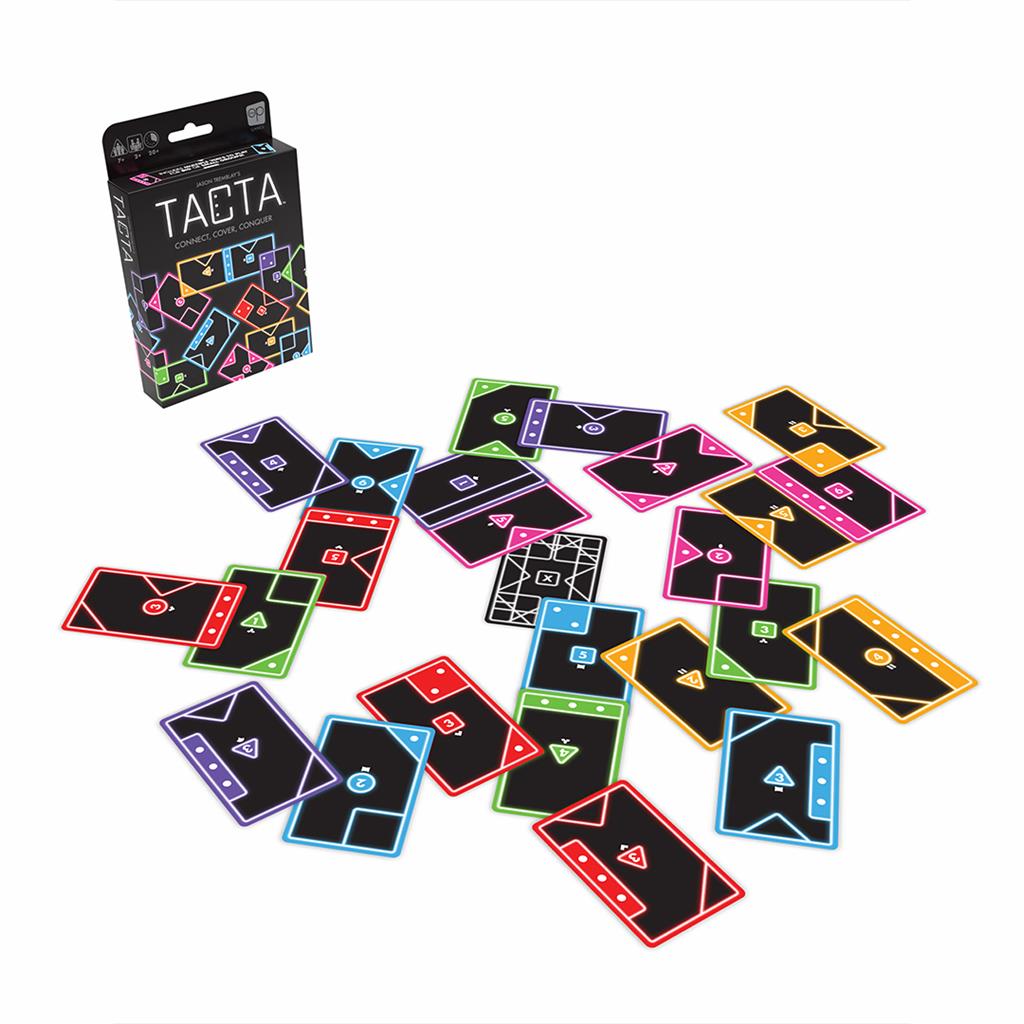
Tacta Peg Version
🐸 Dettagli da BoardGameGeek
Consiglio BGG sul numero di giocatori
Categorie
Meccaniche
Design & Art
Lingua
Pre-order - leggi i dettagli
🐸 Una rana saggia sa quando dividere l’ordine… e quando aspettare il salto giusto.
Pairs well with
FroGames — Moments You'll Remember
You flip the card, rotate it, place it. Cover your opponent's red triangle with your blue square. Every move changes everything, and by the end of the deck, the board is a kaleidoscope no one predicted.
WHAT IT'S ABOUT
A geometric puzzle that builds itself as you play
Tacta is an abstract game by Jason Tremblay, published in 2025 by The Op. It's an adaptable system: from a quick family showdown to a thoughtful two-player match. The cards are transparent, colors blend when overlapped, and the board is different every time.
You place cards with geometric shapes (squares, triangles, rectangles) trying to cover opponent's shapes with your colors. You flip, rotate, overlap. Each card modifies the state of the board, creating new opportunities or closing spaces. The player who controls the most areas when the cards run out wins.
What they say abroad
A game that makes you think in geometry, not military strategy.
— FroGames
Rules in five minutes, but every game feels like a new abstract painting.
— FroGames

Tacta
The game includes a solo mode with dedicated scenarios that ask you to build specific configurations within a number of moves. It works as an abstract puzzle, but it loses the direct interaction that makes Tacta brilliant at the table with more people.
FrogScore · FroGames editorial rating · based on rules, international reviews and game sessionsWhat's in the deck
Four elements that build the board
Shape Cards
Each card shows combinations of squares, triangles, and rectangles in one or more colors. They overlap, blend, and change control of areas.
Free Rotation
Before placing, rotate the card however you like. The same card can become a vertical defense or a horizontal expansion.
Chromatic Overlap
The cards are semi-transparent. When you overlap red with blue, purple is born. Geometry becomes chromatic, the board comes alive.
Dynamic Board
There is no fixed plan. The board grows with each card placed, in unpredictable directions. No two games are alike.
Recommended sleeves 218 cards in 2 sizes ▼
If you play often, we recommend protecting your cards with transparent sleeves to make them last longer.
| Size | Quantity |
|---|---|
| 64 × 89 mm | 109 |
| 56 × 87 mm | 109 |
| Total cards | 218 |
In twenty minutes, the table will be a mosaic of shapes and colors. And no one will be bored.
A game in five moments
What happens at the table
Not the rules. The experience.
Everyone places their first card
The table is empty. Everyone chooses where to start their territory. The first cards cannot be touched, they are separate islands. For now.
Territories draw closer
The first contact arrives. Someone places a card that touches another's border. You start to think in terms of overlapping, not just expansion.
The geometric battle
Now it's a chromatic war. Cover his red triangle with your blue square. He responds by rotating a card and creating a purple rectangle that claims two areas in one go.
The board explodes
The plan is no longer recognizable. Intertwining shapes, colors born from fusion. Someone realizes that they can still turn everything around with a well-rotated card.
End of deck, final count
The last card falls. Everyone looks at the board trying to count their areas. Someone had a plan, someone improvised. The winner smiles, but everyone wants to play again.
How to play
The flow of each turn
A turn lasts a few seconds, but it can change balances built up over ten minutes.
You have several options. Each card shows different shapes and colors. Decide which one to place.
You can orient the card in any direction. The same card becomes a defensive or offensive tool.
You place it adjacent to or overlapping existing cards. If you overlap, the colors merge and areas change control.
Fill your hand and pass the turn. The board grows, possibilities multiply.
Why it's different from others
Six mechanics that make a difference
Cards can be overlapped without constraints
There are no grids, no slots. You place where it makes sense to you, rotate as you wish, overlap freely. The board has no predefined shape.
Real chromatic fusion
The cards are semi-transparent. When red meets blue, it becomes purple. Colors physically blend, not by abstract rule. It's geometry becoming art.
Fluid area control
You don't conquer territories once and for all. Every overlap can overturn the control of an area. The game remains open until the last card.
True scalability from 2 to 6 players
With two players, it's a thoughtful geometric duel. With six, it's chromatic chaos with rapid placements. The game changes pace without changing rules.
Optional real-time mode
You can play classic turns or activate the timer. In real-time mode, everyone places simultaneously. The abstract game becomes frantic.
Emergent depth
You learn to play in five minutes. But after ten games, you discover patterns, attack angles, geometric defenses. Simplicity hides tactical layers.
How it ends
How to win and how to lose
When the cards run out, controlled areas are counted. Each shape of your color is worth one point.
Victory
- You control more geometric shapes (squares, triangles, rectangles) of your color than your opponents
- You built strategic overlaps that multiplied your areas without exposing too much territory
- You stole control from opponent areas with surgical placements in the last turns
Defeat
- You expanded too early without protecting your territory, leaving easy spaces to cover
- You didn't use card rotation, placing without thinking about attack angles
- You ignored opponent moves and woke up too late, when the board was already dominated
Tacta is geometry applied to board gaming. It doesn't require hours of study, it requires a willingness to think in shapes and colors. And to play again immediately after.
Frequently asked questions
Tacta FAQ
How different is it with 2 versus 6 players?
With two players, it's a thoughtful geometric duel, almost a pure abstract game. Every move counts, every overlap is calculated. With six, it's chromatic chaos: the board explodes in unpredictable directions, placements are more opportunistic than planned. Both experiences work, but the heart of the game feels best with 2-4 players.
Are transparent cards really necessary or is it just aesthetics?
They are the heart of the game. The chromatic overlap is not decorative: the blending colors change area control. Red + blue = purple, and purple can belong to a third player. Without transparency, Tacta would be just another card placement game.
Can I play with 7-year-old children?
Yes, but it depends on the child. The rules are immediate (place, rotate, overlap), and the visual component helps. The challenge is that spatial thinking is required: understanding how a rotated shape covers others, predicting chromatic fusions. From 9 years old upwards, it's more natural.
How long does a real-time game last compared to a turn-based game?
In classic turn-based mode, a 4-player game lasts about 20-25 minutes. With the real-time timer, it drops to 10-15 minutes, but chaos increases exponentially. Real-time mode is fun but loses some of the tactical depth.
Is it available in Italian?
This edition is in English, but Tacta is language-independent: the cards are just shapes and colors, there's no text to read. The rulebook is in English, but once you understand the rules (it only takes five minutes), language is no longer an issue.
Tacta is an abstract card placement game for 2-6 players, designed by Jason Tremblay and published by The Op in 2025. Each game lasts approximately 20 minutes, recommended age 7+. The main mechanics are tile placement, area majority, and chromatic overlay: transparent cards overlap to create new colors and change area control. The board grows dynamically without predefined boundaries, and free card rotation opens up continuous tactical possibilities. It includes a solo mode with puzzle scenarios and a real-time variant for more frenetic games. Available on FroGames.it.
Tacta Peg Version
Frequently Asked Questions
The answers you're looking for, no beating around the bush.
📸Do the images match the actual product?
The photos on the website often come from BoardGameGeek and are intended to give you an idea of the game. They may vary slightly from the version you receive. The content declared by the publisher is always binding.
📦Does the content of the box match what is indicated?
We always strive to provide the correct content, but minor variations are possible due to reprints or updates. The information comes directly from the publishers. If you have any questions, please contact us!
⏳How do pre-orders work?
Pre-order the game before release, payment is immediate, and the game is reserved for you. As soon as it arrives, we'll ship it right away! If there are any delays, we'll update you promptly.
🔒Can I trust buying here?
Absolutely! Secure payments, tracked shipments, and a team that loves board games as much as you do. If something goes wrong, we'll do our best to fix it.
🛠There's a problem with my order, what should I do?
Write to us now! Whether it's a missing part, damage, or an error, we'll help you resolve it as soon as possible. Your experience truly matters to us.