


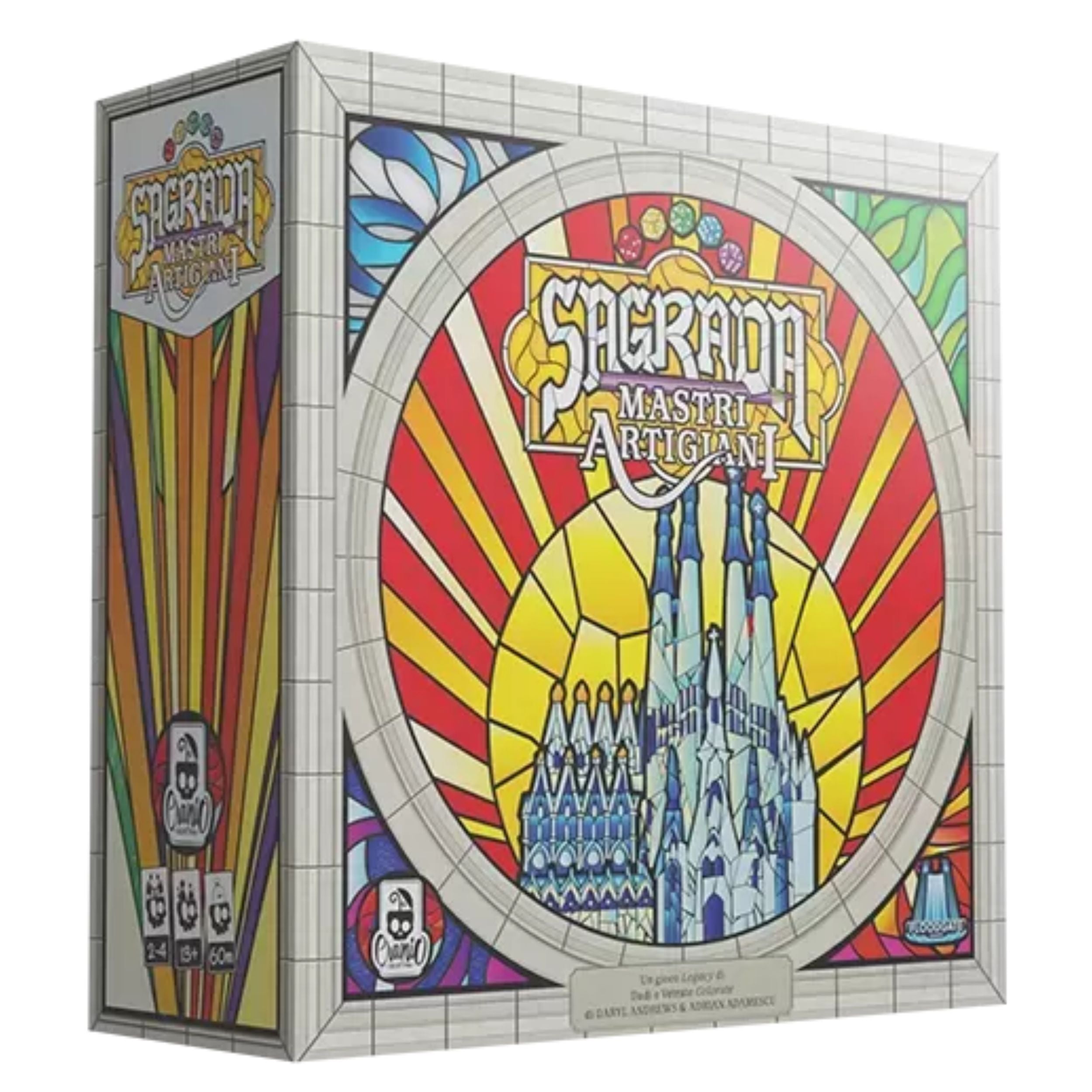
Sagrada Master Artisans
🐸 Dettagli da BoardGameGeek
Consiglio BGG sul numero di giocatori
Categorie
Meccaniche
Design & Art
Lingua
Pre-order - leggi i dettagli
🐸 Una rana saggia sa quando dividere l’ordine… e quando aspettare il salto giusto.
Pairs well with
FroGames — Moments You'll Remember
Three generations of glassmakers. Fourteen windows. A cathedral taking shape sheet after sheet, as family skills are passed down and patterns become increasingly daring.
WHAT IT'S ABOUT
The cathedral is built through generations
Sagrada Artisans is the legacy evolution of the celebrated dice puzzle by Adrian Adamescu and Daryl Andrews. Published by Cranio Creations in 2023, it transforms the original's one-shot experience into a multigenerational campaign where each game leaves its mark. The stained-glass windows of the Sagrada Família take shape in a book that fills up, changes, and completes game after game.
At the table, you draw colored dice, place them in your window grids, respecting color and number constraints, and try to complete increasingly complex patterns. But this time, you unlock permanent abilities, decorate new tools, accumulate advancements that you'll carry into subsequent games. Your family of glassmakers grows in experience as the cathedral takes shape.
What they're saying abroad
"Takes everything beloved about Sagrada and stretches it across a campaign that feels earned."
It takes everything we loved about Sagrada and stretches it across a campaign that feels earned piece by piece.
— Meeple Mountain
A legacy roll-and-write that never erases: every mark remains, every completed window is a visible memory. At the end of the campaign, the book is yours.
— FroGames

Sagrada Mastri Artigiani (Sagrada Artisans)
FrogScore · FroGames editorial rating · based on rules, international reviews, and play sessionsThe glassmaker's tools
What you'll find in the legacy book
Pool of colored dice
Each turn you draw from a common reserve. Red, blue, yellow, green, purple: colors dictate where you can place, numbers create adjacency constraints. The draft is fast but every choice matters.
Window grids
Fourteen stained-glass windows to complete throughout the campaign. Each window has unique restrictions: some require color patterns, others numerical sequences, others complex symmetries.
Family abilities
Unlock permanent powers that modify the basic rules: re-roll dice, ignore constraints, move already placed gems. Your family becomes more skilled generation after generation.
Scenario objectives
Each game introduces objective cards that provide bonus points. Patterns to complete, colors to maximize, temporal constraints. They overlap with window restrictions, creating ever-new puzzles.
In a few weeks, you'll have a complete cathedral. It will be yours, handwritten, unique. And each window will remind you of an evening.
A game in five moments
What happens at the table
Not the rules. The experience.
Open the book, choose your window
Everyone flips through the legacy book to the next stained-glass window to complete. There's a moment of reverent silence: everyone studies the grid, the constraints, the public objectives. Some are already planning their first placements. The first die hasn't even been rolled, but the puzzle is already in their heads.
Drafting the first dice
The dice are rolled, forming the common pool. The draft begins: pick, place, pass. The first choices are cautious, conservative. Then someone takes a "wrong" die to block an opponent, and the game changes pace. It's not aggressive, but it stops being solitary.
Mid-window: the constraints bite
The grid is half full. Now every die counts double: if you choose the wrong color, you close a line; if you choose the wrong number, you block a corner. Family abilities start to weigh heavily: those who have unlocked rerolling breathe a sigh of relief; those who haven't sweat over every choice. Someone quietly curses a die that never rolls.
The last die decides
Two spaces left. You have one objective almost complete and a pattern halfway done. The die you need is in the pool, but so is the one your neighbor needs. Do you take it or leave it for them? In Sagrada, there are no direct attacks, but this moment feels like checkmate. One of you will score points, the other will finish with a gap.
End of game: the book fills up
Points are tallied, medals awarded, and progress recorded. But the best part is seeing the completed window. What was once an empty grid is now a colorful, permanent, signed mosaic. In two games, that window will still be there. The cathedral grows, sheet by sheet.
How to play
The flow of each round
Sagrada Artisans is a shared puzzle with dice drafting. Each turn lasts only a few minutes, but choices carry weight.
Roll as many dice as there are players plus one, forming the common pool. The dice show color and number: both count for placement constraints.
In turn, each player chooses a die from the pool and draws it into their grid, respecting adjacency restrictions (colors and numbers cannot repeat orthogonally). Those with unlocked abilities can modify or ignore constraints.
During your turn, you can spend family abilities to reroll dice, move already placed gems, or temporarily ignore restrictions. Each ability costs and can be used once per round: managing them well makes all the difference.
When all dice are placed, the round ends. If the window is complete, move to the next one in the legacy book. New abilities are unlocked, permanent points are recorded, and campaign objectives are updated.
Why it's different from others
Six mechanics that make a difference
The book is permanent
It never erases. Every mark remains. At the end of the campaign, the book is a complete physical artifact: fourteen hand-colored stained-glass windows, dozens of unlocked abilities, the history of your glassmaking family written in pencil. It's not a game that resets: it's a work that is built.
Shared draft, indirect pressure
There are no direct attacks, but the draft creates constant tension. Every die you take is a die you deny others. With four players, the pool empties quickly: those who draft last often settle, those who draft first must balance greed and blocking.
Asymmetrical progression
Each family unlocks different abilities. Those who focus on rerolling dice become resilient to luck. Those who unlock movement can correct mistakes mid-window. Those who invest in combo abilities build powerful but fragile engines. The campaign diverges: no two families are identical.
Fourteen windows, fourteen puzzles
Each stained-glass window has unique constraints. Some require symmetrical patterns, others increasing numerical sequences, others complete rainbows. The initial windows are gentle tutorials; the later ones are labyrinths of overlapping restrictions. The difficulty curve is calibrated: you learn by playing.
Multiple overlapping objectives
In addition to the window's constraints, each game has public and private objective cards. Maximize reds, create diagonals, avoid certain numbers. Objectives accumulate: you must satisfy the grid, complete your secret, and compete for common bonuses. The brain gently burns.
Adaptive campaign
The legacy book reacts to your results. Finish a window with a high score? Unlock rewards. Barely complete it? The game compensates with help in the next one. It's not a branching narrative, but the progression isn't binary: each group experiences a campaign calibrated to their ability.
How it ends
How to win and how to lose
Sagrada Artisans is a race for points. Whoever accumulates the most points throughout the campaign wins, but each game can be won or lost separately.
Game victory
- You complete the stained-glass window respecting all constraints and maximize public and private objectives
- You accumulate more points than opponents by summing completed patterns, ability bonuses, and excellence medals
- You unlock permanent rewards that give you an advantage in subsequent campaign games
Failure (not elimination)
Sagrada Artisans is an accessible legacy game that doesn't punish, doesn't erase, and leaves a beautiful physical object at the end of the campaign. If you're looking for progression without conflict, this is the cathedral for you.
Frequently asked questions
FAQ about Sagrada Artisans
Do I need to have played base Sagrada to appreciate Artisans?
No, absolutely not. Artisans is standalone and teaches the rules from scratch through the first windows of the campaign. Those who have played the base game will recognize familiar mechanics, but the legacy progression is completely new. If you don't know Sagrada, this is a great starting point.
Can the book be played only once or is it replayable?
The campaign is designed to be played once with the same group, because the book is permanently filled. That said, once the campaign is over, the book remains a beautiful object to browse, and individual games are replayable. Some groups buy multiple copies to experience different campaigns.
How long does the entire legacy campaign last?
Fourteen games, each lasting 45-60 minutes. A total of about 12-15 hours of gameplay spread over weeks or months. The campaign doesn't have a rigid narrative: you can play one game a week or do marathons. You decide the pace, there's no pressure.
Does it work well with two players or do you need a full table?
It works very well with two. The draft is less competitive (fewer dice stolen), but the puzzles remain intact, and the progression flows smoothly. With three or four, the draft becomes nastier, but the campaign is calibrated for any number. You don't need a full table to enjoy it.
Is the edition in Italian?
Yes, this is the Italian Cranio Creations edition. All the content of the legacy book, objective cards, and rulebook are in Italian. You only need to read and write: no complex texts, no language dependence during gameplay.
Sagrada Artisans is a legacy roll-and-write game for 2-4 players designed by Adrian Adamescu and Daryl Andrews, published by Cranio Creations. Each game lasts 45-60 minutes and is suitable for ages 13 and up. The campaign unfolds through fourteen stained-glass windows to complete, with mechanics of colored dice drafting, pattern building, and permanent progression. Glassmaking families unlock abilities, decorate tools, and build a cathedral that remains imprinted in the played book. Ideal for those seeking accessible strategy with legacy progression without direct conflict. Available on FroGames.it.
Frequently Asked Questions
The answers you're looking for, no beating around the bush.
📸Do the images match the actual product?
The photos on the website often come from BoardGameGeek and are intended to give you an idea of the game. They may vary slightly from the version you receive. The content declared by the publisher is always binding.
📦Does the content of the box match what is indicated?
We always strive to provide the correct content, but minor variations are possible due to reprints or updates. The information comes directly from the publishers. If you have any questions, please contact us!
⏳How do pre-orders work?
Pre-order the game before release, payment is immediate, and the game is reserved for you. As soon as it arrives, we'll ship it right away! If there are any delays, we'll update you promptly.
🔒Can I trust buying here?
Absolutely! Secure payments, tracked shipments, and a team that loves board games as much as you do. If something goes wrong, we'll do our best to fix it.
🛠There's a problem with my order, what should I do?
Write to us now! Whether it's a missing part, damage, or an error, we'll help you resolve it as soon as possible. Your experience truly matters to us.