


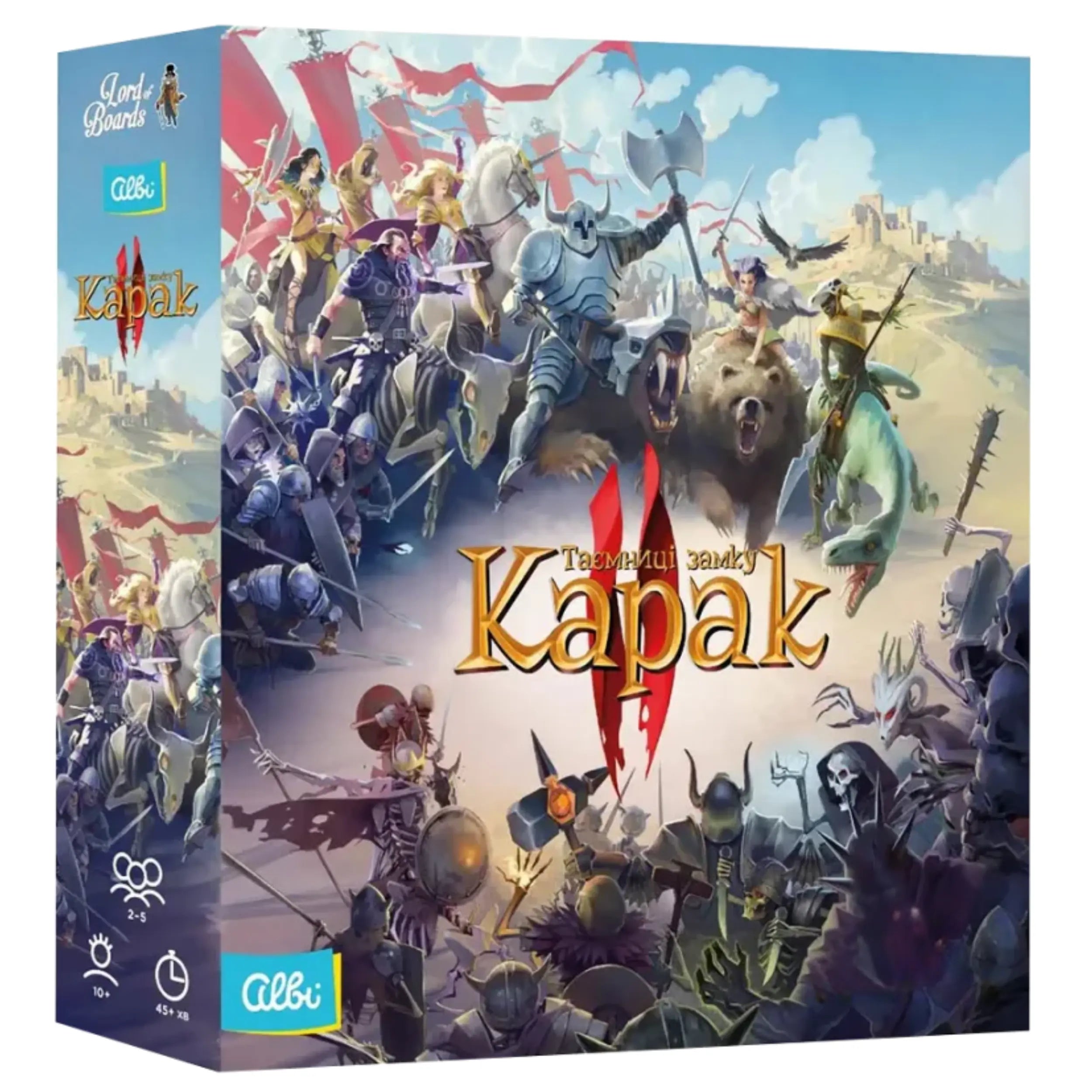
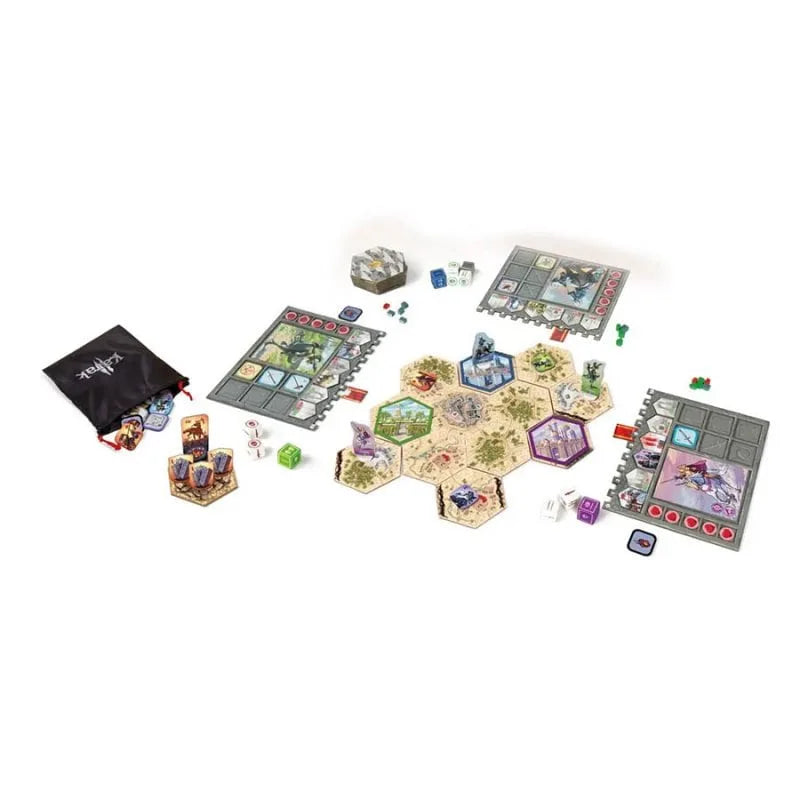
Karak II
🐸 Dettagli da BoardGameGeek
Consiglio BGG sul numero di giocatori
Categorie
Meccaniche
Design & Art
Lingua
Pairs well with
FroGames — Moments to Remember
Someone flips a tile and finds treasure. Someone builds barracks and rolls five dice. Someone encounters the Dark General too soon. And in the end, everyone wants to play again.
WHAT IT IS ABOUT
When exploration meets city building
Petr Mikša returns with a standalone sequel that adds a layer of complexity to the original Karak, while maintaining the accessibility that made the first title a family success. Illustrated by Roman Hladík, Karak II transforms dungeon exploration into a race to build cities and train military. It's no longer just about finding treasure: here you must turn resources into buildings, and buildings into military power represented by increasingly powerful custom dice.
On your turn, you explore the dungeon by placing hexagonal tiles, collect resources from defeated monsters, and use them to develop your city. Each building you construct unlocks new dice to add to your pool: dice with more victory faces, special faces, devastating combinations. The ultimate goal is to defeat the Dark General and collect more soul stones than anyone else. But first you must be strong enough to face him, and that means choosing each turn between exploring, building, or fighting.
What they say abroad
A sequel that doubles down on what worked and adds layers where needed. For families who want to grow with the game.
— FroGames
The custom dice system is brilliant: every building you construct literally changes your combat potential. You see the physical progression on the table.
— FroGames

Karak II
FrogScore · FroGames editorial rating · based on rules, international reviews and gameplay sessionsWhat you build
Four pillars of your city
City buildings
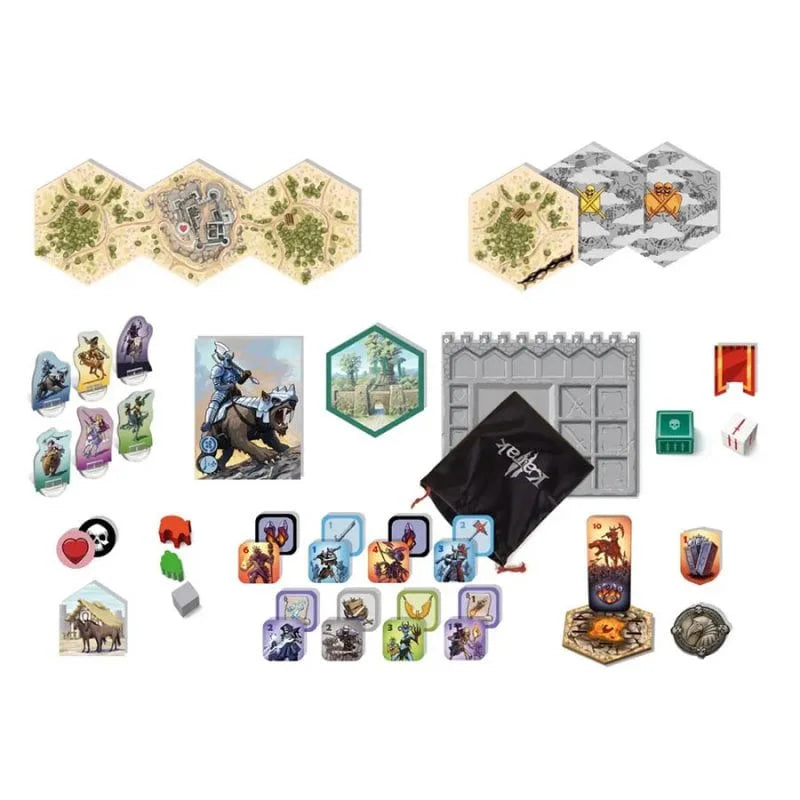
Barracks, towers, warehouses. Every building you construct costs resources but permanently unlocks new dice in your pool. Progression is physical: you see your city grow on the table and your dice bag fill up.
Custom dice
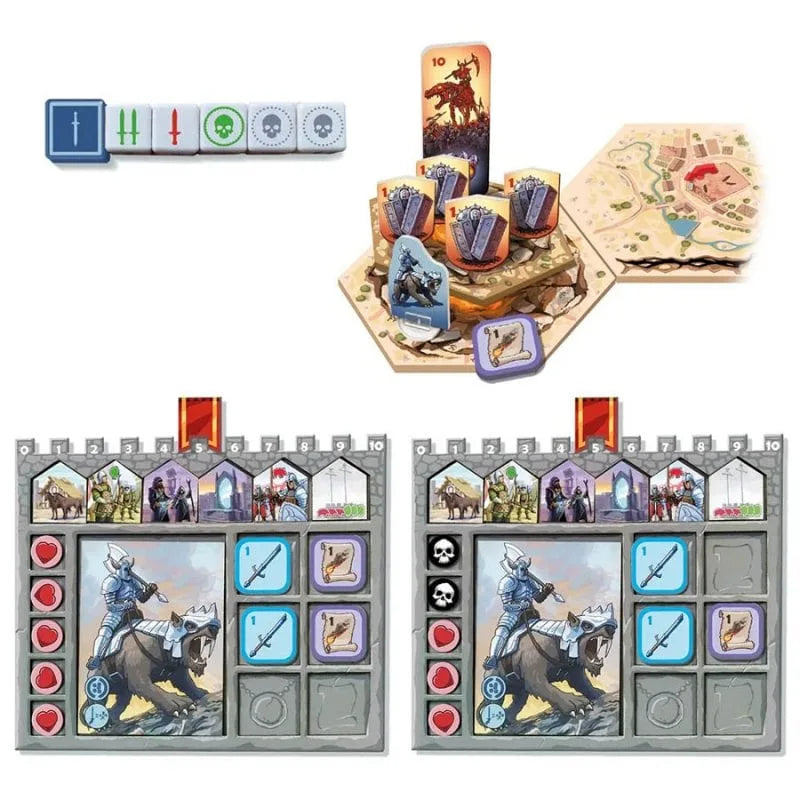
The heart of the game. You start with basic dice, build buildings to add dice with more success faces, special faces, combos. In combat, you roll your pool: the more city you've developed, the more powerful you become.
Hexagon tiles
You explore by placing hexagonal dungeon tiles. Each tile reveals monsters, resources, events. The board grows organically and you never know what you'll find around the corner. The Dark General appears when someone draws his tile.
Soul stones
Collect soul stones by defeating monsters and, most importantly, the Dark General. At the end of the game, whoever has the most wins. It's not enough to explore: you must fight. And to fight you must build. Everything is connected.
In an hour you will have built a city, defeated a boss, and realized which building you should have built first. Karak II is this: the desire to play again better.
A five-moment game
What happens at the table
Not the rules. The experience.
The first tile
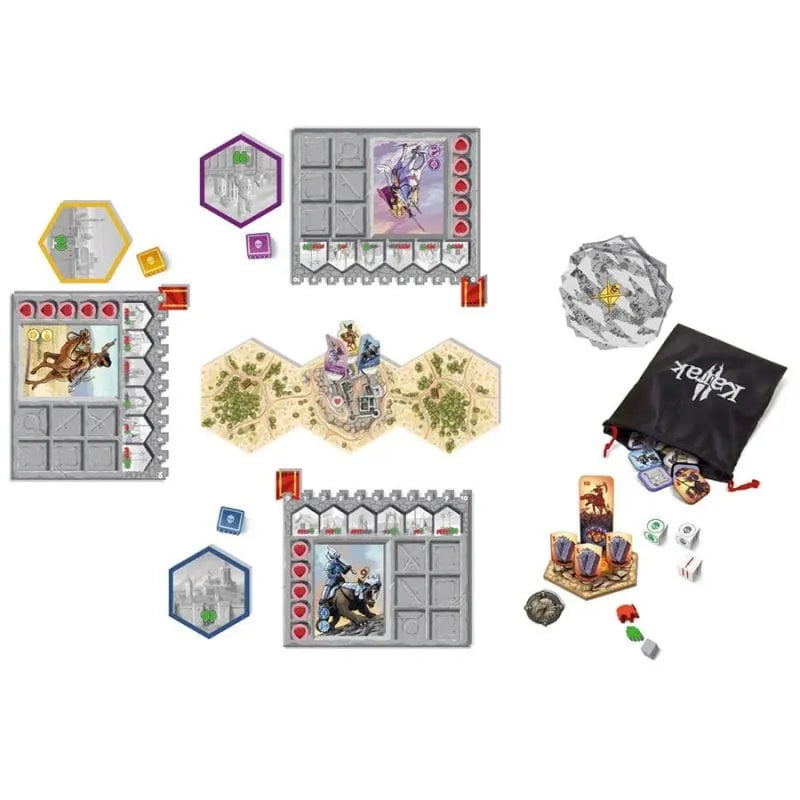
Everyone starts from the same central city and branches out exploring. Someone immediately finds a weak monster and collects the first resource. Someone places an empty tile and curses. The map begins to take shape and no one knows yet where the Dark General will appear.
The first building
Someone returns to the city and builds the first building. They add a die to their pool and proudly show it to the others. The others realize they have to choose: continue exploring for resources or return and build? The race for buildings has begun.
The board explodes
Mid-game, the dungeon is a labyrinth of tiles, monsters everywhere, scattered resources. Someone already has three buildings, someone is still wildly exploring. The dice start to make a difference: those who built win fights they previously lost. The gap widens.
The Dark General appears
Someone draws the boss tile. The Dark General enters play and everyone pauses for a moment. Who is ready? Who has enough good dice? Who has the soul stones to afford to risk it? The game changes pace. It becomes a race.
The final count
The General falls, someone collects the bulk of his soul stones. But it's not over: all the stones collected during the game are counted. Whoever best balanced exploration, building, and combat wins. The others understand where they went wrong and want to play again immediately.
How to play
The flow of each turn
Each turn you take only one action: explore, fight, or build. The simple choice hides profound decisions.
You can move your hero one hex or place a new dungeon tile adjacent to your position. You reveal the tile: it could be empty, have a monster, a resource, an event. You decide what to do.
If you are on a tile with a monster, you can fight. You roll your dice, the monster has a fixed difficulty. If you win, you collect resources and soul stones. If you lose, nothing serious happens. Combat is quick resolution.
If your hero has returned to the central city, you can spend resources to build a building. Each building costs a combination of different resources and permanently gives you a new die to add to your pool. Choose which building based on your strategy.
End of turn. The player to your left does the same: explores, fights, or builds. The game proceeds quickly because each turn is a single clear action. The Dark General appears when someone draws his specific tile.
Why it's different from others
Six mechanics that make a difference
Dice that grow with you
It's not a dungeon crawler where you always roll the same dice. Here you build your pool turn after turn. You start with weak dice, you end up with a custom arsenal. The progression is physical: you see and feel the dice increase. It's tactilely satisfying.
City building in the dungeon
Most dungeon crawlers only send you to explore. Karak II adds city building: you return to base, spend resources, build permanent buildings. Each building changes your abilities. It's a management loop within an adventure game.
Modular hexagonal board
The dungeon doesn't exist at the start of the game. You build it tile by tile, with hexagons. Each game the map is different, the paths change, the Dark General appears in unpredictable places. No two games are alike, zero rigid setup.
Resource-combat balancing
You can't do everything. Each turn you choose: collect resources or fight monsters? Build immediately or explore further? The game forces you to choose between short and long term. Whoever balances better wins, not whoever is luckier.
Boss fights as a culmination
The Dark General is not a normal monster. He only appears when someone draws his tile, and from that moment the game changes pace. Everyone knows that whoever defeats him gets a huge haul of soul stones. It becomes a race.
Depth without weight
Karak II is more complex than the first but remains a family game. The rules are explained in 20 minutes, turns are fast, children aged 10 and up can handle it. Yet there is true strategic depth for those who seek it. It's the perfect gateway to dungeon crawlers with management.
How it ends
How to win
The game ends when the Dark General is defeated. Soul stones are counted: whoever has the most wins.
Victory
- Collect more soul stones than anyone else during the game
- Defeat the Dark General to get the largest loot of stones
- Balance exploration, building, and combat well to maximize collected stones
How to lose ground
- Build too early and waste time while others collect stones by fighting
- Explore too much without building and your dice remain weak, losing important fights
- Arrive late to the Dark General and someone else takes the bulk of his soul stones
Karak II is that game that makes children say "let's play again" and adults say "this time I'll do it differently". It's visible progression, clear choices, and always a desire to replay better.
Frequently Asked Questions
FAQ about Karak II
Do I need to have played the first Karak to understand this?
No, Karak II is standalone. You don't need to know the first one: the rules are self-contained and the game works perfectly well on its own. If you have the first Karak, this adds complexity and city building that still makes it interesting. If you don't, this is a great deeper entry point.
Is it suitable for children aged 10 or older?
The 10+ age is accurate. Children handle the rules well because each turn you take only one clear action: explore, fight, or build. The complexity lies in strategic choices, not in the rules. Families with children aged 10-12 play it without problems, and parents don't get bored.
How long does a game really last?
The box says 45-90 minutes and it stays within that. The first game with rule explanation reaches 90 minutes. From the second game onwards, with players who know what to do, 60 minutes is the average. With 2-3 experienced players, it can go down to 45. It's not a filler but it's not an entire afternoon either.
Are there many custom dice? Do I need bags to organize them?
There are several sets of colored dice, each with different faces. The game includes containers, but many use transparent bags by die type to speed up setup. It's not chaos: each die has a specific purpose and after the first game you'll recognize them instantly.
Is it available in Italian?
Yes, this is the Italian edition from Creativamente. All cards, the rulebook, and components with text are in Italian. The dice are universal symbols, the tiles are illustrated hexagons without strong linguistic dependence.
Karak II is a dungeon exploration and city-building board game for 2-5 players, aged 10 and up, with games lasting 45 to 90 minutes. Designed by Petr Mikša and published by Creativamente in Italian, it combines modular hexagonal tile exploration with a city-building system and progression via custom dice. Each building constructed permanently adds new dice to the player's pool, changing combat probabilities. The goal is to defeat monsters, collect soul stones, and confront the Dark General to win the game. A standalone sequel to the first Karak, it adds strategic depth while maintaining family accessibility. Available on FroGames.it.
Karak II
Frequently Asked Questions
The answers you're looking for, no beating around the bush.
📸Do the images match the actual product?
The photos on the website often come from BoardGameGeek and are intended to give you an idea of the game. They may vary slightly from the version you receive. The content declared by the publisher is always binding.
📦Does the content of the box match what is indicated?
We always strive to provide the correct content, but minor variations are possible due to reprints or updates. The information comes directly from the publishers. If you have any questions, please contact us!
⏳How do pre-orders work?
Pre-order the game before release, payment is immediate, and the game is reserved for you. As soon as it arrives, we'll ship it right away! If there are any delays, we'll update you promptly.
🔒Can I trust buying here?
Absolutely! Secure payments, tracked shipments, and a team that loves board games as much as you do. If something goes wrong, we'll do our best to fix it.
🛠There's a problem with my order, what should I do?
Write to us now! Whether it's a missing part, damage, or an error, we'll help you resolve it as soon as possible. Your experience truly matters to us.