


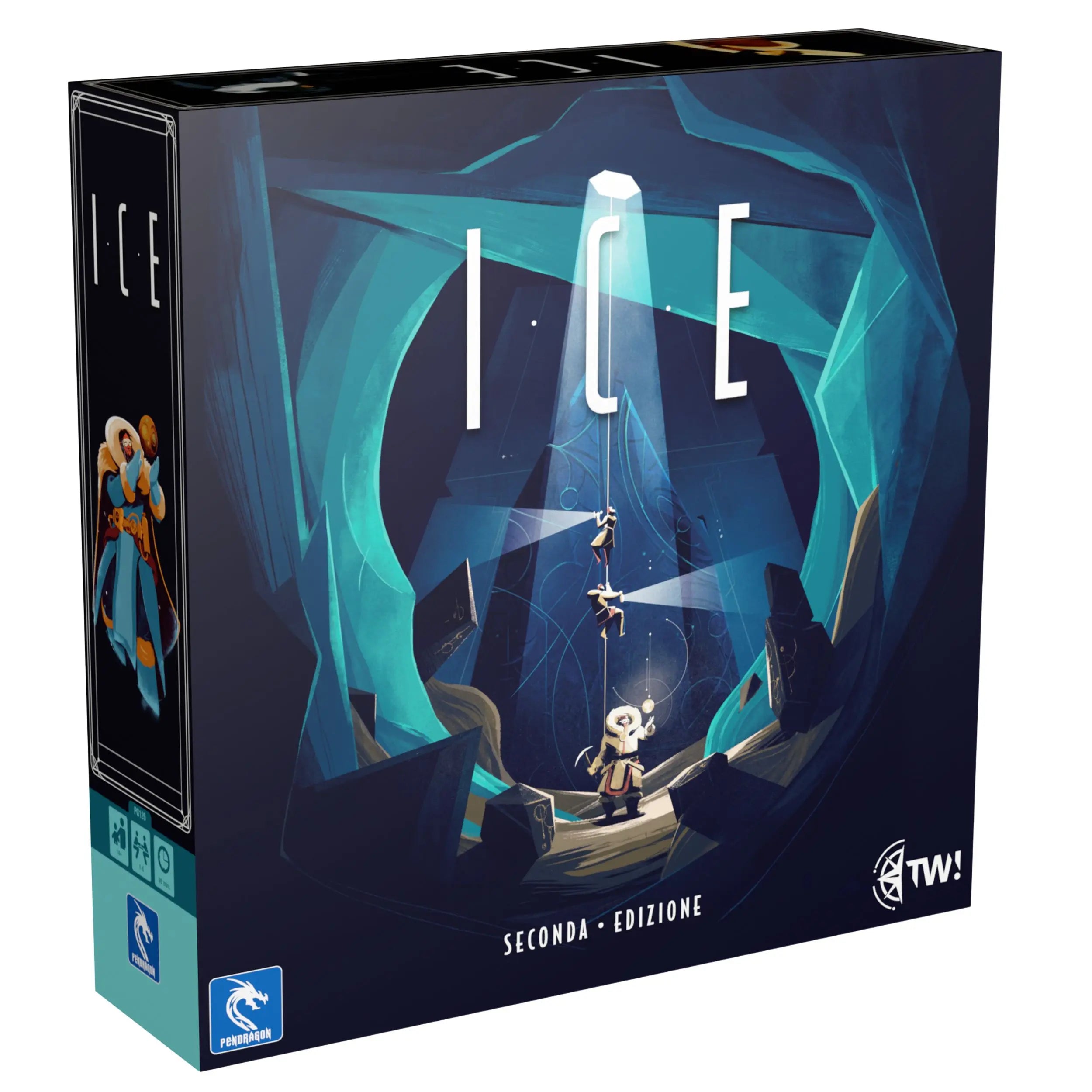
I·C·E: Second Edition
🐸 Dettagli da BoardGameGeek
Consiglio BGG sul numero di giocatori
Categorie
Meccaniche
Design & Art
Lingua
Pre-order - leggi i dettagli
🐸 Una rana saggia sa quando dividere l’ordine… e quando aspettare il salto giusto.
Pairs well with
FroGames — Moments You'll Remember
Someone finds the first artifact and calls the others. Someone digs too fast, and everything collapses. In the end, no one remembers who won, but everyone remembers what was under the ice.
WHAT IT IS ABOUT
Vertical archaeology in a world buried under ice
Designed by Bragou and Sams, with illustrations by Léonard Dupond and published in Italian by Pendragon Game Studio, I·C·E transports you to a post-glacial future where a single city survives by organizing annual expeditions into the Nuuka Valley. Beneath the ice lie the remains of Azulia, an antediluvian civilization that might hold answers, riches, or prestige. Each guild has its own reasons for digging.
At the table, you are an archaeologist who physically removes 3D tiles from the board to reach deeper layers. Three overlapping levels: the superficial ice layer, surface and deep artifacts, and finally, the buried city. The ice tiles you remove become special actions for you. The buildings you uncover change the game rules. You win by collecting reputation through completed requests and city decrees.
Digging has never been so tactile: remove a tile and the board changes for everyone, in real-time.
The secret of I·C·E in one line
The 3D structure isn't just scenery: it's the core mechanic. Every layer you remove is a weighty decision.
From the game experience

I·C·E: Second Edition
The game supports an official solo mode with dedicated rules in the base manual. The experience maintains the tension of vertical excavation and the discovery of legacy buildings, but naturally loses the direct competition for artifacts and interaction in turn order auctions. An excellent alternative for exploring Azulia alone.
FrogScore · FroGames editorial rating · based on rules, international reviews, and play sessionsWhat you dig
The layers of Azulia
Ice Tiles
The surface layer. Removing them gives you bonus actions for the rest of the game: each tile becomes a permanent resource in your personal arsenal.
Surface Artifacts
The second layer. Objects that grant immediate reputation points and allow you to complete guild requests. Easy to reach, contested by all.
Deep Artifacts
The third, buried layer. Worth more reputation but require multiple digs to reach. Risk and reward.
Azulia Buildings
The bottom of the submerged city. Being the first to discover one unlocks new rules that change the game for everyone. Legacy content to be progressively revealed.
What's in the box
Box Contents
Components 21 types · 380 pieces ▼
Recommended Sleeves 110 cards in 1 size ▼
If you play often, we recommend protecting cards with transparent sleeves to make them last longer.
| Size | Quantity |
|---|---|
| 63 × 88 mm | 110 |
| Total cards | 110 |
When it's over, the board is a crater. And everyone wants to know what was under that tile you never touched.
A game in five moments
What happens at the table
Not the rules. The experience.
The first dig
Everyone looks at the 3D board and plans where to start. Some go straight for visible artifacts. Some remove ice to unlock strong actions immediately. The first tile removed changes everything for those who come after.
The rush for artifacts
Guild demands become clear, and everyone understands what needs to be collected. Direct competition for surface artifacts: whoever gets there first takes them, others must dig deeper or change strategy. Auctions for turn order begin to weigh heavily.
Buildings emerge
Someone reaches the bottom and discovers the first building. New rules come into play, often benefiting the discoverer. Others realize that ignoring Azulia costs points and advantages. The table reorganizes around the buried city.
The crater widens
The board now has holes everywhere. The removed ice tiles have given everyone powerful actions, and turns become richer and more complex. Those who focused on depth begin to collect high-value artifacts. Those who remained on the surface rush to city decrees to catch up.
End of the fourth day
A player fully uncovers a building and the game ends. Reputation count: completed requests, satisfied decrees, collected artifacts. Someone won by a whisker thanks to a tile action saved for the last turn. Everyone wants to set up the board again and dig anew.
How to play
The flow of each round
Four days (rounds) marked by auctions, worker placement, and progressive digging.
Players make closed bids to decide who plays first. Those who pass get bonuses. A forced-pass auction system that rewards those who know when to stop.
Each player has archaeologists with different abilities. You place them on action spaces on the board using action points. You dig tiles, collect artifacts, activate special actions from previously removed ice tiles.
Physically remove the chosen tiles. If there's an artifact underneath, you take it. If it's a building, you reveal it and activate its effect for the first time. Ice tiles go to your personal area as new permanent actions.
Check if you have the necessary artifacts to fulfill guild requests or city decrees. Convert collections into reputation points. Prepare for the next day.
Why it's different from others
Six mechanics that make a difference
3D magnetic components
The board uses magnets and stackable tiles to create three physically overlapping layers. It's not just aesthetics: removing a tile genuinely changes the playing field. The vertical structure is tactile and functional, not just scenery.
Ice tiles as resources
Every ice tile you remove becomes a reusable action for you. The more you dig, the more powers you accumulate. This creates an engine-building parallel to artifact collection: those who invest in ice build a more powerful engine for the final turns.
Progressive legacy buildings
Azulia's buildings are material to be discovered game after game. Each building introduces new rules or permanent advantages for those who discover them first. It's not a campaign, but a discovery system that rewards those who explore everything.
Asymmetrical worker placement
Archaeologists are not all equal. Each player has workers with different abilities and costs. Choosing which archaeologist to send where is as tactical a decision as choosing where to dig.
Forced-pass auction
Turn order is decided by closed auctions each round. Those who pass first receive compensatory bonuses. A system that transforms play sequence into a contested resource, not a random setup.
Variable victory condition
The game ends when the first building is completely uncovered, not after a fixed number of turns. This means you can speed up or slow down the end based on your strategy. Those ahead want to finish, those catching up want time.
How it ends
How to win and close
End condition and reputation count.
Victory
- The player with the most reputation points when a building is completely uncovered
- Reputation from completed guild requests (specific artifact collections)
- Reputation from satisfied city decrees and collected artifacts
Game end
- The game ends immediately when an Azulia building is completely revealed
- There are no eliminations: everyone plays until the end and counts points
- Those who ignored the buildings miss the chance to activate legacy powers and close when they want
I·C·E demands digging, literally. Every removed tile is a tactical choice that modifies the field for everyone. The 3D structure isn't an editorial trick: it's the game itself.
Frequently Asked Questions
FAQ about I·C·E: Second Edition
Is the 3D structure just a gimmick or does it really matter in the game?
It matters, and that's the point. Removing a tile isn't aesthetic: it changes action spaces and options for all players for the rest of the game. The ice tiles you remove become your permanent actions, building an engine parallel to artifact collection. Remove the vertical structure and I·C·E ceases to exist: it's the central mechanic, not a scenic accessory.
How sturdy is the 3D board? Do tiles fall off easily?
The system uses magnets to hold the stacked tiles in place. The structure is stable during play: you can remove tiles without everything collapsing. Components are designed to be handled repeatedly. That said, steady hands and a stable table are needed; it's not a game to play on a train.
Are legacy buildings discovered in a fixed or random order?
Buildings are placed during setup according to modular rules, so each game can have different configurations. There's no campaign with a predefined order. This means that even after many games, discovery maintains an element of surprise and replayability.
Does it work well solo or is multiplayer necessary?
The official solo mode maintains the excavation tension and building discovery intact. You naturally lose the turn order auctions and direct competition for artifacts, but the core experience of vertically exploring Azulia remains complete. An excellent choice for those who want to enjoy the 3D structure without competition.
How long does setup take? Does rebuilding the 3D board each time require time?
Initial setup takes 10-15 minutes because you need to correctly stack the three layers of tiles. It's not immediate, but it's part of the experience: you are literally building the archaeological site. Once you get the hang of it, the procedure becomes smooth. It's worth the preparation.
Is it available in Italian?
Yes, this is the Italian edition published by Pendragon Game Studio: rulebook, cards, components, and all texts are translated. You can play entirely in your language without needing reference sheets or external translations.
I·C·E: Second Edition is a strategy and exploration game for 1-5 players, ages 14 and up, with games lasting 75 to 120 minutes. Designed by Bragou and Sams, originally published by This Way! and brought to Italian by Pendragon Game Studio, the game uses a modular 3D board with removable magnetic tiles representing layers of ice, artifacts, and the sunken city of Azulia. Mechanics combine worker placement with differentiated archaeologists, action points, turn order auctions, and artifact collection. Discovered legacy buildings progressively introduce new rules. Italian edition. Available on FroGames.it.
I·C·E: Second Edition
Frequently Asked Questions
The answers you're looking for, no beating around the bush.
📸Do the images match the actual product?
The photos on the website often come from BoardGameGeek and are intended to give you an idea of the game. They may vary slightly from the version you receive. The content declared by the publisher is always binding.
📦Does the content of the box match what is indicated?
We always strive to provide the correct content, but minor variations are possible due to reprints or updates. The information comes directly from the publishers. If you have any questions, please contact us!
⏳How do pre-orders work?
Pre-order the game before release, payment is immediate, and the game is reserved for you. As soon as it arrives, we'll ship it right away! If there are any delays, we'll update you promptly.
🔒Can I trust buying here?
Absolutely! Secure payments, tracked shipments, and a team that loves board games as much as you do. If something goes wrong, we'll do our best to fix it.
🛠There's a problem with my order, what should I do?
Write to us now! Whether it's a missing part, damage, or an error, we'll help you resolve it as soon as possible. Your experience truly matters to us.