


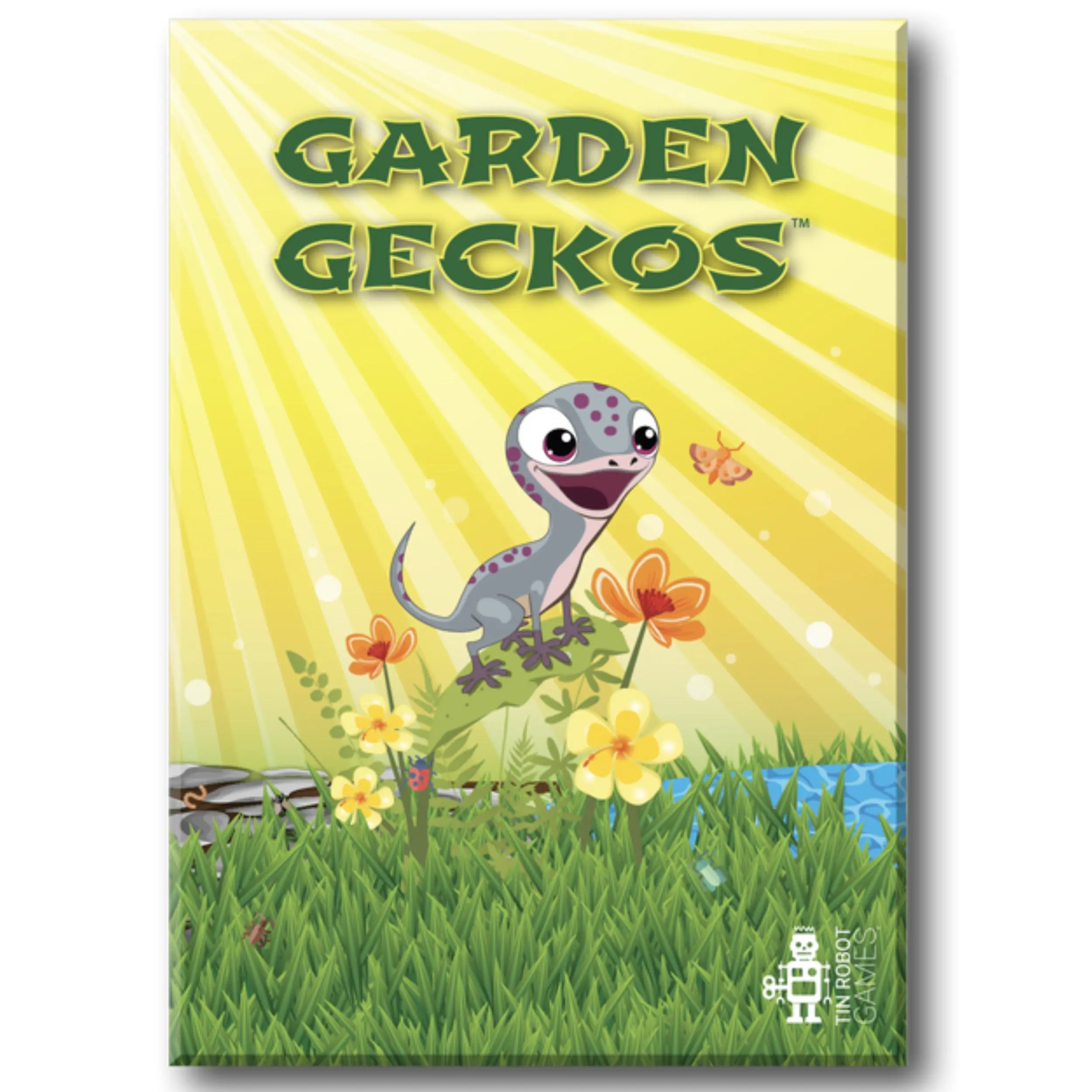

Garden Geckos Cartoon Box Kickstarter Edition
🐸 Dettagli da BoardGameGeek
Consiglio BGG sul numero di giocatori
Categorie
Meccaniche
Design & Art
Lingua
Pre-order - leggi i dettagli
🐸 Una rana saggia sa quando dividere l’ordine… e quando aspettare il salto giusto.
Pairs well with
FroGames — Moments You'll Remember
Someone builds perfect chains, someone else closes the circle just in time. In the end, a mosaic of tiles remains on the table, and no one is sure who really won.
WHAT IT'S ABOUT
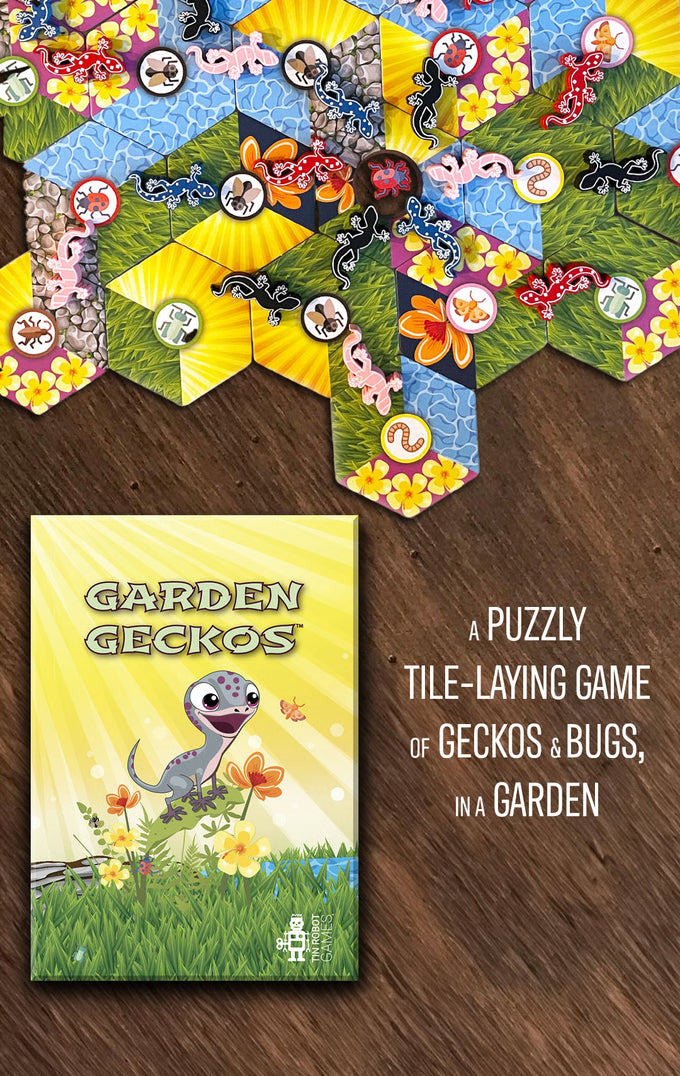
Five geckos per player, a garden that grows tile by tile
James Staley signs an abstract game for Tin Robot Games that embraces the naturalistic theme without ever betraying it. Garden Geckos arrives in 2024 after a Kickstarter campaign that convinced those looking for family games with tactical depth hidden beneath an accessible appearance. It's not an eurogame, it's not a party game: it's a semi-cooperative spatial puzzle where five geckos per player must catch insects and complete secret objectives.
On your turn, you place a hexagonal tile next to an existing one, matching at least one side of the terrain. You position a gecko on the pattern created between the two tiles. If it completely surrounds a previous tile, whoever has more adjacent geckos wins the insect printed on it. If your gecko forms a chain of insects or a terrain pattern specified by the market objectives, you take that card. When someone collects six objectives or the last tile is drawn, the game ends: insect points (objectives + won tiles + initial secret bonus) determine the winner.
What they say abroad
A game where winning together helps, but only one can truly triumph.
— FroGames
The beauty lies in the growing mosaic, not just in the final score.
— FroGames

Garden Geckos
FrogScore · FroGames editorial rating · based on rules, international reviews, and gameplay sessionsThe garden pieces
What you find in the box
Wooden geckos
Five geckos per player, meeples you place on the terrain patterns created between two adjacent tiles. They are your way of claiming insects and completing objectives.
Hexagonal tiles
Each tile shows three terrain patterns on the edges and an insect in the center. You place them by matching at least one side with an already present tile, building the garden game after game.
Objective cards
Public objectives of two types: chains of geckos connecting certain insects, or spatial patterns of terrains. Completing one earns you the card with its insect points.
Secret bonus cards
At the start of the game, you receive a hidden bonus: an insect or terrain type that is worth extra points at the end of the game. Others don't know what you're trying to maximize.
In the end, an hexagonal garden remains that no one had anticipated at the beginning. And the feeling that you could have made a different move three turns ago.
A game in five moments
What happens at the table
Not the rules. The experience.
The first tile and the hidden objective
Each player draws three tiles and a secret bonus. The first player places a starter tile in the center. You look at your objectives, see which insects or terrains you need, and realize you'll have to spy on what others are looking for without revealing what you want. Don't worry, for now.
The garden takes shape
The first tiles are added, geckos begin to populate the edges. Someone places a tile that creates a chain of flowers, another blocks a rocky terrain that you needed. You realize that each tile helps at least two people and damages as many others. The interaction is silent but constant.
The first surrounded tile
Someone closes a circle around a tile with a butterfly printed on it. Adjacent geckos are counted: four against three. The tile goes to the player with more geckos, who collects the insect points. You realize that it's not enough to complete objectives; you also have to win majorities on valuable insects.
Someone has five objectives
A player draws their fifth completed objective. Only one is left until the end of the game. Everyone speeds up, placing tiles to complete their own patterns or sabotage others'. The last available tiles become precious. Someone still has three geckos to place, someone else has already used all of them.
Point counting and revelations
Sixth objective conquered, or last tile drawn. Secret bonuses are revealed: one had "rocky terrains," another "dragonflies." Objectives + won insects + bonuses are added up. The winner had two more points than you, and now you understand why they placed that strange tile three turns ago. You immediately demand a rematch.
How to play
The flow of each turn
Each turn is a placement and a choice: where you place the tile, which gecko you position, which objective you are building.
Choose one of the three tiles in your hand and place it adjacent to one already on the table, matching at least one side of the terrain (rock, flowers, water, grass).
Place one of your geckos on the terrain pattern that has been created between the tile you just placed and the adjacent one. That gecko now counts for objectives and majorities.
If your tile has completely surrounded a previous tile, whoever has more adjacent geckos wins the insect printed on it. If your gecko completes an objective (chain or pattern) on the market, take that card.
Replenish your hand to three tiles by drawing from the deck. End of turn. If someone has completed six objectives or the deck runs out, the game ends immediately.
Why it's different from others
Six mechanics that make a difference
Placement with mandatory match
You don't place tiles randomly: at least one side of the terrain must match an already present tile. This limits options but creates natural patterns that truly resemble an organically growing garden. Each tile has three different borders, so the possible combinations are many but never chaotic.
Geckos as majority indicators
Your five geckos are not just markers: they are hidden votes to conquer insects. When you surround a tile, whoever has more adjacent geckos wins the tile and its points. You have to balance: spreading them to cover more objectives or concentrating them to win a valuable insect?
Public objectives with dual nature
Half of the objectives ask for chains of geckos connecting certain insects (e.g., "three geckos touching butterfly-dragonfly-butterfly"). The other half asks for spatial patterns of terrains (e.g., "four rocks in a square"). Two types of puzzles overlaid on the same board.
Secret starting bonus
At the beginning of the game, you receive a hidden card: a type of insect or terrain that is worth extra points at the end of the game. The other players don't know what you're maximizing, and you don't know what they're looking for. This adds a bluffing component: are you really aiming for that chain of butterflies, or is it a feint?
Semi-cooperative with inevitable betrayal
Surrounding a tile benefits everyone (more insects in play = more points), but only whoever has more adjacent geckos wins the tile. This creates situations where two players collaborate to close a circle, but one of them betrays the other by placing an extra gecko at the last second. Tension without direct malice.
True scalability from 2 to 6 players
It's not a game "that also works with 6 players." Garden Geckos completely changes dynamics depending on the number: in 2, it's a tight spatial puzzle; in 4, it becomes a chaotic majority game; in 6, it's almost an abstract party game where tacit alliances form and dissolve every turn. Setup and number of objectives adapt.
How it ends
How to win and how to lose
The game ends in two ways: someone completes six objectives, or the last available tile is drawn. Then the insect points are counted.
Victory
- Sum the insect points printed on your completed objective cards
- Add the points from conquered tiles (the surrounded insects where you had more geckos)
- Reveal your secret bonus and add points for each occurrence (e.g., +2 for each dragonfly you have)
Mistakes that cost the game
- You placed tiles without considering others' objectives, facilitating their chains
- You scattered your geckos instead of concentrating them on valuable insects, losing all majorities
- You completed low-point objectives, ignoring your secret bonus which was worth triple
Garden Geckos wins if you like abstract games that don't feel abstract, where competition is indirect and the final board tells a different story every time.
Frequently asked questions
Garden Geckos FAQ
Does it really work for 6 players or is it forced?
It works, but it becomes a different game. In 6 players, chaos increases, tacit alliances last half a turn, and winning a majority on an insect becomes almost impossible to plan. If you're looking for tight control, play it with 2-3. If you want a light social puzzle, 5-6 players holds up well. The waiting time between turns remains contained (20-30 seconds per player).
Do the secret objectives unbalance the game?
No, because they are worth few points (2-4 on average) and serve more as tiebreakers. Most of the score comes from public objectives and conquered insects. The secret bonus gives you an initial direction, but if you pursue it too much by sacrificing real objectives, you lose. It's a nudge, not a secret weapon.
How much does luck count in drawing tiles?
You always have three tiles in hand, so you have room to choose. Of course, drawing the perfect tile at the right moment helps, but it's rarely decisive: tiles have three different borders, so even a "bad" draw offers at least one or two valid options. The problem is not the draw; it's seeing which placements open up opportunities three turns later.
Is it suitable for 8-year-olds as the box says?
Yes, but with an adult who explains the objectives well. Tile placement is immediate ("find a matching side"), but understanding which objectives to pursue and when to block others requires at least one warm-up game. In a mixed family, it works if you accept that younger children will play more instinctively and less calculatingly. It's not a game where the adult has to let the child win, which is a plus.
Is it available in Italian?
No, this Tin Robot Games edition is in English. However, language dependence is minimal: objective cards show clear icons and visual patterns, and insect and terrain names are purely descriptive. You need to read the rulebook once (also available online in Italian via the community), then you can play without needing to translate anything during the game.
Garden Geckos is a semi-cooperative abstract game by James Staley for 2-6 players, published by Tin Robot Games in 2024. Each game lasts 20-45 minutes (scales with the number of players) and is recommended for ages 8 and up. The main mechanic is hexagonal tile placement with mandatory border matching, combined with area majority and hidden objectives. Five geckos per player compete to catch insects and complete terrain patterns, but only the player with the most geckos adjacent to a surrounded tile truly conquers it. Variable setup, public objectives, and secret bonuses ensure high replayability. Available on FroGames.it with immediate shipping.
Garden Geckos Cartoon Box Kickstarter Edition
Frequently Asked Questions
The answers you're looking for, no beating around the bush.
📸Do the images match the actual product?
The photos on the website often come from BoardGameGeek and are intended to give you an idea of the game. They may vary slightly from the version you receive. The content declared by the publisher is always binding.
📦Does the content of the box match what is indicated?
We always strive to provide the correct content, but minor variations are possible due to reprints or updates. The information comes directly from the publishers. If you have any questions, please contact us!
⏳How do pre-orders work?
Pre-order the game before release, payment is immediate, and the game is reserved for you. As soon as it arrives, we'll ship it right away! If there are any delays, we'll update you promptly.
🔒Can I trust buying here?
Absolutely! Secure payments, tracked shipments, and a team that loves board games as much as you do. If something goes wrong, we'll do our best to fix it.
🛠There's a problem with my order, what should I do?
Write to us now! Whether it's a missing part, damage, or an error, we'll help you resolve it as soon as possible. Your experience truly matters to us.