



Flash Point: Legacy of Flame
🐸 Dettagli da BoardGameGeek
Consiglio BGG sul numero di giocatori
Categorie
Meccaniche
Design & Art
Lingua
Pairs well with
FroGames — Moments You'll Remember
Someone shouts coordinates, someone counts the remaining turns, someone opens an envelope, and everything changes. And by the end of the campaign, you'll have a team that exists only at your table.
WHAT IT'S ABOUT
A team of firefighters that grows game after game
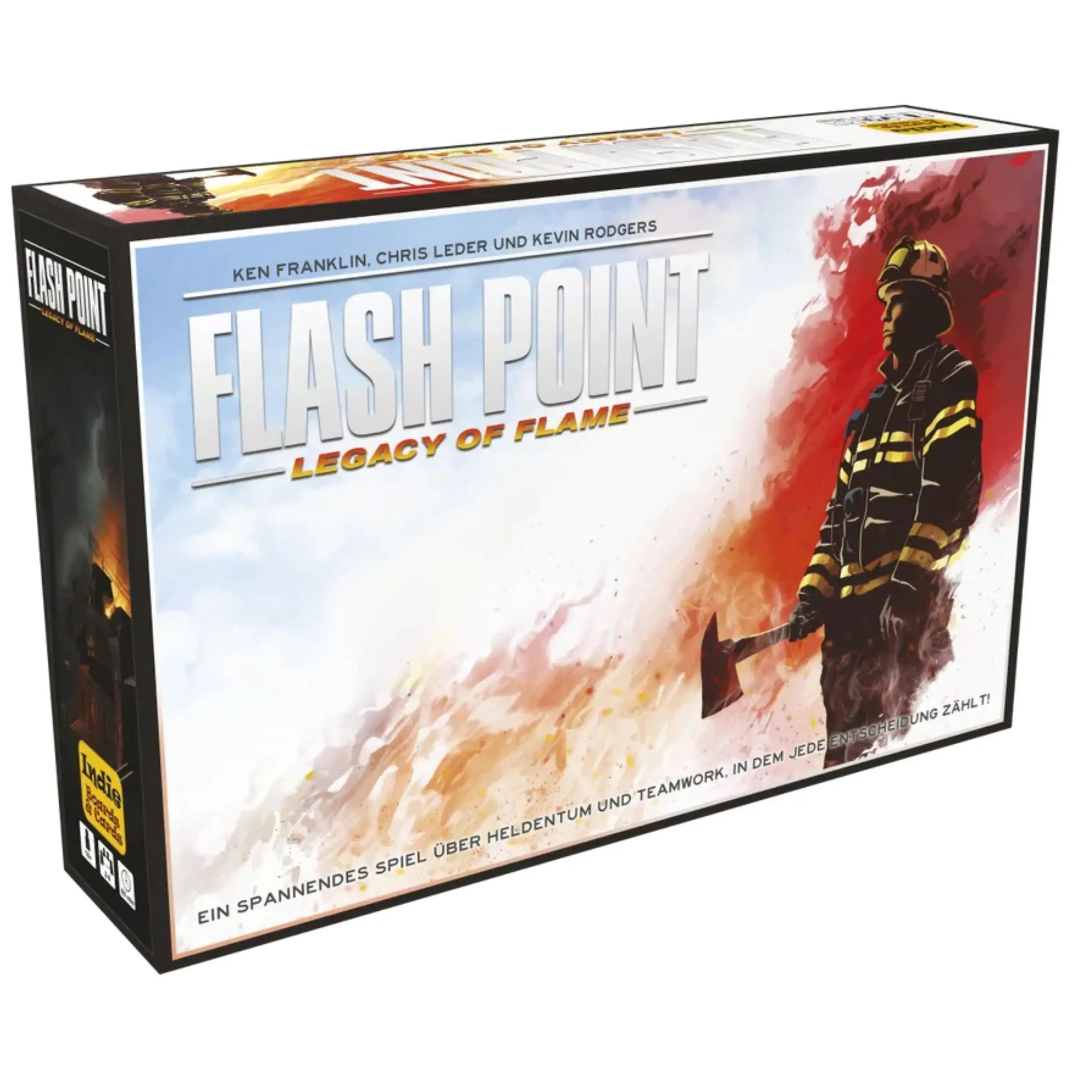
Ken Franklin, Kevin Lanzing, Chris Leder, and Kevin Rodgers take the Flash Point: Fire Rescue system and transform it into a complete legacy campaign. No more isolated missions: here, each game is an episode of a larger story, with sealed envelopes that open at key moments and rules that change before your eyes. Illustrated by Douglas Duarte, Luis Francisco, and George Patsouras, the game brings ten interconnected scenarios to the table where your choices leave permanent marks.
You start as rookie firefighters, and through the campaign, you unlock special abilities, advanced equipment, and unique powers for each team member. Each mission has specific objectives, win and loss conditions that intertwine with the narrative: rescue victims, put out fires, manage limited action points as time runs out. Decisions made in one game resonate in subsequent ones, creating an experience that exists only at your table.
What they say abroad
Mission after mission, your team truly becomes yours.
— FroGames
The fire doesn't wait. Neither do the choices.
— FroGames

Flash Point: Legacy of Flame
Flash Point: Legacy of Flame officially supports solo play: you control multiple firefighters, manage their actions, and face the campaign alone. The tactical experience remains intact, but you lose the frantic discussion about who saves whom that makes multiplayer magical. Great for those who want to experience the narrative at their own pace.
FrogScore · FroGames editorial rating · based on rules, international reviews, and gameplay sessionsWhat you manage
Components that evolve with you
Firefighter cards
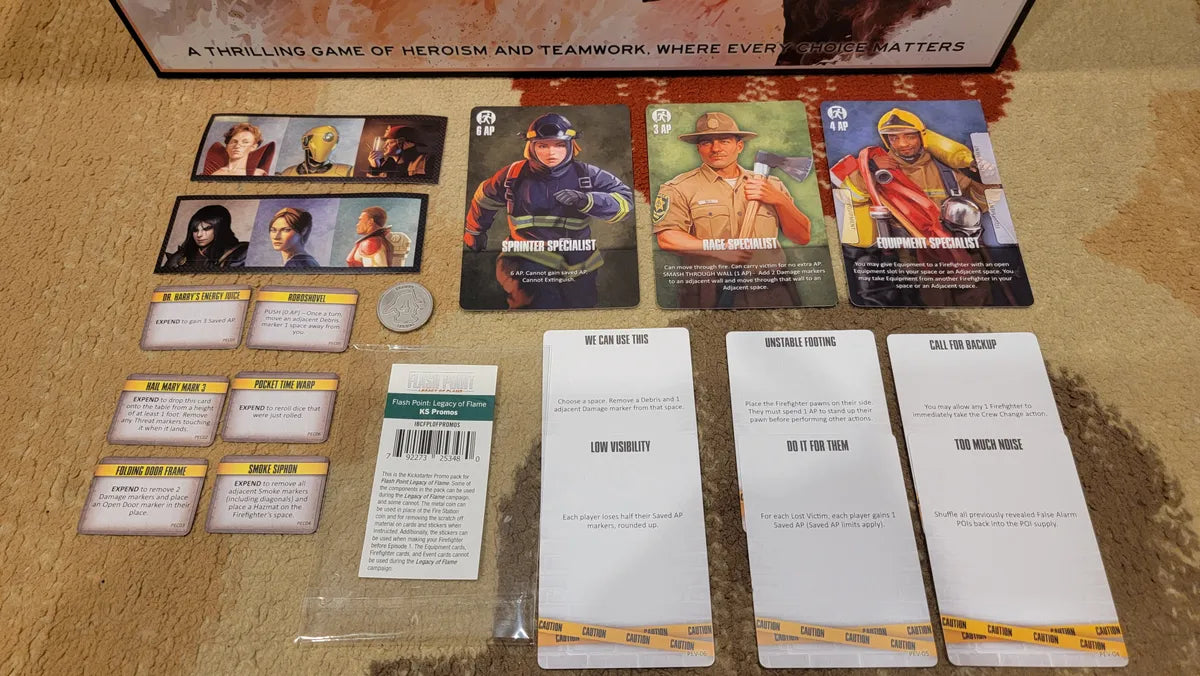
Each character has a card that marks progression, unlocked abilities, and permanent scars. They are not just cards: they are your team's journal through the campaign.
Sealed envelopes
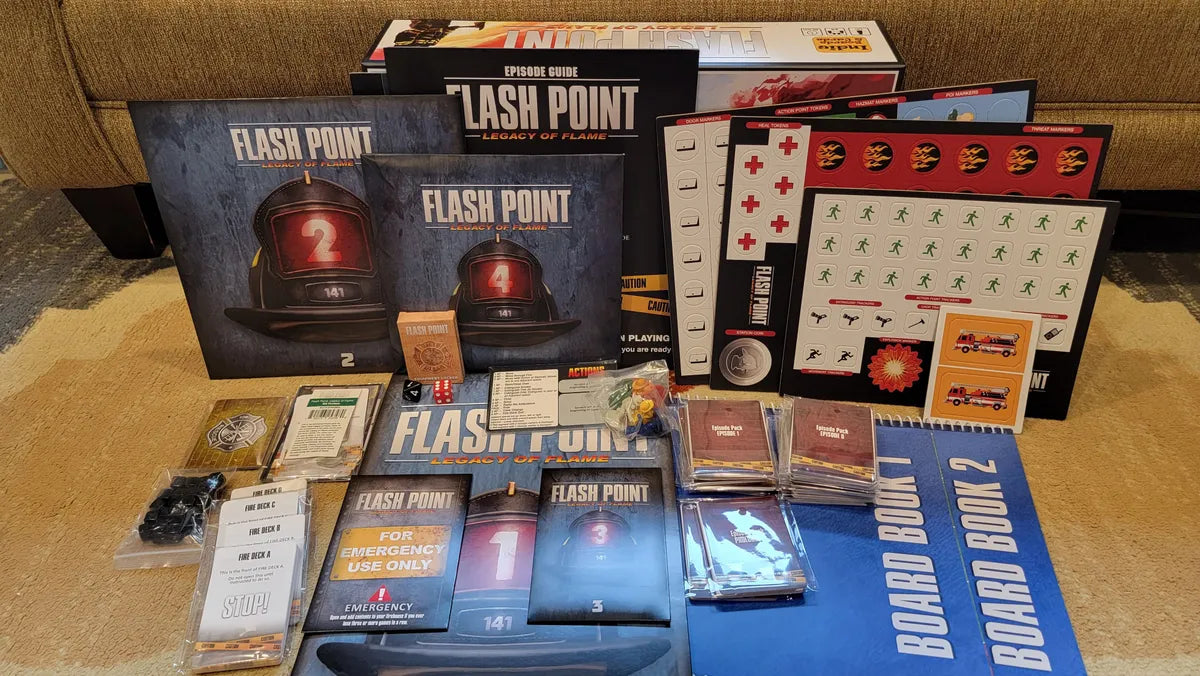
Key narrative moments hidden in numbered envelopes. You open them when the story calls for it, and inside are new rules, components, or plot twists that change everything.
Custom dice
They determine fire spread, explosions, unforeseen events. Chance is mitigated but never eliminated: the fire does what it wants, you react.
Scenario grids
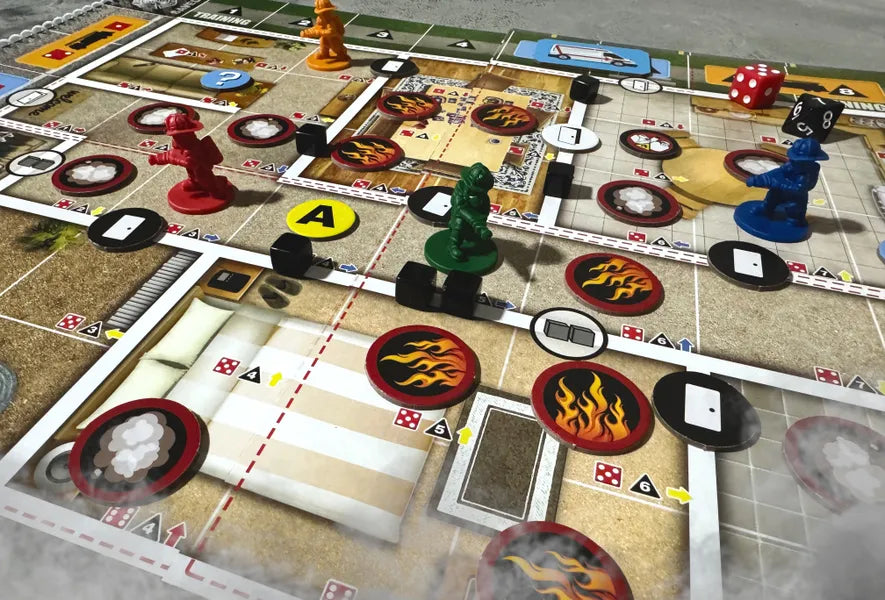
Each mission has its own layout: residential buildings, industrial warehouses, precarious structures. The grid changes tactics, priorities, risks. Each scenario is a different problem to solve.
Recommended sleeves 116 cards in 5 sizes ▼
If you play often, we recommend protecting your cards with transparent sleeves to make them last longer.
| Size | Quantity |
|---|---|
| 56 × 87 mm | 61 |
| 43 × 31 mm | 26 |
| 70 × 120 mm | 18 |
| 80 × 120 mm | 6 |
| 44 × 63 mm | 5 |
| Total cards | 116 |
After ten games, you'll have a team of firefighters that no one else has. That always happens with well-made legacy games.
A game in five moments
What happens at the table
Not the rules. The experience.
Setup and briefing
Read the scenario, place initial victims and hotspots. Someone reads the objectives aloud. The first time you open an envelope is electric: no one knows what's inside, but everyone understands that it will change things. Then you start, and the timer begins.
The first turns: routine
At first it seems manageable. You divide tasks: who deals with victims, who with major hotspots, who explores closed rooms. Action points are enough. Then you roll the fire die and a wall explodes. Someone says, "Okay, let's change the plan." Everyone nods.
Mid-mission: chaos
Now the flames are spreading faster than you can extinguish them. A victim is trapped behind a wall of fire. Someone has to risk it to save them, but if they drop out of the game now the team loses effectiveness. Feverish discussion about who sacrifices themselves. Someone does. Mark damage on the character sheet.
The last victim
There's always one last victim. The one that takes two turns to reach, and you have a turn and a half before structural collapse. Someone proposes a crazy move: using a controlled explosion to open a path. Does it work? Roll the dice. Something memorable always happens here.
Epilogue and consequences
Read the closing paragraph of the scenario. If you win, unlock something for the next episode. If you lose, mark permanent scars. Someone updates the campaign sheet with the choices made. Then you decide: do we play the next mission immediately or stop here? Usually, you play the next one.
How to play
The flow of each turn
A turn lasts two minutes. Then the fire acts and everything gets more complicated.
Each firefighter spends 4 action points: move, extinguish fire, rescue victims, use unlocked special abilities. Discuss priorities aloud, coordinate moves. Actions are simple but choices are not.
Roll the dice to determine where the fire spreads. New hotspots, explosions, dense smoke. The die doesn't ask permission: if an explosion comes up, it explodes. Update the grid, place new tokens.
Check if you have won (all victims rescued) or lost (too many victims dead or building collapsed). If neither, continue. The tension rises every turn: the fire grows faster than your ability to manage it.
Some scenarios introduce special events at specific turns: reinforcements arriving, structures collapsing, new information changing objectives. These events are written in sealed envelopes or scenario notes. Read, apply, adapt the plan.
Why it's different from others
Six mechanics that make the difference
Sealed envelopes that rewrite the rules
Not just narrative: envelopes introduce new mechanics, unprecedented components, twists that change how you play. An envelope can add a new victory condition, a new type of fire, a team ability. The rulebook grows with you, gradually, without ever overwhelming you.
Asymmetric firefighter progression
Each character unlocks unique abilities based on campaign choices. One becomes an explosives specialist, another in rapid rescue, a third in smoke resistance. No two teams are alike: your team is a product of your priorities and failures.
Scenarios that remember
Subsequent missions recall events from previous ones. Did you save the dog in mission 2? It reappears in 5. Did you destroy the east wall in 3? In 7 you'll find structural consequences. The campaign is not a linear sequence: it's a network of causes and effects.
Dice that don't forgive
Fire is managed by dice rolls, not a predictable deck. This means that chance can favor you or crush you, but never in a way that feels unfair. Dice represent the real chaos of a fire: unpredictable, but manageable with solid tactics and quick communication.
Grids that tell a story
Each scenario has a drawn map with rooms, corridors, load-bearing walls, dangerous areas. These are not abstract layouts: they are real buildings. The hospital in mission 4 has an operating room that cannot burn, the warehouse in 6 has strategically placed gas cylinders. Geography is part of the puzzle.
Ten balanced episode campaign
No need to play it all at once: each mission lasts 45 minutes, you can stop whenever you want. The campaign is designed to be played on separate evenings, with increasing but never frustrating difficulty. Ten episodes are enough to build a complete narrative arc without the 20+ hour commitment of other legacy games.
How it ends
How to win and how to lose
Each scenario has specific conditions, but the structure is always clear: save lives or the building collapses.
Victory
- Save all victims indicated by the scenario (typically 7-10) before structural collapse
- Complete the special mission objective (e.g., retrieve critical documents, extinguish the main hotspot)
- Reach the end of the event deck with at least one firefighter still operational and all primary objectives completed
Defeat
- Four or more victims die (lost in the fire or not rescued in time)
- The building completely collapses: too many walls destroyed, too much uncontrolled fire, compromised structure
- All firefighters are incapacitated (accumulated damage, trapped, zero action points remaining)
Flash Point: Legacy of Flame is not a sequence of disconnected missions. It is a story with a beginning, growth, and an end that you build. Every opened envelope, every marked scar, every unlocked ability: everything exists only at your table.
Frequently asked questions
FAQ about Flash Point: Legacy of Flame
Do I need to have played Flash Point: Fire Rescue base to play Legacy of Flame?
No, Legacy of Flame is completely standalone. It contains everything you need: rules, components, full campaign. If you already know Flash Point you'll have an advantage in the first scenarios (the basic mechanics are the same), but the game gradually introduces everything even for those starting from scratch. The campaign is designed to teach as you play.
How long does the entire campaign last?
Ten scenarios of 45 minutes each, so about 7-8 total hours if you play it all at once. But the beauty is that you can stop whenever you want: each mission is a complete session with setup and narrative conclusion. Many groups play one scenario per evening, making the campaign a weekly appointment for a couple of months.
Do permanent choices ruin the game for future replays?
Legacy of Flame is designed to be played once with the same group. Yes, some components are modified (stickers, torn cards, opened envelopes), but the experience is worth the sacrifice. If you want to replay the campaign with another group, you need a second copy. It's not an infinitely replayable game: it's a story to experience.
Is it suitable for families or does it require experience with complex cooperative games?
It is accessible even to casual players. The basic rules are simple (move, extinguish, save), complexity comes gradually with the campaign. The difficulty adapts: if you lose a mission, the next one introduces help or a second chance. Recommended age 10+, perfect for families who want a shared narrative experience without the commitment of a heavy eurogame.
Is it available in Italian?
The edition sold on FroGames is in English. The text on the cards and in the narrative paragraphs is present but not excessive: with basic English, you can play without problems. The mechanics are iconic (universal symbols for actions), so the language barrier is low. Ideal for groups who want to practice English in a playful way.
Flash Point: Legacy of Flame is a cooperative legacy game for 1-6 players, 45 minutes per session, ages 10+. Designed by Ken Franklin, Kevin Lanzing, Chris Leder and Kevin Rodgers, published by Indie Boards & Cards, it brings the Flash Point: Fire Rescue system into a narrative campaign of ten interconnected scenarios. Sealed envelopes, character progression, permanent choices, evolving scenario grids. Mechanics: cooperative action points, dice rolling for fire spread, tactical grid movement. Perfect for families and groups looking for an accessible legacy game without the 20+ hour commitment. Available on FroGames.it.
Frequently Asked Questions
The answers you're looking for, no beating around the bush.
📸Do the images match the actual product?
The photos on the website often come from BoardGameGeek and are intended to give you an idea of the game. They may vary slightly from the version you receive. The content declared by the publisher is always binding.
📦Does the content of the box match what is indicated?
We always strive to provide the correct content, but minor variations are possible due to reprints or updates. The information comes directly from the publishers. If you have any questions, please contact us!
⏳How do pre-orders work?
Pre-order the game before release, payment is immediate, and the game is reserved for you. As soon as it arrives, we'll ship it right away! If there are any delays, we'll update you promptly.
🔒Can I trust buying here?
Absolutely! Secure payments, tracked shipments, and a team that loves board games as much as you do. If something goes wrong, we'll do our best to fix it.
🛠There's a problem with my order, what should I do?
Write to us now! Whether it's a missing part, damage, or an error, we'll help you resolve it as soon as possible. Your experience truly matters to us.