
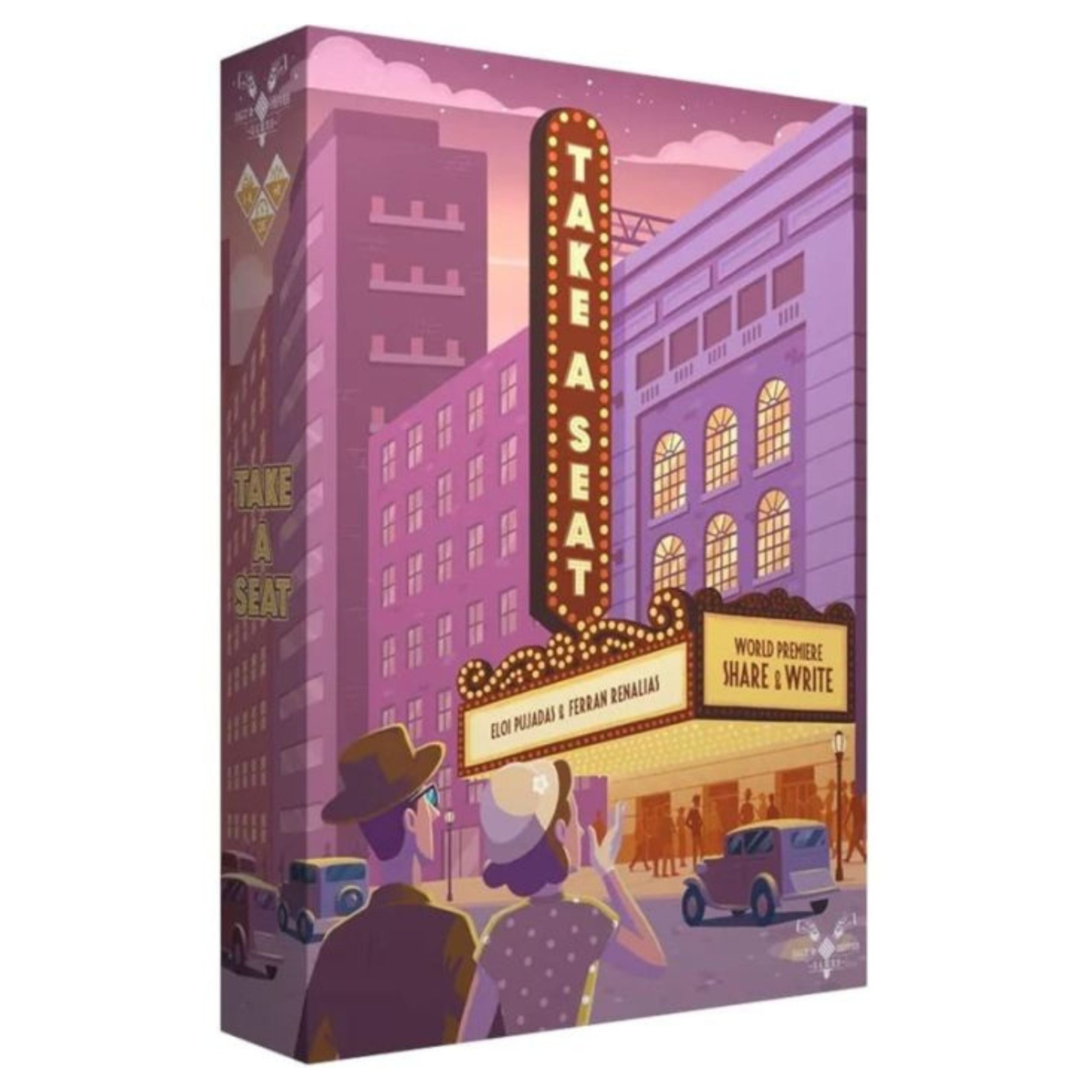
Take a Seat
🐸 Dettagli da BoardGameGeek
Consiglio BGG sul numero di giocatori
Categorie
Meccaniche
Design & Art
Lingua
Si abbina bene con
FroGames — Moments You'll Remember
Someone sighs when you steal their spot. Someone erases and re-erases. Someone finally placed the critic next to the bathroom. And no one talks about anything else for twenty minutes.
WHAT IT'S ABOUT
A premiere where seats matter more than the show
It's opening night and the theater is a battlefield. Eloi Pujadas and Ferran Renalias have created a management puzzle where you have to arrange VIPs, critics, authorities, and celebrities in the right seats. Every choice matters. Every mistake is visible. The graphics by Meeple Foundry and Carlos Ureta bring the glamorous atmosphere of grand gala evenings directly to the table.
On your turn, you choose a booking panel and decide whether to use the usher's ability or take direct points. Then you scratch one of the four tickets and assign seats in your theater by marking shapes and circles. 14 turns to fill the auditorium, maximize majorities by guest type, and complete objective cards. The Share & Write mechanic is at the heart: no dice rolling, no card drawing — player interaction generates randomness.
What they say abroad
A theatrical puzzle where every seat is a difficult choice
— FroGames
"The randomness comes from players, not dice. Brilliant."
Randomness comes from players, not dice. Brilliant.
— Meeple Mountain

Take a Seat
The game includes official rules for solo play where you face objectives with increasing scores. It works as a pure optimization puzzle without the interaction of multiplayer — you lose the tension of other players' choices on the panels, but you gain a clean challenge against yourself. A good alternative for practicing combos.
FrogScore · FroGames editorial rating · based on rulebook, international reviews, and game sessionsWhat's in the auditorium
The components that define the evening
Booking panels
Each panel offers four scratch tickets and an usher ability. Choose what you need: immediate points or tactical flexibility. Passed left or right, it changes everyone's options.
Individual theater sheets
Your personal auditorium where you mark shapes and circles to place guests. Every space counts for majorities and objectives. Mistakes cannot be erased: every pencil stroke is final.
Objective cards
Patterns to complete for bonus points: three VIPs in a row, separated critics, blocks of celebrities. Variable setup: each game has different objectives, each strategy changes accordingly.
Usher abilities
Each panel grants a special power: moving guests, modifying reservations, gaining flexibility. Using them at the right time makes the difference between victory and mediocrity.
In twenty minutes, someone will have a perfect theater. Someone else will have the mayor near the stage and the critic in the last row. It always happens with Take a Seat.
Come si gioca
Video dimostrativo di gameplay.
A game in five acts
What happens at the table
Not the rules. The experience.
The first panel is easy
You choose a reservation, scratch a ticket, mark the first guests in the audience. Everything seems manageable. There are many spaces, infinite options. No one yet knows what will truly be needed for the objectives.
Majorities start to count
Turn 5-6 and you realize someone is monopolizing the VIPs while you focused on critics. Every panel that moves left or right changes the game. You start looking at other players' boards.
Spaces run out
Mid-game. The audience fills up and every new guest has to fit among those already seated. You want to use the usher ability but you need those direct points. Someone has already completed an objective. You haven't.
The cursed panel
Turn 11. You get the perfect panel to complete an objective but all four tickets are in awkward positions. You scratch. You mark. You miss by one circle. Someone laughs. You erase and re-erase but the damage is done.
Final scoring
14 turns elapsed. Everyone tallies completed objectives, majorities by guest type, usher bonuses. The one who optimized everything wins, not the one who filled the most. The difference is two points. Always two points.
How to play
The flow of each round
Four simple actions, repeated for 14 turns. Depth emerges from combos.
Each player gets a reservation panel (from left or right on alternating turns). You observe the four available tickets and the usher ability printed on it.
You decide whether to activate the usher's ability (tactical flexibility) or take direct points by marking the corresponding box. You cannot do both.
Choose one of the four tickets on the panel and mark the reservation on your neighbor's board (right or left, depending on the turn). This is the randomness generated by the players.
On your personal board, mark shapes and circles corresponding to the ticket you received from your neighbor. Try to complete objectives and maximize majorities by type.
Why it's different from others
Six mechanics that make a difference
Share & Write instead of Roll & Write
You don't roll dice, you don't draw cards. Players create the randomness by choosing which tickets to scratch on other players' panels. Every turn is an implicit micro-negotiation: what I choose influences what you receive. Innovative mechanic that eliminates downtime and makes every choice shared.
The theater is a spatial puzzle
Each guest occupies a specific shape (1x2, 2x1, L-shape). Placing them in the audience is like playing Tetris with tactical constraints: you need to maximize points, complete patterns for objectives, and win majorities. Spaces run out quickly and every mistake costs dearly.
Three overlapping scoring layers
Filling the audience isn't enough. You need to balance objective cards (patterns to complete), majorities by guest type, and usher bonuses. Those who focus on only one lose. Those who optimize all three dominate. The tension arises from having to choose what to sacrifice.
Usher abilities as a tactical valve
Each panel offers a power: move a guest, modify a reservation, rotate a shape. Using them means giving up direct points. Timing is everything: activating them too early wastes opportunities, too late doesn't solve problems. The choice is always difficult.
Variable setup with different objectives
Each game draws different objective cards from the deck: three consecutive VIPs, critics never adjacent, a 2x2 block of celebrities. The strategy changes completely based on the objectives drawn. No two games are alike, no dominant strategies.
Scales from 1 to 6 without modifications
The game works identically solo or with six. No special rules, no additional components. Solo play becomes a pure optimization puzzle, 6 players introduces chaos into others' choices. Same game, different intensity.
How it ends
How to win and how to lose
After 14 turns, three scoring categories are added up. The one who optimized everything wins, not the one who did only one thing very well.
Victory
- Complete more objective cards than opponents (specific patterns in the audience)
- Win majorities by guest type (VIPs, critics, celebrities, authorities)
- Maximize usher bonuses by activating abilities at key moments
Mistakes that cost victory
- Focusing only on one guest type and losing other majorities
- Ignoring objectives to fill the audience indiscriminately
- Using usher abilities too early or too late, wasting flexibility or direct points
Take a Seat is an elegant puzzle that rewards planning without punishing a single mistake. Tactical depth in half an hour, rules in five minutes, no downtime. For those looking for compact strategy without dead time.
Frequently asked questions
FAQ about Take a Seat
Is it suitable for those who have never played a roll & write?
Yes, in fact it's perfect for beginners. The Share & Write mechanic is more intuitive than classic roll & write because it doesn't depend on dice or cards but on player choices. Rules in 5 minutes, first game immediate. The depth emerges after 2-3 games when you start seeing the combos between objectives and majorities.
Does it work well with 6 players or does it become chaotic?
It works perfectly. There's no downtime because everyone plays simultaneously: you receive a panel, choose, scratch, mark. With 6 players, the randomness of others' choices increases (less control over what you receive) but the pace remains fast. Games last 25-30 minutes even with a full table.
How much does luck matter compared to strategy?
Randomness exists (depending on what neighbors scratch on your panels) but you always have 4 options each turn and usher abilities offer tactical corrections. Those who plan well win 80% of the time. It's not a game where one unlucky turn ruins everything — it's a puzzle where you optimize imperfect choices.
Is the solo mode a real mode or a fallback?
It's a well-designed official mode but it loses the interaction of multiplayer. It becomes a pure optimization puzzle against increasing target scores. Great for training and discovering combos, less exciting than a shared game. Honest rating: 3/5.
Is the edition for sale in Italian?
No, this edition is in English. The game is almost language-independent: objective cards have clear icons, panels are visual, English is only needed to read usher abilities (short, repetitive text). After one game, you play without a language barrier.
Take a Seat is a strategic flip & write for 1-6 players designed by Eloi Pujadas and Ferran Renalias, published by Salt & Pepper Games. Games last 20-30 minutes, recommended age 8+. The innovative Share & Write mechanic eliminates dice and cards: players themselves create randomness by choosing which tickets to scratch on other players' panels. Each game requires placing VIPs, critics, and celebrities in a theater audience, optimizing three overlapping scoring layers: objective cards, majorities by guest type, usher bonuses. Variable setup, immediate rules, emergent tactical depth. Supports solo play with an official puzzle-based mode. Available on FroGames.it.
Take a Seat
Frequently Asked Questions
The answers you're looking for, no beating around the bush.
📸Do the images match the actual product?
The photos on the website often come from BoardGameGeek and are intended to give you an idea of the game. They may vary slightly from the version you receive. The content declared by the publisher is always binding.
📦Does the content of the box match what is indicated?
We always strive to provide the correct content, but minor variations are possible due to reprints or updates. The information comes directly from the publishers. If you have any questions, please contact us!
⏳How do pre-orders work?
Pre-order the game before release, payment is immediate, and the game is reserved for you. As soon as it arrives, we'll ship it right away! If there are any delays, we'll update you promptly.
🔒Can I trust buying here?
Absolutely! Secure payments, tracked shipments, and a team that loves board games as much as you do. If something goes wrong, we'll do our best to fix it.
🛠There's a problem with my order, what should I do?
Write to us now! Whether it's a missing part, damage, or an error, we'll help you resolve it as soon as possible. Your experience truly matters to us.