
Secret Identity
🐸 Details from BoardGameGeek
Consiglio BGG sul numero di giocatori
Categorie
Meccaniche
Design & Art
Lingua
🐸 How pre-orders work
🐸 A wise frog knows when to split the order… and when to wait for the right leap.
- Arrives
- October 30, 2026
Si abbina bene con
The FroGames Review
You have four clue cards. Eight characters on the table. Each turn you choose: reveal something about yourself or guess someone else. And when the cards run out, the opportunities do too.
WHAT IT IS
Guess the others before they guess you
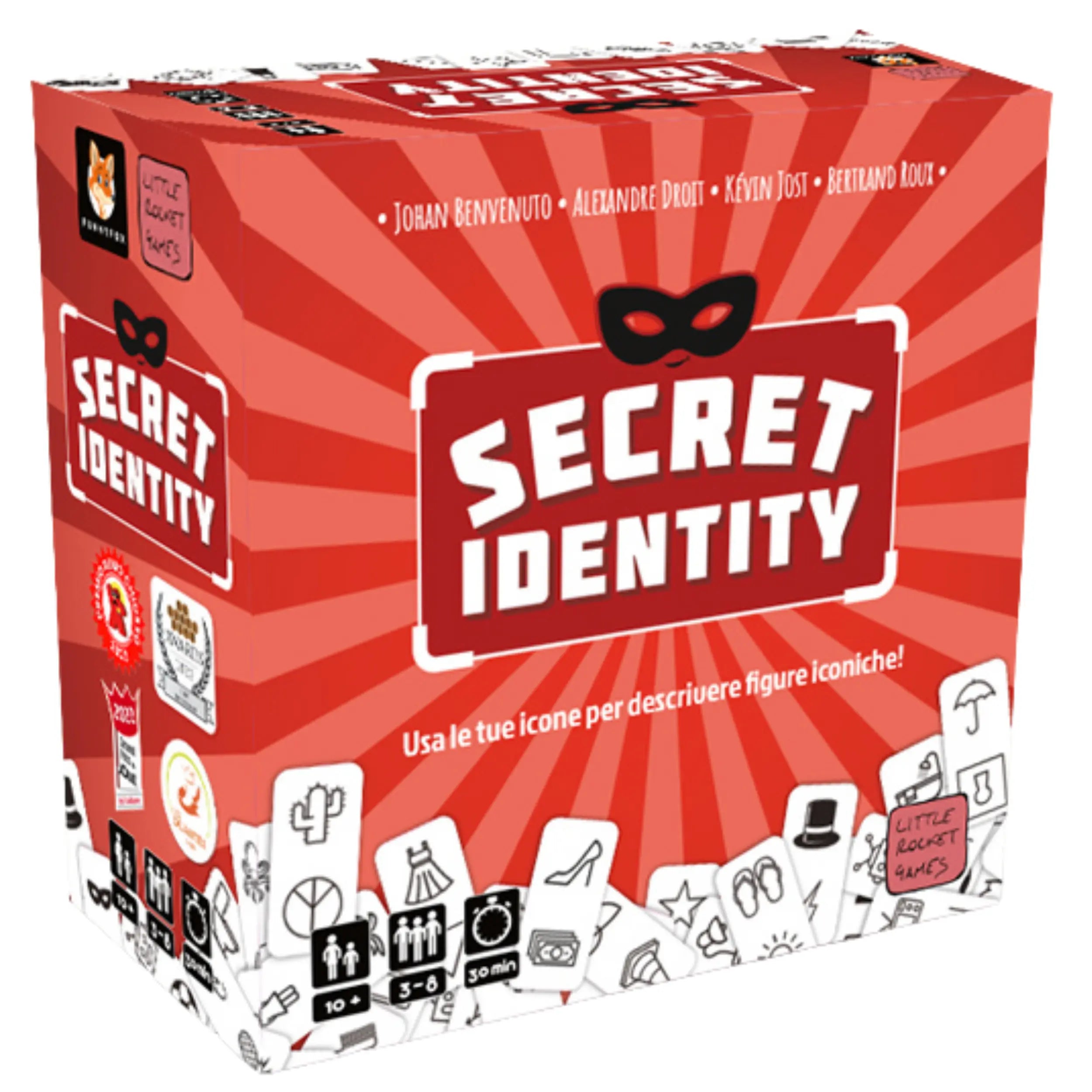
Johan Benvenuto, Alexandre Droit, Kévin Jost, and Bertrand Roux authored an asymmetric deduction party game published by Funnyfox in 2022, now distributed in Italy by Little Rocket Games. Eight characters are on the table, and each receives a secret identity. Alain Boyer’s illustrations give a face to these eight strangers, which change every round.
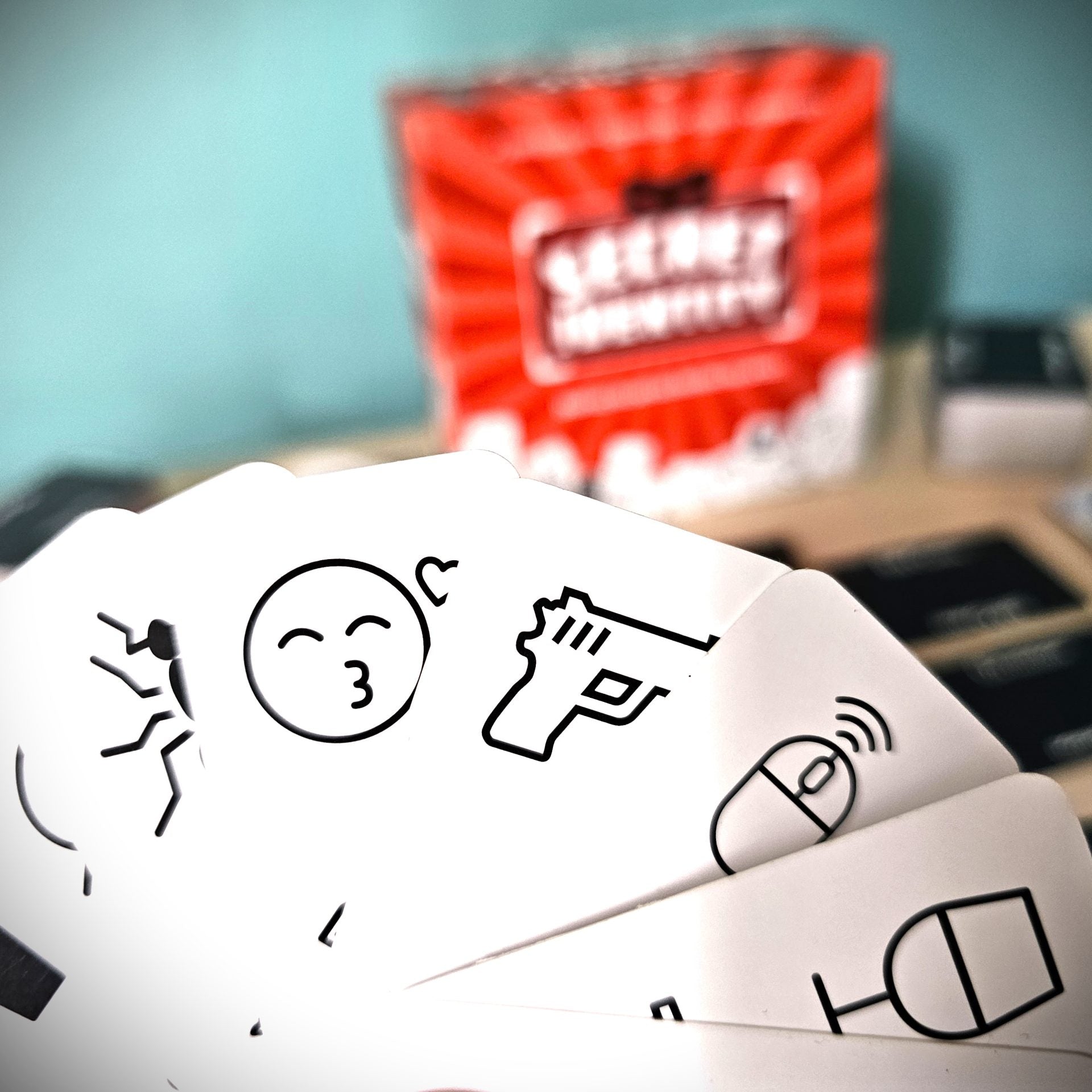
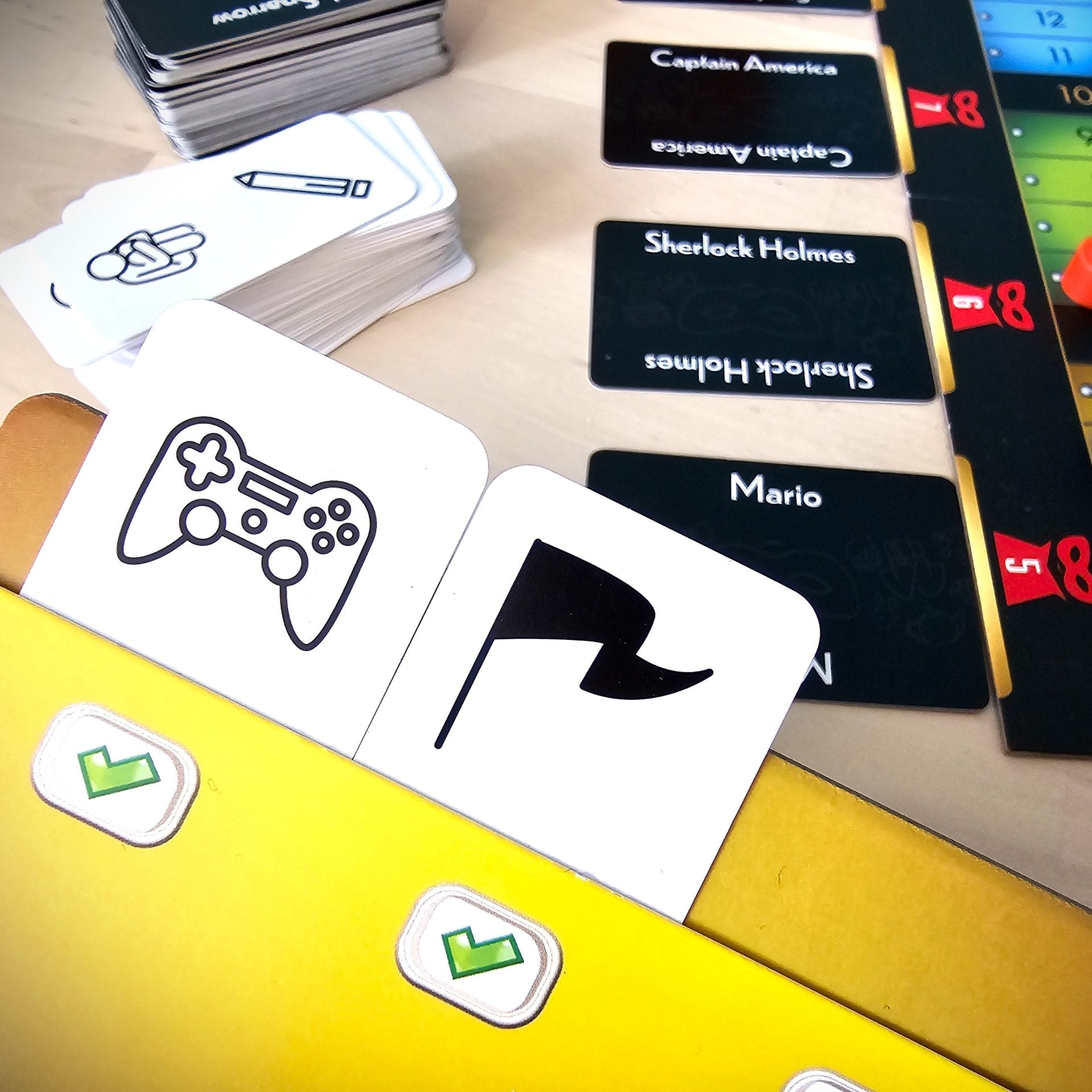
You use double-sided pictogram cards to provide clues about your character, trying to get others to guess who you are. At the same time, you observe the clues of others and place bets on who you think they are. Each correct guess is worth points, but clue cards do not regenerate: when they run out, the game speeds towards its end. Four rounds, eight new characters each time, and a supply of clues that steadily dwindles.
What they say abroad
When you only have three cards left and you are still a mystery, every move becomes a calculation.
— FroGames
"A tight deduction game that forces you to choose between revealing yourself and guessing others."
A tight deduction game that forces you to choose between revealing yourself and guessing others.
— Meeple Mountain

Secret Identity
FrogScore · FroGames editorial rating · based on the rulebook, international reviews, and gameplay sessionsWhat you use to communicate
The tools of the game
Eight characters
Every round, eight new faces appear on the table. One of them is you. The others have to figure out which one.
Pictogram cards
Double-sided, abstract symbols that you can associate with your character. Glasses, hat, beard, age, expression. They never refresh.
Voting tokens
Each turn you bet on who you think an opponent is. Guessing early is worth more points than guessing late.
Key card
At the start of each round, you receive your secret identity. No one knows who you are until they guess it or you reveal yourself.
Come si gioca
Video dimostrativo di gameplay.
🎲How to playThe rules in four moves▼
How to play
The flow of every round
Four identical rounds, with eight new characters each time.
Eight characters are revealed on the table. Each player secretly receives a key card indicating which character they are. Clue cards remain in hand (they are never reloaded during the entire game).
In turns, each player chooses: play a clue card face up or face down to reveal something about their character, OR place a voting token on an opponent they think they have identified. Those who vote first earn more points.
When a player receives enough votes (or decides to reveal themselves), they show their key card. Those who voted correctly earn points; the revealed player earns points for every vote received.
When everyone has been identified or the round ends, move to the next round with eight new characters. Used clue cards do NOT return to hand: in each round you always have fewer resources to communicate with.
⏱️Your first gameThe story, moment by moment▼
A game in five moments
What happens at the table
Not the rules. The experience.
Eight new faces
The character deck opens on the table. Eight different faces, each receives their key card in secret. You look at your number: you are character four, the one with the glasses and the jacket. No one knows yet.
First clues, first guesses
Someone plays a pictogram card with a beard. Someone else a hat. You play glasses, turning the card to the right side. Everyone looks at the characters, crossing the symbols. Someone is already placing a token on you.
The cards dwindle
You are in the second round. You have three clue cards left. The others have figured out half the table, but you are still hidden. You decide to play another card or risk being mistaken for someone else. The reserve doesn't return: every card is a definitive choice.
Revelations and gambles
Someone runs out of cards and has to gamble without giving any more clues. Another is guessed immediately and earns passive points. You vote on who you think character six is: if you guess correctly early, it's worth triple. Guess wrong and you lose the chance.
Game end, tallying up
Fourth round concluded. Final identities are revealed, points are added up: those who guessed more opponents correctly and those who were guessed early. Someone managed their cards perfectly, someone else wasted them all in the first round. The difference shows.
🐸Know this firstThree honest things, from friends▼
Know this first
Three things to consider
Clue cards never reload. You start with a reserve for four rounds: using them all immediately leaves you mute in the last turns. Rationing them poorly means never getting yourself guessed. It is a progressive tension unusual for a party game.
The pictograms are abstract: glasses, hats, beards, expressions. If someone at the table doesn't observe the characters carefully or confuses the symbols, the clues become noise. It's not a game for those who want to chat while they play.
With 3-4 players, the deduction is more mechanical and linear. With 7-8, the table becomes chaotic, clues overlap, and voting becomes a gamble. The sweet spot is 5-6: complex enough but manageable.
🏆Victory and defeatWhat the finale rewards▼
How it ends
How to win and how to lose
After four rounds, points are tallied. You win if you guessed more opponents correctly and if you were guessed at the right time.
Scoring conditions
- Earn points every time you correctly vote for an opponent's identity (more points if you vote first)
- Earn points when others vote for you (more points if they guess you early, fewer if late)
- Whoever has the highest total after four rounds wins
How to waste points
- Vote for wrong identities: no points, token lost
- No one guesses you because you gave clues that were too vague or ambiguous
- They guess you too late (last turn) and you earn minimal points
Secret Identity is a party game that rewards precision, not chaos. If you like observing, deducing, and managing limited resources even within a light game, this is your table.
💬FAQQuick answers before checkout▼
FAQ
FAQ about Secret Identity
What mechanics does Secret Identity use?
Deduction (Hidden Roles), hand management (clue cards are limited resources), connections (matching pictograms to characters), and voting (placing tokens to guess opponents). The game mixes party games and resource management in an unusual way.
Does it work well with few players?
With 3-4 players it works, but the deduction becomes more linear and predictable. The game is designed for groups: from 5 to 8 players, the complexity increases and reading the clues becomes more interesting. Under 5, it loses some of the controlled chaos that characterizes it.
Are the clue cards enough for four rounds?
It depends on how you use them. Each player starts with a fixed number of cards (varying based on the number of participants). If you burn through them all in the first two rounds, you will be forced to vote in the last ones without giving any more clues about yourself. Management is the heart of the game.
Is it suitable for those who don't know board games?
Yes. The rules are explained in ten minutes, the pictograms are intuitive, and the concept of giving/receiving clues is immediate. The only requirement is attention: those who don't observe the characters or don't follow others' clues make random choices and ruin the experience for everyone.
Is the edition available in Italian?
Yes, this Little Rocket Games edition includes rules and components in Italian. The pictograms are universal (visual symbols without text), so language does not impact gameplay.
The people behind the game
Who invented it, who illustrated it, who publishes it — and what else they have done.
Secret Identity is a deduction party game for 3-8 players, lasting 20-40 minutes, age 10+. Designed by Johan Benvenuto, Alexandre Droit, Kévin Jost, and Bertrand Roux, published by Funnyfox and distributed in Italy by Little Rocket Games. It uses Hidden Roles, hand management, and voting mechanics: each player has a secret identity among eight characters and must get themselves guessed using double-sided pictogram cards, which are never reloaded during the game. Deduction is mixed with limited resource management, creating a progressive tension unusual for a social game. Four rounds, eight new characters each time, scoring based on guessing others and being guessed at the right time. Available on FroGames.it.
Secret Identity
Frequently Asked Questions
The answers you're looking for, no beating around the bush.
📸Do the images match the actual product?
The photos on the website often come from BoardGameGeek and are intended to give you an idea of the game. They may vary slightly from the version you receive. The content declared by the publisher is always binding.
📦Does the content of the box match what is indicated?
We always strive to provide the correct content, but minor variations are possible due to reprints or updates. The information comes directly from the publishers. If you have any questions, please contact us!
⏳How do pre-orders work?
Pre-order the game before release, payment is immediate, and the game is reserved for you. As soon as it arrives, we'll ship it right away! If there are any delays, we'll update you promptly.
🔒Can I trust buying here?
Absolutely! Secure payments, tracked shipments, and a team that loves board games as much as you do. If something goes wrong, we'll do our best to fix it.
🛠There's a problem with my order, what should I do?
Write to us now! Whether it's a missing part, damage, or an error, we'll help you resolve it as soon as possible. Your experience truly matters to us.