
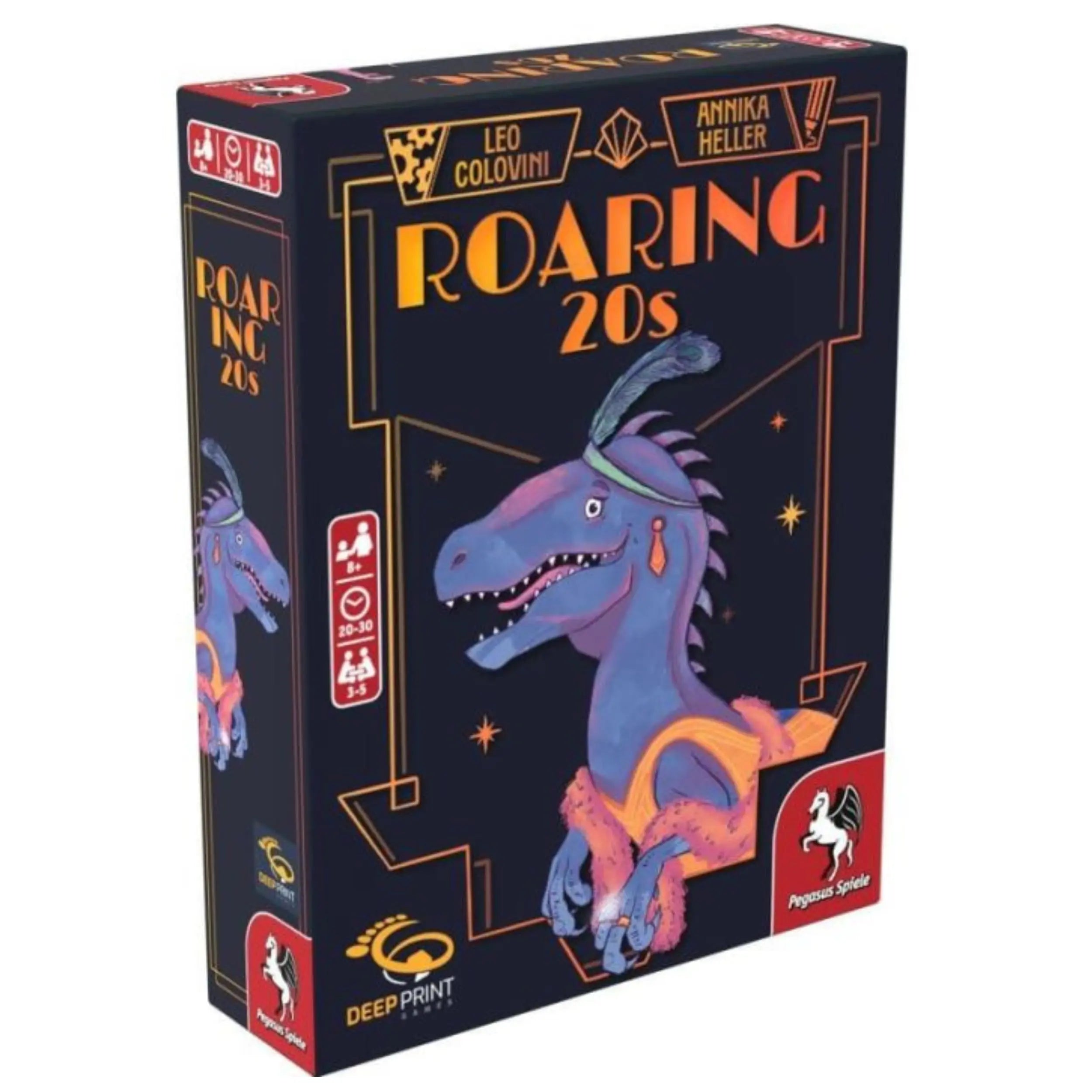
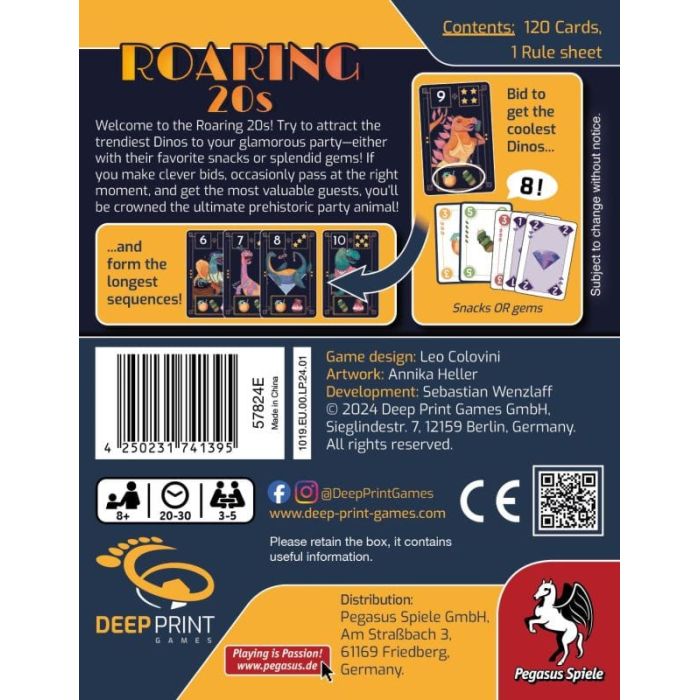
Roaring 20s
🐸 Details from BoardGameGeek
Consiglio BGG sul numero di giocatori
Categorie
Meccaniche
Design & Art
Lingua

Si abbina bene con
FroGames — Moments You'll Remember
One player goes all in on snacks, the other quietly collects gems. In the end, someone laughs, someone curses a lost dino at the finish line. And no one remembers who actually won.
WHAT IT IS ABOUT
An exclusive party where the most fashionable dinosaurs are worth points
Welcome to the Roaring 20s, the era of jazz, luxury, and legendary parties. Leo Colovini, master of mechanical synthesis, signs a party game where each player organizes the party of the year and tries to attract the trendiest dinosaurs of the moment. Illustrated by Annika Heller with a vintage and ironic style, the game brings 120 cards in LongPack format to the table: compact, quick to explain, impossible to forget.
Each round is an auction. Bid snacks or gems to get a dino, or exit the race and choose a Mine! card before others. Each dinosaur is worth points alone, but pairs and sequences multiply the value. If you draw a duplicate, you can discard it and turn your Mine! card into a versatile wild card. The one who manages to balance aggressive bids, tactical exits, and final combos wins the title of prehistoric party king.
What they say abroad
A fast, fun bidding system where every choice costs something tangible.
— FroGames
The tension builds when you have to decide: do I bet everything on this dino or do I withdraw and take the best wild card?
— FroGames

Roaring 20s
FrogScore · editorial rating FroGames · based on rules, international reviews, and gameplay sessionsYour party guests
Four elements that make up every evening
Dino Cards
Each dinosaur is worth 1 to 5 points. But the real value depends on combos: pairs are worth 3 points, triples 6, and long sequences make you skyrocket to the top of the leaderboard. Each dino has different preferences: some want snacks, others gems.
Snacks and Gems
The two currencies of the game. You pay with snacks or gems, but you can't mix them in the same auction. If you offer more than necessary, you don't get change: every bid must be calculated. Resource management is half the game.
Mine! Cards
When you exit the auction, you choose one: the earlier you exit, the more choice you have. Some give you extra resources, others are wild cards that complete impossible combos. Exit timing is an art: exit too late and you're left with scraps.
Strategic Discards
Draw a dino you already have? You can discard it to turn one of your Mine! cards into a universal wild card. It's an elegant mechanic: duplicates are never useless, they become leverage for more aggressive combos.
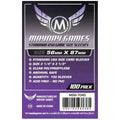
Recommended Sleeves 120 cards in 1 size ▼
If you play often, we recommend protecting your cards with clear sleeves to make them last longer.
| Size | Quantity |
|---|---|
| 56 × 87 mm | 120 |
| Total cards | 120 |
In half an hour, someone will have a 15-point sequence built on a perfect bluff. And someone else will already be asking for a rematch.
Come si gioca
Video dimostrativo di gameplay.
A game in five moments
What happens at the table
Not the rules. The experience.
Everyone wants the same dino
The first dinosaur on the table is worth 5 points. Everyone still has all their resources. Someone immediately bids the maximum to discourage others, someone else raises to bluff. No one wants to be the first out, but someone will have to be. The tension already rises in the first round.
The first wildcard disappears
Someone drops out of the auction and takes the strongest Mine! card. The others give them a dirty look: that wildcard could have been useful to everyone. Now, whoever remains in the game knows that the best wildcards are running out. The next auction becomes more ruthless.
Duplicates and sudden wildcards
You draw a dino you already had. You discard it and convert a Mine! card into a universal wildcard. Now you have a combo no one expected. At the table, someone starts counting your points. Strategies adapt in real-time: those aiming for pairs now try sequences, those accumulating gems burn them all.
The legendary auction
The dino that completes your 15-point sequence appears. Or your opponent's. Everyone bids, everyone raises, resources run out. The winner pays dearly, perhaps too dearly. The one who drops out is comforted by the last remaining wildcard. This is the auction that decides the game, even though three rounds are still left.
Score counting and surprises
Points are counted. Pairs, triples, sequences. Someone made a combo no one saw coming. Someone else spent too much for a dino that was worth less than expected. The rankings are overturned in the final calculations. And the request for a rematch immediately begins.
How to play
The flow of each round
Each turn is a quick auction. A dino is revealed, resources are offered, someone drops out and takes a wildcard. Then it repeats.
The first card from the deck is flipped. Everyone sees its point value and preferences (snacks or gems). The auction begins: you offer one resource at a time, others follow or drop out.
On your turn, you can increase your offer of snacks or gems (not both), or drop out of the auction. If you drop out, you place your Mine! card on one of the available cards: the sooner you drop out, the more choice you have. Those who remain continue to bid.
The last one remaining wins the dino and pays with snacks or gems (they choose, but don't mix them). If they offer more than necessary, they don't get change. Then they decide whether to keep the dino or discard it to turn a Mine! card into a wildcard.
A new dino is revealed and the auction begins again. When the deck runs out, points are counted: each dino is worth its base value, plus bonuses for pairs (3 points), triples (6 points), and sequences (up to 15 points for six consecutive dinos).
Why it's different from others
Six mechanics that make a difference
Two currencies, one choice
You can pay with snacks or gems, but don't mix them in the same auction. Each dino has different preferences: some want snacks, others gems. If you pay with the wrong resource, you waste points. Resource management is seemingly simple, but ruthless in practice.
Dropping out is a tactic
In traditional auction games, dropping out means losing. Not here: dropping out early gives you access to the best wildcards. Staying until the end guarantees you the dino, but you risk paying too much and ending up without useful wildcards. Each round is a calculation of timing.
Duplicates become wildcards
Do you draw a dino you already have? You can discard it to turn a Mine! card into a universal wildcard. It's a very elegant mechanic: no card is ever useless, and duplicates become a lever for impossible combos. Luck transforms into strategy.
Multiple and flexible combos
You can aim for pairs (3 points), triples (6 points), or long sequences (up to 15 points). Strategies partially exclude each other: a dino in a pair cannot be in a sequence. You must choose a path and adapt it to the dinos that appear and the wildcards you draw.
Speed and depth
Rules in 5 minutes, game in 25. But behind the simplicity lies a solid tactical layer: timing of dropping out, resource management, bluffing in bids. Leo Colovini manages to create games that seem like fillers but reward those who think two moves ahead.
LongPack format
120 cards in a long and compact format. It fits in a pocket, is set up in an instant, and can be played anywhere. Annika Heller's vintage graphic design transforms each card into a small 1920s poster. It's beautiful to look at and convenient to carry.
How it ends
How to win and how to lose
When the deck runs out, points are counted. Each dino is worth its base value, plus combo bonuses.
Victory
- You built long sequences (6 consecutive dinos = 15 points) by using wildcards at the right time
- You accumulated pairs and triples without spending too much in auctions, leaving expensive dinos to others
- You discarded strategic duplicates to turn Mine! cards into universal wildcards that complete multiple combos
Defeat
- You won auctions by spending too much and ran out of resources for key final dinos
- You accumulated scattered dinos without building combos: low base points, no bonuses
- You dropped out of auctions too late and ended up with useless wildcards or ones already taken by others
Roaring 20s is a party game that rewards strategic thinking but doesn't punish those who just want to have fun. Perfect as a gateway for auctions, perfect as a filler for experts.
Frequently asked questions
Roaring 20s FAQ
Is it really suitable for ages 8 and up?
Yes. The auction mechanics are intuitive: bid, raise, or drop out. Children understand the system in the first round. Tactical depth emerges with experience, but even in the first game, it's fun. It's a perfect gateway to introduce auctions without being overwhelming.
Does it work well with 3 players, or do you need a full table?
It works great with 3 players. Auctions are tenser because each drop-out carries more weight, and wildcards disappear quickly. With 5 players, there's more chaos and more variability, but the game scales well: there's no ideal number, it depends on how intense you want it to be.
How much does luck count compared to strategy?
Luck exists: you draw random dinos and wildcards. But decisions matter a lot. When to drop out, what to pay, which combos to aim for: these are all calculations. An experienced player will beat a beginner 8 out of 10 times, even with worse cards. Luck provides variety, strategy provides control.
Can you play with people who don't know board games?
Absolutely. It's one of the best gateway games for auctions. You explain it in 5 minutes, play immediately, and no one feels lost. Those who come from classic party games will find familiar interaction and pace. Those who come from eurogames will find a solid tactical layer. It works for everyone.
Is the game available in Italian?
This edition is in English, published by Pegasus Spiele. The text on the cards is minimal (dino names and resource symbols), so language is not a barrier. The rules are available online in Italian, and after a trial game, you won't need to consult them anymore.
Roaring 20s is an auction and set collection party game for 3-5 players, designed by Leo Colovini and published by Pegasus Spiele. Each game lasts 20-30 minutes, recommended age 8+. Players compete to attract the trendiest dinosaurs to their 1920s party, offering snacks or gems in fast-paced auctions. The mechanics reward combos of pairs, triples, and sequences, with the ability to turn duplicates into strategic wildcards. The LongPack format makes the game compact and portable, perfect as a filler or gateway for those who want to discover auctions without excessive complexity. Available on FroGames.it.
Roaring 20s
Frequently Asked Questions
The answers you're looking for, no beating around the bush.
📸Do the images match the actual product?
The photos on the website often come from BoardGameGeek and are intended to give you an idea of the game. They may vary slightly from the version you receive. The content declared by the publisher is always binding.
📦Does the content of the box match what is indicated?
We always strive to provide the correct content, but minor variations are possible due to reprints or updates. The information comes directly from the publishers. If you have any questions, please contact us!
⏳How do pre-orders work?
Pre-order the game before release, payment is immediate, and the game is reserved for you. As soon as it arrives, we'll ship it right away! If there are any delays, we'll update you promptly.
🔒Can I trust buying here?
Absolutely! Secure payments, tracked shipments, and a team that loves board games as much as you do. If something goes wrong, we'll do our best to fix it.
🛠There's a problem with my order, what should I do?
Write to us now! Whether it's a missing part, damage, or an error, we'll help you resolve it as soon as possible. Your experience truly matters to us.