
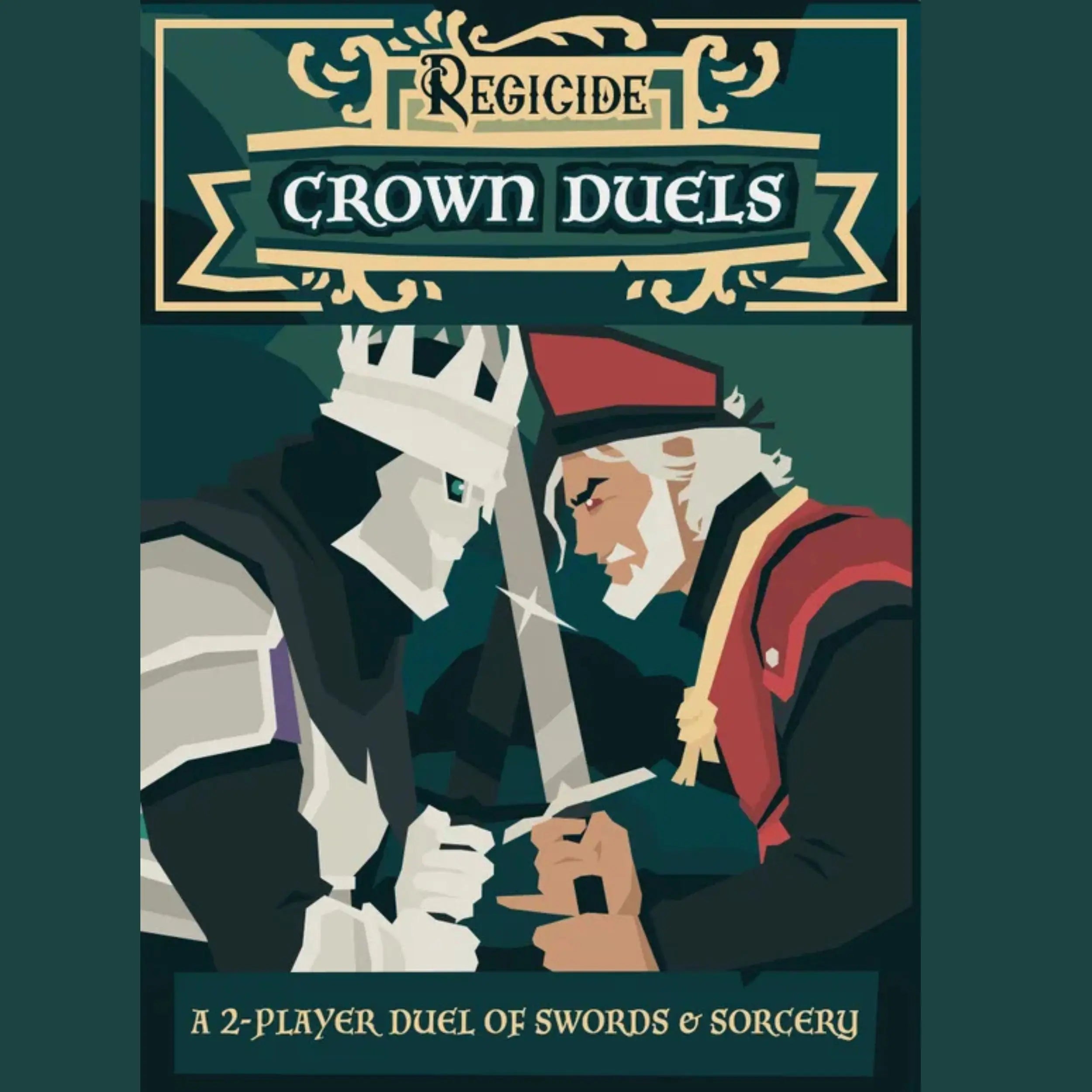
Regicide: Crown Duels
🐸 Details from BoardGameGeek
Consiglio BGG sul numero di giocatori
Categorie
Meccaniche
Design & Art
Lingua
🐸 How pre-orders work
🐸 A wise frog knows when to split the order… and when to wait for the right leap.
- Arrives
- by the end of November 2026
Si abbina bene con
FroGames — Moments You'll Remember
He plays a nine. You respond with a king. He smiles and plays the queen. At the end of the evening, you still remember that smile.
WHAT IT'S ABOUT
When tyrants become adversaries
Crown Duels is born from the universe of Regicide, the cooperative game that made kings, queens, and jacks the enemies to be defeated. Paul Abrahams and Sketchgoblin turn the tables: now you are the corrupt nobility, and your opponent is the player sitting across from you. Same poker deck, completely different philosophy.
Equip armor and weapons, cast spells, upgrade equipment. Every card played pushes you towards corruption as you try to take down your opponent. Tight hand management, calibrated bluffing, reading the other player. In 15-30 minutes, it's decided who stands tall.
What they say abroad
A tense duel where every card counts and corruption advances inexorably
— FroGames
The same cooperative DNA of Regicide, transfused into a surgical PvP
— FroGames

Regicide: Crown Duels
FrogScore · FroGames editorial rating · based on rules, international reviews, and play sessionsYour arsenal
Four pillars of the duel
Armor
Low cards become defense. They absorb damage, delaying corruption. But every hit taken consumes equipment: choose when to keep them and when to sacrifice them.
Weapons
Medium cards deal direct damage. Each attack can be powered up by spending other cards from your hand. Timing and dosage: strike too early and you remain vulnerable.
Spells
Face cards have special effects: draw cards, discard from your opponent, regenerate equipment. Using them at the right moment turns the tide of the duel.
Corruption
The more powerful cards you play, the more corrupted you become. Corruption reduces your defense and brings you closer to defeat. The game is a balance beam: power versus survival.
In half an hour, one of you will have won. The other will already be thinking about a rematch.
A game in five moments
What happens at the table
Not the rules. The experience.
First cards, first signs
Draw your initial hands. Look at the cards and start building your strategy. Does he hold two face cards? He'll probably focus on spells. Do you have three low cards? Armor first, attack later. You haven't played anything yet, but the game has already begun.
First blows and first armor
The first cards hit the table. He plays a six: light armor. You respond with a seven: opening strike. He absorbs it with armor, you both draw. The duel takes shape, health points drop, corruption starts to bite.
The dance of the face cards
He plays a jack: extra draw. You respond with a queen: discard a card from his hand. Now you know part of his arsenal, and he knows that you know. Moves become pure deduction: what is he holding? What is he bluffing?
Corruption vs. survival
You're at 4 health points, he's at 6. But his corruption is higher. You play an eight boosted with a nine: 17 damage in one hit. He has to decide: burn the armor or take the hit? He chooses to take the hit. Now you're even, but you have a face card in hand and he doesn't.
The last turn
He plays his last card: a ten. Direct attack. You have 2 health points. No armor left. The only card that can save you is the king you've been holding for three turns. You play it: special effect, regenerate armor, absorb the blow. Next turn, you win. He shakes his head. Instant rematch.
How to play
The flow of each round
A round lasts a few minutes: you play a card, resolve the effect, your opponent responds. Fast and surgical.
Choose a card from your hand and play it. Low cards are armor (protection), middle cards are weapons (damage), face cards are spells (special effects). Each card played increases your corruption.
If you played a weapon, deal damage to your opponent (equal to the card's value). You can boost the attack by discarding other cards. If you played armor, place it in front of you: it will absorb future blows. Face cards activate unique abilities.
If they take damage, they can absorb it with equipped armor or take it to their health points. If armor absorbs too much damage, it is discarded. Corruption reduces the effectiveness of armor.
Both of you draw until you have five cards in hand (if possible). The turn passes to your opponent. The duel continues until someone drops to zero health points or corruption consumes them.
Why it's different from others
Six mechanics that make a difference
Standard deck, non-standard depth
Played with 52 poker cards. No expansions, no customizations. The genius lies in the system: each card has three possible uses (armor, weapon, boost) and you have to decide which one to exploit. Maximum accessibility, increasing depth.
Corruption is a resource
The more powerful cards you play, the more corrupted you become. Corruption reduces your ability to absorb damage. You can't avoid it: you have to manage it. The game becomes a balancing act between offensive power and survival, and the equilibrium point changes every turn.
Persistent equipment
Armor remains in play until destroyed. You build defense layer by layer, but every blow taken consumes equipment. Do you know when to keep them and when to let them fall? This question defines the rhythm of the duel.
Tactical enhancement
You can discard extra cards to increase the damage of an attack. An eight alone deals 8 damage. An eight boosted with a five deals 13. Do you risk emptying your hand for a decisive blow, or do you keep the cards to defend yourself next turn? The tension comes from here.
Asymmetrical face cards
Jacks, queens, and kings have different special abilities. The jack lets you draw. The queen makes your opponent discard. The king regenerates equipment. Each face card is a disruptive move that turns the table if played at the right moment.
Hand reading
Every card played reveals information. If they play low armor, they probably don't have strong weapons. If they boost an attack with three cards, their hand is almost empty. Bluffing is not in the rules, but it emerges naturally from resource scarcity and mutual reading.
How it ends
How to win and how to lose
Victory is simple: defeat your opponent before they defeat you. Corruption speeds everything up.
Victory
- Reduce your opponent's health points to zero with direct attacks
- Bring your opponent's corruption to maximum (if applicable by the rules)
- Your opponent can no longer draw cards and runs out of hand
Defeat
- Your health points drop to zero
- Your corruption reaches the maximum limit and consumes you
- You no longer have cards in your deck and cannot draw
Crown Duels is the head-to-head confrontation that transforms a deck of poker cards into a medieval arena. Each game lasts half an hour, every card counts, every choice matters.
Frequently asked questions
FAQ about Regicide: Crown Duels
Do I need to know Regicide to play Crown Duels?
No. Crown Duels is a standalone game with completely different mechanics. It shares the setting and the idea of using a standard deck, but the game system is new. If you've played Regicide, you'll recognize the names (corruption, equipment), but the rules are designed for PvP dueling.
Do I need a special deck or will any deck do?
Any standard 52-card deck works. No custom cards, expansions, or extra components are needed. Printable rules, a poker deck, two players. That's all. It's completely portable.
How long does it take to learn the rules?
10 minutes for the initial explanation, 5 minutes for the first test game. The basic mechanics are immediate (play card, resolve effect, draw). The depth emerges after 2-3 games, when you start reading your opponent's hand and calibrating the timing of face cards.
Is it balanced, or does the first player have an advantage?
The design aims for balance, but as an upcoming game (2026), community feedback will be crucial. Public playtests on Kickstarter will help balance any asymmetries. In general, in duels with a shared deck, the first player advantage is compensated by setup rules (e.g., extra starting cards for the second player).
Is it available in Italian?
This edition is in English. The rules are in English, but the deck is a standard deck with no text: only numbers and suits. Once you learn the rules (fan translation available online), the language barrier is minimal.
Regicide: Crown Duels is a tactical duel game for 2 players, lasting 15-30 minutes, recommended age 10+. Designed by Paul Abrahams and Sketchgoblin, it is played with a standard 52-card deck. Hand management, bluffing, and corruption mechanics create a direct confrontation where each card has triple use: armor, weapon, or boost. Published by Badgers from Mars, Crown Duels expands the Regicide universe by bringing it into competitive PvP territory. Accessible, deep, portable. Available on FroGames.it.
Regicide: Crown Duels
Frequently Asked Questions
The answers you're looking for, no beating around the bush.
📸Do the images match the actual product?
The photos on the website often come from BoardGameGeek and are intended to give you an idea of the game. They may vary slightly from the version you receive. The content declared by the publisher is always binding.
📦Does the content of the box match what is indicated?
We always strive to provide the correct content, but minor variations are possible due to reprints or updates. The information comes directly from the publishers. If you have any questions, please contact us!
⏳How do pre-orders work?
Pre-order the game before release, payment is immediate, and the game is reserved for you. As soon as it arrives, we'll ship it right away! If there are any delays, we'll update you promptly.
🔒Can I trust buying here?
Absolutely! Secure payments, tracked shipments, and a team that loves board games as much as you do. If something goes wrong, we'll do our best to fix it.
🛠There's a problem with my order, what should I do?
Write to us now! Whether it's a missing part, damage, or an error, we'll help you resolve it as soon as possible. Your experience truly matters to us.