
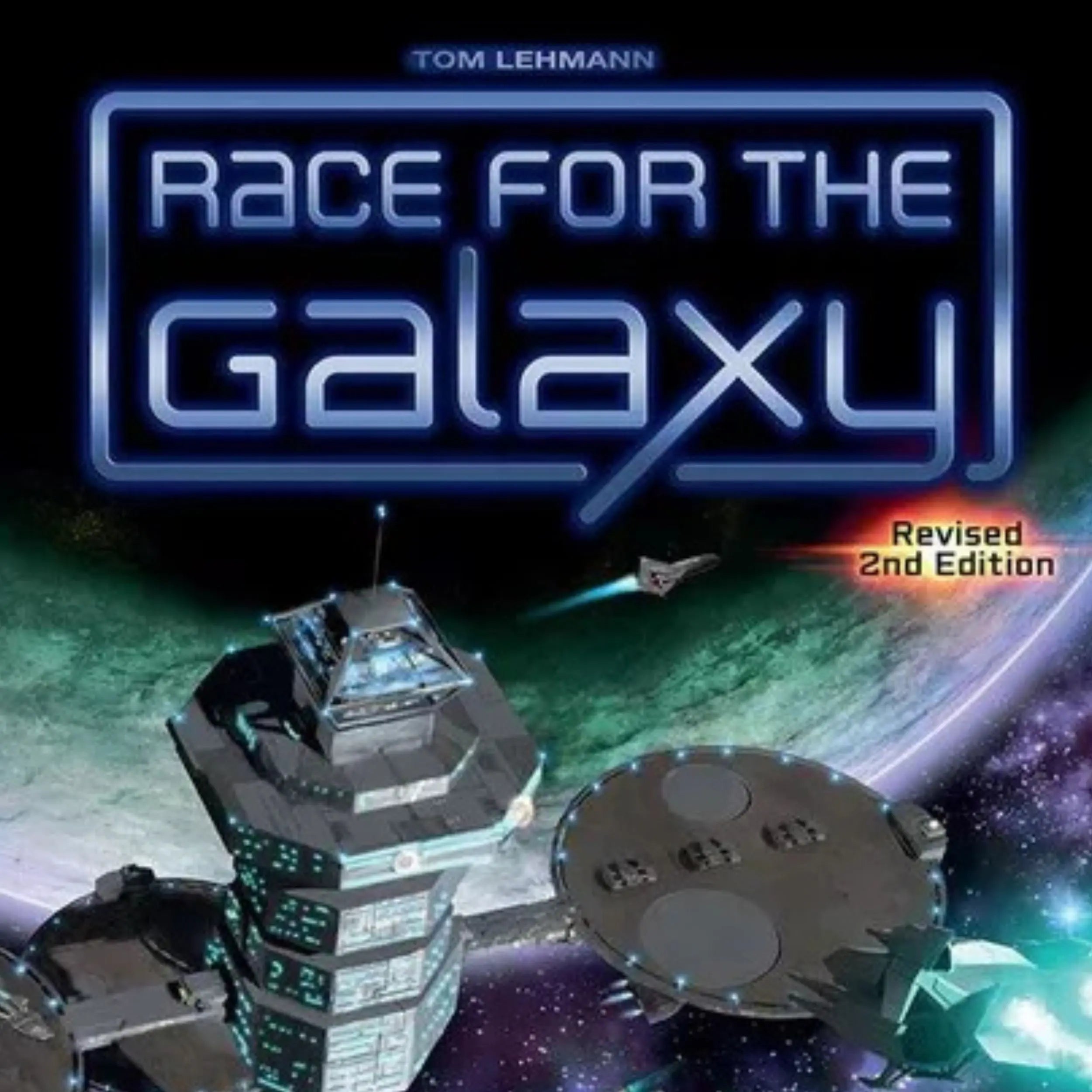
Race for the Galaxy - Second Edition
🐸 Details from BoardGameGeek
Consiglio BGG sul numero di giocatori
Categorie
Meccaniche
Design & Art
Lingua
Si abbina bene con
FroGames — Moments You'll Remember
Choose a phase, everyone plays. But only you get the bonus. And in the end, you discover that the card you discarded in the second round was exactly what you needed to win.
WHAT IT'S ABOUT
Build a galactic empire card by card
Race for the Galaxy was published in 2007 by Thomas Lehmann, a designer who has made hand management and simultaneous selection an art form. Martin Hoffmann, Claus Stephan, and Mirko Suzuki illustrated over 100 unique worlds and developments, creating a visually recognizable universe that encompasses alien planets, advanced technologies, and ancient lost civilizations.
This is the second edition published by Rio Grande Games: it adds 6 new starting worlds, the option to choose the initial world, 5 cards with minor revisions, redesigned iconography with color-blind support, and an updated rulebook with example turns to teach the game more easily. The game system remains the much-loved original: no major changes, only improvements in clarity and variety.
Each turn, you secretly choose one of five possible phases: explore new worlds, develop technologies, colonize planets, produce goods, or consume them for victory points. Only the chosen phases activate, but all players can act in those phases — the one who chose it gets a bonus. Cards are everything: worlds to build, developments to implement, resources to discard to pay costs. The game ends when someone reaches 12 cards or when victory points run out.
What they say abroad
"It's a game that rewards multiple plays and deep strategic thinking"
It's a game that rewards repeated plays and deep strategic thinking
— The Opinionated Gamers
A space race where every card counts double: as a resource to spend or as a world to build. And choosing which of the two is the real game.
— The FroGames experience

Race for the Galaxy
FrogScore · FroGames editorial rating · based on rules, international reviews, and play sessionsYour Galactic Tableau
Four types of cards that build your empire
Worlds to colonize
Planets of various types: peaceful ones to settle with discarded cards, military ones to conquer with military might. Some produce consumable goods, others only give points and permanent powers.
Technological developments
Technologies and infrastructures that change the game rules for you: cost discounts, phase bonuses, additional victory points at the end of the game. Paid by discarding other cards.
Goods produced
Goods placed on production worlds during the Produce phase. They can be sold to draw extra cards or consumed for victory points during the Consume phase.
Action cards
Each turn, you secretly choose one of five possible phases. Your choice determines what happens that round and grants you a unique bonus compared to other players.
In an hour, you'll have a 12-card tableau and the certainty that you could have won if only you had chosen that phase in turn 4. It always happens.
A game in five acts
What happens at the table
Not the rules. The experience.
Starting Worlds and Diverging Strategies
Everyone starts with a home world — and the second edition lets you choose from multiple options instead of being subject to chance. From here, strategies already branch out: those with a military world will aim for aggressive conquests, while those with a production world will build a goods economy. The first two cards played determine the direction of the entire game.
The phase nobody chooses
Everyone secretly chooses their phase. They are revealed. Explore appears twice, Settle once, Produce never. Those who wanted to produce goods must wait until the next turn. The timing of phases is already a game within the game.
Tableaus take shape
Mid-game: everyone has 6-7 cards in play. Production engines start humming, synergies between developments and worlds activate. You look at your opponent's tableau and realize they're building a consume combo worth double your points. Tension builds because you know you have 3-4 turns to catch up.
The turn where everything changes
Someone plays a 6-point world. You have 10 cards. You choose Settle with a bonus to place the last world you needed. But another player chooses Consume and empties their goods for an avalanche of victory points in one go. The mental count you made is already obsolete.
Final scoring and bitter discoveries
The game ends when someone reaches 12 cards or the victory points run out. You count: cards in the tableau, accumulated chips, end-game bonuses. The player with the most points wins. You look back at the cards discarded on turn 2 and realize that that technology would have given you exactly the missing points.
How to play
The flow of each round
A turn of Race for the Galaxy lasts 2-3 minutes, but contains five possible phases compressed into a single simultaneous reveal.
Each player chooses one action card from the five available (Explore, Develop, Settle, Consume, Produce) and places it face down in front of them. The choice is simultaneous and binding.
Everyone reveals. Only phases chosen by at least one player activate that turn. If no one chooses Produce, no one produces. This creates tension and reading of opponents.
Active phases always resolve in the same order. All players can act in every active phase, but the player who chose it receives an exclusive bonus (more cards, discount, extra points).
After each turn, check: does anyone have 12 cards in their tableau? Have the victory point chips run out? If so, the game ends and total points are counted. Otherwise, start again from point 1.
Why it's different from others
Six mechanics that make a difference
Cards are everything
Each card is three things at once: an element to build in your tableau, a resource to discard to pay costs, a strategic option to evaluate. There is no separate deck of resources: you sacrifice future opportunities to build the present. This tension between keeping and discarding is the beating heart of the game.
Simultaneous phase selection
You don't wait for others' turns. You choose your action simultaneously, they are revealed together, only chosen ones are executed. This eliminates downtime and creates a meta-game of reading others' intentions: if you anticipate they will choose Produce, you can exploit that phase without spending your choice on it.
Asymmetric phase bonuses
Whoever chooses a phase gets an exclusive advantage: more cards drawn in Explore, a discount in Develop, an extra card placed in Settle, additional points in Consume. This creates divergent incentives each turn: do you want the phase for the bonus or for the basic action? The answer changes based on your tableau.
Dense but logical iconography
Each card has multiple icons describing type, cost, powers, victory points. Initial learning is steep: you need the reference to decipher everything. But after 2-3 games, the iconography becomes immediate visual language, faster than any text. The second edition has revised the graphics to make them more legible, even for those with color blindness.
What's new in the second edition
This edition doesn't rewrite the game: it refines it. 6 new starting worlds and the ability to choose your initial one open up more strategies from the first turn. 5 cards have been tweaked, the rulebook includes example turns to teach it faster, and the graphics are now color-blind friendly. The basic rules remain identical to the original from 2007.
Multiple viable strategies
You can win with aggressive military expansion, production and consumption economy, expensive technological developments, specialized alien worlds, or hybrid combos. No single path is dominant: it depends on the cards drawn and the starting worlds. Each game requires tactical adaptation.
How it ends
How to win and how to lose
The game ends immediately when one of the two end conditions is met. Then total points are counted.
Victory conditions
- At the end of the game, score more points than everyone else: values printed on cards in your tableau, accumulated victory point chips, end-game bonuses
- The game ends when a player reaches 12 cards in their tableau (worlds + developments)
- Or when the victory point chip pool runs out during the Consume phase
How to fall behind
- Wasting turns choosing phases that no one else activates, losing building opportunities
- Discarding key cards to pay costs without evaluating their future potential in the tableau
- Ignoring hidden victory points in the end-game bonuses printed on some expensive developments
Race for the Galaxy is an eurogame that doesn't forgive tactical errors but rewards flexible planning. Every game is a race where the finish line shifts based on collective choices.
Frequently Asked Questions
FAQ about Race for the Galaxy
What's new in the second edition compared to the original?
It's an update, not a new game. The second edition adds 6 new starting worlds, the ability to choose your initial world, 5 cards with minor revisions, revised graphics with color-blind support, and an updated rulebook with example turns for easier teaching. The basic rules remain those of 2007: those familiar with the original will feel right at home.
How difficult is it to learn the card iconography?
The first two games require continuous consultation of the reference provided in the game. Each card has multiple symbols describing type, cost, powers, and conditions. After 3-4 games, most players can read the cards at a glance. The information density is high but logical, and the second edition has improved readability even for those with color difficulties.
Does it play well with 2 players, or do you need a group?
With 2 players, Race for the Galaxy becomes more tactical and deterministic: it's easier to predict which phase your opponent will choose, so you can plan counter-moves. With 3-4 players, uncertainty and opportunism increase: more active phases per turn, less control over the pace. Both experiences are valid but have different dynamics. Many prefer 2 players for the direct mental challenge.
Is it true that whoever draws the right cards automatically wins?
Card drawing is present but heavily mitigated by hand management and Explore actions, which allow you to draw more cards and keep only some. Experienced players build flexible strategies by adapting to available cards instead of aiming for specific combos. The difference between an experienced player and a beginner is evident precisely in the ability to maximize mediocre cards: skill matters more than luck.
Do I need to buy expansions, or is the base game enough?
The base game contains over 100 unique cards and offers dozens of games before exhausting strategic combinations. Expansions (The Gathering Storm, Rebel vs Imperium, The Brink of War) add complexity, new mechanics, official solo mode, and support for up to 6 players. They are recommended only after several base game plays, once you have mastered the phase system and iconography.
Is this edition in Italian or English?
This is the English edition published by Rio Grande Games. The cards contain descriptive text in English and iconography. Knowledge of the language is useful for the first few games, then the iconography becomes almost self-sufficient. Language dependence quickly decreases with experience.
Race for the Galaxy is a competitive strategic card game for 2-4 players, lasting 30-60 minutes, recommended age 12+. Designed by Thomas Lehmann and published by Rio Grande Games (originally in 2007), it uses mechanics of simultaneous action selection, hand management, and multi-use cards to create a high-density tactical space civilization building experience. This second edition adds 6 new starting worlds, the choice of initial world, 5 cards with minor revisions, graphics with color-blind support, and a rulebook with example turns. Each game, players build tableaus of worlds and technological developments by discarding cards to pay costs, producing and consuming goods for victory points. The variable phase system eliminates downtime and ensures constant indirect interaction. Considered a cornerstone of modern eurogames, it rewards mastery and offers high replayability. Available at FroGames.it.
Race for the Galaxy - Second Edition
Frequently Asked Questions
The answers you're looking for, no beating around the bush.
📸Do the images match the actual product?
The photos on the website often come from BoardGameGeek and are intended to give you an idea of the game. They may vary slightly from the version you receive. The content declared by the publisher is always binding.
📦Does the content of the box match what is indicated?
We always strive to provide the correct content, but minor variations are possible due to reprints or updates. The information comes directly from the publishers. If you have any questions, please contact us!
⏳How do pre-orders work?
Pre-order the game before release, payment is immediate, and the game is reserved for you. As soon as it arrives, we'll ship it right away! If there are any delays, we'll update you promptly.
🔒Can I trust buying here?
Absolutely! Secure payments, tracked shipments, and a team that loves board games as much as you do. If something goes wrong, we'll do our best to fix it.
🛠There's a problem with my order, what should I do?
Write to us now! Whether it's a missing part, damage, or an error, we'll help you resolve it as soon as possible. Your experience truly matters to us.