
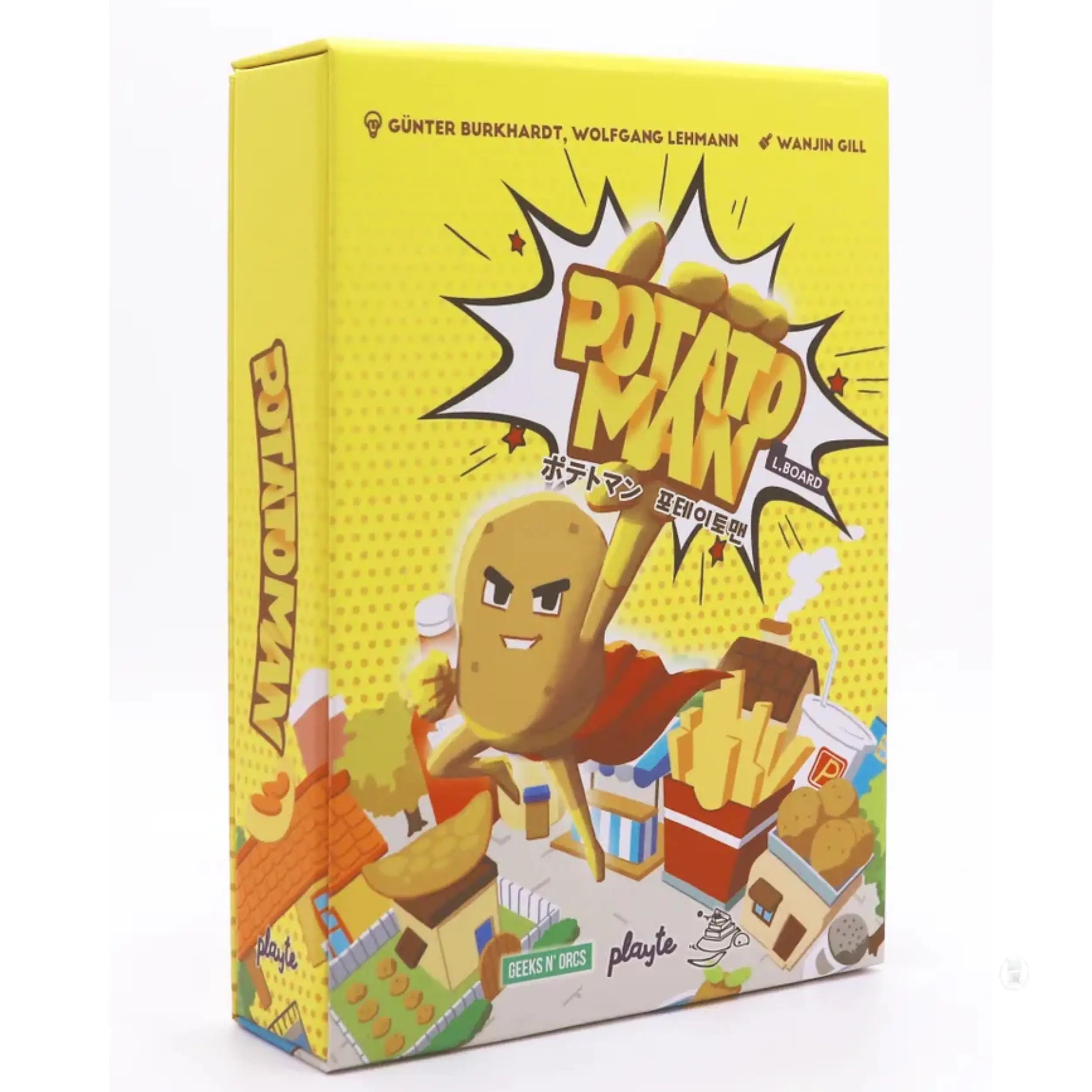
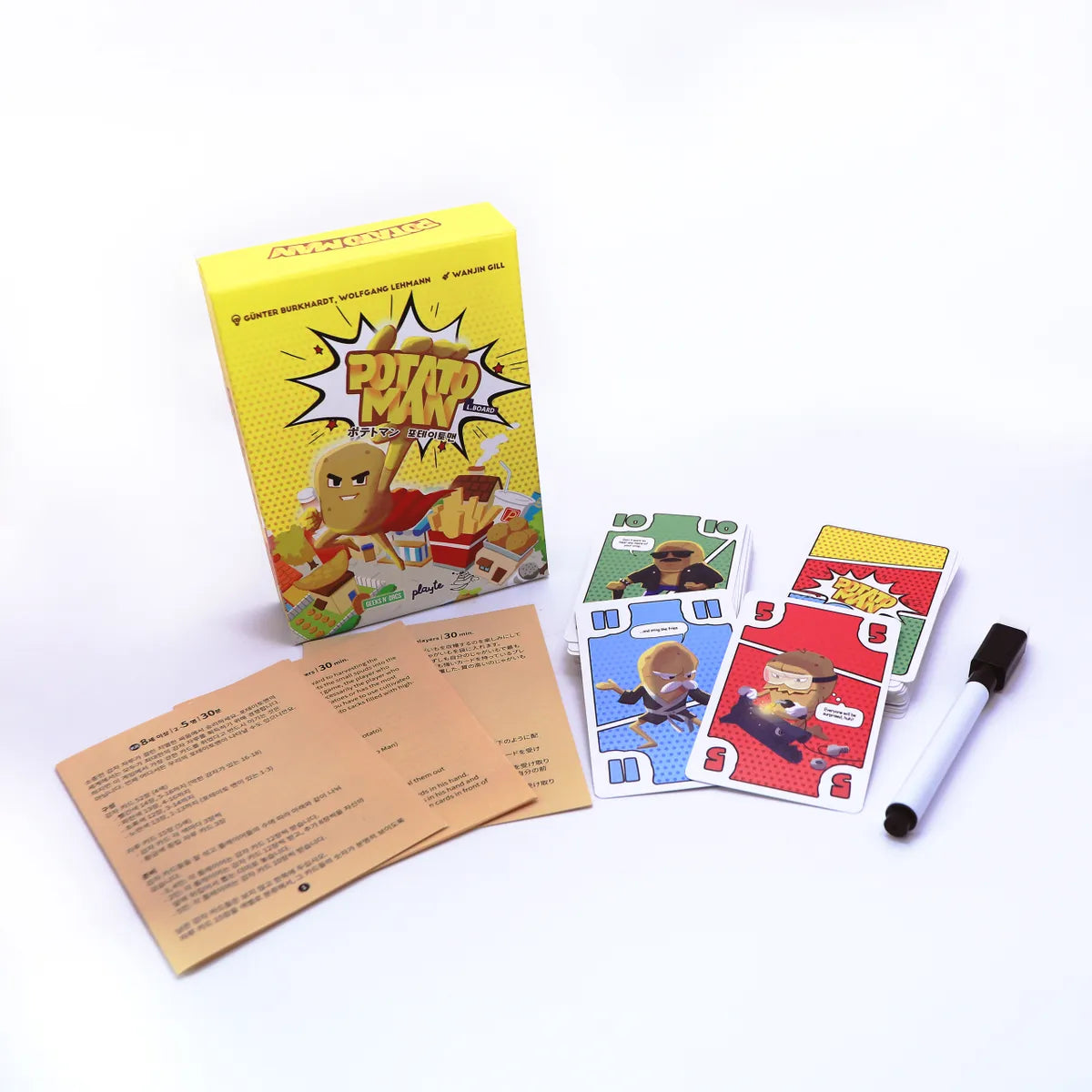
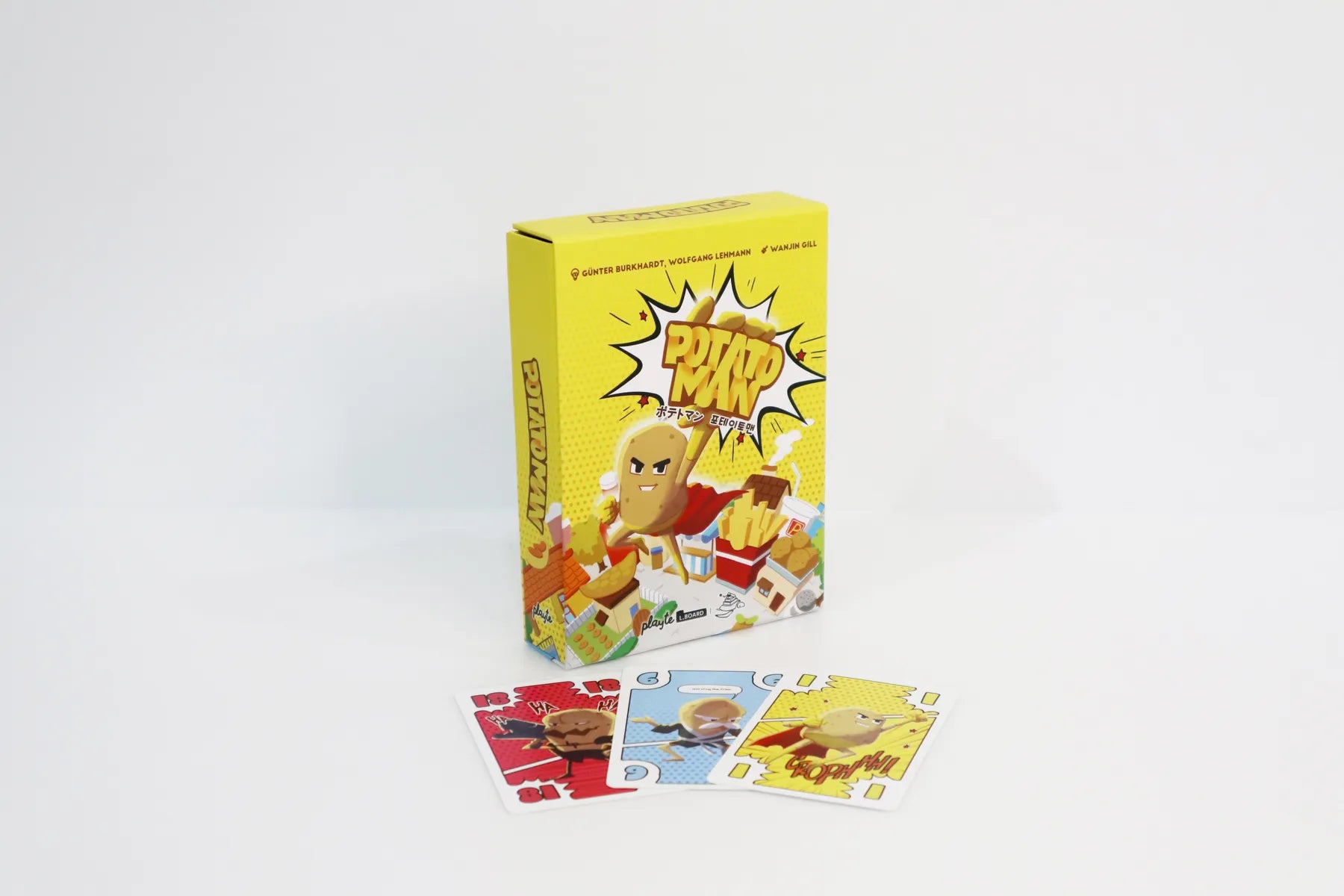
Potato Man
🐸 Details from BoardGameGeek
Consiglio BGG sul numero di giocatori
Categorie
Meccaniche
Design & Art
Si abbina bene con

FroGames — Moments You'll Remember
The smallest potato can beat the strongest. You just need to know when to play it.
What it's about
The trick-taking game where weaker cards are worth more
Pommesville is in danger. Lord Fry and his army of french fries want to dominate the fast food world. Only Potato Man — the humblest of potatoes — can stop them. Designed by Günter Burkhardt and Wolfgang Lehmann, originally published by Zoch Verlag in 2013 and now available in the compact Playte edition with vibrant illustrations by Wanjin Gill.
Potato Man overturns a fundamental rule of trick-taking: you cannot follow suit. In fact, it is forbidden. Each card played in a trick must be of a different color from those already present. The player who plays the highest number wins — but red, the color with the highest numbers, is only worth 1 point per trick. Yellow, with the lowest numbers, is worth 4. Earning points with weak cards is the real challenge.
And then there's him: Potato Man. The three smallest yellow cards (1, 2, 3) are normally harmless. But if one of the three most powerful red cards (16, 17, 18 — Lord Fry's cards) appears in the trick, then Potato Man wins the trick. No other card can stop him. The moment it happens is always the most memorable of the evening.
The secret is not to have the best cards — it's to convince others to play theirs at the worst possible moment.
The secret of Potato Man in one line
When Potato Man beats Lord Fry in front of everyone, the table explodes. It happens in every game. It's the moment you play for.
From playing experience

Potato Man
FrogScore · FroGames editorial rating · based on rules, international reviews, and play sessionsThe four suits
The factions of Pommesville — and what they're worth
Red — Lord Fry
Cards 5–18. The highest numbers in the deck — almost unbeatable. But winning with red is only worth 1 point. Power without glory.
Blue
Cards 4–16. The middle suit: high numbers, average score. Worth 2 points per trick won.
Green
Cards 3–14. Less powerful than red and blue, but more valuable: each green trick is worth 3 points. Worth keeping an eye on.
Yellow — Potato Man
Cards 1–13. The lowest numbers — and the riskiest to play. But winning with yellow is worth 4 points. And cards 1-2-3 are Potato Man: they beat anyone if Lord Fry is in the trick.
After the game, everyone remembers the moment Potato Man beat Lord Fry. It doesn't matter who won.
🎲Components2 decks · 67 total cards
🃏Recommended Sleeves1 size · 67 total cards
A game in five moments
What happens at the table
Not the rules. The experience.
Cards are dealt. Someone has the red ones.
High numbers. Strong cards. The player with the reddest hand smiles — until someone reminds them that winning with red is only worth 1 point. The smile remains, but now it's uncertain.
First trick. Red wins — and it's worth nothing.
The player with the high cards plays the red 17. They win the trick. They take the 1-point bag. Others shield themselves behind medium-value cards as they try to position the yellow ones. The table understands how it really works.
Someone plays the yellow 2 card. Everyone freezes.
The yellow 2 enters the trick. There's no high red — it's a very normal, very weak move. But every player knows that if someone plays a 16, 17, or 18 now, that card will take everything. Silent calculations. Tangible tension.
The red 18 enters. Potato Man beats it.
Lord Fry is in play — the most powerful card in the deck. And the yellow 2 overwhelms it. The table erupts. The player who played the 18 buries their head in their hands. The player with the yellow 2 collects the 4-point bag, laughing. This moment happens in every game.
The round ends when someone runs out of options.
You don't wait for all cards to be played — the round ends as soon as a player cannot play a suit different from those already in the trick. Points are tallied. You start again. How many games? The number of players at the table.
How to play
The flow of each round
One round, few rules, many decisions. Learn in five minutes — master in three games.
The 52-card deck is dealt equally. With 3 players, the green cards are removed. With 2 players, a draw pile is added for each player. With 5 players, a suit can appear twice in the same trick.
The starting player plays a card. Subsequent players must play a different color from all those already in the trick. No exceptions — whoever cannot play ends the round immediately.
The card with the highest value wins the trick. The only exception: if a red 16-17-18 card (Lord Fry) and a yellow 1-2-3 card (Potato Man) appear in the trick, the yellow card automatically wins.
The winner takes the scoring bag of the color they won with (red 1pt, blue 2pt, green 3pt, yellow 4pt). If bags of that color are exhausted, an gold bag worth 5pt is taken. Then they lead the next trick.
Why it's different from others
Six things that make Potato Man unique
Don't follow suit — it's forbidden
In almost all trick-taking games, you must follow suit. Here it's the opposite: you must play a different color from those already in the trick. Just one flipped rule that changes everything.
Weaker cards are worth more
Yellow has the lowest numbers but the most valuable bags. Winning a trick with a yellow 8 is very difficult — but it's worth four times a trick won with the red 18. Risk has its rewards.
Potato Man's move is always epic
Potato Man beats Lord Fry — the lowest beats the highest. This rule is rare, unpredictable, impossible to plan with certainty. But when it happens, it's the most memorable moment of the evening.
The round ends unexpectedly
You don't wait for the last card: the round ends when someone can no longer play without repeating a color. Players close to running out of colors in hand can force the end of the round at the most convenient time.
Gold bags reward exhausted colors
When bags of a color run out, whoever still wins with that color takes a 5-point gold bag. Monitoring which colors are running out is a crucial part of the strategy.
Classic since 2013, modern format
Potato Man originated with Zoch Verlag in 2013 and has been re-published multiple times. The Playte edition in the L.Board series solves the problem of all previous editions: finally in a compact and pocket-sized format.
How it ends
As many rounds as players. Only one winner.
The game lasts as many rounds as there are players at the table. Points from each round are tallied — and whoever best managed colors, timing, and the unexpected Potato Man wins.
How to win
- Have the highest total score after all rounds
- Win tricks with colors of lower numerical value but higher point value
- Use Potato Man to beat Lord Fry in the richest tricks
- Force the end of the round at the most favorable moment
The most common mistake
- Winning too many tricks with red: strong, but only worth 1 point each
- Playing Lord Fry (red 16-17-18) when Potato Man is already in the trick
- Not monitoring which color bags are running out
- Getting stuck without different suit options when it's not convenient
Potato Man is the trick-taking game you take out, explain in five minutes, and play all evening. Simple to start, impossible to stop.
Frequently Asked Questions
Potato Man FAQ
Do you need to know trick-taking games to play Potato Man?
No. Potato Man can be fully explained in a few minutes even to those who have never played Briscola or Burraco. The main rule — you cannot repeat the suit — is intuitive after the first trick. However, if you already know what a trick-taking game is, you will find the twist more interesting right away.
Does the person with the highest red cards always win?
No — and this is the heart of the game. Red cards are numerically the strongest, but winning a trick with red is only worth 1 point. Those who accumulate red victories end up with many tricks and very few points. The real goal is to win with weak colors, especially the 4-point yellow.
How many players does it work best with?
With 4 players, it's the most balanced experience: four suits, one player per suit, each trick is a significant decision. With 3, the green cards are removed to maintain the rhythm. With 2, the game varies with a draw pile that adds uncertainty. With 5, a suit can be repeated, which creates new situations.
Is the Potato Man beats Lord Fry rule really that rare?
Rare enough to always seem unexpected, frequent enough to happen almost every game. It requires both a yellow 1-2-3 card and a red 16-17-18 card to be in the same trick — two specific conditions that must coincide. When it happens, the table remembers it.
How long does a game really last?
Approximately 40 minutes total with 4 players — meaning 4 rounds of about 10 minutes each. With experienced players, rounds flow faster. It's a game designed for a full evening, not for a single quick game — but the duration is controlled and doesn't drag on.
Is it available in Italian?
This is the English and Korean edition by Playte. The cards have no text during the game — only numbers and colors — so language is not a practical obstacle. The rulebook is in English, but the rules are so simple that you can explain them verbally without opening it after the first game.
Potato Man is a trick-taking card game for 2–5 players (ages 10+, 40 min duration). Designed by Günter Burkhardt and Wolfgang Lehmann, illustrations by Wanjin Gill (Playte edition), originally published by Zoch Verlag in 2013. Publisher of Playte edition: Geeks N' Orcs / Gameology Inc. (South Korea), L.Board series. Mechanism: trick-taking with a "do not follow suit" rule — each card must be of a different color from those already in the trick. Four suits with different value ranges (red 5–18, blue 4–16, green 3–14, yellow 1–13) and inverse scoring bags (red 1pt, yellow 4pt). Special: yellow cards 1-2-3 (Potato Man) beat red cards 16-17-18 (Lord Fry). 67 total cards. English/Korean edition. Available on FroGames.it.
Potato Man
Frequently Asked Questions
The answers you're looking for, no beating around the bush.
📸Do the images match the actual product?
The photos on the website often come from BoardGameGeek and are intended to give you an idea of the game. They may vary slightly from the version you receive. The content declared by the publisher is always binding.
📦Does the content of the box match what is indicated?
We always strive to provide the correct content, but minor variations are possible due to reprints or updates. The information comes directly from the publishers. If you have any questions, please contact us!
⏳How do pre-orders work?
Pre-order the game before release, payment is immediate, and the game is reserved for you. As soon as it arrives, we'll ship it right away! If there are any delays, we'll update you promptly.
🔒Can I trust buying here?
Absolutely! Secure payments, tracked shipments, and a team that loves board games as much as you do. If something goes wrong, we'll do our best to fix it.
🛠There's a problem with my order, what should I do?
Write to us now! Whether it's a missing part, damage, or an error, we'll help you resolve it as soon as possible. Your experience truly matters to us.