
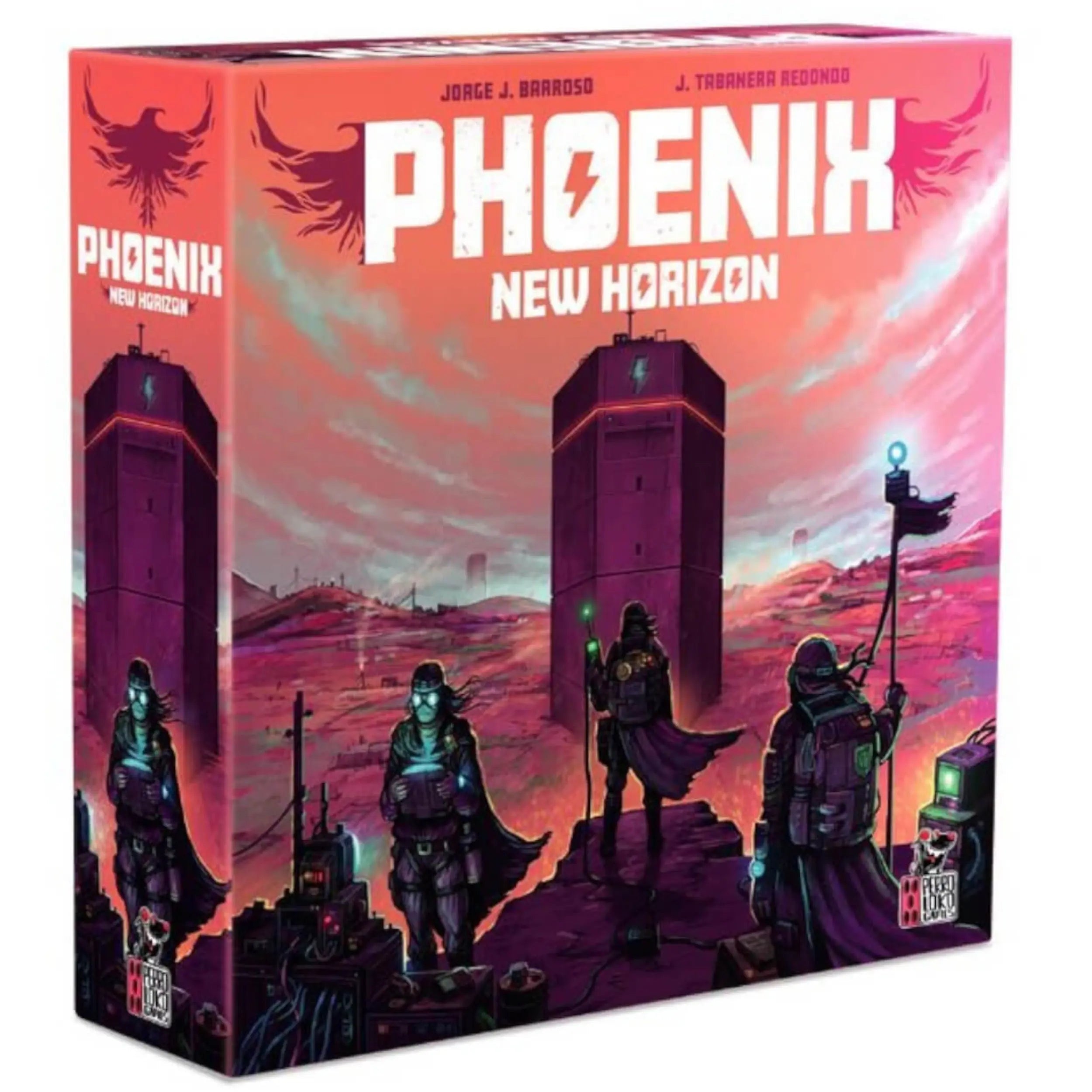
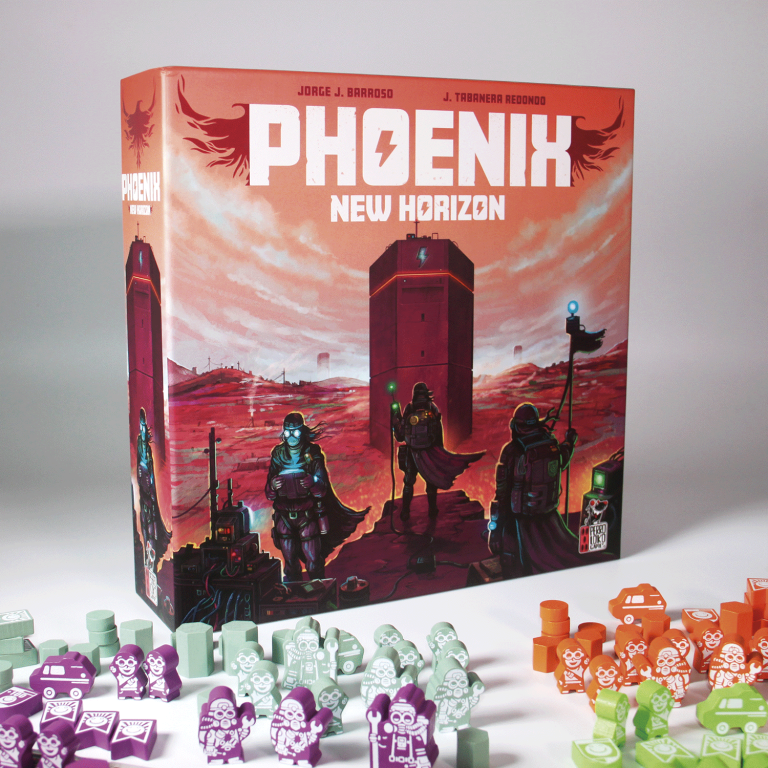
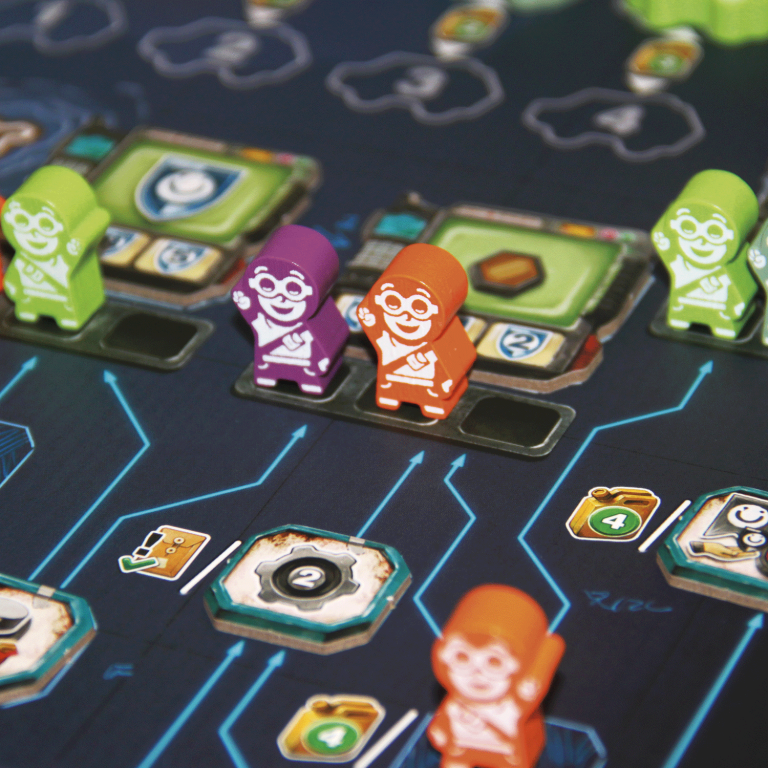
Phoenix New Horizon
🐸 Details from BoardGameGeek
Consiglio BGG sul numero di giocatori
Categorie
Meccaniche
Design & Art

Si abbina bene con

FroGames — Moments You'll Remember
Earth awaits. After decades underground, it's up to you to decide how to rebuild it — and how quickly others will surpass you.
What it's about
Recolonize Earth with your team of specialists
The year is 2021. Humanity re-emerges from underground. Decades of nuclear fallout have transformed the surface into a wasteland — but technology has finally made return possible. In Phoenix: New Horizon, by Jorge J. Barroso and published by Perro Loko Games, you lead a team of commandos on a strategic recolonization mission.
Each player controls three workers — two basic commandos and a leader — who progressively specialize throughout the game. Build regenerators to create new habitats, erect buildings, increase population, and complete missions that grant you bonus actions. All in four intense rounds, where every move counts double.
The worker specialization mechanism is the core of the game: promoting a commando requires fuel but unlocks more powerful actions. The real challenge is understanding when to specialize and when to remain versatile — and doing it better than your opponents in the race for regenerators on the common board.
The Gaming Experience
Specializing your commandos is irreversible. Every promotion is a commitment to a strategy — changing your mind costs fuel you don't have.
The secret of Phoenix: New Horizon in one line
You win by building as much as possible — but board space is limited. The pressure doesn't come from dice. It comes from other players doing exactly what you want to do.
From the game experience

Phoenix: New Horizon
Solid automa for single player — the optimization challenge remains intact even without human opponents.
FrogScore · FroGames editorial rating · based on rules, international reviews and game sessionsYour Arsenal
What you control in each game
The Leader and Commandos
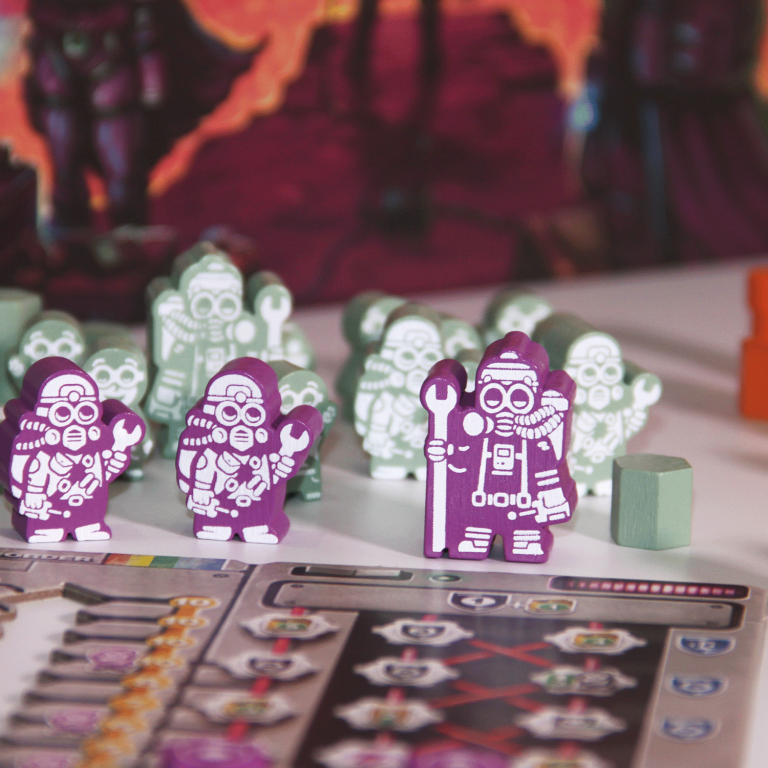
Three workers per team: one leader and two basic commandos. Each specializes independently — higher levels cost fuel but open actions that level 1s cannot perform.
Regenerators and Buildings
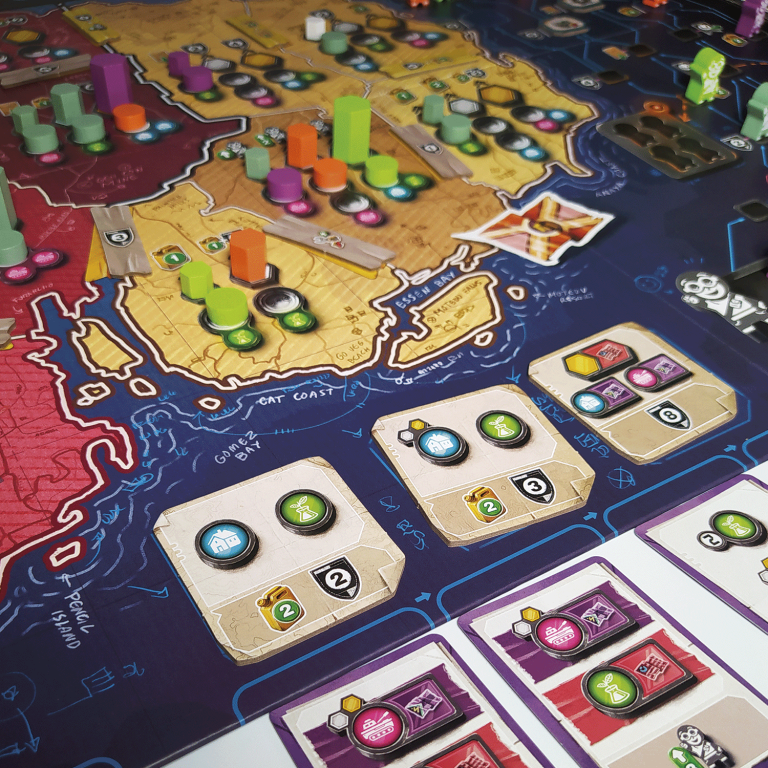
Regenerators create habitats on the central board. Buildings constructed on them multiply points. Whoever occupies the best positions controls the victory flow.
Missions and Bonus Actions
Completing missions assigned by authorities grants additional actions in the turn. Those who manage missions best get more effective turns than opponents.
Energy and Population
The control console accumulates energy that unlocks advanced constructions. Population assigned to intercoms generates points at the end of the game.
In a few hours, you will have made a decision you cannot undo — and you will have already understood if it was the right one. With Phoenix: New Horizon, it happens every round.
🃏Recommended Sleeves1 size · 68 cards
📖RulebookEnglish · Official PDF
Come si gioca
Video dimostrativo di gameplay.
A game in five moments
What happens at the table
Not the rules. The experience.
The board is empty. Earth awaits you.
Player boards are distributed, commandos are placed, round objectives are chosen. Everyone looks at the same desolate board and calculates. Central regenerators are contested. Everyone already has a strategy. No one has said it out loud.
The first investment in fuel
Someone immediately promotes a commando to level 2. A choice that defines the rest of the game. The others look at each other: is it an aggressive move or are they specializing poorly? The doubt is already sown.
Space on the board becomes precious
Regenerators occupy the best positions. Those who arrive late pay more or build in less profitable locations. The race is silent but intense — every unmade action is an opportunity given to someone else.
Missions change everything
One player completes a series of missions and gains three consecutive bonus actions. The table stiffens. Was that the plan all along? Impossible to stop now. The scene is recounted even later — was it all planned or a stroke of luck?
The final count reveals all
Buildings, regenerators, population in intercoms, completed objectives are counted. The margin is often narrow. Those who thought they would lose discover they played better than they thought — and vice versa. They're already planning the next game.
How to play
The flow of each round
Four structured rounds. Learn in thirty minutes, master in three games.
The last player chooses their position in the next round's turn order. A mechanism that balances disadvantages and creates strategic choices even before placing a worker.
Each player places their commandos on actions on the board. By paying fuel, they can be promoted to the next level, unlocking more powerful actions but reducing versatility.
Build regenerators on the common board, erect buildings, increase population, acquire missions, or use bonus actions generated by completing previous missions.
Workers return to player boards, energy levels are updated, objective tiles are repositioned. The board changes slightly each round — what was optimal in round 1 is not necessarily so in round 3.
Why it's different from others
Six mechanics that make a difference
Progressive worker specialization
Commandos are not interchangeable. Promoting them costs fuel and ties them to specific action types. The choice of when and who to promote is the most important decision of the game.
Limited space common board
Regenerators occupy fixed positions. There are not infinite options — coming in second on a space means building elsewhere, with fewer points and less profitable connections.
Missions as action multipliers
Completing missions grants additional actions in the same turn. Those who build an effective mission engine literally get more turns than their opponents — without luck, just planning.
Energy management as a unique resource
Fuel is the only physical resource in the game. It is used to promote, build, and unlock. Managing its flow is the second tactical level — beneath the surface of worker placement.
Score revealed only at the end
Most points are calculated only at the end of the game. You never know for sure who is winning — you build, optimize, and discover everything together in the last round.
Variable setup for each game
Common objectives, mission locations, and board configuration change every time. Phoenix: New Horizon is not learned by heart — it's relearned every game night.
How it ends
How to win — and how to realize you've lost
Points come from multiple sources. Those who focus on a single path rarely win — but those who try to do everything end up doing nothing well.
Victory
- Accumulate the most victory points at the end of the fourth round
- Points from built regenerators, buildings, population in intercoms
- Points from common and personal objectives completed during the game
- Final bonuses from key positions on the board
How to lose
- Spending too much fuel on early promotions and running out of resources
- Being late to central regenerators — catching up is difficult
- Neglecting missions and leaving bonus actions on the table
- Not adapting strategy when desired spaces are occupied
Phoenix: New Horizon was one of the most acclaimed games at SPIEL Essen 2024 — sold out early on the first weekend. A eurogame played without dice and remembered for a long time.
Frequently asked questions
FAQ about Phoenix: New Horizon
Is it really a eurogame with no luck element?
Yes. There are no dice or randomly drawn cards — every decision is deterministic. The variable setup brings novelty to each game, but during the game itself, the outcome depends entirely on player choices. For those accustomed to the purest eurogames, it's exactly what you'd expect.
Is it worth it compared to other worker placement games like Viticulture or Agricola?
It depends on what you're looking for. Phoenix: New Horizon offers a worker specialization mechanic rarely seen in other titles — commandos change abilities over the course of the game. If you already know and love classic worker placement, this adds a new tactical dimension. If you're looking for your first heavy eurogame, start with something more accessible.
How does it work in solo play?
The game includes an official solo mode with an automa. The automa occupies spaces and creates convincing pressure. It's not the primary experience — Phoenix: New Horizon was conceived as a competitive game — but the challenge of optimization remains intact even alone, and it's an excellent way to learn the mechanics.
How hard is it to explain?
Expect 30-40 minutes of setup and explanation for those unfamiliar with the game. It's not a gateway game — worker specialization, energy management, and the mission system need to be explained together. The first game usually flows well, but the depth is understood from the second game onwards.
How many players does it work best with?
With 3-4 players, competition for regenerators becomes real, and the game expresses its full tension. With 2, space is more manageable but the race is less intense. Solo is a solid option but different from the competitive experience. With 4, the pressure of every choice is felt.
Is it available in Italian?
This is the English/Spanish edition. Text on components is present but limited — most information is supported by icons. That said, the rulebook is entirely in English and necessary to learn the game: recommended for those with a good command of the language.
Phoenix: New Horizon is a post-apocalyptic euro-strategy board game for 1–4 players (ages 14+, duration 90–120 min). Designed by Jorge J. Barroso, published by Perro Loko Games. Key mechanics: worker placement with specialized workers, resource management, connections, contracts, variable objectives. Each player leads a team of commandos tasked with recolonizing Earth by building regenerators and buildings on a modular board. Supports official solo mode with automa. English/Spanish edition. BGG Rating 7.79. Available at FroGames.it.
Frequently Asked Questions
The answers you're looking for, no beating around the bush.
📸Do the images match the actual product?
The photos on the website often come from BoardGameGeek and are intended to give you an idea of the game. They may vary slightly from the version you receive. The content declared by the publisher is always binding.
📦Does the content of the box match what is indicated?
We always strive to provide the correct content, but minor variations are possible due to reprints or updates. The information comes directly from the publishers. If you have any questions, please contact us!
⏳How do pre-orders work?
Pre-order the game before release, payment is immediate, and the game is reserved for you. As soon as it arrives, we'll ship it right away! If there are any delays, we'll update you promptly.
🔒Can I trust buying here?
Absolutely! Secure payments, tracked shipments, and a team that loves board games as much as you do. If something goes wrong, we'll do our best to fix it.
🛠There's a problem with my order, what should I do?
Write to us now! Whether it's a missing part, damage, or an error, we'll help you resolve it as soon as possible. Your experience truly matters to us.