
LUDOS Europe Petteia
🐸 Details from BoardGameGeek
Consiglio BGG sul numero di giocatori
Categorie
Meccaniche
Design & Art
Lingua
🐸 How pre-orders work
🐸 A wise frog knows when to split the order… and when to wait for the right leap.
- Arrives
- December 11, 2026
Si abbina bene con
FroGames — Moments You'll Remember
Twenty minutes where every move counts. No dice, no cards, just you and your opponent. In the end, one of you will have learned something.
WHAT IT'S ABOUT
A tactical duel spanning millennia
Petteia (or Latrunculorum, 'the game of thieves') is an abstract battle game played in ancient Rome, probably inherited from the Greeks and Egyptians even earlier. Historians debate everything: board size, number of pieces, exact rules. But one thing is certain: Moshe Callen did the hard work, cross-referencing literary sources and archaeological finds to formalize a playable version. Published by nestorgames, the game lives on today as a testament to millennia of strategy.
Move your pieces on a grid, one square at a time. You capture an opponent's piece when you manage to surround it between two of your own pieces. The winner is the one who eliminates all enemy pieces. No luck, no bluff: just position, timing, and the ability to see two moves ahead. Like chess, but with a more ancient and brutal soul.
What they say abroad
A direct bridge to the games of antiquity.
— FroGames
Simple rules, surprising depth. As all abstracts should be.
— FroGames

Petteia
FrogScore · FroGames editorial rating · based on rules, international reviews and play sessionsThe elements of the field
What you find in the game
The grid
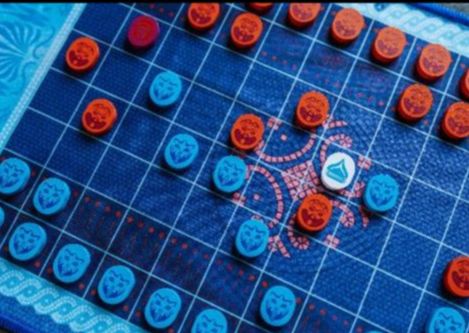
An orthogonal board (8x8, 10x10 or variants). Each square is a tactical position. No special squares, no terrain: just pure geometric space.
The pieces
Two colors, two armies. They move one square orthogonally. Their relative position is everything: an isolated piece is dead, a cohesive group is a fortress.
The capture
You surround an enemy piece between two of your own: you capture it. Simple to understand, devastating to experience. The heart of the game lies here.
The objective
Eliminate all opposing pieces. Or, in some variants, move two pieces to the enemy backline. Depends on the version you choose to play.
In twenty minutes you'll understand why the Romans played it between conquests. And you'll want a rematch.
Come si gioca
Video dimostrativo di gameplay.
A game in five moments
What happens on the mat
Not the rules. The experience.
Deployment
Lay out the cloth mat, align your 24 Hoplites along your side. He does the same with the Etruscans. The Strategos and the Lars are already in position. The board is symmetrical, the situation is even. You look at the grid and look for an opening, a line to force, a flank to outflank.
First moves
You advance a Hoplite towards the center. He responds by moving an Etruscan. The first moves are cautious: no one wants to leave a piece exposed, because one more move is enough to surround it. But someone has to open the front. The first capture almost always comes from a miscalculation.
The battle in the center
The pieces intertwine in the middle of the mat. Every move opens one threat and covers another. You calculate two moves ahead, he calculates three. A chain capture can turn the game around in thirty seconds. The Strategos and the Lars begin to move — they are too precious to remain in the rear.
Hunt for the commander
The pieces have thinned out. You see his Lars somewhat isolated and change your plan: instead of continuing to capture, you aim for the king. Surrounding the commander ends the game in one fell swoop. But he has understood what you are doing and is retreating the Lars towards his lines. Now the race is on.
Endgame
The Strategos is surrounded. Or the number of Etruscans on the mat drops to zero. The game ends. The winner is the one who best read the field, who forced the error, who recognized the right moment to change objectives. No dice saved you. Immediate rematch.
How to play
The flow of each turn
There are no complex phases. Every turn is a move, and that move can change everything.
You can move any of your pieces still on the mat — Hoplite or Strategos. All move in the same way, none have privileged movements.
One square horizontally or vertically to a free space. No diagonals, no jumps. The rigidity of movement is the tactical heart of the game.
If after your move an opposing piece is surrounded by two of yours, you capture it and remove it from the mat. You can capture multiple pieces in a single move if the positions align.
It's your opponent's turn. The cycle continues until you capture all their pieces or their commander (Strategos or Lars), or until they do the same to you.
Why it's different from other abstracts
Six elements that make it Petteia
Three thousand years of history
It's not an abstract invented last year. Homer mentions it in the Odyssey, Plato in the Republic, Achilles and Ajax play it on an amphora from 450 BC. Lemery Games has reconstructed a playable version by cross-referencing literary sources and archaeological finds. Sitting at the table means participating in a twenty-eight-century-long conversation.
Capture by encirclement
You don't eliminate by jumping, you don't eliminate by reaching: you surround between two of your pieces. An isolated piece is a target, a cohesive group is a fortress. The geometry of the mat becomes tactical language — and you only learn to read it by playing.
Strategos vs Lars
Each faction has its commander: Strategos for the Greeks, Lars for the Etruscans. Capturing him ends the game — it's the second victory condition besides total elimination. It changes everything: now you can play by attrition or aim for the king's move.
Zero luck
No dice, no cards, no hidden tokens. Every move is a decision. Every defeat is a lesson. You can't blame the dice, you can't hope for a stroke of luck — you can only play better next time.
Pocket game in fabric
Rollable and washable fabric mat, flat wooden pieces, satin pouch that serves as a box. It fits in your pocket, you pull it out at the bar, on the train, under a tree. The LUDOS philosophy is this: ancient games in modern pocket format.
Manual that narrates
LUDOS rulebooks don't just explain how to play: they narrate the historical context, the sources, the variants, the archaeological traces. Reading them is already a journey. Petteia in particular is one of the richest in the collection.
How it ends
Two paths to victory
The game ends by attrition or by striking the commander. No draws, no points: only victory or defeat.
Victory
- You capture all 24 enemy pieces and leave him without an army
- Or you surround and capture his commander — Strategos if you are Etruscan, Lars if you are Greek
- Or you reduce him to having no more legal moves available
Defeat
- You lose all your pieces on the mat
- Your commander is surrounded and captured
- You have no more legal moves — you are stalemated before your opponent
Petteia Greece is a pocket game that takes twenty minutes to play and is remembered for days. Four games from the same LUDOS Europe series all fit in a drawer.
Frequently asked questions
FAQ about Petteia Greece
Are these the original Greek rules?
In part. The exact rules of the original Petteia have not survived: historians reconstruct them from citations by Homer, Plato, Aristotle, Plutarch, and from archaeological finds. Lemery Games has codified a playable and balanced version by adding thematic asymmetry (Greeks-Etruscans) and the figure of the commander (Strategos/Lars) as a second victory condition. It is a plausible and fun reconstruction, not a time machine.
What does the LUDOS Europe edition box contain?
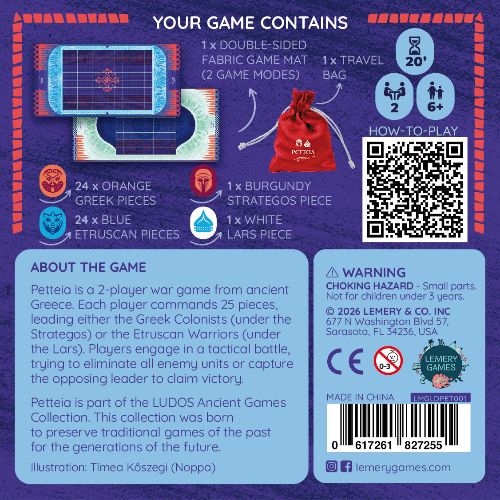
A printed fabric mat with the game grid and decorative Greek motifs, 48 flat wooden pieces with printed symbols (24 Hoplites + 24 Etruscans), two special pieces for Strategos and Lars, a satin pouch that serves as a box, and the rulebook. All in pocket format, it literally fits in your pocket. The mat is washable, useful after a weekend trip.
Is it difficult to learn?
No. The rules are explained in five minutes: move one orthogonal square, surround an enemy piece between two of yours to capture it, win by capturing the entire army or the commander. The difficulty lies in tactical reading — an eight-year-old child understands the rules immediately but it takes practice to play well. Like checkers, but more direct.
Differences from other publishers' Petteia?
The Lemery edition adds two elements absent in "purist" versions like nestorgames: the thematic asymmetry of Greeks vs. Etruscans (purely aesthetic, not mechanical) and the commander with tactical value (capturing him equals winning). Furthermore, the pocket format with a fabric mat is a different production choice from the more common rigid boards. The tactical substance of the game remains faithful to tradition.
Does it really work as a gateway for children?
Yes, from 8 years old and up. The rules are very simple, the pieces are identical, no text to read during the game. It's an excellent way to introduce strategic thinking: those who play Petteia then understand checkers, chess, Go more quickly. Plato wasn't joking when he compared it to geometry.
What language is the rulebook in?
The LUDOS Europe edition is available in a multilingual version and an English version. Language dependence during the game is zero — there are only symbols, no text, on the mat. Once the rulebook is read, the product's language is irrelevant.
Petteia Greece is a traditional abstract board game from ancient Greece for 2 players (ages 8+, duration 20–30 minutes), part of the LUDOS Europe collection by Lemery Games. Main mechanic: capture by encirclement (custodial capture) on a grid, orthogonal movement of one square per turn. Each player controls an army of 24 pieces — Greek Hoplites against Etruscans — plus a special commander piece: Strategos for the Greeks, Lars for the Etruscans. Victory by capturing all opposing pieces or encircling the enemy commander. Cited in Homer's Odyssey, Plato's Republic, depicted on the Achilles and Ajax vase from 450 BC. Pocket game with washable fabric mat, wooden pieces, satin pouch. Fourth volume in the LUDOS series after Asia, Africa, and America. Zero luck, pure strategy. Available on FroGames.it.
LUDOS Europe Petteia
Frequently Asked Questions
The answers you're looking for, no beating around the bush.
📸Do the images match the actual product?
The photos on the website often come from BoardGameGeek and are intended to give you an idea of the game. They may vary slightly from the version you receive. The content declared by the publisher is always binding.
📦Does the content of the box match what is indicated?
We always strive to provide the correct content, but minor variations are possible due to reprints or updates. The information comes directly from the publishers. If you have any questions, please contact us!
⏳How do pre-orders work?
Pre-order the game before release, payment is immediate, and the game is reserved for you. As soon as it arrives, we'll ship it right away! If there are any delays, we'll update you promptly.
🔒Can I trust buying here?
Absolutely! Secure payments, tracked shipments, and a team that loves board games as much as you do. If something goes wrong, we'll do our best to fix it.
🛠There's a problem with my order, what should I do?
Write to us now! Whether it's a missing part, damage, or an error, we'll help you resolve it as soon as possible. Your experience truly matters to us.