
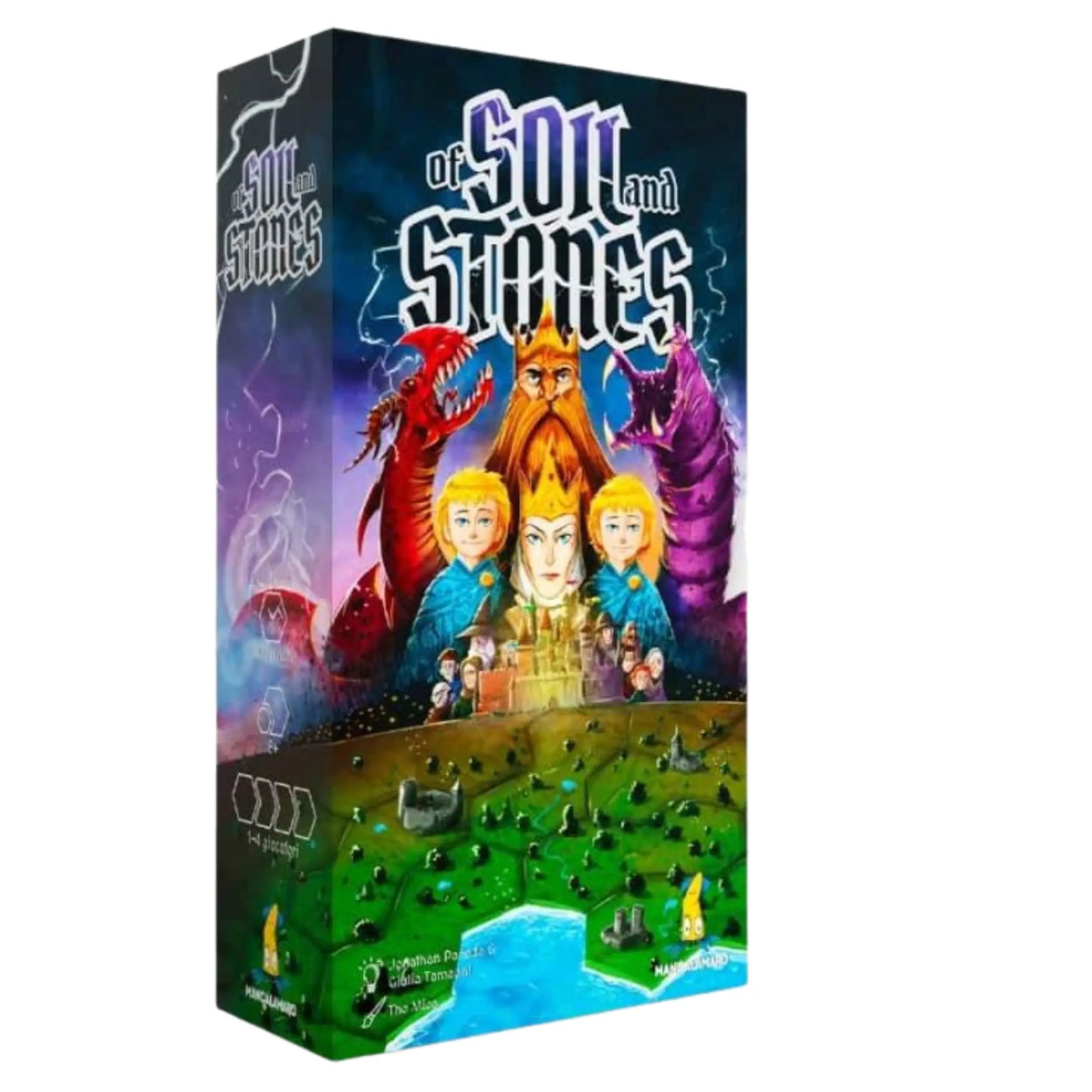
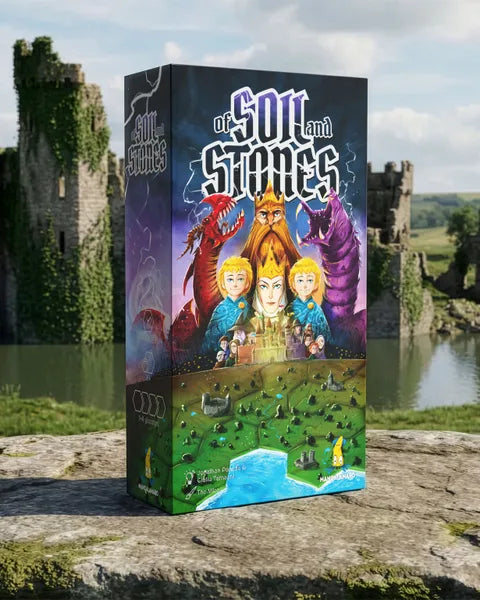
Of Soil and Stones
🐸 Details from BoardGameGeek
Consiglio BGG sul numero di giocatori
Categorie
Meccaniche
Design & Art
Lingua
Si abbina bene con
FroGames — Moments You'll Remember
Every tile is a promise or a problem. And when you play the last one, you'll know if the kingdom will survive or crumble before dawn.
WHAT IT'S ABOUT
A kingdom to build tile by tile, before the enemy arrives
Of Soil and Stones is the work of Jonathan Panada and Giulia Tamagni, with illustrations by Mihajlo Dimitrievski. You are architects and builders in the service of a young king and queen: the kingdom has just been born, and every tile you place is a meadow, a fortress, or a defensive moat. The story unfolds through 10 scenarios, each with new challenges and increasingly dangerous enemies.
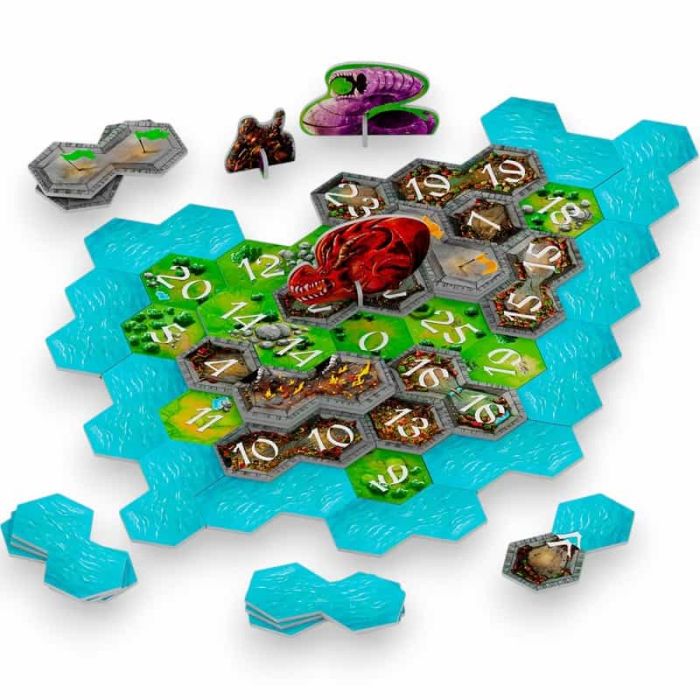
The game works with simple rules but sharp choices: each tile has a value, and you can only overlap it with others if its number is between the two it covers. You must play all tiles without getting stuck, build the necessary defenses, and withstand assaults. No downtime: you play together, you discuss, you take risks. And when the last tile lands on the table, you discover if the kingdom holds or falls.
What they say abroad
Every tile is a choice. Every choice could be the last.
— FroGames
Promises to take cooperative tile placement into uncharted territory, with a narrative campaign that gets tighter and tighter.
— FroGames

Of Soil and Stones
The game works solo with the same rules as multiplayer: you manage all tiles and face scenarios as a personal puzzle. The experience is complete, but it loses the discussion and collective confrontation that make every game a small assembly.
FrogScore · FroGames editorial rating · based on rules, international reviews and play sessionsWhat you'll find
The components of your kingdom
Meadow Tiles
Each tile has a numerical value. They must be placed to form the kingdom, respecting overlapping constraints. They are the basis of the puzzle.
Fortress Tiles
Defensive structures to build to protect the kingdom. Each scenario requires a minimum number of fortresses to win.
Moat Tiles
The back of each tile can become a defensive moat. Choosing when to flip a card is one of the key decisions.
Enemy Cards
Each scenario introduces different enemies with specific rules. The further you advance in the campaign, the more relentless the assaults become.
At the end of the game, look at the kingdom you have built. And ask yourself: would a different tile have been enough?
A game in five moments
What happens at the table
Not the rules. The experience.
Setup and first breath
Set up the initial kingdom, shuffle the tiles, read the scenario. The table is clean, possibilities are endless. Someone proposes the first tile. It starts calmly, almost everything seems possible.
The puzzle tightens
After 5-6 tiles, options dwindle. A high-value card blocks half the table, someone suggests turning it over as a moat. But if you do that now, you'll lack fortresses later. You start discussing every move.
Tension rises
Half the tiles played, and the enemy presses. Two more fortresses are needed, but the remaining cards have awkward values. Someone mentally calculates possible combinations. The table falls silent.
The last decisive tile
Only one card remains. If it fits, you win. If it doesn't, the scenario is lost. Everyone holds their breath. You place it. It works. Or it doesn't. But you'll remember this moment.
Victory or reset
If you won, read the narrative paragraph of the scenario and unlock the next one. If you lost, reset and try again immediately: games are quick, revenge is instant. And next time you'll do better.
How to play
The flow of each turn
Of Soil and Stones doesn't have turns in the classic sense: one tile is played at a time, together, until they are all gone.
Depending on the scenario, draw from the deck or choose from the available tiles. The numerical value on the tile determines where you can place it.
You can place it next to other tiles, or overlay it on two existing tiles: the value must be equal to or between the two you cover. This is where the puzzle is born.
Some tiles can be played as fortresses (front) or flipped to form the defensive moat (back). Each scenario has minimum requirements for both.
If you have played all the tiles, built enough fortresses and moat, and withstood the enemies: you have won. Otherwise, you start over.
Why it's different from others
Six mechanics that make a difference
Numerical overlay
It's not enough to place tiles: each card has a value, and when you overlay it, its value must be between the two numbers it covers. It's a simple mathematical puzzle in theory, ruthless in practice. One wrong tile and you get stuck.
Double-sided: meadow or moat
Each tile can be played as a meadow (contributes to the kingdom) or flipped as a moat (defense). The choice is irreversible. Flipping too early leaves you with no options, too late and the enemy breaks through.
Progressive narrative campaign
10 linked scenarios, each with a unique story and rules. Difficulty increases, enemies change, conditions become more complex. It's not a sandbox: it's a journey with a beginning and an end.
Scenario-specific enemies
Each chapter introduces a different type of threat: some attack fortresses, others the moat, still others change placement rules. You never face the same problem twice.
20-minute games
There's no downtime, no lengthy phases. You play a tile, discuss, play another. In 20 minutes you know if you've won or lost. And if you lose, reset and try again immediately.
Pure cooperative without alpha player
All information is public, but the puzzle is tight enough to require everyone's input. No one dominates the table: all eyes are needed to see the solution.
How it ends
How to win and how to lose
Each scenario has specific conditions, but the structure is always the same: play all tiles without getting stuck and meet the defense requirements.
Victory
- You played all the tiles from the deck without getting stuck
- You built the minimum number of fortresses required by the scenario
- You completed the defensive moat to the necessary extent
Defeat
- You can no longer place tiles: the values don't match and you are stuck
- Enemies destroyed too many fortresses before the end
- You did not meet the special conditions of the scenario
Of Soil and Stones is a cooperative game that respects players' time and intelligence. No endless setup, no manuals to study. Just 20 minutes of pure tension and an unforgiving puzzle.
Frequently asked questions
FAQ about Of Soil and Stones
Is it really a family game if it's so difficult?
Yes, because the rules are immediate and a game lasts 20 minutes. The difficulty lies in the choices, not in the rulebook. The first scenarios are accessible, and if you lose, you reset immediately. It's a challenge within everyone's reach, but it requires concentration.
Is the campaign mandatory or can I play single scenarios?
The campaign is designed to be played in order: scenarios progressively unlock rules and enemies. But nothing prevents you from replaying single chapters after completing them, or skipping ahead if you want more difficulty right away.
How does it work solo?
Exactly like in cooperative play: you manage all the tiles by yourself and face the scenarios. The experience is complete, but you lose the collective discussion that makes every move a small negotiation. Perfect for those who love logical puzzles.
Is it replayable after finishing the 10 scenarios?
Yes: each scenario has difficulty variants and alternative conditions. And even repeating the same chapter, the random order of the tiles always changes the puzzle. It's not a legacy game: nothing is destroyed or permanently modified.
Is it available in Italian?
Yes, this edition is entirely in Italian. Rules, narrative texts of the scenarios, and cards are translated, so you can focus on the puzzle without language barriers.
Of Soil and Stones is a cooperative tile-placement game for 1-4 players, designed by Jonathan Panada and Giulia Tamagni and published by Mancalamaro in an Italian edition. Games last 20 minutes, recommended age 8+. The game is based on a numerical overlay mechanic: each tile has a value and can only be placed if it is between the two numbers it covers. It includes a narrative campaign of 10 scenarios with increasing difficulty, unique enemies, and variable conditions. It works solo with the same rules as multiplayer. Available on FroGames.it.
Frequently Asked Questions
The answers you're looking for, no beating around the bush.
📸Do the images match the actual product?
The photos on the website often come from BoardGameGeek and are intended to give you an idea of the game. They may vary slightly from the version you receive. The content declared by the publisher is always binding.
📦Does the content of the box match what is indicated?
We always strive to provide the correct content, but minor variations are possible due to reprints or updates. The information comes directly from the publishers. If you have any questions, please contact us!
⏳How do pre-orders work?
Pre-order the game before release, payment is immediate, and the game is reserved for you. As soon as it arrives, we'll ship it right away! If there are any delays, we'll update you promptly.
🔒Can I trust buying here?
Absolutely! Secure payments, tracked shipments, and a team that loves board games as much as you do. If something goes wrong, we'll do our best to fix it.
🛠There's a problem with my order, what should I do?
Write to us now! Whether it's a missing part, damage, or an error, we'll help you resolve it as soon as possible. Your experience truly matters to us.