
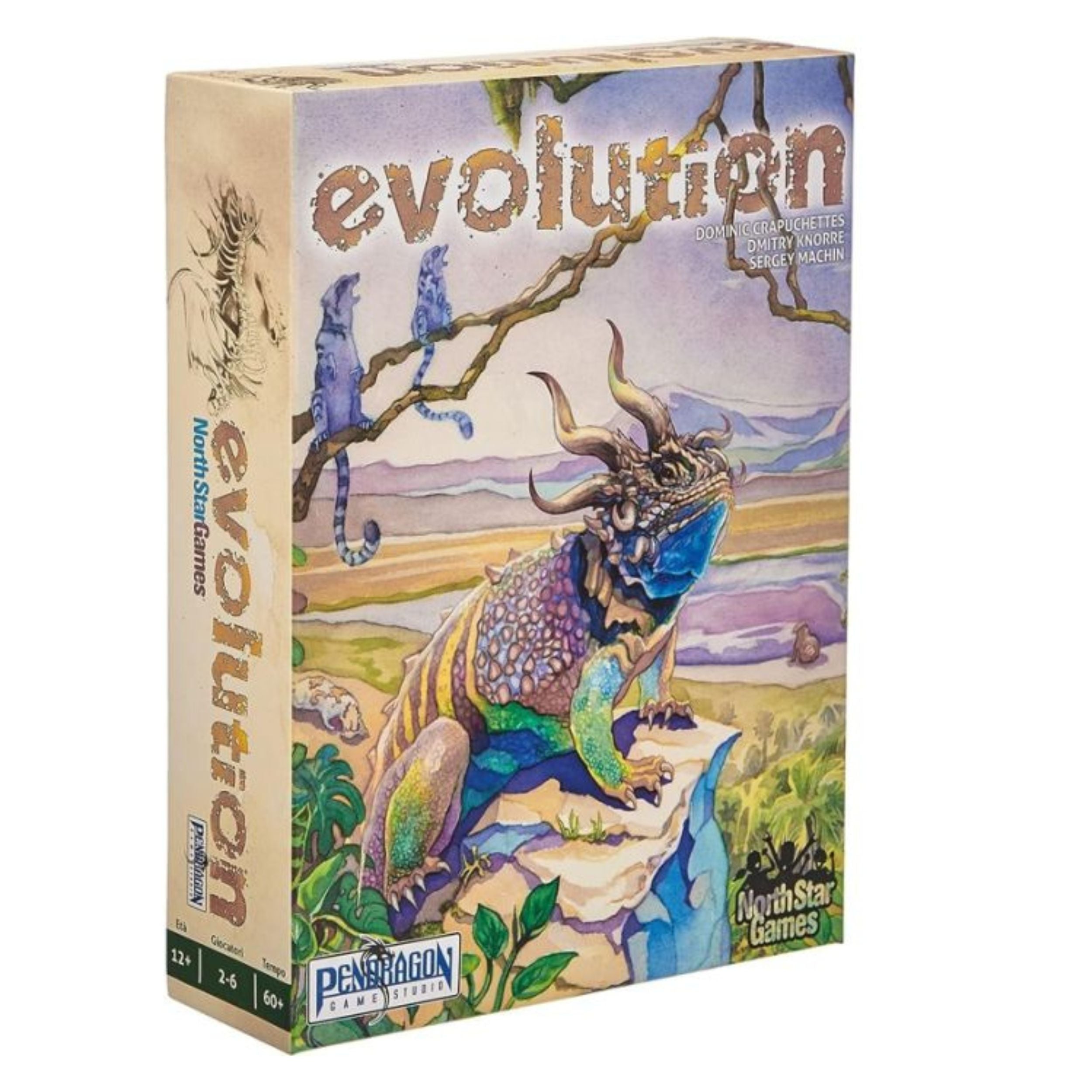
Evolution
🐸 Details from BoardGameGeek
Consiglio BGG sul numero di giocatori
Categorie
Meccaniche
Design & Art
Lingua
Si abbina bene con
FroGames — Moments You'll Remember
Someone builds impenetrable defenses. Someone becomes a carnivore and destroys your best species. And in the end, you discover that the real enemy was hunger, not others.
WHAT IT'S ABOUT
An ecosystem that changes every time
Evolution was created by Dominic Crapuchettes, Dmitry Knorre, and Sergey Machin in 2014, after a successful Kickstarter campaign. The game is published by North Star Games, with naturalistic illustrations by Catherine Hamilton, Jacoby O'Connor, and others. The theme is natural selection: each game is a simulation of evolution, where survival depends on choices and adaptation.
At the table, you create animal species and modify them with evolutionary traits. Each turn you play cards to add traits (Long Neck, Hard Shell, Claws), create new species, or increase population and size. Then comes the food phase: those who don't eat enough lose population. And if you become a carnivore, you can attack other species. The ecosystem is dynamic: what works today may be useless in the next round.
What they say abroad
"Every game tells a different evolutionary story."
Ogni partita racconta una storia evolutiva diversa.
— Shut Up & Sit Down
The ecosystem reacts to your choices. Build defenses, and someone evolves to overcome them. Ignore carnivores, and they'll devour you. It's Darwin in 60 minutes.
— FroGames

Evolution
FrogScore · FroGames editorial rating · based on rules, international reviews and game sessionsThe Evolutionary Traits
Four examples of how to survive
Hard Shell
Protects against small carnivores. A predator must be larger than you to attack you. It's the basic defense, inexpensive but effective against early threats.
Long Neck
Allows you to eat from the food supply before others. Useful when food is scarce, because those who arrive first survive. But it doesn't protect you from anything.
Carnivore
You eat by attacking other species. Each successful attack gives you food equal to the prey's size. But now you must hunt; you can no longer feed from the plant supply.
Horns
When a carnivore attacks you, it loses population even if it succeeds. It's an aggressive defense: it doesn't prevent the attack, but it makes it costly for the predator.
Recommended Sleeves 110 cards in 1 size ▼
If you play often, we recommend protecting your cards with transparent sleeves to make them last longer.
| Size | Quantity |
|---|---|
| 57 × 89 mm | 110 |
| Total cards | 110 |
In an hour, you'll have at least one species you won't forget. It always happens with Evolution.
A game in five acts
What happens at the table
Not the rules. The experience.
The peaceful beginning
Everyone starts with a basic species. The first few turns are calm: you add defensive traits, increase your population, nobody wants to become a carnivore yet. The food supply is abundant. It seems like a cooperative game.
The first carnivore
Someone plays the Carnivore card. The tone at the table changes. Now undefended species are food. Those who had only focused on population and size start building Shells, Horns, Camouflage. The ecosystem reacts.
The arms race
Carnivores increase in size to overcome defenses. Prey accumulate combined traits (Shell + Horns + Camouflage). Someone creates a second species as bait. Food supply starts to dwindle, and those who don't eat lose population.
Extinction
A species is completely eliminated. The player loses the points accumulated with that species. There's a moment of silence. Then someone makes a joke and the game resumes, but now everyone knows that every turn could be someone's last.
The deck runs out
When the deck runs out and needs to be reshuffled, the last round begins. Now it's a race for points: population and traits are worth victory points. Those who had accumulated small but resilient species often overtake those who had focused on huge but costly carnivores. The winner is the one who survived best, not who attacked most.
How to play
The flow of each round
Each round has four linear phases. The pace is fast, choices are immediate.
Each player draws 3 cards plus 1 for each species they own. The cards are evolutionary traits that you will use to modify your species or for other actions.
Everyone plays simultaneously. You can: create a new species, increase the population or size of an existing species, add a trait to a species. One card must be discarded face down to determine the food supply for the turn.
Discarded cards are flipped face up: the sum determines how much food is available this turn. If there's a shortage, someone will starve. If there's abundance, everyone eats.
In turn, each player feeds a population of a species (takes 1 food from the supply). Those with Long Neck eat first. Carnivores attack other species. Those who don't eat enough lose population. Collected food becomes victory points.
Why it's different from others
Six mechanics that make a difference
Dynamic ecosystem
There is no dominant strategy. If everyone builds defenses, it's advantageous to become a carnivore. If everyone is a carnivore, it's better to focus on fast and small species. The table balances itself, because every choice creates a counter-play.
Targeted predation
When you attack, you choose which species to hit. It's not random. You can target the leading player, eliminate a weak species for easy points, or attack someone who just built an expensive defense to slow them down. Every attack is a statement.
Multi-use cards
Each card is a trait, but you can also use it to create a species, increase size or population, or discard it for food. This creates continuous choices: keep Carnivore to use it, or sacrifice it to feed a dying species?
Size vs population
Size protects against small carnivores. Population gives you more points but requires more food. You need to balance: a huge species with population 1 is worth little, but a species with population 6 and size 1 is vulnerable.
Trait combos
Traits combine in surprising ways. Carnivore + Ambush allows you to attack species with Camouflage. Shell + Horns + Symbiosis creates an almost impenetrable defense. Over 4000 possible combinations, and you discover new ones every game.
Survival points
You don't win by massacring others. You win by accumulating food, maintaining high population, and collecting traits. A player who has never attacked anyone can win if their species are resilient. Survival rewards more than aggression.
How it ends
How to win and how to lose
The game ends when the trait deck runs out and needs to be reshuffled. Accumulated food, population, and traits are counted.
Victory
- 1 point for each food collected during the game (stored in your bag)
- 1 point for each population on your species at the end
- 1 point for each trait card played on your species (even extinct ones count if they had traits)
Extinction
- A species becomes extinct if it loses all its population (due to starvation or predation)
- You lose the population points for that species, but you keep the collected food points
- If all your species become extinct, you continue playing: you can create new species in subsequent turns
Evolution is not a combat game. It's a game of adaptation. And every time you open it, the ecosystem tells a different story.
Frequently asked questions
FAQ about Evolution
How aggressive is it? Is it a game of continuous attack?
No. Carnivores exist, but they are not mandatory. Many games see 1-2 carnivores out of 4 players, and the rest focus on defenses or alternative strategies (Long Neck, Cooperation, Scavenger). Aggression is an option, not the dominant strategy. If someone attacks too much, others isolate them.
Does it work well with 2 players?
It works, but it's different. With 2 players, it becomes more deterministic: you see exactly what your opponent is doing and can counter them directly. It loses some unpredictability. The sweet spot is 3-5 players, where the ecosystem is truly dynamic.
How long does the first game take?
About 75-90 minutes with explanation. From the second game onwards, 60 minutes sharp. The game has a natural timer (the deck), so it doesn't drag on. The phases are quick, and the feeding phase is the only sequential one.
Is it educational? Do you really learn something about evolution?
Yes, surprisingly. After a few games, you understand concepts like evolutionary arms race, natural selection, ecological niches, adaptive pressure. It's not a documentary, but the theme and mechanics are aligned. It's used in some schools to teach biology.
Is this edition in Italian?
Yes, this is the Italian edition published by Pendragon Games. Rulebook, cards and components are all in Italian.
Evolution is a strategy board game for 2-6 players, lasting 60 minutes, age 12+, designed by Dominic Crapuchettes, Dmitry Knorre, and Sergey Machin. In Evolution, you create animal species and modify them with evolutionary traits (Shell, Carnivore, Long Neck, Horns) to adapt them to a dynamic ecosystem. The hand management and tableau building mechanics offer over 4000 possible combinations. Interaction is direct: carnivores attack other species, but survival rewards more than aggression. Published by Pendragon Games in Italy, Evolution is a perfect gateway for those looking for an accessible yet deep thematic game. Available on FroGames.it.
Frequently Asked Questions
The answers you're looking for, no beating around the bush.
📸Do the images match the actual product?
The photos on the website often come from BoardGameGeek and are intended to give you an idea of the game. They may vary slightly from the version you receive. The content declared by the publisher is always binding.
📦Does the content of the box match what is indicated?
We always strive to provide the correct content, but minor variations are possible due to reprints or updates. The information comes directly from the publishers. If you have any questions, please contact us!
⏳How do pre-orders work?
Pre-order the game before release, payment is immediate, and the game is reserved for you. As soon as it arrives, we'll ship it right away! If there are any delays, we'll update you promptly.
🔒Can I trust buying here?
Absolutely! Secure payments, tracked shipments, and a team that loves board games as much as you do. If something goes wrong, we'll do our best to fix it.
🛠There's a problem with my order, what should I do?
Write to us now! Whether it's a missing part, damage, or an error, we'll help you resolve it as soon as possible. Your experience truly matters to us.