
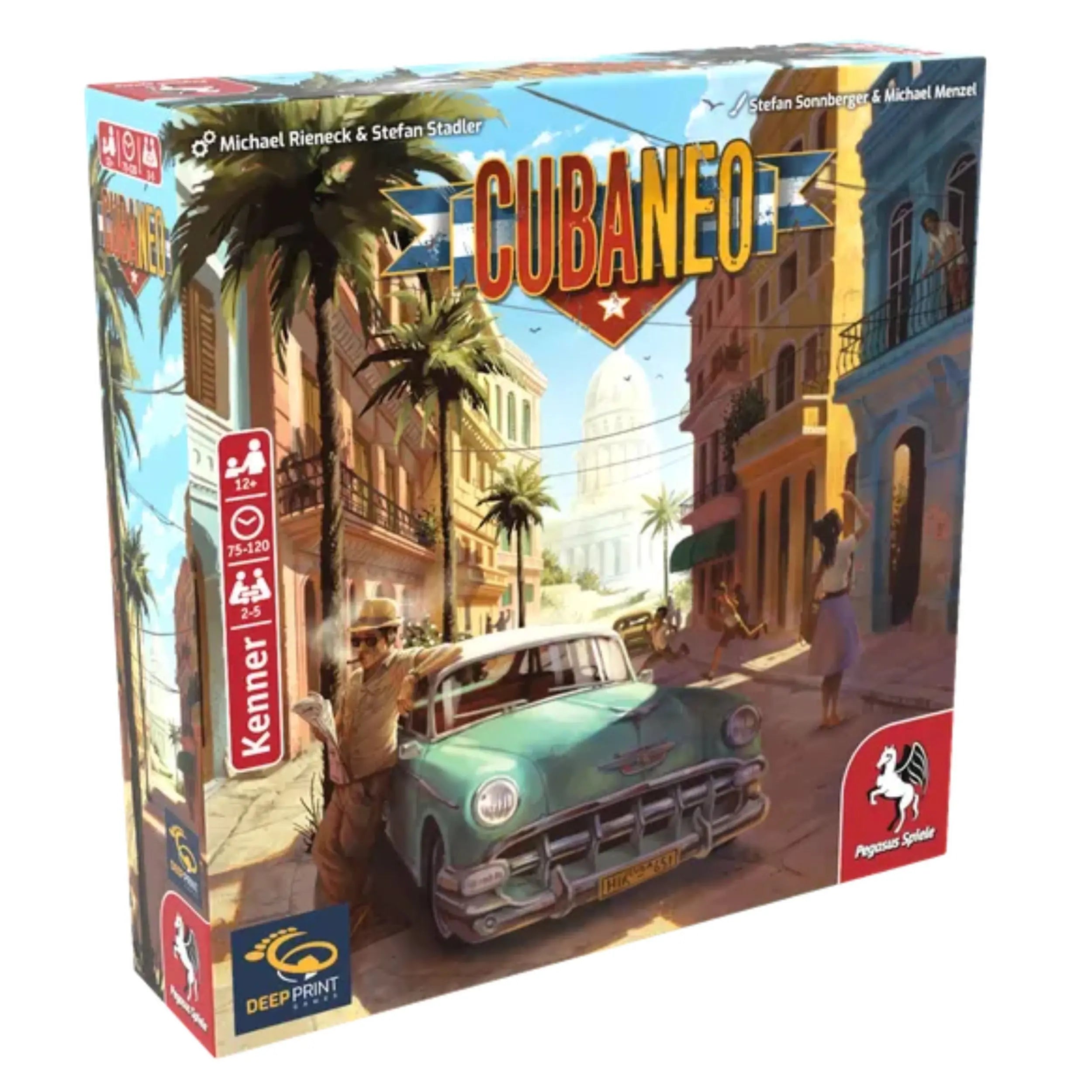
Cubaneo
🐸 Dettagli da BoardGameGeek
Consiglio BGG sul numero di giocatori
Categorie
Meccaniche
Design & Art
Lingua
Pre-order - leggi i dettagli
🐸 Una rana saggia sa quando dividere l’ordine… e quando aspettare il salto giusto.
Si abbina bene con
FroGames — Moments You'll Remember
Someone promises favorable laws, someone blocks other people's ships, someone builds the hotel that will change everything. And in the end, no one remembers who won the auctions, only who won the game.
WHAT IT'S ABOUT
Trade, politics, and power in pre-revolutionary Cuba
Michael Rieneck and Stefan Stadler take us to Cuba in the turbulent years before the Revolution, when the island's cities vied for wealth and influence. With illustrations by Michael Menzel and Stefan Sonnberger, Cubaneo recreates an era of economic opportunity, political tensions, and decisive strategic choices.
At the table, you manage goods and delegates: ship products to your home port or to merchant ships, build distilleries, hotels, and banks for the well-being (and control) of the population, and most importantly, send representatives to parliament to pass laws that favor your plans. Every decision intertwines economics and politics, because who controls the vote controls the rules of the game.
What they say abroad
Cubaneo promises to intertwine trade, building, and voting in a system where every economic choice has political repercussions.
— FroGames
A eurogame that puts parliament at its center: the laws you pass aren't flavor, they're your strategy.
— FroGames

Cubaneo
FrogScore · editorial rating FroGames · based on rules, international reviews, and gameplay sessionsYour Tools
What you have in your hands to win
Merchant Ships
Ship goods to the ships for immediate profits. But be careful: holds fill up quickly, and whoever arrives first gets the best bonuses.
Delegates in Parliament
Your representatives vote on laws. The more you have, the more you control which acts pass and which don't. And whoever controls the laws controls the strategies of others.
Buildings (Distilleries, Hotels, Banks)
Build to activate permanent abilities and generate resources every round. Each building unlocks a different economic engine.
Action Cards
Your hand determines what you can do and when. Managing it well means anticipating others' moves and playing your cards at the right moment.
In two hours, you'll understand that Cuba isn't won in the market. It's won in parliament.
A game in five moments
What happens at the table
Not the rules. The experience.
Setup and first timid moves
Everyone studies their cards and the board. The first auctions are cautious; no one wants to overcommit too early. But someone is already counting delegates: who controls parliament from the start can shape the game in their favor.
The first laws change everything
The first parliamentary vote arrives, and someone passes a law that benefits their strategy. The others realize too late. Auctions become aggressive: more delegates are needed, now.
The market explodes
Ships fill up, buildings produce, cards turn quickly. Someone has built a perfect engine; someone else realizes they got their priorities wrong. Whoever planned three turns ahead is now smiling.
The decisive vote
A key law is on the table. If it passes, it overturns the strategies of half the table. Temporary alliances form, bluffs fly. Someone sacrifices points now to block others' points later. Parliament has never been so tense.
Final count and surprises
The last cards are played, the last goods shipped. Someone has built more buildings; someone else has dominated the port. But points from delegates and approved laws decide who truly won. Often, the winner is not who seemed to be in the lead.
How to play
The flow of each round
A round of Cubaneo alternates between variable phases decided by players, competitive auctions, and simultaneous actions.
Players vote (or negotiate) the order in which the round's phases will take place. Whoever controls more delegates has more sway.
Auctions are held for contracts, buildings, or delegates. The market is dynamic: prices and availability change based on collective choices.
Ship products to the domestic port or on merchant ships. Whoever arrives first gets the best bonuses; whoever arrives late is left empty-handed.
Build distilleries, hotels, or banks to activate permanent abilities. Buildings produce resources or points each round but require heavy investment.
Why it's different from others
Six mechanics that make a difference
Parliament decides the rules
Laws are not flavor text: they genuinely change the game. Do you pass an act that favors distilleries? Those who built them dominate the round. Do you block a law about ships? You save your maritime strategy. Voting is as tactical as auctions.
Variable phases
The order of phases changes each round based on player votes. Anticipating a phase can give you a huge advantage; delaying it can sabotage others. Timing becomes a strategic weapon.
Dynamic and competitive market
Merchant ships have limited cargo holds: whoever ships first gets the bonuses; whoever arrives late loads nothing. The domestic port is less profitable but always available. Every turn you have to decide: risk or safety?
Buildings as production engines
Distilleries, hotels, and banks don't just give points: they activate permanent abilities that accelerate your economy. But they cost resources and occupy limited spaces. Building at the right time is crucial.
Strategic hand management
Action cards determine what you can do and when. Playing them at the wrong time is a waste; holding them too long blocks you. Whoever manages their hand best anticipates others' moves and maximizes every turn.
Interwoven economy
Each resource has three possible uses: sell it to the market, use it to build, or convert it into political influence. There is no obvious move: each choice excludes two alternatives, and opportunity cost always weighs heavily.
How it ends
How to win and how to lose
Cubaneo is won by accumulating victory points from buildings, shipped goods, delegates in parliament, and approved laws.
Victory
- Build high-value buildings and activate them multiple times to multiply points
- Dominate parliament and pass laws that give you bonus points or permanent abilities
- Ship goods on merchant ships at the right time to collect the best bonuses
How to fall behind
- Invest too much in one strategy and find yourself blocked by a law passed by others
- Ignore parliament and let opponents control the vote: the rules of the game change against you
- Always arrive late to the market: others take the best contracts, and you settle for scraps
Cubaneo is for those who seek a eurogame where politics weighs as much as economics, and where each game rewrites its own rules through collective voting.
Frequently asked questions
FAQ about Cubaneo
How important is the parliamentary vote compared to the economy?
Very important. Approved laws truly change the rules: they can favor a type of building, modify ship bonuses, or give extra points to those who control certain resources. Ignoring parliament means playing by others' rules, and that rarely works.
Is it a game with high interaction or more of a head-down game?
High indirect interaction: auctions are competitive, parliamentary voting is direct, and building where others build can block spaces. It's not an attack game, but each of your moves affects others' options.
Does it work well with 2 players, or do you need a full table?
It works for 2 to 5 players, but the experience changes. In 2 players, the duel is more tactical and calculated; in 4-5 players, parliament becomes chaotic, and temporary alliances weigh more. Both configurations are solid, depending on the type of tension you're looking for.
How complex is it to explain?
Medium-high. The individual mechanics (auctions, hand management, voting) are clear, but the intertwining of economy and politics requires one game to get into the rhythm. First game: 20 minutes explanation + at least 90 minutes at the table. From the second game, it runs faster.
Is the game available in Italian?
This edition is in English. The text on the cards is present but limited: basic knowledge of English is needed to play smoothly. The rulebook and components are in English.
Cubaneo is a strategic economic board game set in Cuba before the Revolution, for 2-5 players aged 12 and up, lasting 75-120 minutes. Designed by Michael Rieneck and Stefan Stadler, it combines competitive auctions, hand management, a dynamic market, and parliamentary voting in a system where approved laws change the game's rules each time. Build distilleries, hotels, and banks, ship goods on merchant ships, send delegates to parliament to control the vote. Published by Deep Print Games, Cubaneo is a eurogame for experienced players seeking deep strategy and indirect interaction. Available on FroGames.it.
Cubaneo
Frequently Asked Questions
The answers you're looking for, no beating around the bush.
📸Do the images match the actual product?
The photos on the website often come from BoardGameGeek and are intended to give you an idea of the game. They may vary slightly from the version you receive. The content declared by the publisher is always binding.
📦Does the content of the box match what is indicated?
We always strive to provide the correct content, but minor variations are possible due to reprints or updates. The information comes directly from the publishers. If you have any questions, please contact us!
⏳How do pre-orders work?
Pre-order the game before release, payment is immediate, and the game is reserved for you. As soon as it arrives, we'll ship it right away! If there are any delays, we'll update you promptly.
🔒Can I trust buying here?
Absolutely! Secure payments, tracked shipments, and a team that loves board games as much as you do. If something goes wrong, we'll do our best to fix it.
🛠There's a problem with my order, what should I do?
Write to us now! Whether it's a missing part, damage, or an error, we'll help you resolve it as soon as possible. Your experience truly matters to us.