
LUDOS Europe Brandubh
🐸 Details from BoardGameGeek
Consiglio BGG sul numero di giocatori
Categorie
Meccaniche
Design & Art
Lingua
🐸 How pre-orders work
🐸 A wise frog knows when to split the order… and when to wait for the right leap.
- Arrives
- December 11, 2026
Si abbina bene con
FroGames — Moments You'll Remember
Eight Vikings on the hunt, five Celts on defense, a king who must reach the corner. A thousand years later, you're still sitting at the table counting moves.
What it's about
The Irish "Black Raven" that Nordic sagas have told for a thousand years
Brandubh means "Black Raven" in Gaelic. It is the Irish variant of tafl, the family of Nordic board games that Vikings played on long winter nights and which later spread throughout Northern Europe. Original 7×7 boards have been found in Ballinderry, Downpatrick, in a peat bog in County Antrim. Dated from the 9th to 12th century. Icelandic sagas mention it. The stones remember it.
Lemery Games' LUDOS Europe edition brings Brandubh in a pocket format with a clear theme: Celts against Vikings. The Celtic player controls the king and four defenders, and must escape the king to one of the four corners of the mat. The Viking player has eight warriors and only one goal: to capture the king before he escapes. Straight-line movement like a chess rook, capture by encirclement. The forces are different, so are the goals — and that's precisely where the game lies.
What they say abroad
"Brandubh doesn't give you much space to recover. One slip can undo several turns of careful play."
Brandubh doesn't give you much space to recover. One slip can undo several turns of careful play.
— Tabletopping Games
"The Viking player perhaps has a more tactical game, working out moves and strategies two steps ahead."
The Viking player perhaps has a more tactical game, working out moves and strategies two steps ahead.
— Zatu Games

Brandubh Ireland
FrogScore · FroGames editorial rating · based on rules, international reviews, and gameplay sessionsOn the Black Raven's mat
What you control in each game
The Celtic King
Starts at the center of the mat. Must reach one of the four corners to win. Moves like other pieces but is the main target — losing him means losing the game instantly.
4 Celtic Defenders
Deployed around the king in a cross shape. Their job is to open a path to the corners and protect the sovereign from Viking assaults. They are outnumbered — they must play cleverly.
8 Vikings
Positioned along the four sides of the mat, two per edge. Double the Celtic forces. The goal is only one: to capture the king before he escapes. They must think two moves ahead, always.
Cloth mat
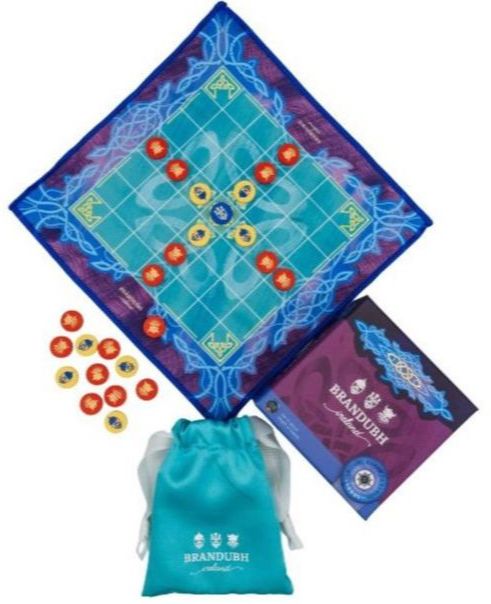
7×7 grid printed on fabric with interwoven Celtic motifs. Rolls up into the satin bag, fits in a pocket. Washable after intense game nights — LUDOS philosophy is truly pocket-sized.
In twenty minutes you'll understand why the Vikings carried it on their ships. And you'll want to switch sides for a rematch.
Come si gioca
Video dimostrativo di gameplay.
A game in five moments
What happens on the mat
Not the rules. The experience.
The Siege
The Celtic King stands in the center of the mat, surrounded by his four cross-shaped defenders. The eight Vikings are lined up along the edges, two per side. You are the Viking and you start first. You look at the four corners and you understand: you must close them all. The Celt looks at the same corners and thinks the opposite.
The First Assaults
You move a Viking towards a corner to block it. The Celt opens a breach with a defender. The pieces move in a straight line like chess rooks: no jumps, but the distance covered can be long. The first capture by encirclement comes on the third or fourth turn — a Celtic defender caught between two Vikings.
The King Moves
The Celt moves the King. Now he is exposed, but he has a route to the northeast corner. You have two Vikings close but not close enough. You calculate two moves ahead: if you move this one here, he escapes there, then you must first... your head is spinning. The manual said fifteen minutes. Forty minutes have passed.
The Mistake
A wrong move. Yours. You moved the Viking blocking the corner to capture a defender — gaining a piece but losing the net. The Celt sees the gap and strikes. A quick move of the King, two free squares to the corner, and the game is over. "Brandubh gives you no room to recover," the review had said.
Switching Sides
The King reaches the corner. Celtic victory. You sit down and mentally replay the entire game, recognizing where you went wrong. "Now it's your turn to be the Celt," he says. You replay by swapping sides — because it's the only honest way. Brandubh should always be played in pairs of games.
How to play
The flow of each turn
Turns alternate starting with the Vikings. One move per turn, no dice rolling, no drawing: just decisions.
The Viking moves one of his eight warriors. The Celt moves the King or one of the four defenders. All pieces move in the same way, including the King.
Move the piece any number of free squares horizontally or vertically, like a chess rook. You cannot jump over other pieces, you cannot move diagonally. Only the King can stop on the corners.
If your move leaves an enemy piece between two of your pieces (in an orthogonal line), you capture it and remove it from the mat. A single move can capture multiple pieces if the positions align in multiple directions.
If the King has reached a corner: the Celt wins. If the King has been captured (surrounded on four sides or between two Vikings): the Vikings win. Otherwise, the turn passes to the opponent.
Why it's different from other abstracts
Six elements that make it Brandubh
Total asymmetry
It's not symmetrical like chess or petteia. Different forces, different goals: the Celt must escape with the king, the Viking must capture him. A game is not complete without swapping sides — it's the only true measure of who is stronger.
Four corners, four routes
The Celt doesn't have just one goal: he has four possible escapes. The Viking must protect all four simultaneously. This creates a spatial dynamic that no symmetrical abstract can replicate — it's a hunt and escape on the same board.
Rook-like movement
Pieces move in a straight line any number of squares, like chess rooks. This amplifies the scope of each move: a Viking on the other side of the mat can threaten an action five turns away. Planning is everything.
Zero room for error
Brandubh is ruthless. One wrong move can ruin five turns of careful play. There's no recovery, no second chance: you often realize the mistake only after the game is over. This is why it makes you want to play again immediately.
A thousand years of tafl
7×7 Brandubh boards have been found in Ballinderry, Downpatrick and other medieval Irish sites. Icelandic sagas from the 10th century mention it. Playing it means moving pieces as monks, Vikings and Irish clan chiefs did a thousand years ago.
Clean pocket game
Fabric mat with Celtic motifs, flat wooden pieces, satin pouch. It fits in your pocket, you take it out in five seconds, put it away in ten. LUDOS philosophy: the ancient game in a modern pocket format, without frills.
How it ends
Two opposing goals
Brandubh's asymmetry means that the two players play different games. The one who reaches their goal first wins.
Celt wins
- The King reaches one of the four corners of the mat — game over instantly
- The Vikings have no more legal moves — a rare situation, but valid
- Strategy: open a gap with the defenders and lead the King to escape
Vikings win
- The King is captured by surrounding him between two or four Viking pieces
- The Celt can no longer move any piece legally
- Strategy: close the routes to the corners and tighten the net on the King
Brandubh Ireland should be played in pairs of games, swapping sides. It's the only way to truly understand the game — and to find out who between you two is stronger.
Frequently asked questions
Brandubh Ireland FAQ
Is the asymmetry balanced?
Yes, by definition. The Viking has twice as many pieces (8 vs 5) but the more difficult goal (capturing a King who has four escape routes). The Celt has fewer pieces but the advantage of moving the King. Games are often decided by a single wrong move, not by a disparity of forces. This is why it should be played in pairs: one as Viking, one as Celt. The winner is whoever wins both.
What does the LUDOS Europe edition box contain?
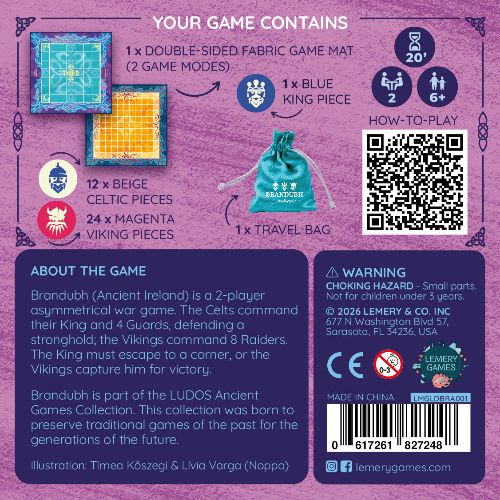
Fabric mat with 7×7 grid and printed Celtic motifs, 13 flat wooden pieces (1 Celtic King + 4 Celtic defenders + 8 Vikings), satin pouch that acts as a box and rulebook. All in pocket format — it literally fits in your pocket. The mat is washable.
Is it difficult to learn?
No, the rules can be explained in ten minutes: straight-line movement like a rook, capture by encirclement, victory for the King in the corners or capture of the King. The difficulty lies in the tactics — especially on the Viking side, where you have to think two moves ahead. An eight-year-old child immediately understands the rules; it takes a few games to truly understand the game.
Differences from other tafl games (Hnefatafl, Tablut)?
Brandubh is the smallest historically attested tafl game: a 7×7 grid instead of 9×9 (Tablut) or 11×11 (Hnefatafl). Fewer pieces, faster games, sharper decisions. The mechanics are identical to the tafl family, but the aggressiveness of the tactical lines is greater precisely due to the smaller size. It's the tafl that you play in 20 minutes.
Does it work as a gateway game or is it too unforgiving?
It works very well as a gateway game, provided you accept that the first few games will be lost. The rules are simple, the asymmetry teaches you to think in different ways (offensive vs defensive), and the short duration means that defeat doesn't sting for hours. Great for children, great for those who want to get into the tafl family.
What language is the rulebook in?
The LUDOS Europe edition is available in multiple languages and English. Language dependence during play is zero — there are only symbols on the mat, no text. Once you've read the rulebook, the product's language is irrelevant.
Brandubh Ireland is an asymmetrical abstract board game from the tafl family, originating in medieval Ireland, for 2 players (ages 8+, duration 15–30 minutes), part of the LUDOS Europe collection by Lemery Games. Main mechanic: orthogonal straight-line movement on a 7×7 grid, custodial capture by encirclement. Strong asymmetry: one player controls the Celtic King plus 4 defenders (total 5 pieces), the other controls 8 Viking attackers. Celtic victory: bring the King to one of the four corners. Viking victory: capture the King. Brandubh means "Black Raven" in Gaelic. Original 7×7 boards found in Ballinderry, Downpatrick, and other Irish sites between the 9th and 12th centuries, mentioned in Icelandic sagas. Pocket game with washable fabric mat, wooden pieces, satin pouch. Fourth volume in the LUDOS series after Asia, Africa, and America. Zero luck, pure strategy. Available on FroGames.it.
LUDOS Europe Brandubh
Frequently Asked Questions
The answers you're looking for, no beating around the bush.
📸Do the images match the actual product?
The photos on the website often come from BoardGameGeek and are intended to give you an idea of the game. They may vary slightly from the version you receive. The content declared by the publisher is always binding.
📦Does the content of the box match what is indicated?
We always strive to provide the correct content, but minor variations are possible due to reprints or updates. The information comes directly from the publishers. If you have any questions, please contact us!
⏳How do pre-orders work?
Pre-order the game before release, payment is immediate, and the game is reserved for you. As soon as it arrives, we'll ship it right away! If there are any delays, we'll update you promptly.
🔒Can I trust buying here?
Absolutely! Secure payments, tracked shipments, and a team that loves board games as much as you do. If something goes wrong, we'll do our best to fix it.
🛠There's a problem with my order, what should I do?
Write to us now! Whether it's a missing part, damage, or an error, we'll help you resolve it as soon as possible. Your experience truly matters to us.