
LUDOS Europe Brandubh
🐸 Details from BoardGameGeek
Consiglio BGG sul numero di giocatori
Categorie
Meccaniche
Design & Art
Lingua
🐸 How pre-orders work
🐸 A wise frog knows when to split the order… and when to wait for the right leap.
- Arrives
- December 11, 2026
Si abbina bene con
FroGames — Moments You'll Remember
Three gladiators close the circle. The bear has forty turns to avoid being trapped. It seems impossible to win — until you sit down to play it.
What it's about
The Roman hunt carved into thresholds
Archaeologists call them "Roman Wheel Patterns": wheels with eight, ten or twelve spokes carved on house thresholds, temple pavements, and villa walls. They are found throughout the Empire — from Britannia to Turkey, from Gaul to Italy. Were they auspicious symbols? Protective talismans? Perhaps. But on many of these wheels, the Romans played Bear Hunt: three hunters against a beast, on the geometry of the wheel.
The LUDOS Europe edition by Lemery Games revives this tradition, giving it a Roman theme: three gladiators against a bear. The bear player moves only one piece. The gladiator player moves any one of their three. No captures, no eliminations — just movement. The gladiators win if they trap the bear in a stalemate. The bear wins if it survives 40 turns. A turn tracker marks each step. It's the most stressful piece on the table.
What they say abroad
"Pieces are never removed from the board, and everything stays visible and keeps mattering."
The pieces are never removed from the board, and everything remains visible and continues to matter.
— Tabletopping Games
"There's a turn tracker which slowly becomes the most stressful piece on the table."
There is a turn tracker which slowly becomes the most stressful piece on the table.
— Tabletopping Games

Bear Hunt Roman Empire
FrogScore · FroGames editorial rating · based on rules, international reviews, and play sessionsOn the Roman wheel
What you control in each game
The bear
Only one pawn, wooden with a printed symbol. The bear player moves only this one, moving to a connected intersection per turn. The goal is one: don't get trapped, survive 40 turns.
3 Gladiators
Three hunters working together. Each turn the gladiator player moves only one of the three — the choice of which is already half the game. They must coordinate to close the circle around the bear.
The turn tracker
The most stressful piece on the table. It advances by one with each bear's turn. When it reaches 40, the bear has won. The gladiators watch it like an hourglass emptying — they must hurry.
"Wheel" mat
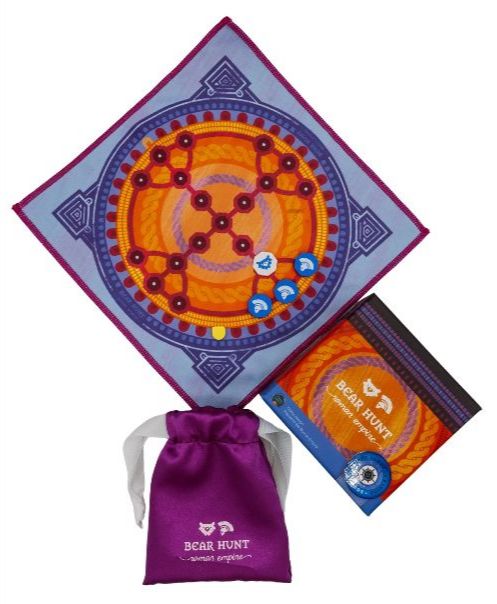
Fabric mat with the Roman wheel pattern. The pieces are not in the squares but on the intersections of the lines, like in the game of Go. It rolls up into the satin bag, fits in your pocket.
In twenty minutes you'll understand why the Romans carved it on their thresholds. And you'll want to switch sides for a rematch.
Come si gioca
Video dimostrativo di gameplay.
A game in five moments
What happens on the wheel
Not the rules. The experience.
Deployment
Lay out the mat, place the bear in the center of the wheel and the three gladiators on the starting intersections. The turn tracker is at zero. You are the gladiator and you go first. You look at the radiating lines and you understand one thing: the bear has a thousand ways to escape if you don't surround him immediately.
The first approach
You move a gladiator one intersection. The bear moves sideways, gaining distance. The turn tracker advances. You try to close the lines from one side, but moving only one gladiator at a time slows you down. The bear has all the time in the world. Or so it seems.
The circle tightens
Mid-game, two gladiators are in position, the third is arriving. The bear has slipped into a corner of the wheel — it seems trapped but sees a clear line. You calculate: if I move this gladiator here, he'll escape there. You need to move the right one. The turn tracker is already at twenty.
The pressure of time
Thirty-two, thirty-three, thirty-four. The turn tracker is no longer a pawn, it's a ticking time bomb. The bear continues to dance, exploiting every open line, forcing you to make precise movements. If you make a mistake with just one gladiator, he survives. You sweat. He smiles.
Stalemate or survival
Two possible outcomes: your third gladiator closes the last free line and the bear cannot move — gladiators win on turn 38. Or the turn tracker reaches 40 and the bear has danced until the end — bear wins. In both cases: switch sides, play again. It's a twenty-minute game.
How to play
The flow of each turn
The simplest rules in the LUDOS Europe series. One move at a time, no captures, no eliminations. Just board reading.
The gladiator moves any of his three, the bear moves its single piece. You move it to an adjacent intersection connected by a line on the mat. Only one intersection per turn.
After each bear movement, the turn tracker advances by one. It starts at zero, and the bear wins if it reaches 40. The gladiators control the timer and must speed up.
No pieces are ever removed from the mat. Everything remains visible, everything continues to count. The only thing that changes is the position of the pieces and the number on the turn tracker.
If the bear has no more legal moves: the gladiators win. If the turn tracker reaches 40: the bear wins. Otherwise, the turn passes to the opponent and the game continues.
Why it's different from the other three LUDOS Europe games
Six elements that make it Bear Hunt
Extreme asymmetry 1 vs 3
Sahkku, Petteia, and Brandubh all have multiple pieces per side. Not here: one piece against three. You are either the whole bear or all the gladiators. It completely changes the way you think about movement — no longer "which one do I move", but "how do I move the only one I have" or "which of the three do I move now".
No captures
The only LUDOS Europe game without captures. Pieces are never removed, no blood, no elimination. Everything is decided by movement and position. This makes it particularly suitable for children — defeat doesn't sting like when you lose pieces.
The terrifying turn tracker
Forty turns. The tracker advances one click at a time. For the bear, it's a lifeline growing. For the gladiator, it's an hourglass emptying. The most stressful piece on the table, international reviews say.
The Roman wheel
The board is not a square grid: it's a spoked wheel. Archaeologists call them "Roman Wheel Patterns" and they are found carved on doorsteps throughout the Empire, from Britannia to Turkey. Perhaps they were talismans, perhaps games — probably both.
Super fast games
The fastest in the LUDOS Europe series: 10-20 minutes per game. Perfect as a filler, as a second game in the evening, as a repeated challenge in impromptu tournaments. Switching sides after each game is the norm.
Minimalist pocket game
Four wooden pieces, a fabric mat, a turn tracker, a satin bag. It fits in your pocket, takes thirty seconds to set up, and thirty more to put away. LUDOS philosophy at its purest.
How it ends
Two inverse objectives
Stalemate or survival. The gladiators want to stop the movement, the bear wants to withstand the pressure of time.
Gladiators win
- The bear has no more free adjacent intersections to move to: stalemate, victory at whatever turn
- Strategy: move the three gladiators in a coordinated way to close the lines, not to "chase"
- The risk is time: every wasted turn brings the bear closer to victory
Bear wins
- The turn tracker reaches 40 and the bear is still free to move
- Strategy: always keep at least two lines open, dance on the edges when possible
- The risk is being pushed into a corner of the wheel with no way out
With perfect play, the gladiators should always win — but it requires coordination, patience, and speed. Bear Hunt should be played in pairs of games, switching sides: it's the only way to truly test yourself.
Frequently Asked Questions
FAQ about Bear Hunt Roman Empire
Did the Romans really play it?
Most likely yes, at least in some provinces. Archaeologists have found "wheel patterns" carved on thresholds, pavements, and walls throughout the Empire, from Britannia to Turkey. Some were certainly protective or decorative symbols, but many have the perfect geometry for bear games. The exact dating is debated — some call them "Italian Bear Games" because the tradition is mainly Italian. In any case, it's an ancient, simple game that is still played.
With perfect play, do the gladiators always win?
Yes, in theory. Game theory states that gladiators, playing perfectly, should always trap the bear within 40 turns. In practice, however, it's very difficult: it requires coordinating the three pieces without wasting turns, and the bear has 40 moves to exploit every mistake. Real games are much more balanced than theory suggests. Curiously, human players beat computers at this game.
What does the LUDOS Europe edition box contain?
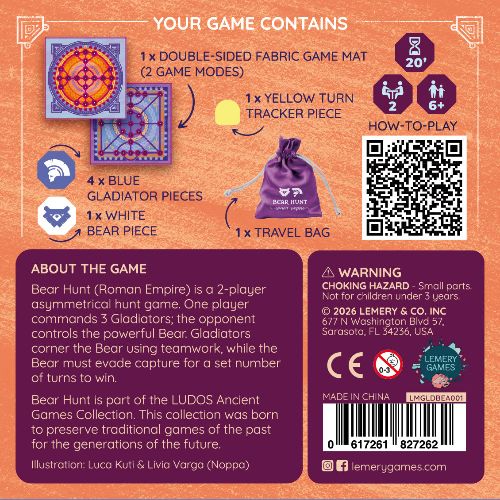
Fabric mat with the Roman wheel pattern, 4 wooden pieces (1 bear + 3 gladiators), physical turn tracker for the 40 turns, satin bag that doubles as a box, and rules. All in pocket size — the smallest in the LUDOS Europe series.
Why are there no captures?
Because it's a hunt game, not a battle game. The family of bear games (and the related fox games and Asian tiger games like Bagha-Chal) is based on the concept of trapping, not elimination. The idea is for the hunters to corner the prey, not kill it on the board. This is also why it's a great gateway for children: there's no explicit violence.
Is it suitable for children?
Yes, strongly. Rules in three sentences, no eliminations, 15-minute games, asymmetry that teaches different ways of thinking. It's probably the most suitable LUDOS Europe game for children aged 8 and up, and it also works for a few years younger if parents explain the lines on the mat. There's nothing violent about the concept of trapping a bear.
What language are the rules in?
The LUDOS Europe edition is available in multiple languages and English. Language dependence during the game is zero — on the mat there are only the spokes of the wheel, the pieces are identifiable at a glance. Once the rules are read, the product's language is irrelevant.
Bear Hunt Roman Empire is an asymmetric abstract board game from the Roman hunt games family, for 2 players (ages 8+, duration 10-20 minutes), part of Lemery Games' LUDOS Europe collection. Main mechanic: movement on intersections of a mat with a "Roman wheel" pattern, one piece per turn, no captures. Strong asymmetry: one player controls 1 bear, the other controls 3 gladiators (hunters). Gladiator victory: trap the bear in a stalemate with no legal moves. Bear victory: survive 40 turns using a physical turn tracker. The "Roman Wheel Pattern" motif has been found carved on thresholds, pavements, and walls throughout the Roman Empire, from Britannia to Turkey, with documented variants also in Italy, France, and other regions. Pocket game with a washable fabric mat, wooden pieces, satin bag. Fourth and final volume in the LUDOS series after Asia, Africa, and America. Zero luck, pure strategy, accessible rules. Available on FroGames.it.
LUDOS Europe Brandubh
Frequently Asked Questions
The answers you're looking for, no beating around the bush.
📸Do the images match the actual product?
The photos on the website often come from BoardGameGeek and are intended to give you an idea of the game. They may vary slightly from the version you receive. The content declared by the publisher is always binding.
📦Does the content of the box match what is indicated?
We always strive to provide the correct content, but minor variations are possible due to reprints or updates. The information comes directly from the publishers. If you have any questions, please contact us!
⏳How do pre-orders work?
Pre-order the game before release, payment is immediate, and the game is reserved for you. As soon as it arrives, we'll ship it right away! If there are any delays, we'll update you promptly.
🔒Can I trust buying here?
Absolutely! Secure payments, tracked shipments, and a team that loves board games as much as you do. If something goes wrong, we'll do our best to fix it.
🛠There's a problem with my order, what should I do?
Write to us now! Whether it's a missing part, damage, or an error, we'll help you resolve it as soon as possible. Your experience truly matters to us.