

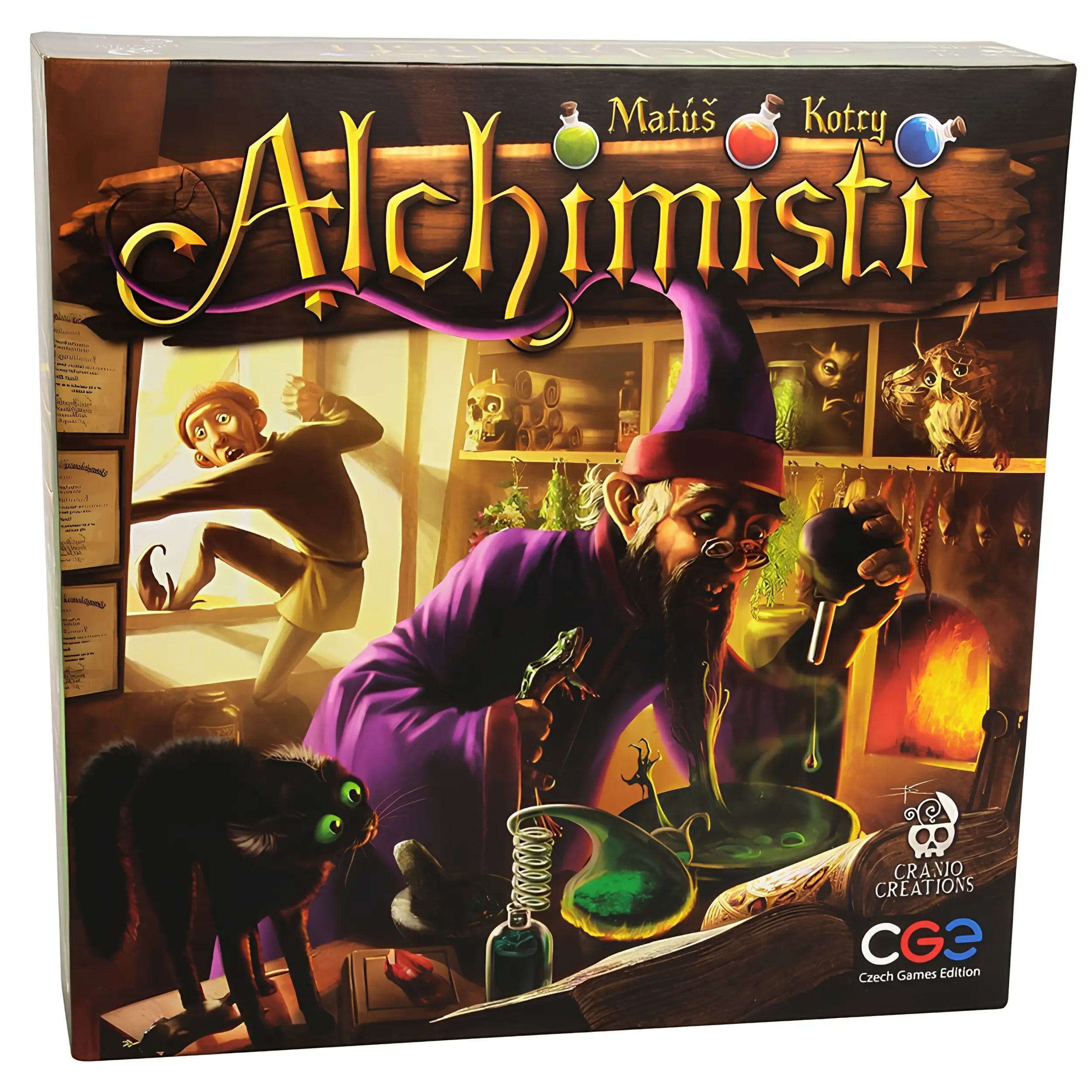
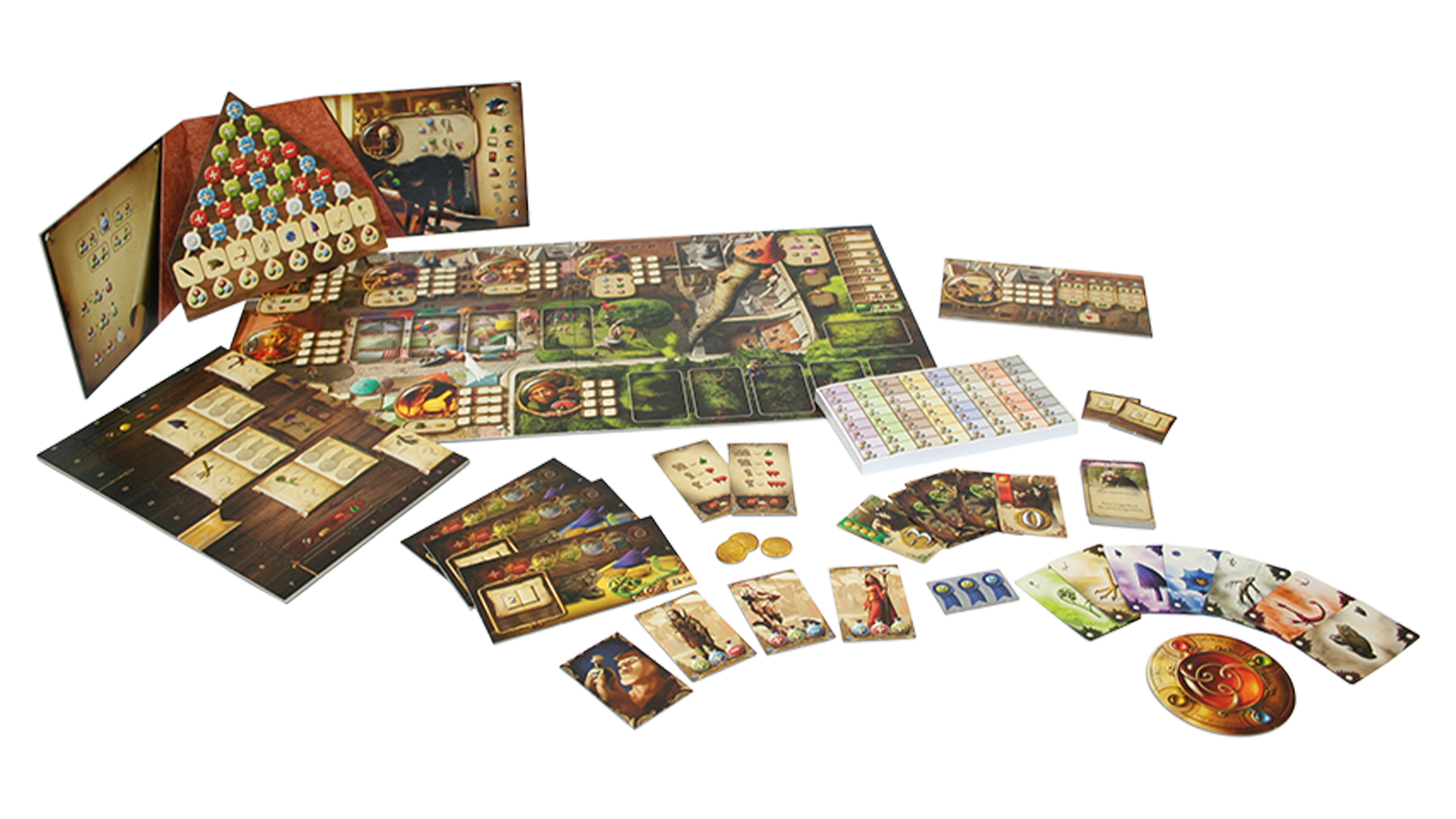
Alchemists
🐸 Dettagli da BoardGameGeek
Consiglio BGG sul numero di giocatori
Categorie
Meccaniche
Design & Art
Lingua

Si abbina bene con
FroGames — Moments You'll Remember
Someone publishes a brilliant theory. Someone else knows it's wrong but stays silent. At the end of the game, it's revealed who was bluffing and who understood everything. And the one with the most courage wins.
WHAT IT'S ABOUT
A Eurogame where bluffing is as important as deduction
Matúš Kotry (Slovak designer debuting with this title in 2014) took classic worker placement and integrated a hidden logical deduction system into it. The art is by David Cochard, the original publisher Czech Games Edition. Cranio Creations handles the Italian edition with full localization.
You are an alchemist mixing mysterious ingredients to discover their properties. Each game, the app randomizes the eight alchemical formulas: you test potions, sell concoctions to adventurers, publish theories (even false ones) to gain reputation. The problem? Others can refute your theories if they have proof. And you can bluff knowing that no one has tested that combination yet. The one who ends with the most reputation points wins, but false points are subtracted at the end of the game when the true formulas are revealed.
What they say abroad
"It's a worker placement game where lying is not only allowed, it's profitable."
It's a worker placement where lying is not only allowed, it's profitable.
— Shut Up & Sit Down
The tension isn't in not knowing. It's in deciding when to publish a theory you're only 70% sure of.
— FroGames

Alchemists
FrogScore · FroGames editorial rating · based on rules, international reviews, and play sessionsWhat you handle at the table
The Alchemist's Tools
Eight Ingredients
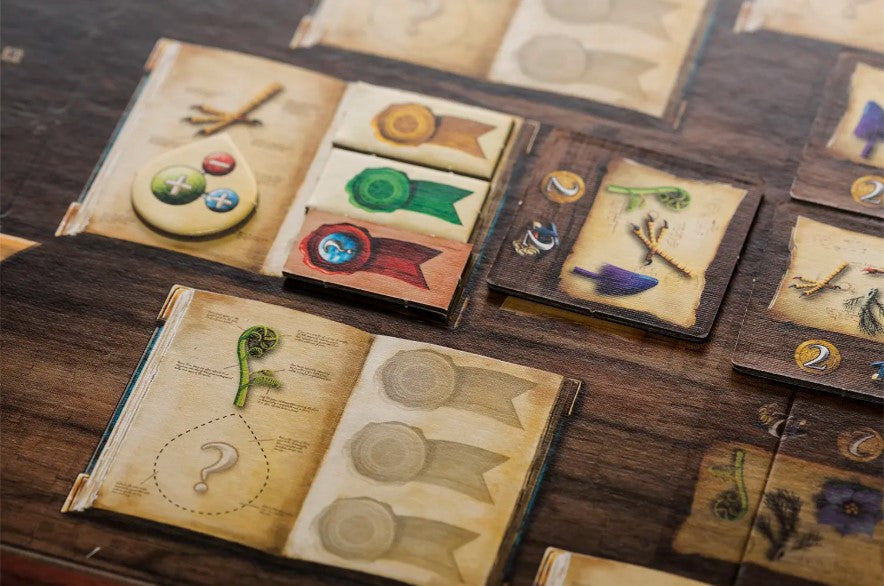
Mandragora root, scorpion tail, spongy mushroom, warty toad. Each has three hidden alchemical properties (red+, green-, blue+...). The app randomizes them at the start of the game.
Alchemical App
Mix two ingredients in the app, and it tells you the result (positive red potion, neutral green...). You deduce. The app doesn't lie, but it doesn't tell you everything. You have to do the right tests.
Publishable Theories
You publish a theory about an ingredient (e.g., "the mushroom is red+ blue-") and gain reputation. If it's wrong and someone proves it, you lose it. If it's right but you have no proof, you risk it.
Magical Artifacts
Nine variable artifacts every game. Expensive but powerful: they give you extra actions, discounts, unique advantages. Those who buy them often win, but they are a risky investment.
Recommended Sleeves 96 cards in 1 size ▼
If you play often, we recommend protecting your cards with clear sleeves to make them last longer.
| Size | Quantity |
|---|---|
| 43 × 67 mm | 96 |
| Total cards | 96 |
In a few hours, you'll discover that your most trusted friend let you publish a false theory just to refute you in the final round. It always happens with Alchemists.
Come si gioca
Video dimostrativo di gameplay.
A game in five moments
What happens at the table
Not the rules. The experience.
The first experiments
Everyone randomly mixes ingredients in the app. Some immediately discover a positive red potion, others a negative green one. No one knows anything yet, but everyone is frantically taking notes on their screen. Deduction hasn't started yet, but paranoia has.
The first published theory
Someone places a cube on "Publish theory" and announces: "The mushroom is red+ and blue-". They gain three reputation points. The others look at each other. Someone knows it's wrong but doesn't have enough evidence to refute it. Or perhaps they are bluffing too.
The race for artifacts
Mid-game. Those with money buy artifacts, those without still test ingredients. An artifact allows you to test without wasting an action, another gives you discounts on publications. Those with good artifacts have an advantage, but they've spent everything. Those who saved must catch up with theories.
Public refutation
Someone refutes another's theory. They prove with a potion that the published theory was false. The one who published it loses a reputation point, the one who refutes it gains two. People laugh at the table, but the refuted person doesn't forget. And sometimes refuting is a waste of actions: it's better to let others ruin themselves.
The final revelation
Round 6, then final exhibition. Each alchemist presents their theories, buys a last artifact, sells potions. Points are counted. Then the app reveals the true formulas. Those who published correct theories gain extra points, those who bluffed lose them. Those who refuted correctly gloat. Those who kept quiet bite their hands. The one who knew how to balance risk and certainty wins.
How to play
The flow of each round
Six identical rounds. Each round: choose turn order, place workers, resolve actions, move to the next.
The first player gets fewer bonuses but chooses the best spaces. The last player takes favor cards or money. Variable order, decided each round.
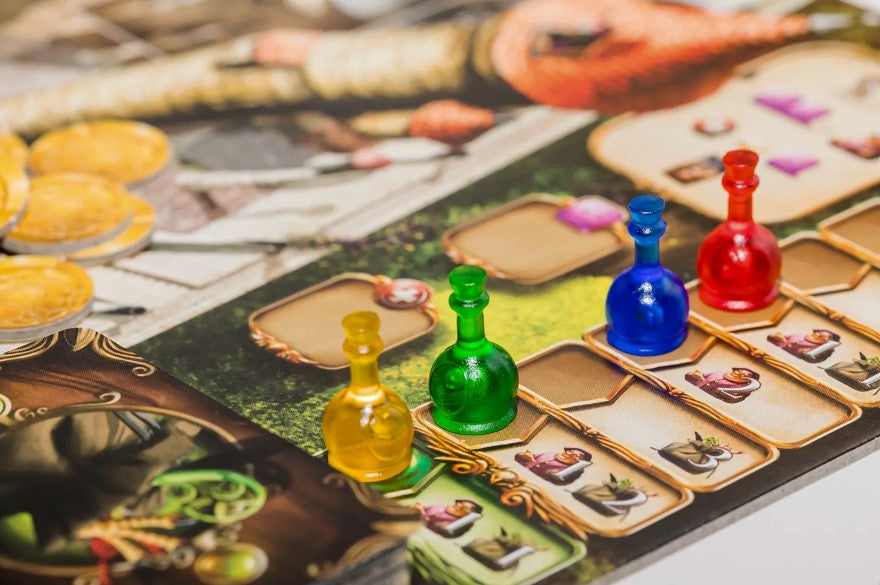
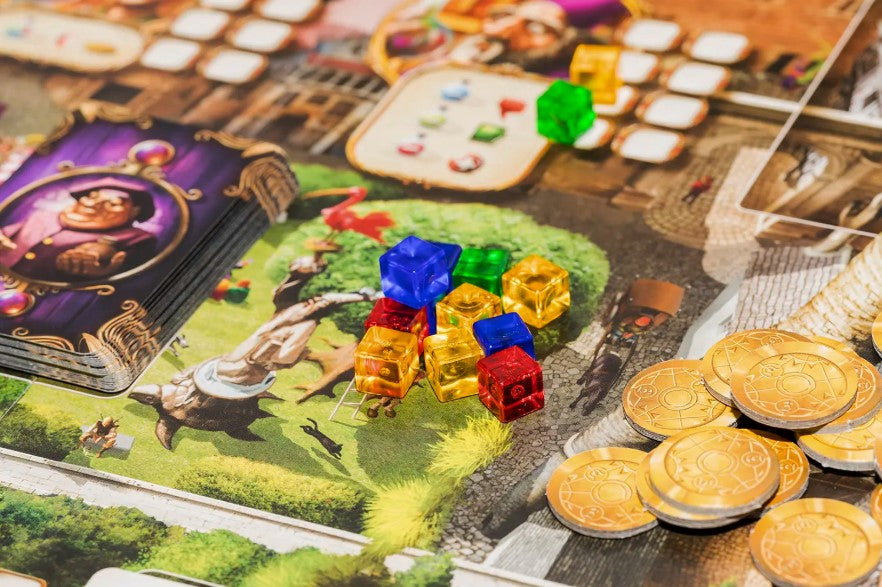
In turn, you place your cubes on the action spaces: test ingredient, sell potion, buy artifact, publish theory, refute another's theory, draw card. Limited spaces, direct competition.
Actions are resolved in a fixed order (not in turn order). First tests, then sales, then publications. If two players want the same single space, the first one to get there wins.
The round marker is advanced. Some artifacts give bonuses at the end of the round. If it's round 6, move to the final exhibition: last chance to publish or refute before the revelation.
Why it's different from others
Six mechanics that make a difference
App as a hidden master
The app is not a tutorial. It is the game system. It randomizes the eight formulas at the start of the game, manages tests, and never cheats. You mix ingredients, it tells you the result, you deduce. No tables, no human master. Works offline, zero lag, zero known bugs.
Deduction without elimination
It's not Sherlock Holmes. You don't have to guess THE solution. You have to understand enough to publish correct theories before others. You can win even knowing only 5 out of 8 ingredients, if others know less. Perfection is not needed, timing is.
Mechanically incentivized bluffing
Publishing a false theory gives you points immediately. Losing them at the end of the game is a future problem. If no one refutes, those points remain. Bluffing is profitable if others have no proof or don't want to waste actions. The game pushes you to take risks.
Asymmetrical artifacts
Nine different artifacts each game, drawn randomly from a larger deck. Each one breaks a rule: test for free, publish at a discount, sell at double price. Those who buy them change strategy. Those who don't must compete with fewer tools. They cost a lot, but they change the game.
Public vs. private information
Test results are private (only you see them in the app). Published theories are public (everyone sees them). Others can deduce from your behavior: if you publish a theory immediately, maybe you have solid proof. Or maybe you're bluffing. The table reads the table.
Punitive final scoring
It's not a game where "everyone wins a little". At the end of the game, the app reveals the formulas. Every wrong theory subtracts points. Every correct theory gives them to you. Those who bluffed too much collapse. Those who published little fall behind. Those who calibrated well win. The score can completely turn around in the last 30 seconds.
How it ends
How to win and how to lose
After six rounds there is a final exhibition (last chance to publish/refute), then everything is revealed. Reputation points + artifacts + grants - wrong theories = final score.
Victory
- You published correct theories in the middle rounds, gaining reputation before others
- You bought artifacts that gave you concrete advantages (extra actions, discounts, free tests)
- You refuted at least one other's theory, stealing points and slowing down a rival
Defeat
- You published false theories hoping no one would refute them, but someone did. You lost points and actions.
- You tested too much and published too little: others capitalized before you, even with less certainty.
- You ignored artifacts to save money, but those who had them performed three times as many actions in the last hour of play.
Alchemists is a game where the smartest doesn't always win. The one who knows when to stop being clever and start taking risks wins. And then laughs when others discover they've been bluffing for three rounds.
Frequently Asked Questions
FAQ about Alchemists
Is the app mandatory or can I play without it?
Mandatory. Alchemists does not work without the app. It randomizes formulas, manages tests, and tracks sold potions. It's available for iOS, Android, and Windows. Offline, free, zero in-app purchases. If you don't have a compatible smartphone/tablet, the game won't start.
Is it a family game or does it require experience?
Experience is needed. BGG weight 3.9, recommended age 12+, but 12-year-olds should be experienced players. The rules are clear, but logical deduction + resource management + bluffing + worker placement create a high cognitive load. It's not a gateway game. It's for those who have already played Agricola, Tzolk'in, and similar games.
How much does luck matter? Can a wrong test turn everything upside down?
Low luck. The only random element is the initial ingredient configuration (decided by the app). After that, zero dice, zero card drawing. Everything is deduction + choices. A "wrong" test doesn't exist: every test gives you true information. It's up to you to interpret it. If you lose, it's your fault, not the dice's.
What is the best number of players?
3-4 players. It works with 2 players but worker placement is less competitive (too many free spaces) and bluffing loses its edge (you know your only opponent too well). With 4, it's tense and vicious: every space is contested, every published theory is a risk. 3 is the sweet spot: competition without paralysis.
Is it available in Italian?
Yes. This is the Cranio Creations edition with rules, cards, tokens, and board entirely in Italian. The app is multilingual (you can set it to Italian). Localized texts, no language issues.
Alchemists is a competitive board game for 2-4 players, ages 12+, duration 120 minutes, designed by Matúš Kotry and published by Czech Games Edition (Italian edition by Cranio Creations). It combines eurogame worker placement and logical deduction with a mandatory app (iOS/Android/Windows). Each game, eight ingredients are randomized: players test combinations, publish theories (even false ones) to gain reputation, refute others' theories, and buy magical artifacts. Mechanics: worker placement, deduction, bluffing, resource management, variable turn order. BGG weight 3.9, advanced strategy category. The game rewards those who can balance certainty and risk: publishing too early risks refutations, publishing too late leaves points to others. At the end of the game, the app reveals the true formulas and those who bluffed lose points. High-quality components, player screen included, 96 standard size cards. Available on FroGames.it with immediate shipping.
Alchemists
Frequently Asked Questions
The answers you're looking for, no beating around the bush.
📸Do the images match the actual product?
The photos on the website often come from BoardGameGeek and are intended to give you an idea of the game. They may vary slightly from the version you receive. The content declared by the publisher is always binding.
📦Does the content of the box match what is indicated?
We always strive to provide the correct content, but minor variations are possible due to reprints or updates. The information comes directly from the publishers. If you have any questions, please contact us!
⏳How do pre-orders work?
Pre-order the game before release, payment is immediate, and the game is reserved for you. As soon as it arrives, we'll ship it right away! If there are any delays, we'll update you promptly.
🔒Can I trust buying here?
Absolutely! Secure payments, tracked shipments, and a team that loves board games as much as you do. If something goes wrong, we'll do our best to fix it.
🛠There's a problem with my order, what should I do?
Write to us now! Whether it's a missing part, damage, or an error, we'll help you resolve it as soon as possible. Your experience truly matters to us.