
Tile drafting · 1-4 players · English edition
Night at the Zoo
The animals sneaked out of the zoo at night, and now they must get back before the keepers notice. You draft terrain tiles and build the paths home on your board. But every animal walks its own way: the penguin slides, the snake can’t turn, the sloth falls asleep.
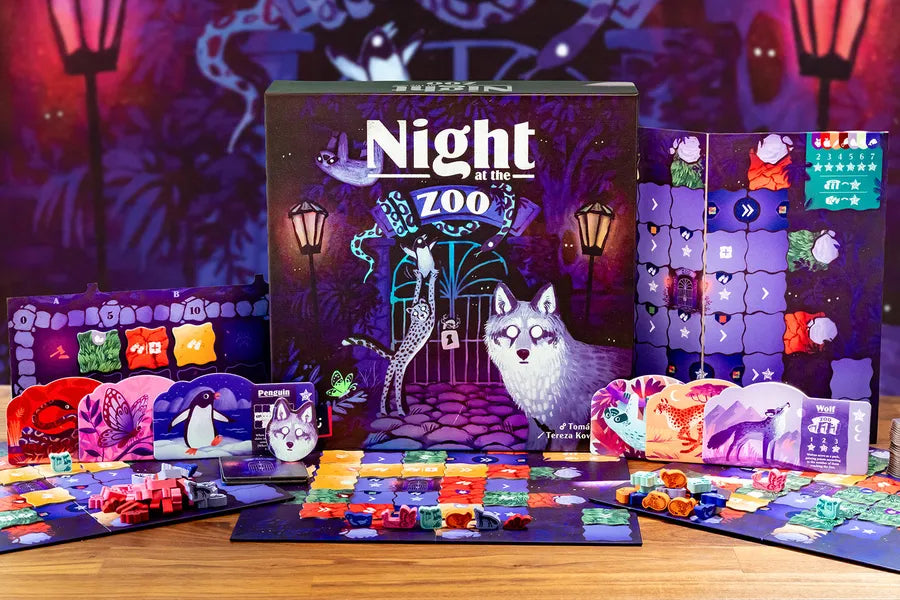
11:40 pm — Round check. The penguin was on the gate. The cheetah was giving it a boost.
Leo’s night log, keeperYou build the road.Each animal walks it its own way.
A path that is perfect for the wolf can be useless for the penguin, which only slides in straight lines. In every game three animals out of six (or ten, with Latecomers) escape, and each one is a different puzzle.
Three rounds, five drafts each.
Draft
In turn, everyone takes one tile from a shared market. The tile nobody takes slides into the Leftover zone below.
Place, store or discard
Everyone at once: place it on your 5×5 Neighborhood and resolve its action, keep it in the Warehouse (2 max), or discard it so all your animals on that terrain move.
Bring them home
Animals walk only on tiles you have placed, towards the Zoo in the middle. Once home they leave the board and wait for scoring.
End of round
The most common terrain among the leftover tiles gives one movement to every animal standing on it, for all players.
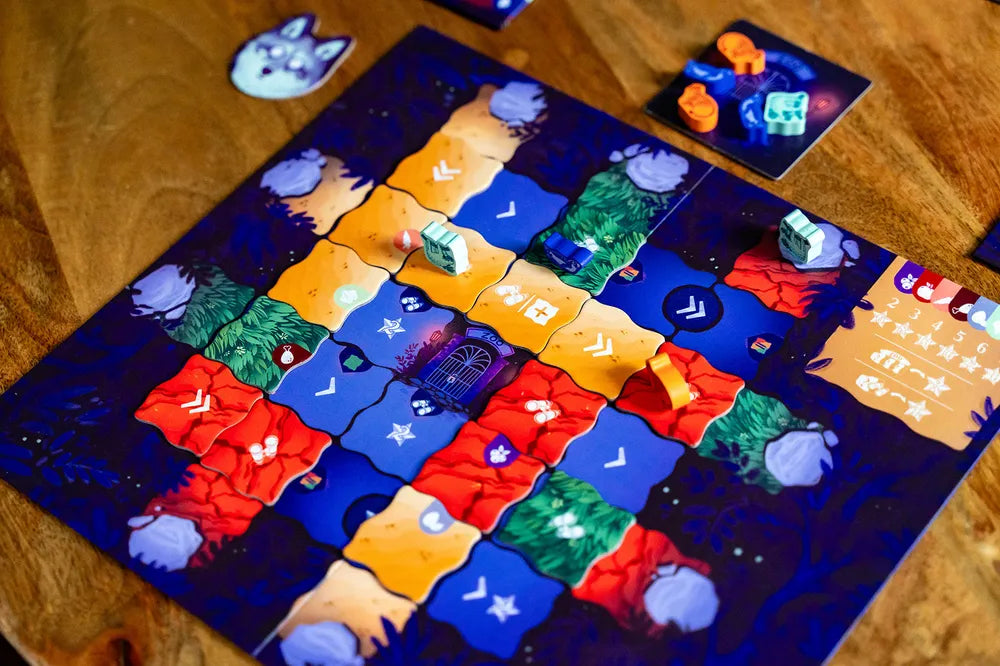
A half-hour puzzle you play side by side.
Everyone builds on their own board: nobody can ruin your work. The only contact is the shared market, and the leftovers that move everyone’s animals.
Spatial puzzle lovers
Every tile is road and action at once, and each animal needs a different shape of road.
Couples, families, groups of 3-4
Thirty minutes, simultaneous turns, no attacks: it works from age 10 and doesn’t drag with more players.
Solo players
Leo the keeper takes tiles from the market like a second player, and a table rates your night.
Light rules, real choices: one tile, used for one thing only.
The game in seven answers.
Tile drafting, tile placement on your own board, animals with their own movement patterns.
Few rules, but every tile asks: road, action or movement?
The three animals and your starting layout are random, but you see the market before choosing.
You take the tile someone else wanted, and what you leave behind can move their animals at the end of the round.
A different trio every game; Latecomers adds 4 animals to the pile.
The animals ↓Turns are simultaneous after the draft, so it stays short with four.
Solo ↓The only text in play is on the animal tiles: a few lines each, read once. Tiles and boards use symbols.
A straight line helps the penguin, a short path helps the wolf: you rarely build for everyone.
The last draft of the round.
Goal: bring as many animals as you can into the Zoo with one tile from the market and the Grass tile in your Warehouse.
What you see: the market, your board (the Zoo in the middle, an entrance on the left) with the Penguin, the Cheetah and the Sloth, and your Warehouse. Tap a tile, then where it goes; tap an animal, then where it moves.
Rules from the official English rulebook. The position is ours: a simplified board (no symbols printed on the spaces, one entrance drawn), one figure per animal, and food symbols are not counted.
1:15 am — The sloth is asleep in the middle of the path. It has been taking all night.
Leo’s night log, keeperWho escapes tonight?
At setup three Animal tiles are drawn at random, and their moons (the difficulty) must add up to at least 6. Each player gets three figures of each. Every tile says how that animal moves and what it scores at the Zoo.
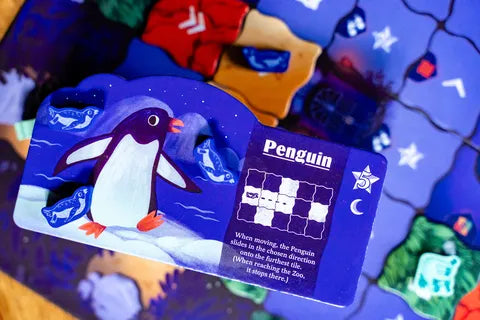
Penguin 5 pts each
Each movement it picks a direction and slides as far as it can in a straight line. It stops as soon as it reaches the Zoo.
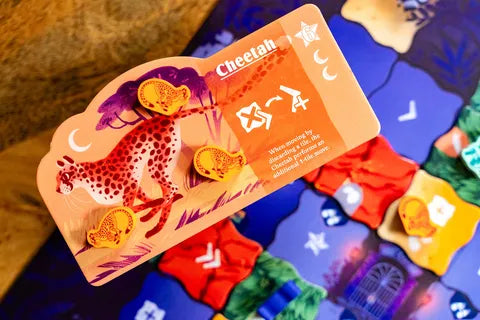
Cheetah 6 pts each
When you discard a tile for a special move, it moves one extra space.
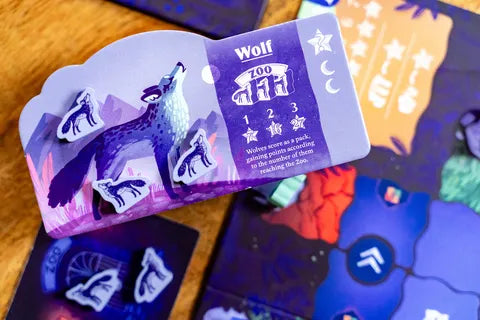
Wolf 7 · 16 · 27
Moves normally, but scores as a pack: 7 points for one Wolf at the Zoo, 16 for two, 27 for three.
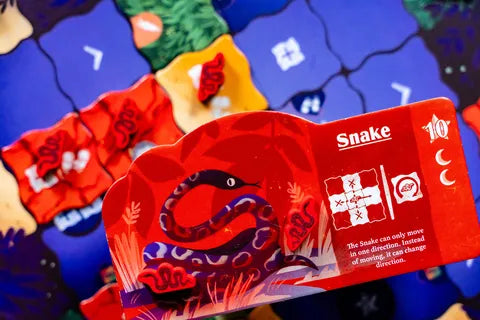
Snake 10 pts each
Each movement: one step forward in the direction it faces, or turn to face another way. It starts facing the Neighborhood.
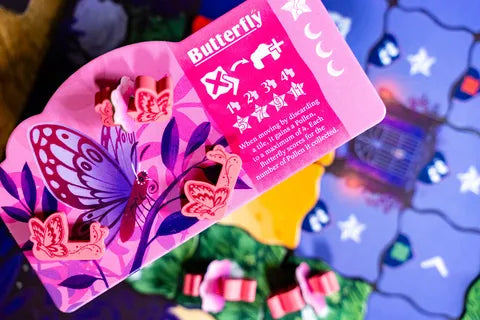
Butterfly 0 · 5 · 7 · 9 · 11
Each time it moves in a special move it collects a Pollen (4 max). At the Zoo it scores by its Pollen: 0, 5, 7, 9 or 11.
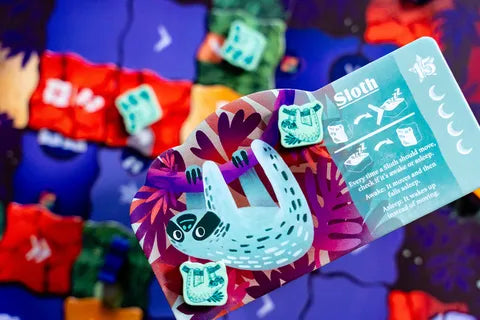
Sloth 15 pts each
Awake: one step, then it falls asleep. Asleep: the movement only wakes it up. The most valuable, and the slowest.
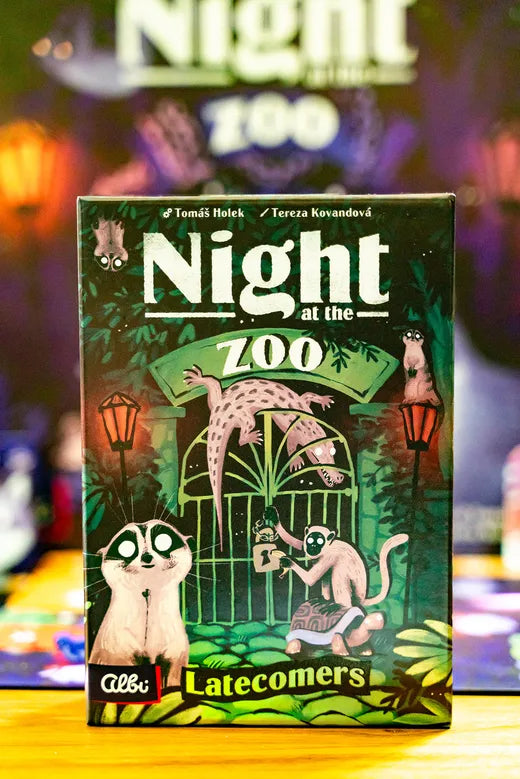
Night at the Zoo: Latecomers
Four new enclosures, four latecomers who joined the escape. The expansion changes no rules: at setup you add the 4 new Animal tiles to the pile, and the trio is still drawn at random with at least 6 moons.
- 4 Animal tiles and 12 figures
- 12 Monkey movement tokens
- Movements that are harder to plan
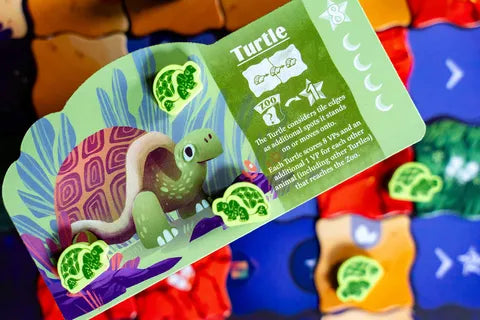
Turtle 8 + 1 per animal
It needs 2 movements per space: halfway it sits on the edge between two tiles and counts as being on both. At the Zoo: 8 points, plus 1 for every other animal at your Zoo.
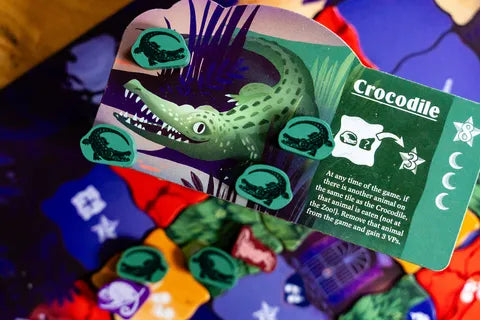
Crocodile 8 pts each
Any other animal on its tile gets eaten (not at the Zoo): the figure leaves the game and you score 3 points at once. It doesn’t eat other Crocodiles. Mind your path.
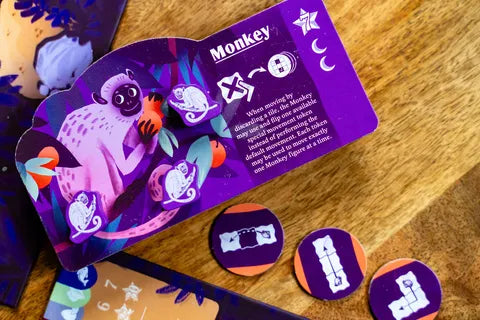
Monkey 7 pts each
In a special move it can use one of 3 movement tokens (shapes you may rotate or mirror) instead of a normal step. Tokens refresh once all are used.
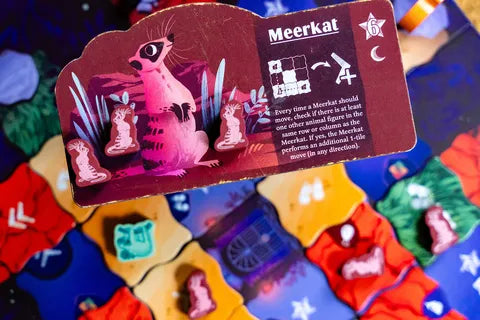
Meerkat 6 pts each
Before moving it looks around: if another animal is in the same row or column, it makes one extra step in any direction.
Latecomers only adds animals: turns, tiles and scoring stay those of the base game.
The new tiles go into the pile: you don’t pick the animals, you draw them, with at least 6 moons in total.
Boards, tiles and the other animals are in the Night at the Zoo box.
With the base game alone you already have 6 animals; Latecomers is for those who know them well and want harder trios.
3:05 am — Four new enclosures, four latecomers. One of them is a crocodile. Counting the penguins again.
Leo’s night log, keeperSolo: you against Leo the keeper.
The official solo mode is in the rulebook and uses 6 Solo tiles from the box. Leo has no board: he only takes tiles from the market, like a second player.
How Leo plays
Each draft you reveal a Solo tile: Leo takes the market tile in position 1 (or 2 if it’s empty) and removes it from the game. The first player token alternates between you and him.
A market of three
As in a two-player game: Leo takes one, you take one, the third goes to the leftovers and still counts for the end-of-round movement.
Rate your night
You score as usual and compare with a five-level table.
See it on the table.
«How to Play Night at the Zoo», the official video by ALBI, the original publisher. In English.
Is it for you?
You will like it if
- you like building on your own board and seeing a plan work
- you want a short game that works from 1 to 4
- you enjoy each game having different rules for the pieces
- you also play solo
Maybe not if
- you want to interfere with the others: interaction is only through the market
- you need a game fully in Italian: the animal tiles are in English
- random setups bother you: the trio and your starting layout are drawn
The frog’s advice
Look at the leftovers: the tile you don’t take can move everyone’s animals at the end of the round, yours included. And start the slow ones early.
What people ask before buying
What is Night at the Zoo?
A tile drafting and placement game for 1-4 players by Tomáš Holek, illustrated by Tereza Kovandová, published by Albi and in English by Capstone Games. Ages 10 and up, about 30 minutes. You build paths on your own board to bring escaped animals back to the Zoo.
How does a turn work?
Three rounds of five drafts. In each draft everyone takes a tile from the shared market, then at the same time places it on their Neighborhood and resolves its action, stores it in the Warehouse (2 max) or discards it so all their animals on that terrain move. The leftover tile goes to the Leftover zone.
How do you score?
Each animal at your Zoo scores what its tile says (Penguin 5, Cheetah 6, Snake 10, Sloth 15, Wolves and Butterflies on a scale). Discovered animals still outside score 1 each. Plus a set of different food symbols on your placed tiles: from 6 points for two kinds to 30 for seven.
What does Latecomers add?
Four new animals, Turtle, Crocodile, Monkey and Meerkat, with 12 figures and 12 Monkey movement tokens. It changes no rules: their tiles go into the pile the trio is drawn from.
Do I need the expansion?
No. The base game has six animals and every game uses three of them. Latecomers is for those who want harder trios.
Can you play it solo?
Yes, the rulebook has an official solo mode against Leo the keeper, who takes tiles from the market using 6 Solo tiles. At the end a table rates your score.
Is it in Italian?
No, this is the English edition by Capstone Games. The text in play is only on the animal tiles; the other components use symbols.
Is there a lot of luck?
The three animals and your starting layout are random, and so is the stack the market is refilled from. But you always see the market before choosing.
How long does it take with four?
About 30 minutes: after the draft everyone plays at the same time.
What is in the box?
A game board, 4 player boards, 6 Animal tiles with 72 figures, 75 Action tiles, 42 Bonus tiles, 9 Setup tiles, 6 Solo tiles, 48 Pollen tokens, score trackers and multipliers, and the first player token.


