
Cute faces, ruthless jumps
Jump Masters!
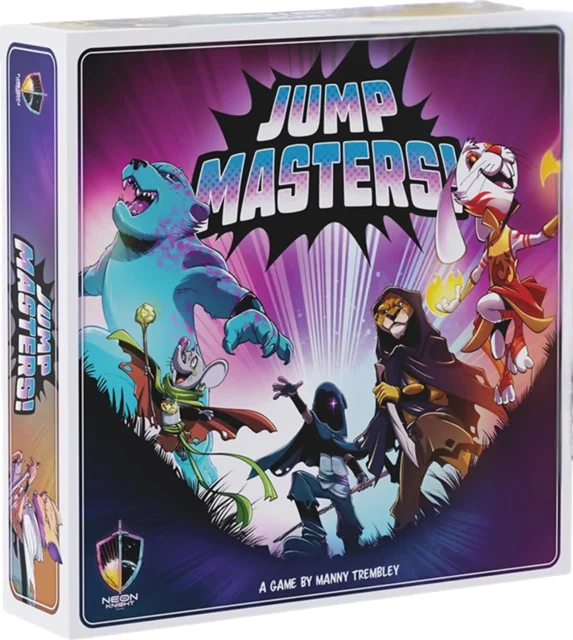
A team battle on a board of nodes, like Chinese checkers with claws. Your heroes are dice: jump your allies to charge up, jump your opponents to knock them out. First to 20 points wins.
Jump a friend: charge up.Jump an enemy: fight.
And you can chain jumps in the same turn: two allies to get stronger, then the attack. The whole game is deciding when to stop.
Four heroes, one action.
The die is the hero
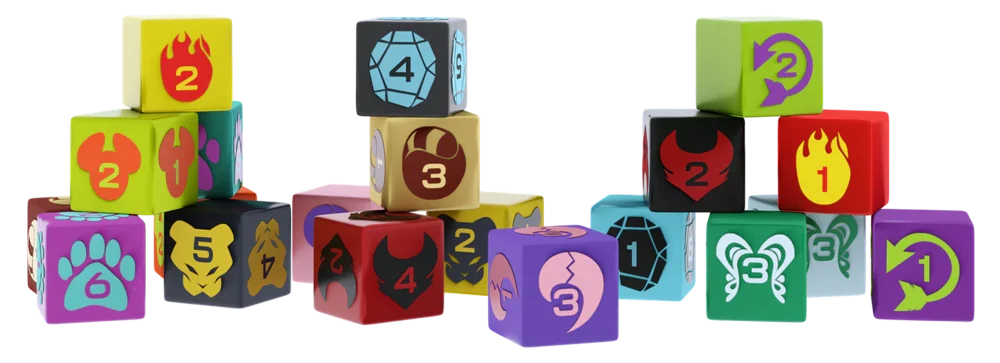
The face showing is its current energy; the highest face is its maximum, and that is how many points it is worth when defeated. Each hero also has a special ability on its card.
One action per turn
With one hero: step one node, run two, or jump. Jumps go in a straight line over an adjacent hero to the empty node beyond.
Attack = countdown
Both heroes lose 1 energy at a time until one or both reach 0. A 5 against a 2 ends with a 3 standing.
The Hill
The four central nodes. At the start of your turn, if you control them you score 1 point: with an opponent there too, the higher total energy wins.
A jump sequence.
Goal: score as many points as you can this turn without losing the hero who jumps. In the real game the first to 20 points wins.
What you see: a 5×5 corner of the arena. Blue dice are your heroes, red ones your opponent’s; the big number is current energy, «max» the maximum. Tap one of your dice: lit nodes show where it can go (⤴ jump, • step, » run).
blue = yoursred = opponent⤴ jump• step» run
Rules and the attack «Pinkbeary 5 against Katula 2» are from the rulebook; maximum energies are printed on the hero cards. The position of the dice is ours, on a corner of the arena without terrain or deployment zones, and special abilities are left out to keep the rules bare.
Ten heroes, four arenas.
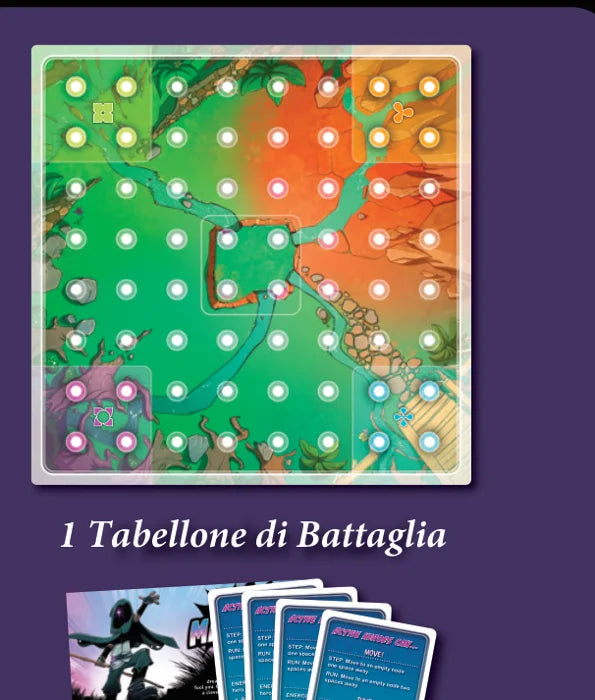
20 hero cards and 20 hero dice (two copies of each of the 10 heroes, so both players can field the same team), the skirmish board, 8 terrain pieces, a victory point track with 4 tokens, 4 player aid cards.
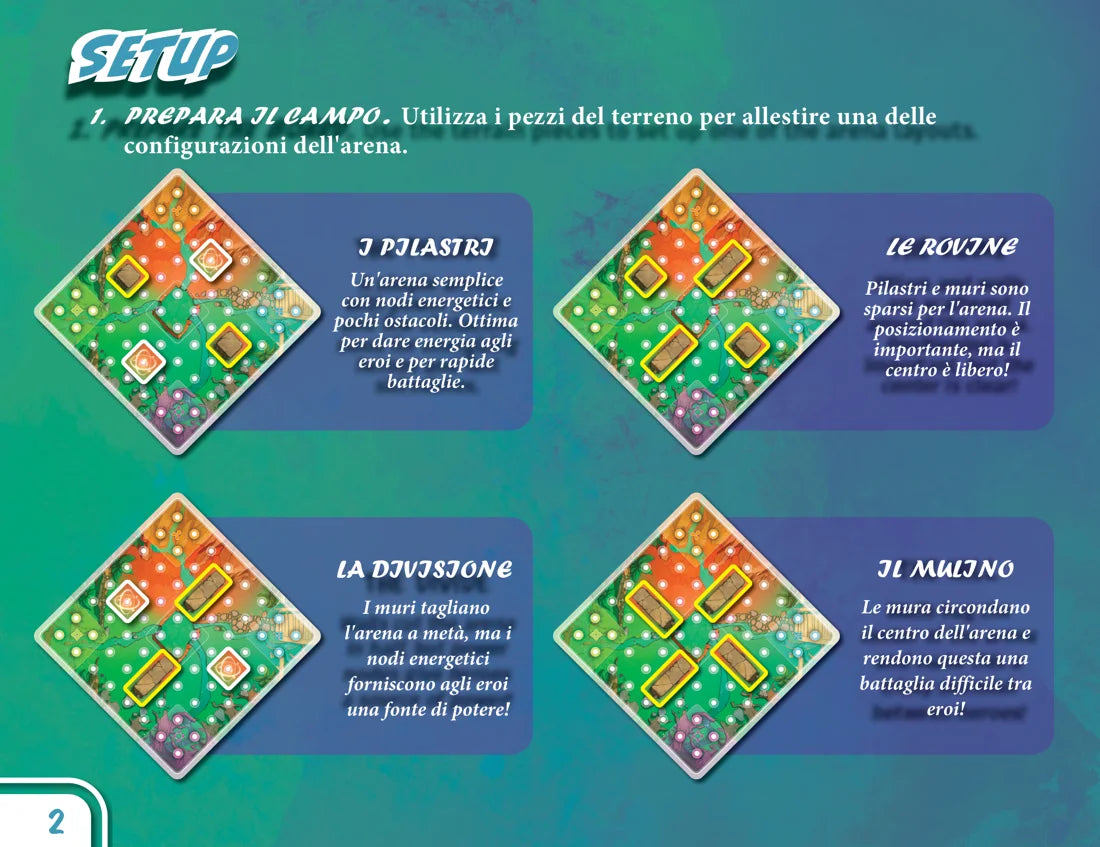
Terrain builds four arenas: The Pillars, The Ruins, The Divide and The Mill. Pillars and walls block movement and straight lines; energy nodes give +1 to whoever steps, runs or jumps onto them.
A real card, as printed: «When attacking, Pinkbeary can jump over 1 or 2 spaces». Maximum energy 6.
The game in seven answers.
Abstract, light (1.7 on BGG), with heroes that each have a power.
Also 2 against 2 (30 points) or 3-4 free-for-all, which the rulebook calls chaos. No solo mode.
Nothing is drawn or rolled: everything is on the board, visible to both.
Every attack takes points from someone; you also fight over the central Hill.
Four heroes each from ten, with three optional draft variants.
Only the hero ability is written; everything else is numbers on dice.
Never. They are counters: you turn them by hand when a hero gains or loses energy.
Points, zones and the Hill.
Who scores
If you defeat an opponent you score its maximum energy. If your attacker falls, your opponent scores its maximum. If both fall, only your opponent scores.
Deployment zones
Safe corners: heroes there cannot be attacked or targeted, and defeated heroes come back there at their lowest value. You can energize over a hero there only on your first jump.
Abilities
Once per turn, optional, only if the full effect can be resolved, and never bringing your own hero to 0. Some steal energy, some deal damage at a distance, Pinkbeary jumps two spaces when attacking.
First game: the Pillars arena and the «Starters» team for both players (Burnny, Hopper, Pinkbeary, Torturn), as the rulebook suggests.
See it on the table.
The official how-to-play by Chip Theory Games, in English.
Is it for you?
You will like it if
- you look for a quick, mean game for two
- you like games without luck, where everything is on the board
- you enjoy those turns where three jumps in a row turn the game around
- the rules must fit on one card
Maybe not if
- you usually play in three or four: it shines in two
- you don’t like losing pieces to an opponent’s move
- you want a game with a story or a campaign
The frog’s advice
Before every attack, count: if your energy is not higher than your target’s, both fall and only your opponent scores. Charge up on your allies first, then strike.
What people ask before buying
What is Jump Masters!?
A light team battle game for 2 to 4 players by Manny Trembley and Jeff Jacobson, illustrated by Manny Trembley, from Chip Theory Games’ Neon Knight Games line. Each player drafts four heroes, represented by dice, and moves and jumps them on a board of nodes. First to 20 victory points wins.
How does a turn work?
At the start of your turn you score 1 point if you control the Hill, the four central nodes. Then you take one action with one hero: a step to an adjacent node, a run two nodes away, or a jump sequence. Finally defeated heroes are redeployed.
How do jumps work?
A hero jumps in a straight line over an adjacent hero to the empty node beyond. Over a friendly hero it energizes, gaining 1 energy; over an opponent it attacks. Jumps can be chained in the same turn, but each hero can be jumped only once per sequence.
How does an attack work?
Both heroes lose 1 energy at a time until one or both reach 0. For example Pinkbeary with 5 attacking Katula with 2 ends at 3, and Katula is defeated. The winner’s player scores the defeated hero’s maximum energy; if both fall, only the opponent scores.
Are the dice rolled?
No. The dice show each hero’s energy and are turned by hand; the highest face is the hero’s maximum energy and its value in points.
How many players?
2 to 4, best with 2. In 2 against 2 the first team to 30 points wins; in 3-4 player free-for-all the target stays 20. The rulebook says the game is most balanced one against one and two against two. There is no solo mode.
How much luck is there?
None: nothing is drawn or rolled, and all information is on the board.
How much English is there?
Each hero card has one special ability written in English, a single sentence. The rest of the game is numbers and positions.
What is in the box?
20 hero cards, 20 hero dice, 1 skirmish board, 8 terrain pieces, 1 victory point track with 4 tokens, 4 player aid cards and the rulebook.


