
Outlandish
🐸 Dettagli da BoardGameGeek
Consiglio BGG sul numero di giocatori
Categorie
Meccaniche
Design & Art
Lingua
Si abbina bene con
The FroGames Sheet
You answer a question. Others laugh, someone shakes their head, one person says you're crazy. Then comes the Dumpster Fire Award. And you proudly accept it.
WHAT IT'S ABOUT
Absurd questions and even more absurd awards
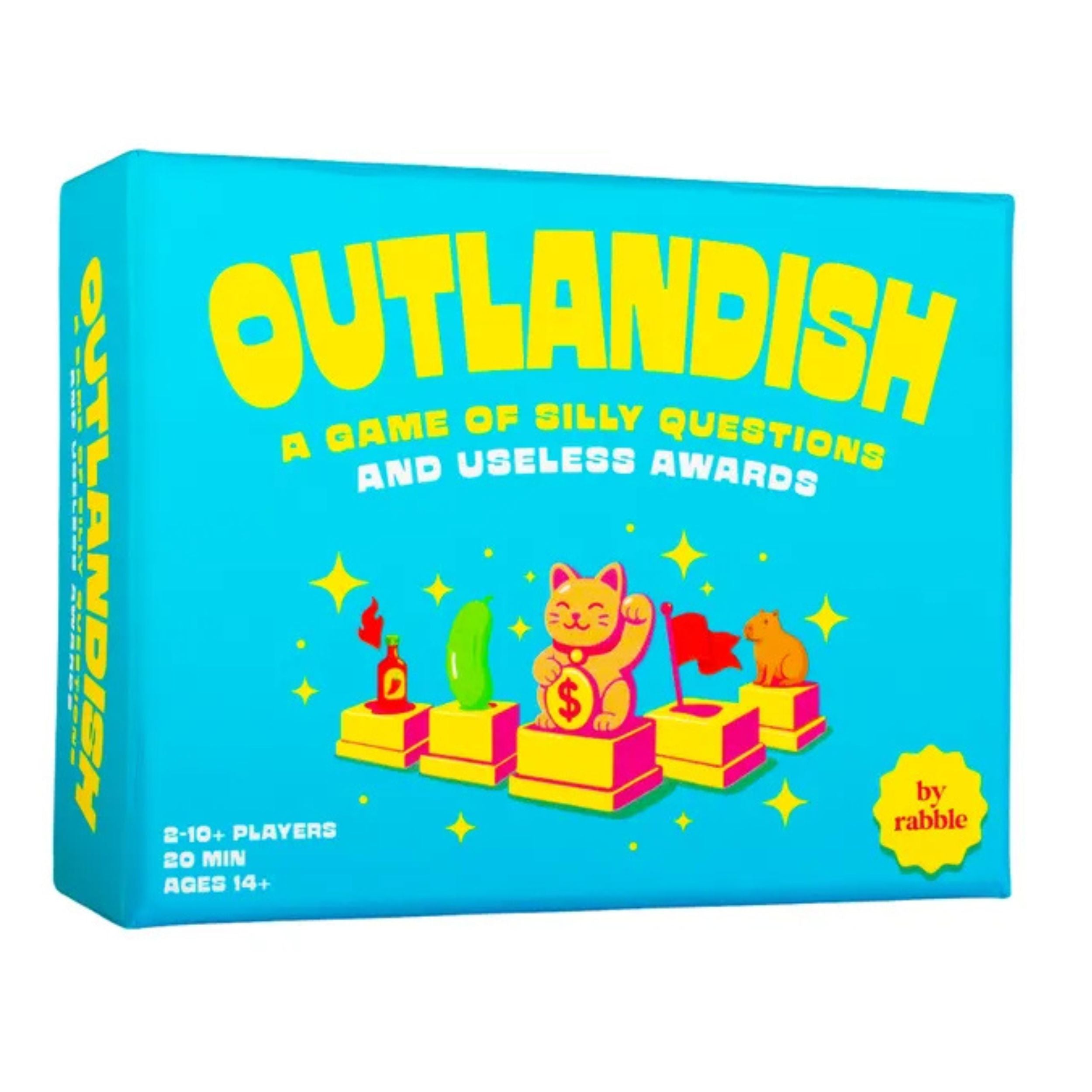
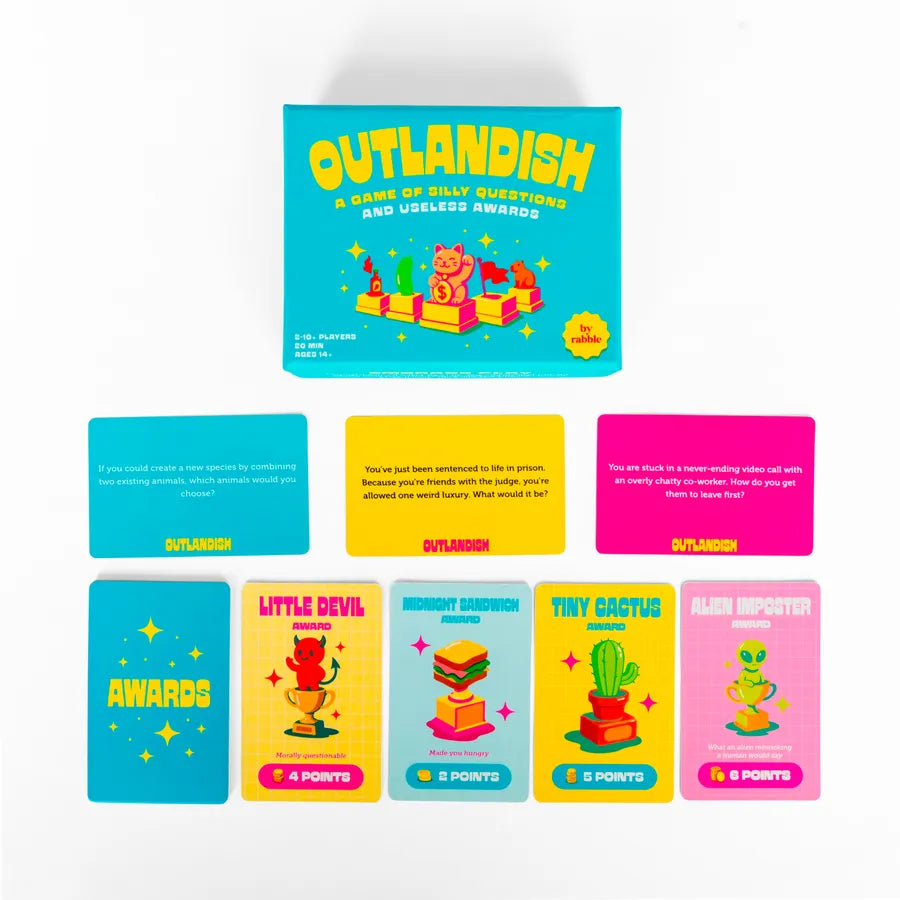
Outlandish is a conversational party game designed by George Li and published by Rabble, an American company specializing in light games for groups. It is set to be released in October 2025 with 150 question cards and 75 illustrated award cards. The goal is simple: answer wacky hypothetical questions, listen to others' answers, and vote for who deserves the most bizarre awards of the evening.
Around the table, players take turns drawing questions like: what superpower would you want if it only worked in the dark? Would you turn into a human lie detector, knowing you could never lie again? The other players listen, discuss, and give out awards like the Lucky Cat Award or the Dumpster Fire Award. Whoever accumulates the most points wins, but the real victory is the chaos and laughter generated along the way.
What they say abroad
"Outlandish is an absurd conversation game of silly questions and useless awards."
— Rabble
First impression of Outlandish: promises surreal conversations and ridiculous awards. It's a game that thrives on the people at the table, not the mechanics. This sheet will be updated with the first international reviews.
— FroGames

Outlandish
FrogScore · FroGames editorial rating · first impression: based on rulebook and official presentation, updated with first playsWhat's in the box
150 questions and 75 bizarre awards
Question Cards
150 wacky hypothetical questions, printed front and back on 75 cards. Each question is a pretext for table discussion: superheroes, lies, homemade Olympic sports.
Award Cards
75 illustrated awards to be given to the player who gave the strangest, wisest, or bravest answer. Each award is worth different points, but the true value is in the embarrassment.
Illustrations
Each award card has a unique illustration. Rabble collaborates with different artists to give personality to the Lucky Cat Award, Dumpster Fire Award, and co.
Rulebook
A sheet explaining setup, turn order, and scoring system. Nothing complex: it only serves to understand how to assign awards and count points at the end of the game.
🎲How to playThe rules in four steps▼
How to play
The flow of each round
Each turn is identical: question, answer, debate, awards. The variation comes from the people.
The active player draws a question card from the deck and reads it aloud. The questions are hypothetical and open-ended: there's no right answer, only interesting ones.
The player answers however they like: seriously, absurdly, provocatively. Others listen and can comment, discuss, or challenge. The debate is the heart of the game.
Other players choose which awards to give for that answer: the Lucky Cat Award for the clever one, the Dumpster Fire Award for the disastrous one, and so on. Each award has a point value.
Play passes to the next player. The question deck rotates, awards accumulate. The game continues until the deck runs out or the group decides to stop. The player with the most points wins.
⏱️Your first gameThe chronicle, moment by moment▼
A game in five moments
What happens at the table
Not the rules. The experience.
The first round is a test
Someone draws the first question and reads it aloud. There's a moment of silence, then someone laughs, someone raises an eyebrow. The player answers with a half-joke, the table nods. You still don't know where you're going.
Answers get serious (or absurd)
After two or three questions, someone answers with conviction. Someone else counters. A debate arises about which superpower would only be truly useful in the dark. Award cards start to circulate: the Dumpster Fire Award goes to the most ridiculous, the Lucky Cat to the cleverest.
The table divides
A question divides the group. Two opposing factions form, and the debate becomes passionate. Other players bring out awards they hadn't seen yet: there's one for the wisest, one for the bravest. Points start to climb.
The legendary answer
Someone answers a question with a phrase that leaves everyone silent for three seconds. Then the table erupts. That answer will win three awards in one go, and become the meme of the evening. No one will forget it.
Game over, point count
Points from won awards are counted. Someone wins, but no one really cares: the winner is the one with the collection of the most embarrassing awards. The table reviews the most absurd answers of the evening, laughing again.
🐸Know before you playThree honest things, as friends▼
Know before you play
Three honest warnings
Depends on the group
Outlandish is an excuse to get people talking. If the group isn't willing to discuss absurd hypothetical questions, the game won't take off. It works best with already close friends or strangers willing to get involved. With shy or reserved people, it risks dying in 10 minutes.
Limited replayability with the same faces
150 questions are enough for many games, but with the same group, answers repeat. After three or four evenings, someone will start remembering what others answered last time. The game thrives on spontaneity: when it loses that, it becomes mechanical.
No deep structure
The scoring system is almost an appendix: the awards are fun, but counting points at the end of the game can feel forced. The real game is the conversation, not the competition. If you're looking for intricate mechanics or tactical decisions, this isn't the place.
🏆Victory and defeatWhat the ending rewards▼
How it ends
How to win
The game ends when the group decides to stop, or when the question deck runs out. Points from won awards are counted.
Victory
- Accumulate the most points from awards received during the game.
- Awards have different values: some are worth more points, others less.
- The winner is the one who convinced other players that their answers were the strangest, wisest, or bravest.
Defeat (or almost)
- There are no eliminations: everyone plays until the end.
- You lose if you accumulate few awards, or if no one votes for you.
- The real defeat is remaining silent: those who don't participate in the debate don't win awards and don't have fun.
Outlandish is not a game of mechanics: it's an excuse to bring out the personalities at the table. If it works, you take home stories. If it doesn't, you've discovered that your group prefers something else.
💬Frequently Asked QuestionsQuick answers before checkout▼
Frequently Asked Questions
Outlandish FAQ
What mechanics does Outlandish use?
No traditional board game mechanics. It's a conversation game based on open-ended hypothetical questions and social voting to assign awards. The structure is minimal: draw, answer, discuss, vote.
Does it work with fewer than 4 players?
Yes, the game starts with 2 players, but the best experience is with 4-8. With only 2 people, it loses variety in debates and awards. With 10+ it becomes chaotic but can work if the group is close-knit and someone moderates.
How long do games really last?
The box says 15 minutes, but it depends on the group. If the table gets into passionate debates over every question, a game can last 30-40 minutes. If you draw 10 questions and vote quickly, you're done in fifteen minutes. There's no timer: it ends when you want it to.
Is it a game for families or adults?
The recommended age is 14+. The questions are not explicit or vulgar, but require a minimum level of maturity to appreciate the hypothetical nuances. It works well with teenagers and adults, less so with young children who seek more concrete or structured answers.
Is it available in Italian?
No, the edition for sale is in English. The questions are written in English and require a good understanding of the language to grasp the nuances. Currently, there are no verifiable official or fan-made Italian translations.
The people behind the game
Who invented it, who designed it, who publishes it — and what else they've done.
Outlandish is a conversational party game for 2-20 players, ages 14+, lasting 15 minutes, designed by George Li and published by Rabble in 2025. The game includes 150 outlandish hypothetical questions and 75 illustrated awards to be given for the strangest, wisest, or bravest answers. The mechanic is simple: each turn a player draws a question, answers, and others vote on which awards it deserves. There are no eliminations, but points accumulate: the winner is whoever convinces the table that their answers are the most memorable. Outlandish thrives on debate and the personalities at the table, not intricate mechanics. Available on FroGames.it.
Outlandish
Frequently Asked Questions
The answers you're looking for, no beating around the bush.
📸Do the images match the actual product?
The photos on the website often come from BoardGameGeek and are intended to give you an idea of the game. They may vary slightly from the version you receive. The content declared by the publisher is always binding.
📦Does the content of the box match what is indicated?
We always strive to provide the correct content, but minor variations are possible due to reprints or updates. The information comes directly from the publishers. If you have any questions, please contact us!
⏳How do pre-orders work?
Pre-order the game before release, payment is immediate, and the game is reserved for you. As soon as it arrives, we'll ship it right away! If there are any delays, we'll update you promptly.
🔒Can I trust buying here?
Absolutely! Secure payments, tracked shipments, and a team that loves board games as much as you do. If something goes wrong, we'll do our best to fix it.
🛠There's a problem with my order, what should I do?
Write to us now! Whether it's a missing part, damage, or an error, we'll help you resolve it as soon as possible. Your experience truly matters to us.