
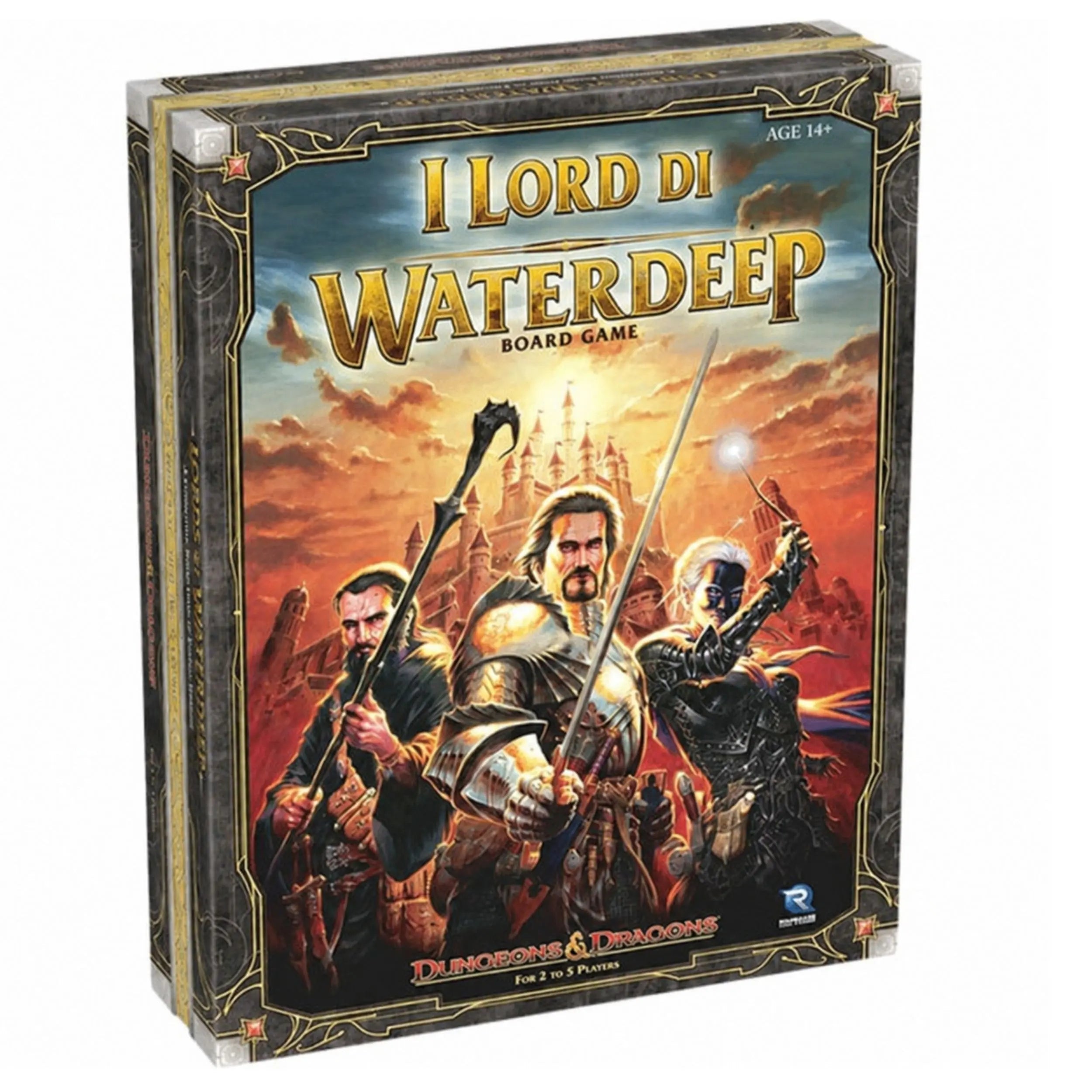
I Lord di Waterdeep
🐸 Details from BoardGameGeek
Consiglio BGG sul numero di giocatori
Categorie
Meccaniche
Design & Art
Lingua
Si abbina bene con
FroGames — Moments You'll Remember
Every move feels like a favor. Every building a concession. And when it ends, someone has won by controlling a city they thought they governed together with others.
WHAT IT'S ABOUT
Politics, intrigue, and adventurers in the heart of the Forgotten Realms
Waterdeep is the City of Splendors, the most luminous jewel of the Forgotten Realms. Behind its golden facade, however, the city's true masters do not sit on the throne: they hide behind masks, manipulate from the shadows, control guilds and taverns. Peter Lee and Rodney Thompson brought this intrigue to the table in 2012 with Lords of Waterdeep, an eurogame that wears D&D fantasy clothes but plays like clockwork.
You are one of the Masked Lords who secretly rule Waterdeep. Each turn you send your agents into the city: you recruit adventurers, construct buildings, complete quests, and play intrigue cards to hinder other Lords. You gather fighters, wizards, clerics, and rogues, combining them to complete quests that earn you points and resources. Each Lord has secret objectives that reward different strategies: control politics, expand trade, dominate magic. After eight rounds, whoever has accumulated the most influence—and built the most solid hidden empire—wins.
What they say abroad
"Lords of Waterdeep remains one of the cleanest introductions to worker placement."
Lords of Waterdeep remains one of the cleanest introductions to worker placement.
— Shut Up & Sit Down
It's an eurogame that feels like D&D without asking you to be a role-player. It works for those who know the Forgotten Realms and for those who have never heard of them.
— FroGames

Lords of Waterdeep
FrogScore · FroGames editorial rating · based on rules, international reviews, and play sessionsYour secret resources
Adventurers, buildings, and intrigue: the tools of power
Adventurers
Warriors, wizards, clerics, and rogues: you recruit them from taverns and send them on quests. Each type is needed for different quests, some Lords reward them more than others.
Buildings
Construct inns, guilds, magic towers that become new spaces on the board. Whoever uses them pays you a commission: a passive resource flow that grows round after round.
Quests
Cards that require combinations of adventurers. You complete them for victory points, gold, and rewards. Some are mandatory, others you choose: read them carefully, they reveal your strategy.
Intrigue Cards
Play them to change the rules, steal resources, block others. They are the most direct way to mess up others' plans without raising your voice.
Recommended sleeves 121 cards in 1 size ▼
If you play often, we recommend protecting your cards with clear sleeves to make them last longer.
| Size | Quantity |
|---|---|
| 64 × 89 mm | 121 |
| Total cards | 121 |
In the end, someone controls Waterdeep. The others thought they were playing the same game. It always happens when the Lords sit at the table.
A game in five acts
What happens at the table
Not the rules. The experience.
Secret Identity
Draw your masked Lord and read their secret quest. No one knows which strategy will reward you: commerce, warfare, magic, politics. For now, you are just one of five players. But your choices are already starting to shape your plan.
The City Fills Up
The first turns are cautious: everyone recruits adventurers, completes easy quests, places buildings. Then someone builds a tavern that offers bonus warriors, and everyone starts using it. Others' buildings become part of your strategy — and you pay for the privilege.
Spaces Get Blocked
Mid-game, agents are scarce and good spaces are already taken. Someone plays an intrigue card that takes away a key adventurer from you. Someone else builds exactly the building you needed, before you do. Moves start to get tight, each turn is a negotiation between what you want and what you can do.
The Final Blow
Someone completes a 25-point quest that no one saw coming. Or builds the perfect building that others will use for three rounds, filling it with gold. Or plays three intrigue cards in a row and dismantles two opponents' strategies. It's the turn everyone remembers at the end.
The Masks Fall
Eight rounds over, everyone reveals their masked Lords and tallies secret points. Someone had prerequisites for arcane quests and completed seven. Someone else seemed behind but owned half the buildings on the board. The one who calculated best wins — and the one who best hid their plan.
How to play
The flow of each round
A round is a series of quick turns: you place an agent, take what the space offers, and pass to the next player. When everyone has run out of agents, the round ends.
Choose one of your agents and place it on a free space on the board (or on a building constructed by players). Each space can only host one agent per round.
Take the adventurers, gold, or cards that the space offers. If you use someone else's building, the owner receives a commission (usually an adventurer or some coins).
If you have the adventurers required by one of your quests, you can complete it: return the adventurers to the supply and take victory points, rewards, and sometimes intrigue cards.
The next player places one of their agents. When everyone has placed all their agents, the round ends: you retrieve your agents, reveal new quests, and the first player changes. After eight rounds, the game ends.
Why it's different from others
Six mechanics that make a difference
Secret Masked Lords
Everyone has hidden objectives that reward different strategies: quests of a certain type, specific buildings, resource control. You don't know what others are pursuing until the final tally. Asymmetry is invisible until the last turn.
Player-built buildings
Spend resources to build inns, guilds, magic towers that become new spaces on the board. Others can use them, but you get a commission each time. Those who build well create an engine that passively works for eight rounds.
Adventurers as currency
Four types (fighters, rogues, clerics, wizards) that function as resources to collect and spend. Each quest requires different combinations. Set collection is the heart of the game, but remains invisible: no decks, just colored cubes.
Intrigue cards
Playable at any time to change rules, steal resources, force opponents to discard cards. They are the most direct way to disrupt, but using too many distracts you from quests. Interaction is constant but never brutal.
Mandatory quests
Each round a mandatory quest appears that, if not completed, counts as negative points at the end of the game. It creates urgency: someone has to take it, and it often becomes a race to avoid the penalty or exploit others' weaknesses.
Stratified final scoring
At the end you tally: points from completed quests, points from owned buildings, points from your Lord's secret objectives, bonuses for remaining gold and adventurers. Someone who seemed last can win if they built a perfect hidden engine.
How it ends
How to win and how to lose
The game lasts exactly eight rounds. At the end, everyone reveals their masked Lords and tallies the points. The one with the most wins.
Victory
- You complete the quests your secret Lord rewards: you scored more points than anyone else by following your hidden strategy
- You build buildings that others constantly use, accumulating passive commissions for eight rounds
- You perfectly balance quick quests, intrigue cards, and building construction: you scored points from all sources, no one surpassed you
Defeat
- You ignore your Lord's objectives and complete random quests: others followed consistent strategies, you wasted turns
- You don't build buildings and always use others': you paid commissions for eight rounds, enriching your opponents
- You forget about mandatory quests and accumulate negative ones: you lose 2-6 points for each uncompleted mandatory quest at the end of the game
Lords of Waterdeep is an elegant eurogame: clean German mechanics within a D&D setting that doesn't require knowledge of the Forgotten Realms. It works for everyone.
Frequently asked questions
FAQ about Lords of Waterdeep
Is it necessary to know Dungeons & Dragons to play?
No. The D&D setting is a theme, the game underneath is a pure worker placement eurogame. The card names (Waterdeep, Forgotten Realms, Masked Lords) provide atmosphere but do not affect the mechanics. It works perfectly even if you've never heard of the Forgotten Realms.
How long does the first game last?
About 90-120 minutes. The rules can be explained in 15 minutes, but the first turns are slow as everyone evaluates the available quests and buildings. From the second game onwards, it drops to 60-90 minutes, because you already know the cards and possible strategies.
Does it work well with two players?
Yes, but with reservations. In a two-player game, the board is less crowded and spaces are rarely blocked: interaction decreases, and it becomes more of a parallel race than a competition. It remains solid, but the game is best with 3-4 players, where spaces are scarce and intrigue cards hit hard.
Is the Scoundrels of Skullport expansion worth it?
If you play Lords of Waterdeep often, yes. The expansion adds two modules (Undermountain and Skullport) that introduce new buildings, quests, and the corruption mechanism (negative points you can accumulate for immediate advantages). It increases complexity and replayability, but is not necessary to enjoy the base game.
Is this edition in Italian?
Yes. This is the Italian edition published by Asmodee, with all cards, rulebook, and components translated. The mechanics remain identical to the original Wizards of the Coast edition.
Lords of Waterdeep is a strategic worker placement board game for 2-5 players, set in the Dungeons & Dragons universe. Designed by Peter Lee and Rodney Thompson, published by Asmodee in an Italian edition, the game lasts 60-120 minutes and is suitable for ages 12 and up. Players take on the role of secret Masked Lords who control Waterdeep by recruiting adventurers, completing quests, constructing buildings, and playing intrigue cards. Mechanics include worker placement, set collection, and asymmetrical hidden objectives. Lords of Waterdeep is considered one of the best gateway games to the eurogame genre, with accessible rules and strategic depth that holds up for dozens of plays. Available on FroGames.it.
I Lord di Waterdeep
Frequently Asked Questions
The answers you're looking for, no beating around the bush.
📸Do the images match the actual product?
The photos on the website often come from BoardGameGeek and are intended to give you an idea of the game. They may vary slightly from the version you receive. The content declared by the publisher is always binding.
📦Does the content of the box match what is indicated?
We always strive to provide the correct content, but minor variations are possible due to reprints or updates. The information comes directly from the publishers. If you have any questions, please contact us!
⏳How do pre-orders work?
Pre-order the game before release, payment is immediate, and the game is reserved for you. As soon as it arrives, we'll ship it right away! If there are any delays, we'll update you promptly.
🔒Can I trust buying here?
Absolutely! Secure payments, tracked shipments, and a team that loves board games as much as you do. If something goes wrong, we'll do our best to fix it.
🛠There's a problem with my order, what should I do?
Write to us now! Whether it's a missing part, damage, or an error, we'll help you resolve it as soon as possible. Your experience truly matters to us.