

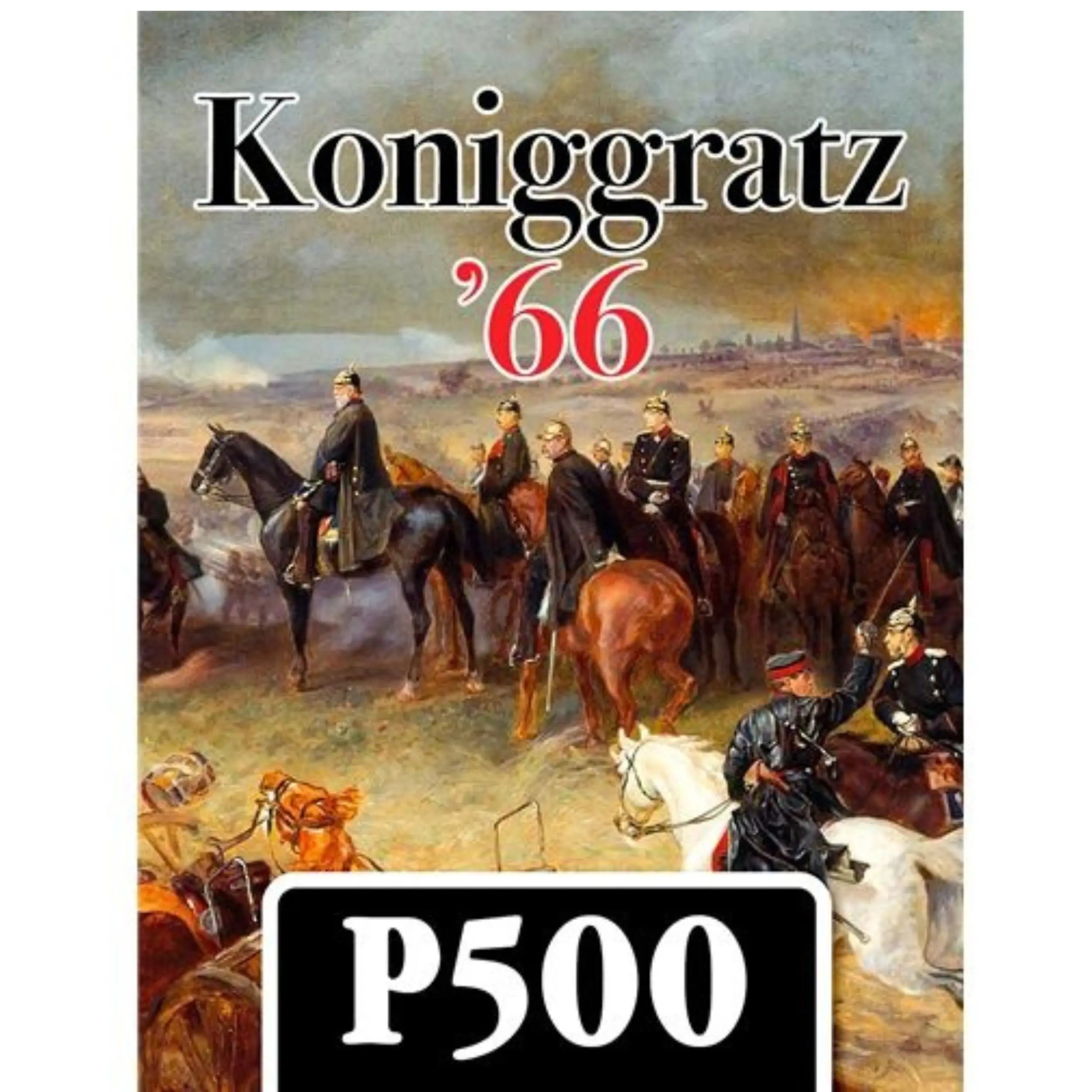
Koniggratz '66
🐸 Dettagli da BoardGameGeek
Consiglio BGG sul numero di giocatori
Categorie
Meccaniche
Design & Art
Lingua
Pre-order - leggi i dettagli
🐸 Una rana saggia sa quando dividere l’ordine… e quando aspettare il salto giusto.
Si abbina bene con
The FroGames Card
Three Prussian armies converge on the field. Austrian artillery sweeps the plain. You wait for the right moment to move the reserves, but when the order comes, it's already too late. And the history of Europe changes in an afternoon.
WHAT IT'S ABOUT
The battle that decided the fate of Germany
On July 3, 1866, Prussia and the Austrian Empire clashed in what would become the decisive battle of the Austro-Prussian War. It was the largest European land battle before World War I. Mark Simonitch, author of Hannibal and the '44 series, brings this epic battle to the table with a system designed to be accessible yet large enough to capture the scale and details of the battlefield.
The game covers that decisive battle for 2-4 players, with battalion/regiment scale for infantry and regiment/brigade for cavalry. The battlefield was twice the size of the largest battle of the American Civil War, so two maps at a scale of 400 yards per hex are needed. Each turn represents 45 real minutes. Move your units, manage the superior Austrian artillery or the deadly precision of Prussian breech-loading rifles, and see if you can change history or repeat it.
What they say abroad
"Three years after Gettysburg, a similar epic battle occurred in Europe"
Three years after Gettysburg, a similar epic battle occurred in Europe
— GMT Games
Königgrätz '66 is one of the most anticipated titles in the 2026 GMT catalog. It is a game that we have not yet seen on the table, but which promises to bring Simonitch's narrative mastery to a little-explored battlefield. The card will be updated with direct experience.
— FroGames

Koniggratz '66
FrogScore · FroGames editorial rating · first read: based on rules and official presentation, updated with first playsWhat you find in the box
The components of an epic battle
Two maps
The battlefield was twice the size of Gettysburg, so GMT provides two maps at 400 yards per hex. The scale is enough to see the villages, bridges, and defensive positions.
Battalion/regiment units
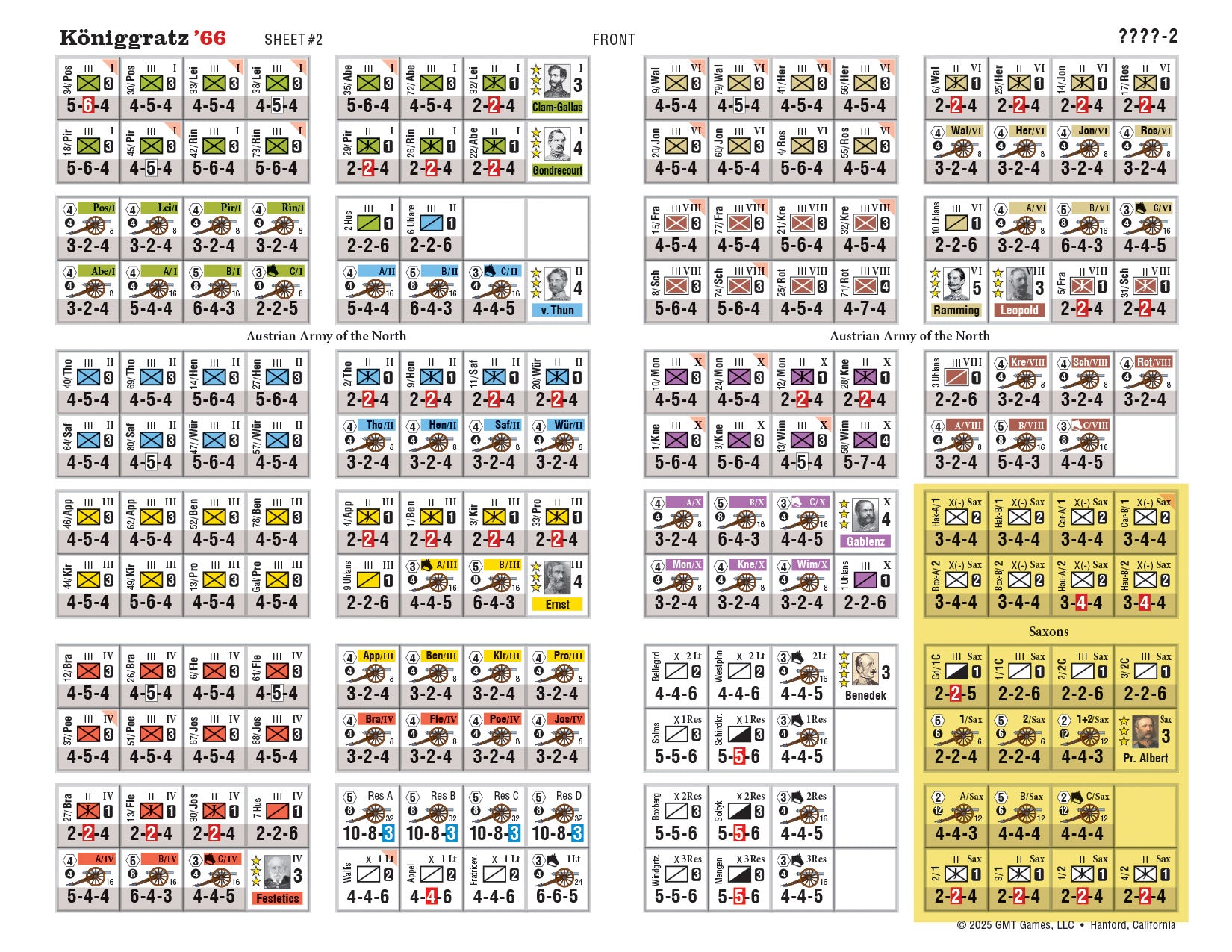
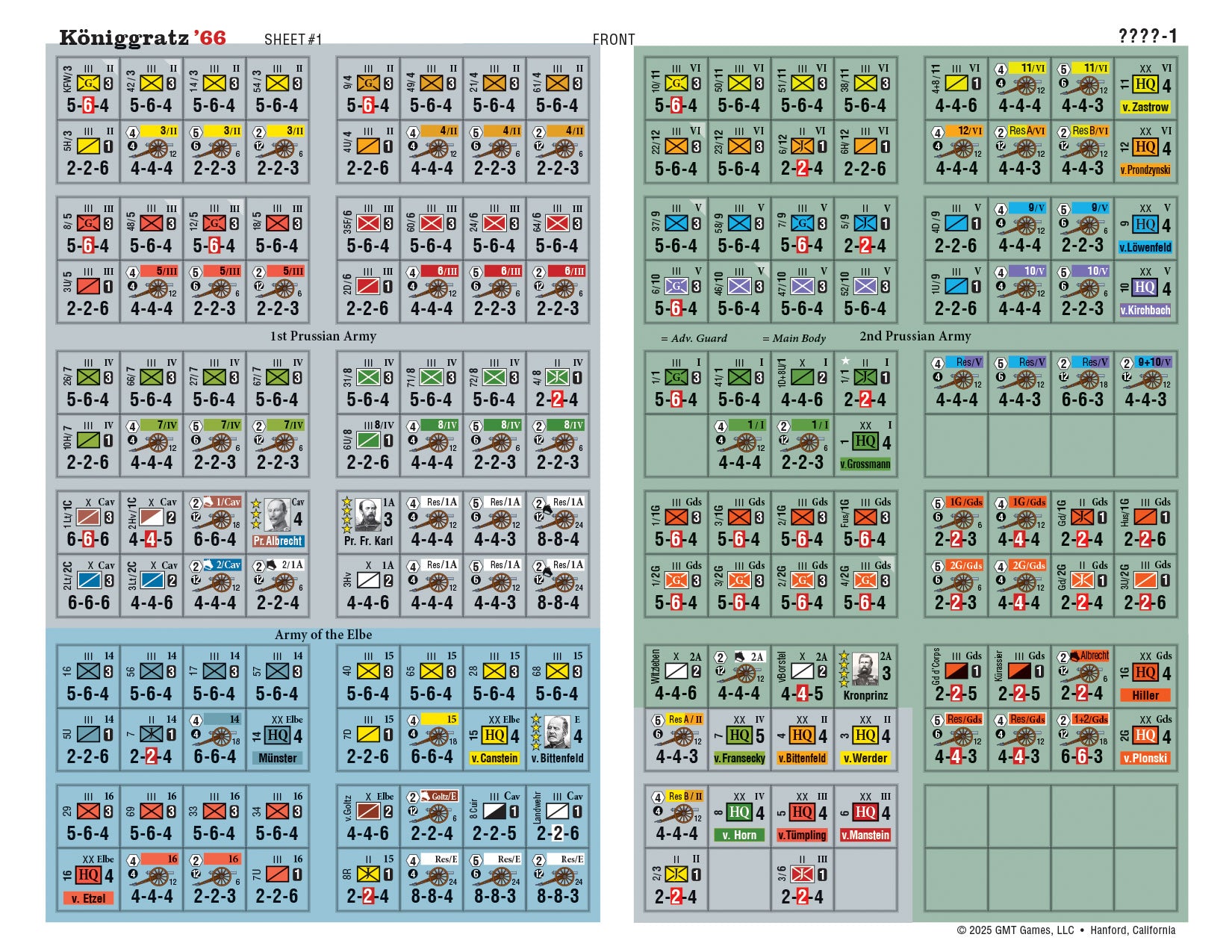
Battalion and regiment scale for infantry, regiment and brigade for cavalry. Counters representing the real historical Prussian and Austrian formations.
Five scenarios
Introductory scenario, morning action, full day, retreat, and a what-if variant that gives more freedom to Austrian reserves. From quick play to full simulation.
Weapons and tactics of 1866
The Prussians had the Dreyse breech-loading rifle, which fired 7-10 rounds per minute compared to the 3 of the Austrian Lorenz musket. The game captures this technological asymmetry.
🎲How to playThe rules in four steps▼
How to play
The flow of each turn
Each turn covers 45 minutes of real combat. The exact mechanics are still to be verified in the final rulebook, but the Simonitch system aims for clarity and playability.
Determine which faction moves first. In a battle of this scale, tactical initiative makes the difference between exploiting an opening and arriving late.
Move your units on the hex grid. Infantry, cavalry, artillery: each has different speeds and limitations. Terrain matters, bridges matter, roads matter.
Resolve engagements. Austrian artillery is superior, but Prussian Dreyse rifles fire faster. The mechanics will capture this technological asymmetry of 1866.
Disorganized units attempt to regroup. Reserves enter the fray. This is the moment where you decide whether to press the attack or consolidate your position.
⏱️Your first gameThe chronicle, moment by moment▼
A game in five moments
What happens on the table
Not the rules. The experience.
Initial Deployment
The Austrians hold the defensive line along the Bystrice, covering Königgrätz. The Prussians are divided into three separate armies; they must converge. You look at the map and understand: if you arrive first with reinforcements, you win. Otherwise, history repeats itself.
Artillery Fire
The Austrians repel the first Prussian assault thanks to superior artillery. But they don't capitalize on the advantage. The Prussians reorganize, and you understand that the decisive moment has not yet arrived.
The Convergence
The three Prussian armies begin to unite. Moltke manages to combine forces on July 1st, and the pressure on the Austrian flank becomes untenable. Every turn (45 real minutes) counts. Where do you place your reserves?
The Counterattack That Never Comes
The Austrians still have the numerical strength to react, but the terrain, the confusion, the command work against them. The Prussians press on. Someone at the table shouts an order, someone else curses the dice. History is still open.
Retreat or Victory
The Austrians lost 44,000 men, the Prussians 9,000. The game ends when one side can no longer hold the field. You count the losses, look at the positions, and you understand that Germany will never be the same.
🐸What to know beforeThree honest things, from friends▼
What to know before
Three things you need to know
Two maps mean table space
The battlefield was twice the size of the largest American Civil War battle. You need at least 120x80 cm free. It's not a bar table game.
The game can last over 5 hours
The full scenario covers the entire day of July 3, 1866. Even though Simonitch promises accessibility, the battalion scale on two maps requires time. Plan accordingly.
It's a game still in the works
At the time of writing (August 2026), the game is being printed. This description is a first reading based on official GMT materials and historical research. Direct table experience will update everything.
🏆Victory and defeatWhat the ending rewards▼
How it ends
How to win and how to lose
Victory and defeat are linked to controlling the battlefield and inflicting casualties. Exact conditions vary by scenario.
Victory
- The Prussians must sweep the Austrians off the field (as historically happened)
- The Austrians must maintain a significant presence on the field to justify their political primacy
- Victory in shorter scenarios tied to territorial objectives and casualties inflicted
Defeat
- Casualties too high to continue fighting
- Loss of key positions such as the bridges over the Elbe or defensive heights
- Inability to coordinate the three Prussian armies (or to stop them, if you are Austrian)
Königgrätz '66 promises to bring one of the most decisive battles in European history to an accessible table. It's a game worth waiting for.
📦In the boxComponents and materials▼
- Two 22” x 34” Paper Maps, Three 8.5 x 11 Countersheets, One 32-page Rules Booklet, Two (identical) 11 x 17 Player Aid Cards, Two 8.5 x 11 Prussian Setup Cards, Two 8.5 x 11 Austrian Setup Cards, One 8.5 x 11 Swiep Wald Setup Card, One 8.5 x 11 Mini Map Card, Two 6-sided Dice, One 2 deep Box
💬Frequently asked questionsQuick answers before checkout▼
Frequently asked questions
Königgrätz '66 FAQ
How difficult is it to learn?
GMT describes the game as 'easy to learn and play'. Mark Simonitch has a reputation for clear systems (see Hannibal or the '44 series), but the battalion scale on two maps suggests medium complexity. We await the final rulebook for confirmation.
Does it play well with 2 players?
Yes, the game is primarily designed for 2 players (Prussia vs Austria). 3-4 player mode likely divides command of the armies, but we don't have official details yet.
How long does a game really last?
The full day scenario can exceed 5 hours. There are shorter scenarios (morning action, introductory) that promise games under 3 hours. Each turn covers 45 minutes of real time.
Do you need to know history to play?
No, but it helps. The game teaches you the battle as you play: you discover why the Prussians had that technological advantage, why the Austrians didn't exploit their superior artillery, why reinforcements arrived late. History emerges from the table.
What mechanics does Königgrätz '66 use?
Hex grid system, battalion/regiment scale, 45-minute turns. Tactical movement and combat with technological asymmetry (Prussian Dreyse rifles vs Austrian Lorenz muskets, superior Austrian artillery). Precise mechanics will be clear with the final rulebook.
Is there a solo mode?
Not according to official GMT information. The game is designed for 2-4 players, with no mention of an automa or solo rules.
How much table space is needed?
Two GMT maps at 400 yards per hex scale require at least 120x80 cm of surface. Add space for tracks, off-board counters, rulebook. Plan for a large table.
What scenarios are included?
Five scenarios: introductory (for learning), morning action, full day (the longest), retreat scenario, and a what-if variant that gives more freedom to Austrian reserves. From a quick game to a full historical simulation.
Is it suitable for those who have never played wargames?
It depends. Simonitch promises accessibility, but the scale (two maps, hundreds of battalion counters) can be intimidating. If you're curious about wargames and history fascinates you, it can be a good starting point with patience. Otherwise, start with something more compact.
Comparison with other wargames on the same battle?
Other titles on Königgrätz exist (Battles of 1866, S&T versions), but this is the first by Mark Simonitch for GMT with modern production and a focus on playability. The battalion scale is more granular than many others.
How much luck is there?
Simonitch's tactical wargames balance chance and decision. There will be dice (or cards) to resolve combat, but tactical choices (where to attack, when to use reserves, how to exploit terrain) weigh more heavily. It's not a game of pure luck.
Is it in Italian? Do I need to know English?
The GMT edition is in English. The game will have maps, counters, rulebook, and cards (if any) in English. A decent understanding of the language is required to read the rules and any tables. No Italian editions are planned.
The people behind the game
Who invented it, who designed it, who publishes it — and what else they've done.
Königgrätz '66 is a tactical wargame for 2-4 players designed by Mark Simonitch and published by GMT Games. The game reconstructs the decisive Battle of the Austro-Prussian War on July 3, 1866, with battalion/regiment scale on two hexagonal maps at 400 yards per hex. Each turn represents 45 real minutes. It includes five scenarios (introductory, morning action, full day, retreat, what-if variant) and captures the technological asymmetry between Prussian Dreyse rifles and Austrian Lorenz muskets. Estimated duration 180-300 minutes, recommended age 14+ years. Available on FroGames.it.
Koniggratz '66
Frequently Asked Questions
The answers you're looking for, no beating around the bush.
📸Do the images match the actual product?
The photos on the website often come from BoardGameGeek and are intended to give you an idea of the game. They may vary slightly from the version you receive. The content declared by the publisher is always binding.
📦Does the content of the box match what is indicated?
We always strive to provide the correct content, but minor variations are possible due to reprints or updates. The information comes directly from the publishers. If you have any questions, please contact us!
⏳How do pre-orders work?
Pre-order the game before release, payment is immediate, and the game is reserved for you. As soon as it arrives, we'll ship it right away! If there are any delays, we'll update you promptly.
🔒Can I trust buying here?
Absolutely! Secure payments, tracked shipments, and a team that loves board games as much as you do. If something goes wrong, we'll do our best to fix it.
🛠There's a problem with my order, what should I do?
Write to us now! Whether it's a missing part, damage, or an error, we'll help you resolve it as soon as possible. Your experience truly matters to us.