

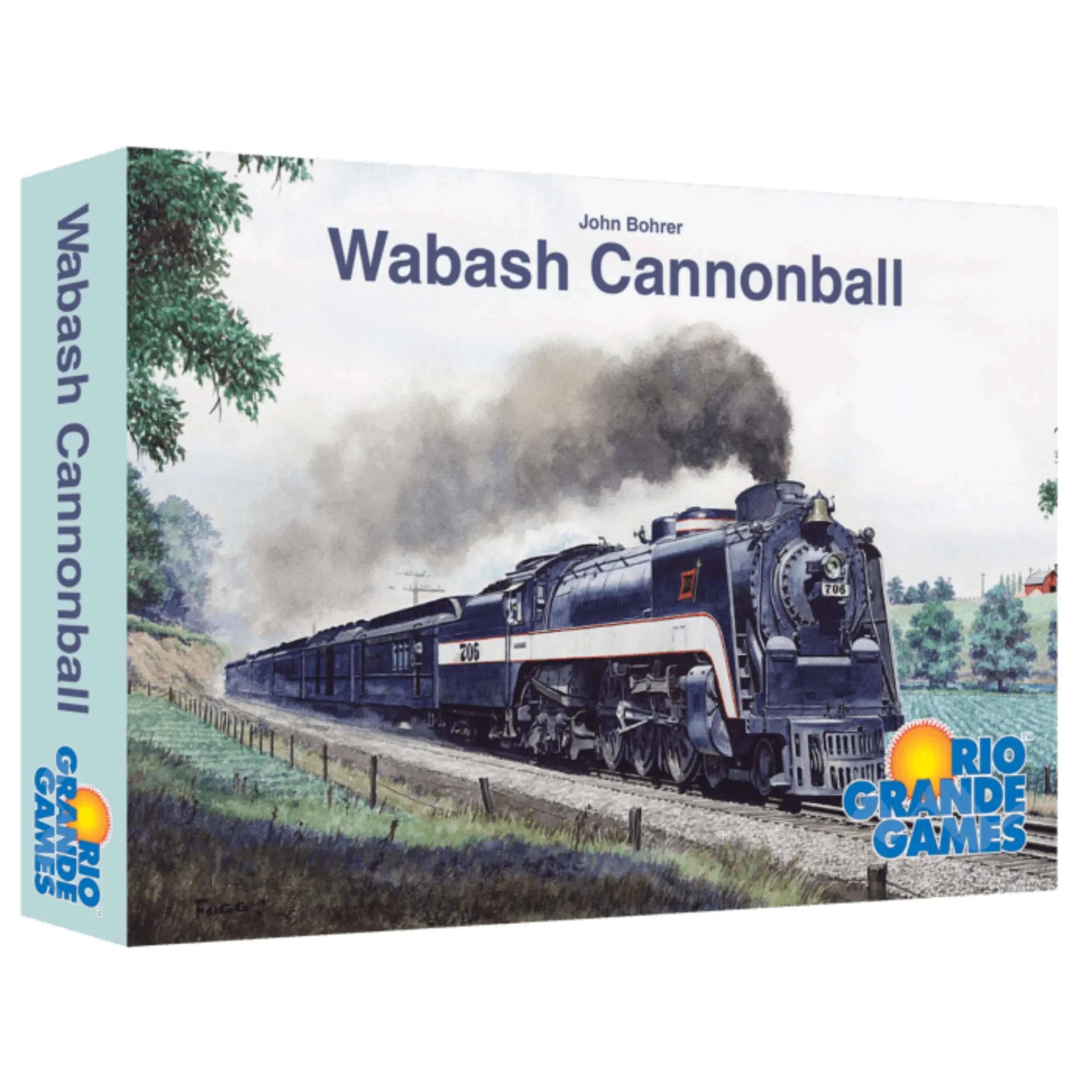
Wabash Cannonball
🐸 Dettagli da BoardGameGeek
Consiglio BGG sul numero di giocatori
Categorie
Meccaniche
Design & Art
Lingua
Si abbina bene con
The FroGames Card
You buy shares in a railway company. Then you decide: do you expand it yourself, or do you let others grow it while you collect dividends? Some get rich. Others realize too late they invested in the wrong horse.
WHAT IT'S ABOUT
American railways, real money, no dice
John Bohrer designed the first title of Winsome Games' Historic Railroads System in 2007. We are in post-Napoleonic America: the great railways (B&O, C&O, Pennsylvania, New York Central) push towards Chicago from the East. Smaller, more aggressive companies like Wabash emerge to expand the system. Spartan graphics by Todd Sanders and Michael Menzel, no theme: just hexes, colored cubes, and calculations.
At the table, you do three things, in turn: auction company shares, expand a company's railway network, or develop a hex on the board. Each action is available a limited number of times. When two actions run out, dividends arrive, and everyone collects based on the shares they own. The game ends after eight rounds or when three companies run out of locomotives or shares, or when there are at most three houses left in the general supply. The player with the most money wins.
What they say abroad
"A tightly wound economic game where every decision matters and luck never interferes."
A tightly wound economic game where every decision matters and luck never interferes.
— The Opinionated Gamers
It's not a railway game. It's a speculation game where the tracks are just an excuse to make you realize too late that you've invested poorly.
— FroGames

Wabash Cannonball
FrogScore · FroGames editorial rating · based on rules, international reviews and play sessionsYour tools at the table
What you have in front of you during the game
Railway Cubes
Each company has a color. You place a cube on a hex to expand the network. The more hexes you connect, the more the company is worth. But expanding costs limited actions.
Stock Certificates
Each company has a fixed number of shares. You auction them, buy them, keep them. At dividends, you collect based on how many you own. You can own shares in multiple companies.
Houses and cities
You develop a hex by placing a house on it (increases the value of the hex for railways touching it). Houses left in the general supply are an end-game condition.
Money
Cash. You use it to buy shares at auctions. You collect it at dividends. At the end of the game, whoever has the most money wins. No abstract victory points: just dollars.
Recommended sleeves 20 cards in 1 size ▼
If you play often, we recommend protecting your cards with clear sleeves to make them last longer.
| Size | Quantity |
|---|---|
| 64 × 90 mm | 20 |
| Total cards | 20 |
Come si gioca
Video dimostrativo di gameplay.
🎲How to playThe rules in four steps▼
How to play
The flow of each round
Each round, the same cycle repeats until two actions are exhausted.
On your turn, choose one of three available actions: auction a share, expand a company's network (by placing up to 3 cubes), or develop a hex (by placing a house).
If you chose to auction, players bid clockwise until everyone passes. The winner pays and takes the share. If you chose expansion or development, you immediately modify the board. Each action is limited: auctions (20 total), expansions (variable per company), developments (houses in supply).
After each action, you check how many actions of each type are still available. If two action types are exhausted (e.g., no more auctions available AND a company has run out of locomotives), dividends are paid.
Each company pays based on the value of its network (connected hexes × developed hex value). Players collect proportionally to the shares they own. Then, the number of available actions resets, and a new round begins. After 8 rounds or if an end condition occurs (3+ companies without locomotives/shares, or ≤3 houses), the game ends.
⏱️Your first gameThe chronicle, moment by moment▼
A game in five moments
What happens at the table
Not the rules. The experience.
The first auctions
Someone auctions a share of the Pennsylvania Railroad. You bid $10, another player bids $15. You don't yet know how much that company is really worth because the network hasn't been built yet. You buy blind, trusting your intuition.
The first expansions
It's your turn to expand a railway. You choose Pennsylvania (of which you own shares) and place two cubes towards Chicago. Someone else develops a hex that increases the value of ONE of your routes. You understand that every move changes everyone's dividends.
The first dividends
Two actions are exhausted. The dividend phase arrives. The Pennsylvania you expanded pays well, but you discover that another player has more of your shares and collects double. You realize you've been working for them.
The locomotive war
Companies begin to run out of locomotives (each expansion costs one). You expand the Wabash to connect a key city. Someone else empties a rival company's locomotives to force the game to end. Tension rises.
The last dividend
Last round of dividends. You count your money. You discover you invested too late in the wrong company, and someone else made three times your money with half the moves. You understand what you should have done. The next game will be different.
🐸Good to know before playingThree honest things, from friends▼
Good to know before playing
Three things you need to know before buying it
The first game is opaque
The rules are simple, but understanding WHEN to take an action requires at least one full game. In the first 4-5 rounds, you don't understand if you are investing well or poorly. The learning curve is steep: expect to lose badly the first time.
Doesn't work well with 2 players
The game is designed for 3-6 players. With 2 players, there's a lack of auction competition, and speculation loses its edge. With 4-5 players, however, the economic dynamics explode: every move has unpredictable consequences.
Spartan graphics
Functional but ugly board. Colored cubes, gray hexes, zero illustrations. The railway theme is a pretext: this is an Excel spreadsheet disguised as a game. If you're looking for thematic immersion, look elsewhere.
🏆Victory and defeatWhat the ending rewards▼
How it ends
Victory and game end conditions
The game ends after eight rounds or if one of the following conditions occurs.
Victory
- The player with the most cash wins. No hidden points, no bonuses: just dollars.
- If there's a tie, the player with the most total shares (sum of all companies) wins.
- Victory is built by investing in the right companies at the right time and collecting more dividends than others.
Early game end
- Three or more railroad companies run out of locomotives (expansions exhausted).
- Three or more companies no longer have available stock certificates (all shares sold).
- The general supply contains a maximum of three houses (development exhausted).
Wabash Cannonball is the fiercest and most honest cube rail game you can put on the table. Zero luck, just calculation and speculation. If you like losing the first game to win the tenth, this is your game.
💬Frequently Asked QuestionsQuick answers before checkout▼
Frequently Asked Questions
FAQ about Wabash Cannonball
What's the difference between Wabash Cannonball and Chicago Express?
They are the same game. Chicago Express is the Queen Games reprint (2007), Wabash Cannonball is the original Winsome name. The mechanics are identical; only the graphics change (Chicago Express has a slightly more readable board). Some editions are marked for 2-6 players, others for 3-6: no rules have changed.
Does it really work well with 6 players?
Yes, but the game gets longer (towards 90 minutes), and downtime increases. With 4-5 players, the experience is optimal: enough economic chaos, fast turns. With 6 players, someone gets bored between turns. With 2-3 players, it loses its edge (see above).
Is it suitable for those who have never played a cube rail game?
No. Wabash Cannonball is the toughest introduction to the genre. If you've never touched a railroad investment game, try Irish Gauge first (more immediate) or Ages of Steam (more guided). This one throws you into the deep end and leaves you struggling for 2-3 games.
What mechanics does Wabash Cannonball use?
Turn-order auctions until pass, network and route building on a hexagonal grid, stock holding (you own shares in multiple companies), investment and ownership (your choices increase or decrease the value of other companies). Victory points are a resource (money itself).
Is the edition for sale in Italian?
No, this edition is in English. The game is completely language-independent: there are no cards or texts to read, only colored cubes and a hexagonal board with city names. The rulebook is in English, but you can find fan-made Italian translations online. Once learned, you play without reading anything.
The people behind the game
Who invented it, who designed it, who publishes it — and what else they've done.
Wabash Cannonball is an economic strategy game for 2-6 players (optimal 3-5), lasting 30-60 minutes, ages 12+. Designed by John Bohrer and published by Winsome Games in 2007, it is the first title in the Historic Railroads System. It uses auction mechanics, stock investments, network building on a hexagonal grid, and stock holding. Zero luck: every decision is deterministic, and the economic consequences are immediate. Medium-high weight (2.8/5 BGG), steep learning curve but very high replayability. Available on FroGames.it.
Frequently Asked Questions
The answers you're looking for, no beating around the bush.
📸Do the images match the actual product?
The photos on the website often come from BoardGameGeek and are intended to give you an idea of the game. They may vary slightly from the version you receive. The content declared by the publisher is always binding.
📦Does the content of the box match what is indicated?
We always strive to provide the correct content, but minor variations are possible due to reprints or updates. The information comes directly from the publishers. If you have any questions, please contact us!
⏳How do pre-orders work?
Pre-order the game before release, payment is immediate, and the game is reserved for you. As soon as it arrives, we'll ship it right away! If there are any delays, we'll update you promptly.
🔒Can I trust buying here?
Absolutely! Secure payments, tracked shipments, and a team that loves board games as much as you do. If something goes wrong, we'll do our best to fix it.
🛠There's a problem with my order, what should I do?
Write to us now! Whether it's a missing part, damage, or an error, we'll help you resolve it as soon as possible. Your experience truly matters to us.