
Evergreen - Pines and Cacti - Espansione
🐸 Dettagli da BoardGameGeek
Consiglio BGG sul numero di giocatori
Categorie
Meccaniche
Design & Art
Lingua







Si abbina bene con
FroGames — Moments You'll Remember
Now you also have to think about what grows too fast and what dies in the dark. Evergreen only asked you to build forests. Now it asks you to keep them alive.
WHAT IT'S ABOUT
Two expansions that turn Evergreen's certainties upside down
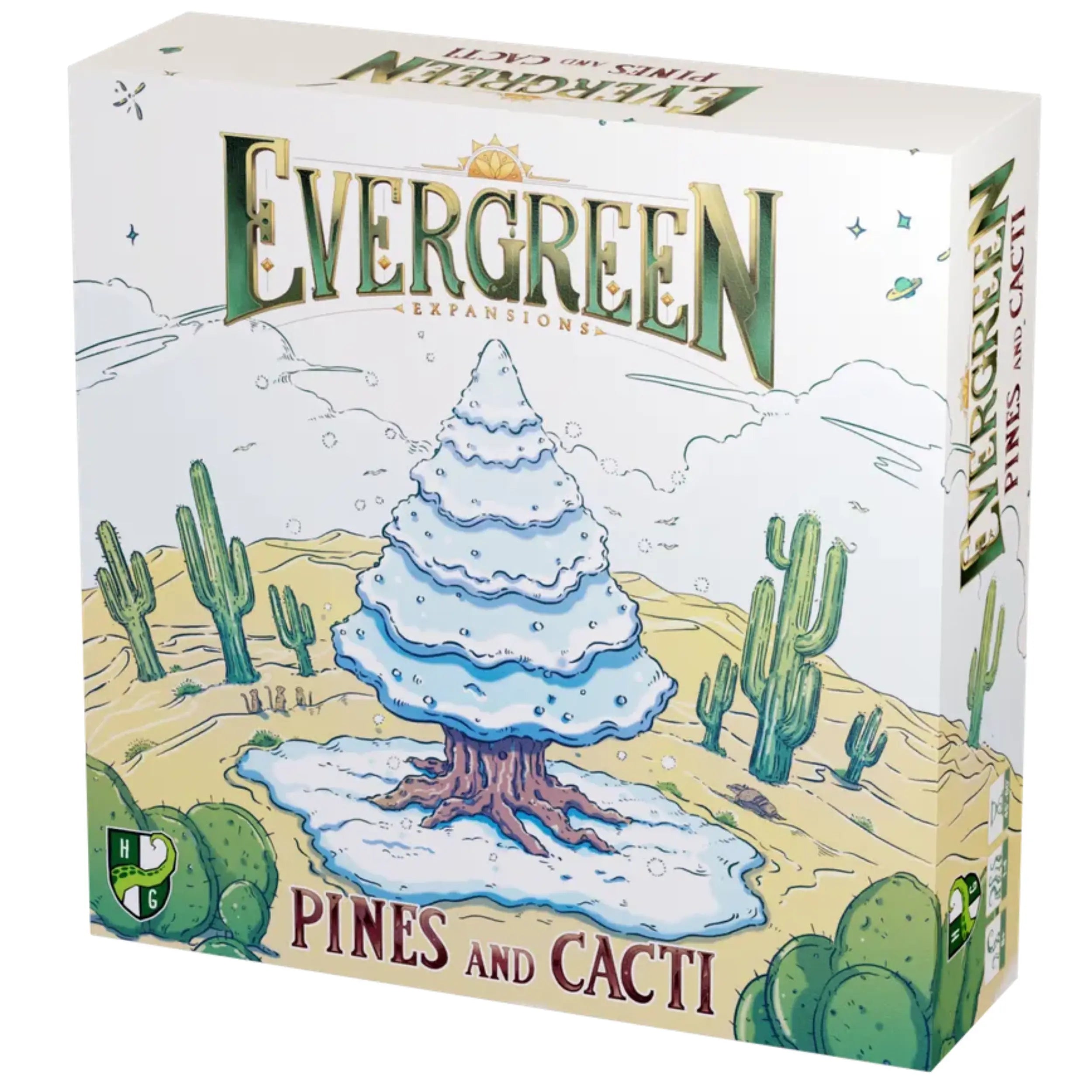
Hjalmar Hach returns to his light and shadow system with two modules that radically change the way you plan. Pines and Cacti introduces plants that react to light in opposite ways: pines grow spontaneously when in shadow, cacti die if they don't see the sun. Published by Horrible Guild in 2023, with naturalistic illustrations by Wenyi Geng, the expansion maintains the visual clarity of the base game while adding strategic complexity without weighing down the rulebook.
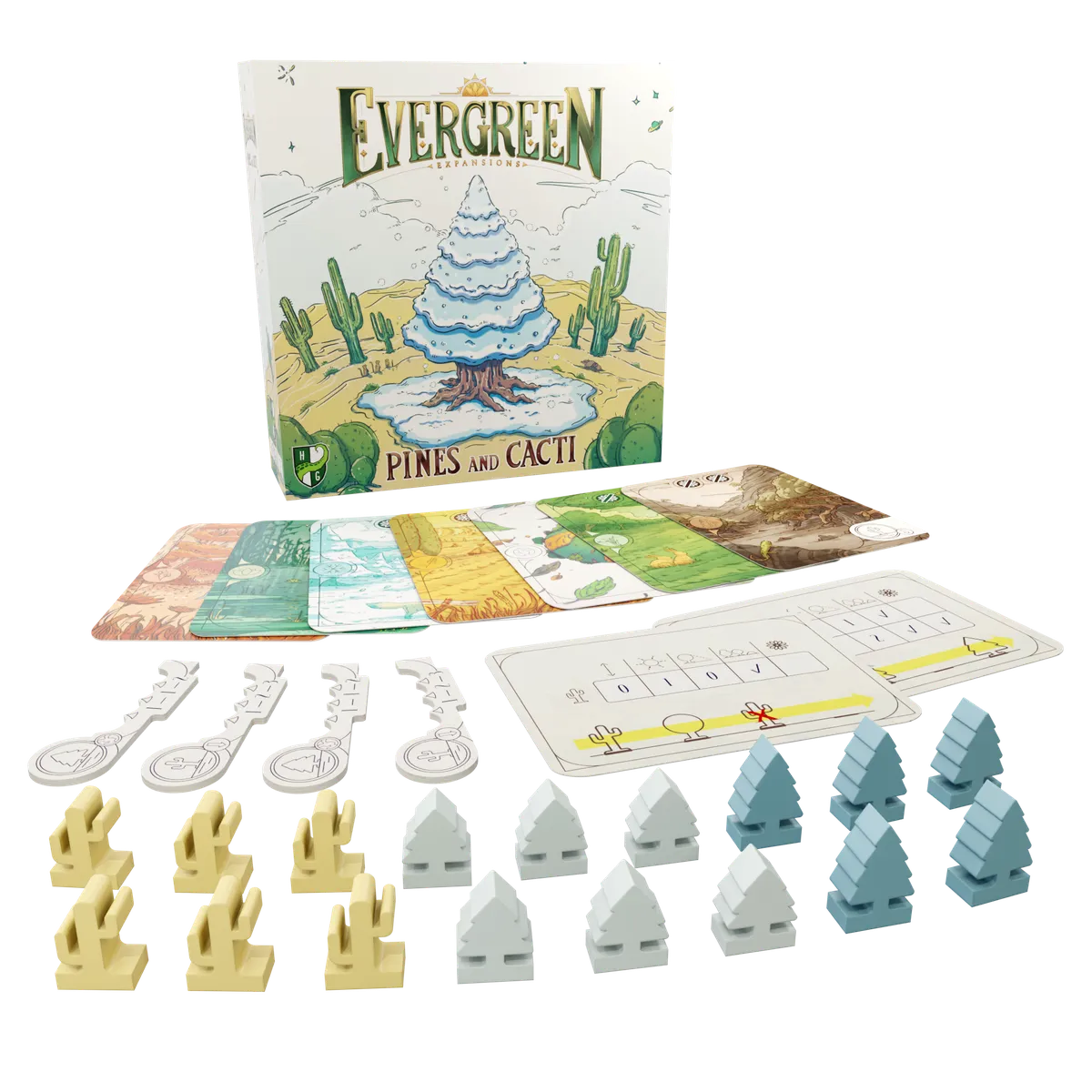
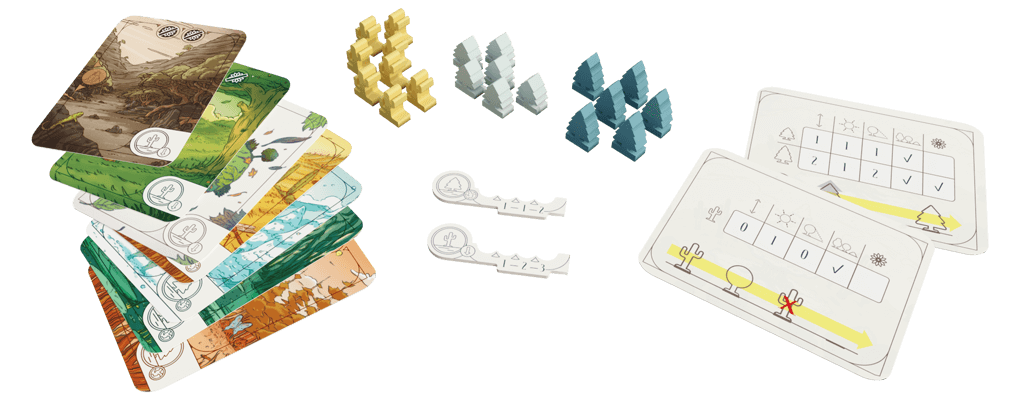
Each module introduces a new power and a new type of plant. You can use them individually or together, but the game always uses six total powers: for each expansion you add, you remove one from the base set. Pines reward those who can build deep shadows, cacti punish those who miscalculate exposure. The game remains fluid, but choices become riskier and more intricate.
What they say abroad
Evergreen is a game that breathes. Pines and Cacti teach it to hold its breath.
— FroGames

Evergreen: Pines and Cacti - Expansion
FrogScore · FroGames editorial rating · based on rules, international reviews and game sessionsWhat's inside
Two modules, four ways to play
Pine Module
Small pines spontaneously grow into large pines when in shadow at the end of the season. Transforms shadow from a limitation into a strategic resource.
Cactus Module
Cacti grow rapidly but die if they end up in shadow at the end of the season. Every placement becomes a calculation of survival.
New powers
Each module introduces an unprecedented power. The game always uses six powers: for each active expansion, you remove one from the base set.
Modular system
Use one module or both together. Four possible configurations to adapt complexity to the table.
Evergreen taught you to build forests. Pines and Cacti teach you to keep them alive.
🧤 BUSTINE
📜 REGOLAMENTO
Come si gioca
Video dimostrativo di gameplay.
A game in five moments
What happens at the table
Not the rules. The experience.
Initial uncertainty
Choose which module to activate, remove a power from the base set. You look at the new plant cards and immediately realize that the certainties of the base game no longer apply. Pines grow in the shade, cacti die without sun. You have to rethink everything.
The first cactus that dies
End of the first season. Resolve light and shadow. A cactus you confidently placed ends up in the shade due to an opponent's card. You remove it from the board. You realize that every placement is a calculated risk.
Spontaneous growth
If you play with pines, the end of the season becomes a waiting game. Small pines in the shade automatically grow large. A forest that grows on its own, if you've created the right shadows. You realize you're playing on two levels: placement and prediction.
The final calculation
Last season. You have exposed cacti, pines waiting, powers not yet used. Every card you draw can save or ruin your plan. You count the shadows, anticipate others' moves, place the last plant hoping it holds until resolution.
The count of survivors
Resolve light and shadow one last time. Cacti in the shade leave the game, pines grow, powers activate. The one with the highest biosphere wins, but not the one who placed the most: the one who calculated best wins. And in the end, you look back at the board and understand where you went wrong.
How to play
The flow of each round
Evergreen remains identical. The expansion only adds new plants and different end-of-season resolution.
You draw plant cards from your pile. If you have activated Pines or Cacti, some cards are small pines or cacti. You choose them and pass the rest.
You place a card on your board. Pines go low like normal shrubs, cacti grow quickly but require constant light. Position matters more than ever.
Grow plants, activate powers, build your forest. The basic rules don't change, but now you also have to calculate where the shadows will fall at the end of the season.
End of season: resolve light and shadow. Small pines in the shade automatically grow large. Cacti in the shade die and leave the game. Then you count biosphere points as usual.
Why it's different from others
Six mechanics that make a difference
Spontaneous pine growth
Small pines grow large if they are in the shade at the end of the season. No cost, no action: they grow on their own. This reverses the basic logic of the game, where shade was a limit to avoid. Now shade is a resource to cultivate.
Instant cactus death
Cacti grow quickly but die if they end up in the shade at the end of the season. Every dead cactus is removed from the board and does not count for the biosphere. This turns every placement into a gamble: is it worth the risk?
Pure modularity
Each expansion is a separate module. You can play with only pines, only cacti, both, or neither. Four possible configurations without changing the core of the game. You adapt the complexity to the table in 30 seconds.
Balancing via removal
The game always uses six powers. For each module you add, you remove a power from the base set. You don't add overwhelming complexity: you replace elements. This keeps the duration and flow intact.
Layered planning
With cacti, you have to anticipate where others' shadows will fall. With pines, you have to build deep shadows to trigger passive growth. It's no longer enough to place well: you have to think three turns ahead and calculate opponents' moves.
Continuous risk/reward
Cacti grow quickly but can die. Pines grow for free but only in the shade. Every choice has a hidden cost. There is no longer a safe move: there is a move you hope holds until the end of the season.
How it ends
How to win and how to lose
The victory conditions remain those of the base game, but the expansion radically changes how you reach the final score.
Victory
- Highest biosphere at the end of the game: tree height multiplied by the number of trees in the lake
- Automatically grown pines count as normal trees for the final calculation
- Secret objectives and fertile majorities grant bonus points as always
Plant death
- Every cactus in the shade at the end of the season dies and is permanently removed from the board
- Dead cacti do not count for the biosphere or for objectives
- Placing too many cacti without calculating shadows will make you lose potential points each season
Evergreen was an elegant puzzle. Pines and Cacti transforms it into a minefield where every card can be the last for one of your plants. And that makes it much more tense.
Frequently Asked Questions
FAQ on Evergreen: Pines and Cacti - Expansion
Can I play with just one module or do I have to use both?
Each module is independent. You can activate only Pines, only Cacti, both, or neither. The game always requires you to use a total of six powers: for each active module, you remove a power from the base set. Flexibility is total.
Are cacti too risky? Is it worth placing them?
They grow quickly and give points immediately, but they die if they end up in the shade. They are high risk, high reward. They work well if you control the shadows well or if you play last in the turn and can anticipate others' placements. But yes, they can all die in one season if you miscalculate.
How much does the complexity change compared to the base game?
The flow remains identical: draft, place, grow, resolve. You only add one rule per module (pines grow in shade, cacti die in shade). Complexity increases because you have to plan better, not because the rules multiply. It remains a family game, but more cerebral.
Is the base game required?
Yes. This is an expansion, not a standalone game. You must have the Evergreen base game to play. The modules add cards, powers, and rules, but do not include boards, basic components, or a complete rulebook.
Is it available in Italian?
Yes. Evergreen: Pines and Cacti is published by Horrible Guild with rules and components in Italian. No language barrier.
Evergreen: Pines and Cacti is a modular expansion for Evergreen that introduces two new plant types: pines and cacti. Designed by Hjalmar Hach and published by Horrible Guild, the expansion maintains the base game's drafting and placement system while adding risk/reward mechanics related to light and shadow. Pines grow automatically when in shade at the end of the season, while cacti die if they don't receive direct light. Each module can be used individually or in combination, adapting the complexity to the table. For 1-4 players, ages 8+, duration 45 minutes. Available on FroGames.it.
Evergreen - Pines and Cacti - Espansione
Frequently Asked Questions
The answers you're looking for, no beating around the bush.
📸Do the images match the actual product?
The photos on the website often come from BoardGameGeek and are intended to give you an idea of the game. They may vary slightly from the version you receive. The content declared by the publisher is always binding.
📦Does the content of the box match what is indicated?
We always strive to provide the correct content, but minor variations are possible due to reprints or updates. The information comes directly from the publishers. If you have any questions, please contact us!
⏳How do pre-orders work?
Pre-order the game before release, payment is immediate, and the game is reserved for you. As soon as it arrives, we'll ship it right away! If there are any delays, we'll update you promptly.
🔒Can I trust buying here?
Absolutely! Secure payments, tracked shipments, and a team that loves board games as much as you do. If something goes wrong, we'll do our best to fix it.
🛠There's a problem with my order, what should I do?
Write to us now! Whether it's a missing part, damage, or an error, we'll help you resolve it as soon as possible. Your experience truly matters to us.