
Beyond the Sun
🐸 Dettagli da BoardGameGeek
Consiglio BGG sul numero di giocatori
Categorie
Meccaniche
Design & Art
Lingua



Si abbina bene con
FroGames — Moments You'll Remember
Someone has gone all-in on android production. Someone else is colonizing systems you don't even know exist. And in the end, the one who built the tech tree others failed to understand will win.
WHAT IT'S ABOUT
Humanity builds its future among the stars, one technology at a time
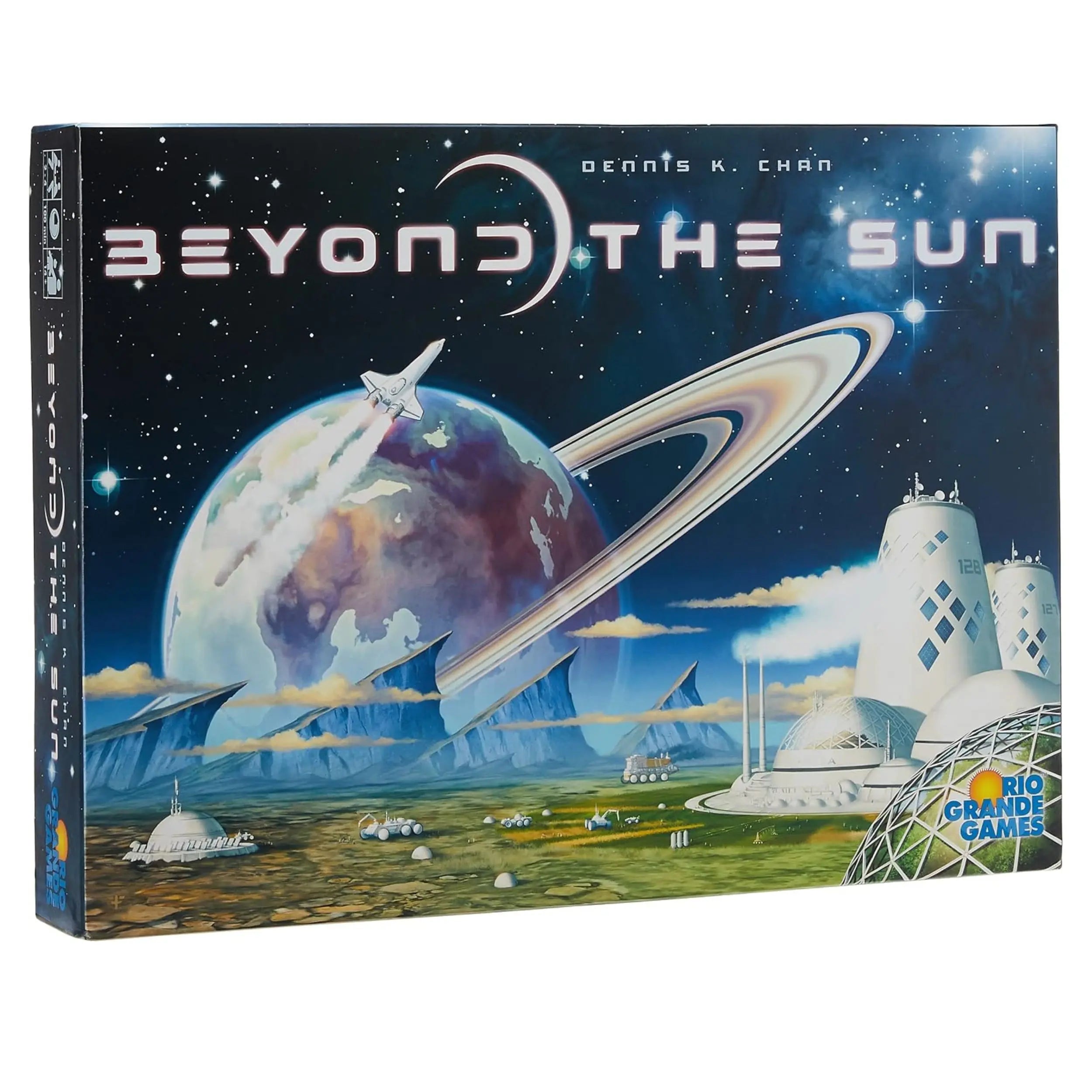
Beyond the Sun is the first major project by Dennis K. Chan, released in 2020 by Rio Grande Games and brought to Italy by Ghenos Games. It is a space civilization eurogame set at the dawn of the interstellar era, as earthly factions compete to define humanity's technological progress. The illustrations by Franz Vohwinkel portray a clean, optimistic future, where science opens doors instead of closing them.
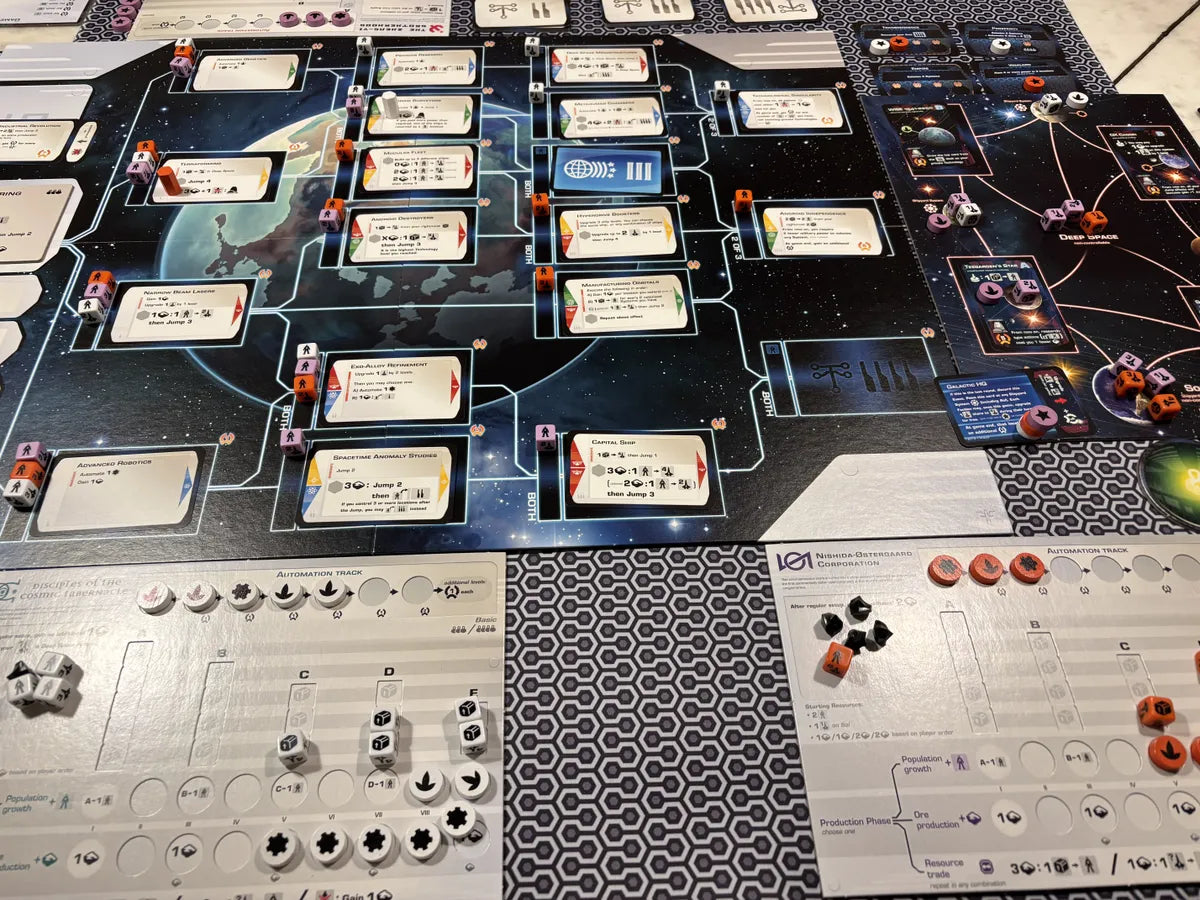
At the table, you manage a faction through worker placement on a technological board that you build together, game after game. You research four types of technologies (scientific, economic, military, commercial), produce resources, colonize exoplanetary systems, and complete achievements. Each unlocked technology changes the available actions for everyone: the tech tree is shared but asymmetric, as each player chooses different branches and diverging strategies.
What they say abroad
"A tech tree that grows differently every game, brilliant design."
A tech tree that grows differently every game, brilliant design.
— Meeple Mountain
Beyond the Sun is a Eurogame that asks you to think three turns ahead. And then someone unlocks a technology that turns everything upside down.
— FroGames

Beyond the Sun
FrogScore · FroGames editorial rating · based on rules, international reviews, and play sessionsThe pillars of your expansion
Four elements that define your space empire
Technologies
The heart of the game. Each unlocked technology becomes a new action available to everyone, but only you benefit from its immediate bonuses. The branches intertwine: scientific, economic, military, commercial. Choose poorly and you fall behind.
Colonized systems
Exoplanetary systems offer resources, victory points, and territorial control. Colonizing them requires movement and population technologies. Whoever dominates a galactic region gains influence and end-game points.
Production
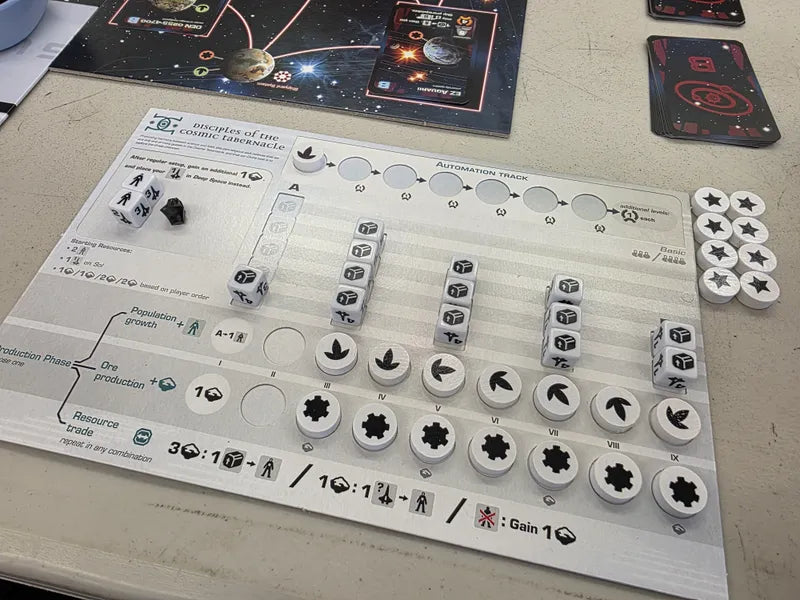
Each turn you produce a resource: minerals, population, or trade. Androids (advanced technology) allow growth without population. Production is the engine, but it must be synchronized with actions.
Achievements
Shared objectives that grant victory points and mark the end of the game. Whoever completes one claims it forever. They are the final race: finishing first matters more than you think.
Recommended sleeves 100 cards in 1 size ▼
If you play often, we recommend protecting your cards with transparent sleeves to make them last longer.
| Size | Quantity |
|---|---|
| 56 × 87 mm | 100 |
| Total cards | 100 |
In two hours, you will have built completely different space civilizations. And you'll argue for another twenty minutes about who really won.
Come si gioca
Video dimostrativo di gameplay.
A game in five acts
What happens at the table
Not the rules. The experience.
Technology board setup
Place the first eight Level 1 technologies around the central board. The rest of the tree is empty: you will build it, turn by turn, unlock by unlock. Each player chooses a faction with slight asymmetry (an initial bonus, nothing unbalanced). The atmosphere is calm, almost contemplative.
First turns: exploring basic actions
The first turns are identical for everyone: researching Level 1 technologies, producing minerals or population, exploring nearby systems. No one yet has a clear direction. But whoever unlocks a military or commercial technology first begins to diverge. The table observes.
Mid-game: the trees diverge
Now the tech tree has exploded. Someone focuses entirely on economic technologies to produce resources in abundance. Someone else unlocks interstellar movement and colonizes distant systems. Strategies diverge, available actions multiply. The race for achievements begins.
The moment someone unlocks androids
There's always that moment. Someone researches android technology and stops depending on population for growth. The others realize they've fallen behind on that branch. Counter-moves begin: aggressive colonizations, last-minute stolen achievements, events that overturn plans.
Endgame: achievements and final scoring
When enough achievements are claimed, the game ends. The final scoring is long: points from achievements, from colonized systems, from technologies, from completed events. Those who seemed ahead lose. Those who played quietly win by three points. The table counts twice.
How to play
The flow of each turn
Each turn has three phases: action, production, achievement. Simple in structure, profound in consequences.
Choose an empty action space on the technology board or on an unlocked technology. Each action has a cost (resources, population) and an effect (research, colonization, trade, events). More powerful actions require advanced technologies.
Research a new technology (which becomes a new action for everyone), colonize an exoplanetary system, complete an event, improve your economy. Some actions have immediate bonuses, others build long-term engines.
Produce a resource: minerals (ore), population, or trade resources at the market. Production is mandatory and dictates the economic pace of the game. Androids (if unlocked) offer alternative production.
If you meet the requirements of an available achievement, you claim it and take the points. Achievements are limited: whoever gets there first wins, the others are left behind. When enough are claimed, the game ends.
Why it's different from others
Six mechanics that make a difference
Player-built tech tree
There is no fixed tech tree. Each game you build it, unlock by unlock. Higher-level technologies must connect to lower-level technologies of the same type. Each game the tree grows differently, and winning strategies change.
Shared but asymmetric actions
When you unlock a technology, it becomes an action available to everyone. But you get an immediate bonus: resources, points, economic advantages. Others can use it, but you unlocked it first. It's forced generosity with a competitive advantage.
Point-to-point colonization
The galaxy is a network of connected systems. You can't jump anywhere: you must move along paths, and each jump requires movement technologies. Whoever unlocks interstellar drives dominates remote systems, rich in resources but distant.
Mandatory production each turn
You cannot skip the production phase. Each turn you generate minerals, population, or trade. Androids (advanced technology) break this rule: you produce without consuming population. It's the economic game changer in the mid-game.
Achievements as a dynamic timer
Achievements are not just points: they are the game's timer. When enough are claimed, the game ends. Whoever completes achievements too early shortens the game, whoever waits too long loses them. It's a tense balance.
Four intertwined technology types
Scientific, economic, military, commercial. Each branch offers different advantages: production, exploration, colonization, trade. You must specialize but not close yourself off, because Level 3-4 technologies require mixed paths. Those who remain monochromatic get stuck.
How it ends
How to win and how to lose
The game ends when a predetermined number of achievements are claimed (depends on the number of players). Points are counted.
Victory
- Points from achievements claimed during the game
- Points from colonized systems and territorial control (area majority per galactic region)
- Points from researched technologies, completed events, end-game bonuses
How to fall behind
- Choosing technologies that don't synchronize: isolated branches that block higher levels
- Ignoring achievements: others claim them, shorten the game, and gain easy points
- Over-investing in production without converting it into actions or colonizations: the engine runs idle
Beyond the Sun rewards those who can plan their tech tree three levels ahead and read other players' moves. The winner is not the one who produces the most, but the one who converts best.
Frequently Asked Questions
FAQ about Beyond the Sun
How long does the first game last?
The first game can approach 2 and a half hours, including explanation. From the second game onwards, it stabilizes at 90-120 minutes. Setup is quick, but the first tech tree requires slow reasoning: everyone evaluates each unlock. With experienced players, it drops below 90 minutes.
Is it too complex for those not used to heavy eurogames?
No, but familiarity with worker placement is needed. The BGG weight is 3.15: it's not a gateway game, but not a monster game either. The rules can be explained in 20 minutes. Complexity arises from the cascading consequences of technologies, not from the rulebook. If you've played Lords of Waterdeep or Agricola, you'll feel at home.
How much does luck matter?
Little. Events and discovery cards bring variability, but they don't overturn games. Luck perhaps accounts for 15-20%: it can help you close an achievement at the right time or give you an extra resource, but it doesn't compensate for bad strategic choices. It's a eurogame: the best planner wins.
Does it play well with two players?
Yes, but the pace changes. With two, the board fills up slower, achievements are claimed with less urgency, long-term strategies are safer. With four, it's more competitive and accelerated. Both configurations work, but the experience is different.
Is it available in Italian?
The edition sold on FroGames is in English, published by Rio Grande Games. Ghenos Games published the Italian edition, but we currently offer the English version. The game has text on technology cards and events: knowledge of English or translated references is needed.
Beyond the Sun is a strategy and space civilization game for 2-4 players, ages 14+, lasting 60-120 minutes. Designed by Dennis K. Chan and published by Rio Grande Games (Italian edition by Ghenos Games), it is a eurogame with worker placement and a player-built asymmetric tech tree. Each game the tech tree grows differently: you research scientific, economic, military, or commercial technologies, colonize exoplanetary systems, complete achievements that act as a dynamic timer. Rated 3.15 on BoardGameGeek, suitable for experienced players looking for high replayability and divergent strategies. Available on FroGames.it.
Frequently Asked Questions
The answers you're looking for, no beating around the bush.
📸Do the images match the actual product?
The photos on the website often come from BoardGameGeek and are intended to give you an idea of the game. They may vary slightly from the version you receive. The content declared by the publisher is always binding.
📦Does the content of the box match what is indicated?
We always strive to provide the correct content, but minor variations are possible due to reprints or updates. The information comes directly from the publishers. If you have any questions, please contact us!
⏳How do pre-orders work?
Pre-order the game before release, payment is immediate, and the game is reserved for you. As soon as it arrives, we'll ship it right away! If there are any delays, we'll update you promptly.
🔒Can I trust buying here?
Absolutely! Secure payments, tracked shipments, and a team that loves board games as much as you do. If something goes wrong, we'll do our best to fix it.
🛠There's a problem with my order, what should I do?
Write to us now! Whether it's a missing part, damage, or an error, we'll help you resolve it as soon as possible. Your experience truly matters to us.