

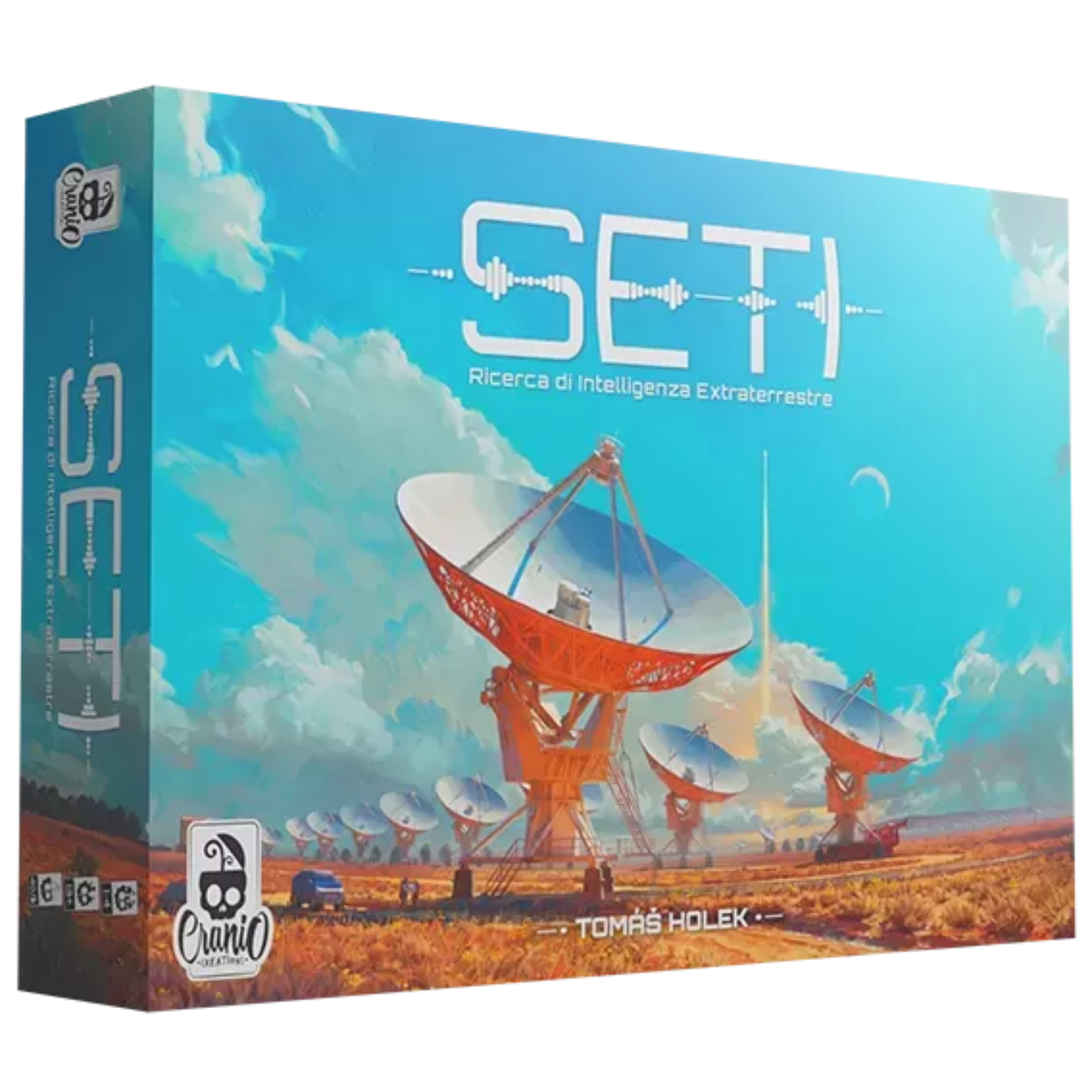
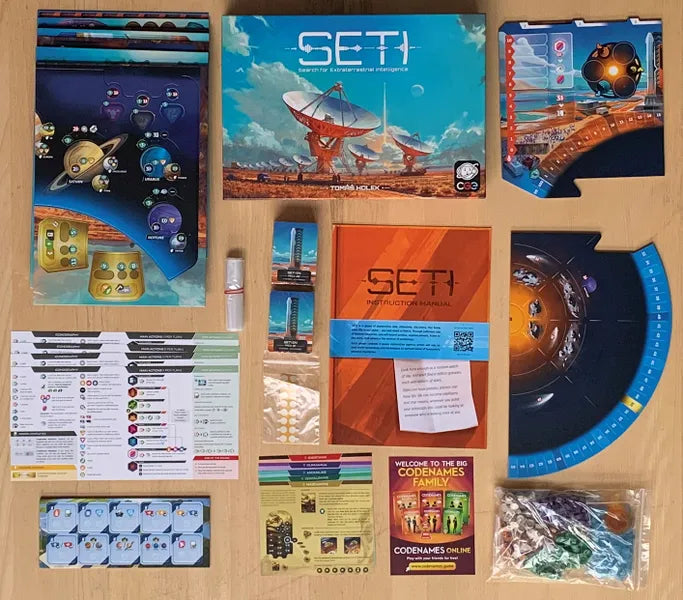
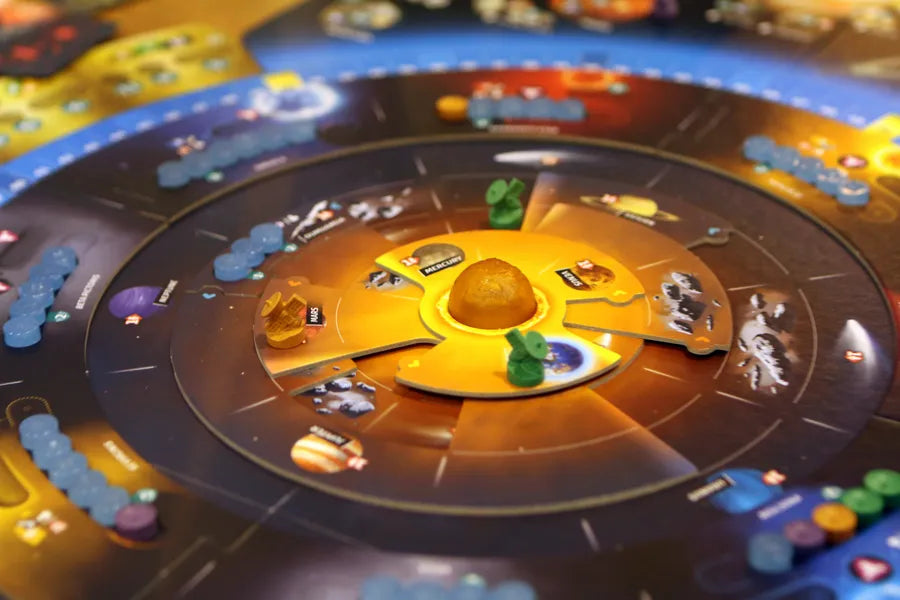
SETI Search for Extraterrestrial Intelligence
🐸 Dettagli da BoardGameGeek
Consiglio BGG sul numero di giocatori
Categorie
Meccaniche
Design & Art
Lingua






Pairs well with
The FroGames Card
You've just launched a probe to Mars, another is in Jovian orbit. Your telescope picks up something from Proxima Centauri. And someone just swiped your Enceladus samples.
WHAT IT IS ABOUT
The search for life in the universe, on your table
Designed by Tomáš Holek and published in 2024 by Czech Games Edition, SETI translates real astronomical research into a space exploration eurogame. Over 200 illustrated cards feature real technologies: the ISS, the Large Hadron Collider, the Perseverance rover, the Voyager probes. A cast of 12 Czech artists meticulously recreated this scientific catalog.
You lead a scientific institution that launches probes into the solar system, detects radio signals from distant stars, and collects samples from icy moons. Every round, the planets actually move: orbits change, launch windows open and close. The cards in your hand have three different uses: you must decide when to burn them for resources, when to keep them for upgrades, and when to play them for their effects. Five rounds to decide who makes the most significant scientific discovery.
What they say abroad
"In SETI: Search for Extraterrestrial Intelligence, you lead a scientific institution tasked with searching for traces of life beyond planet Earth."
— Czech Games Edition (CGE)
This is a game for those who love when mechanics reflect the theme. Orbits move, signals arrive late, resources are scarce. Exactly like in real research.
— FroGames

SETI Search for Extraterrestrial Intelligence
The game includes an official solo mode with dedicated scenarios and progressive objectives. The experience is complete: you play against time and challenging objectives, not against an automa. You lose competitive interaction on common goals but gain a more focused narrative campaign.
FrogScore · FroGames editorial rating · based on rules, international reviews, and play sessionsYour arsenal
Cards, probes, and telescopes: what you have in front of you
Planetary Probes
Wooden pawns you launch towards Mars, Jupiter, Saturn. Each probe can orbit (fast scan) or land (valuable samples, but it keeps you there). Planetary orbits change each round: an optimal launch window can close.
Telescopes
Point towards distant stars and capture radio signals or discover exoplanets. They have limited capacity: each signal occupies slots. You must decide whether to analyze immediately (certain points) or keep in memory (stronger but riskier combos).
Technology Cards
Over 200 unique cards with three uses: burn it for immediate resources, play it for a one-time effect, or build it into your research center (permanent upgrade). Each card is a real technology: ISS, Hubble, LIGO, Cassini.
Research Tracks
Six areas of study (exoplanets, biosignatures, radio signals, lunar samples...). You advance in those where you invest. At the end of the game, the most advanced track counts double: you must specialize, but not too early.
Recommended Sleeves 218 cards in 1 size ▼
If you play often, we recommend protecting your cards with clear sleeves to make them last longer.
| Size | Quantity |
|---|---|
| 63.5 × 88 mm | 218 |
| Total cards | 218 |
Come si gioca
Video dimostrativo di gameplay.
🎲How to playThe rules in four steps▼
How to play
The flow of each round
Five rounds identical in structure, but very different in choices. Each round has four phases.
Planets advance in their orbits. Distances from Earth change: what cost 2 resources now costs 4, what was out of reach is now within range. You receive income from built cards and your permanent upgrades. You mentally plan what to do this turn.
Progressive order: whoever passes first will be first in the next round. On your turn, you take ONE action: launch a probe (pay fuel based on orbital distance), land on a moon, point a telescope, analyze data, build a card. Each action costs resources or cards. When you pass, you are out of the round.
Telescopes pointed at stars capture signals or discover exoplanets. Whoever has collected enough data on a common objective (e.g., 'Three biosignatures from different moons') claims it and scores points. Common objectives are limited: if someone takes them first, you are left empty-handed.
You draw new technology cards based on your lab capacity. You advance on research tracks if you have collected enough data. You look at others' tracks, understand who is winning, decide whether to continue on your path or change course. The round card is flipped: if it's the fifth, the game ends.
⏱️Your first gameThe chronicle, moment by moment▼
A game in five moments
What happens at the table
Not the rules. The experience.
Setup: the solar system is arranged
Place the planets in their initial orbits, distribute the probes on Earth, discover the first technology cards. Someone reads the names aloud: Perseverance, Event Horizon Telescope, Breakthrough Listen. The table looks like an astronomy classroom. Then the first turn starts, and you realize it's a cutthroat race.
The race to the icy moons
Europa and Enceladus promise biosignatures. Everyone wants to get there, but probes cost a lot, and Jovian/Saturnian orbits move away. Someone launches too early and ends up in orbit without fuel to land. Someone else waits one round too long and misses the window. The first sample collected is worth gold: it unlocks an entire track.
The telescopes begin to sing
Mid-game, everyone is pointing their telescopes at different stars. You were picking up a promising signal from Proxima, but someone steals your common objective. You have to choose: analyze what you have immediately (certain but few points) or keep searching (risk of the game ending with nothing). At the table, no one speaks: everyone calculates orbits and probabilities.
Specialization crystallizes
You look at others' tracks and understand who is focusing on what. You've invested everything in exoplanets, she in lunar samples, he in radio signals. The most advanced track at the end of the game counts double: those ahead try to extend their lead, those behind try to catch up or change course. There are always too few cards in hand to do everything.
The final decisive signal
Last round. Someone burns three cards to launch a desperate probe towards Titan. Someone else bets everything on a radio signal picked up at the last second. The table counts points in their heads, no one is sure who wins. It ends, you flip the tracks, do the math. The winner is whoever made the most relevant discovery, not whoever did the most things. And that makes a huge difference.
🐸Good to know upfrontThree honest things, from friends▼
Good to know upfront
Three things you should expect
Consistent rulebook
The manual is 24 pages long, cards have icons to learn, tracks have exceptions. The first game is for understanding how it works, the second for really playing. If you're looking for a family game that teaches in ten minutes, this isn't it. If you're looking for strategic depth that rewards study, here it is.
Indirect interaction
You don't attack anyone, you don't directly steal anything. But you steal common objectives, occupy telescope slots, collect samples before others. Interaction exists, but it's all about the race for limited resources. If you love games where you insult your opponent, this is multiplayer solitaire.
Variable downtime
In 2 players, turns flow. In 4, if someone suffers from analysis paralysis, their turns drag on. Cards have text, options are many, serial calculators slow down the table. The official duration is 40-160 minutes: that range says it all. Play it with people who make decisions in a reasonable amount of time.
🏆Victory and defeatWhat the ending rewards▼
How it ends
How to win and how to lose
After five rounds, points are counted from five different sources. There is no player elimination: you play until the end, even if you are behind.
Victory points (sources)
- Research tracks: the most advanced counts double, the others count single. Specialize but not too early.
- Common objectives completed during the game (samples collected, signals captured, exoplanets discovered).
- Technology cards built in your research center: some give end-game points based on conditions.
Fatal errors
- Burning too many cards for immediate resources: at the end of the game you lack permanent upgrades.
- Chasing all tracks without specializing: you come second everywhere, someone else gets the double track.
- Launching probes without calculating orbits: you end up stuck in Jovian orbit while someone else collects samples.
SETI is for those who seek strategic depth, integrated theme, and zero luck. If you love when real science becomes real game, this is the title.
💬Frequently asked questionsQuick answers before checkout▼
Frequently asked questions
FAQ about SETI: Search for Extraterrestrial Intelligence
What mechanics does SETI: Search for Extraterrestrial Intelligence use?
Multi-use cards (each card has three different uses), resource management (fuel, data, technology), area majority on research tracks, income from built cards, progressive turn order (whoever passes first is first in the next round). Planetary orbits move each round: a unique mechanic that simulates real launch windows.
How long does a full game last?
The box says 40-160 minutes, and that range is realistic. With 2 experienced players, it finishes in 60-90 minutes. With 4 players on their first game, with someone suffering from analysis paralysis, it can take up to 2 and a half hours. The game has no timer, so the duration heavily depends on the group.
Does it work well solo?
Yes, it has an official solo mode with dedicated scenarios. You don't use an automa: you play against progressive objectives and a narrative campaign. The experience is complete, minus the direct competition for common objectives. If you love Mage Knight or Ark Nova solo, this is along the same lines.
How much interaction is there between players?
Indirect but significant interaction. You steal common objectives (limited), occupy telescope slots (if two point at the same star, one loses the action), collect samples before others. You don't directly attack anyone, but the race for resources is fierce. If you're looking for direct conflict, look elsewhere.
Is it available in Italian?
Yes, this is the Italian edition published by Cranio Creations. Cards, rulebook, and components are fully localized. The illustrations and cited technologies are identical to the international edition.
The people behind the game
Who invented it, who designed it, who publishes it — and what else they've done.
SETI: Search for Extraterrestrial Intelligence is a spatial strategy game for 1-4 players, lasting 40-160 minutes, recommended age 14+. Designed by Tomáš Holek and published by Cranio Creations, it translates real astronomical research into a eurogame of resource management and multi-use cards. Launch probes towards Mars and Jupiter's moons, point telescopes at distant stars, collect samples and alien signals. Planetary orbits move each round: a unique mechanic that simulates real launch windows. Over 200 cards illustrated with real technologies (ISS, Perseverance, Voyager, Hubble). Three paths to victory (exoplanets, biosignatures, radio signals), variable setup, official solo mode. Weight 3.8/5: for experienced players seeking strategic depth and a scientific theme integrated into the mechanics. Available on FroGames.it.
SETI Search for Extraterrestrial Intelligence
Frequently Asked Questions
The answers you're looking for, no beating around the bush.
📸Do the images match the actual product?
The photos on the website often come from BoardGameGeek and are intended to give you an idea of the game. They may vary slightly from the version you receive. The content declared by the publisher is always binding.
📦Does the content of the box match what is indicated?
We always strive to provide the correct content, but minor variations are possible due to reprints or updates. The information comes directly from the publishers. If you have any questions, please contact us!
⏳How do pre-orders work?
Pre-order the game before release, payment is immediate, and the game is reserved for you. As soon as it arrives, we'll ship it right away! If there are any delays, we'll update you promptly.
🔒Can I trust buying here?
Absolutely! Secure payments, tracked shipments, and a team that loves board games as much as you do. If something goes wrong, we'll do our best to fix it.
🛠There's a problem with my order, what should I do?
Write to us now! Whether it's a missing part, damage, or an error, we'll help you resolve it as soon as possible. Your experience truly matters to us.